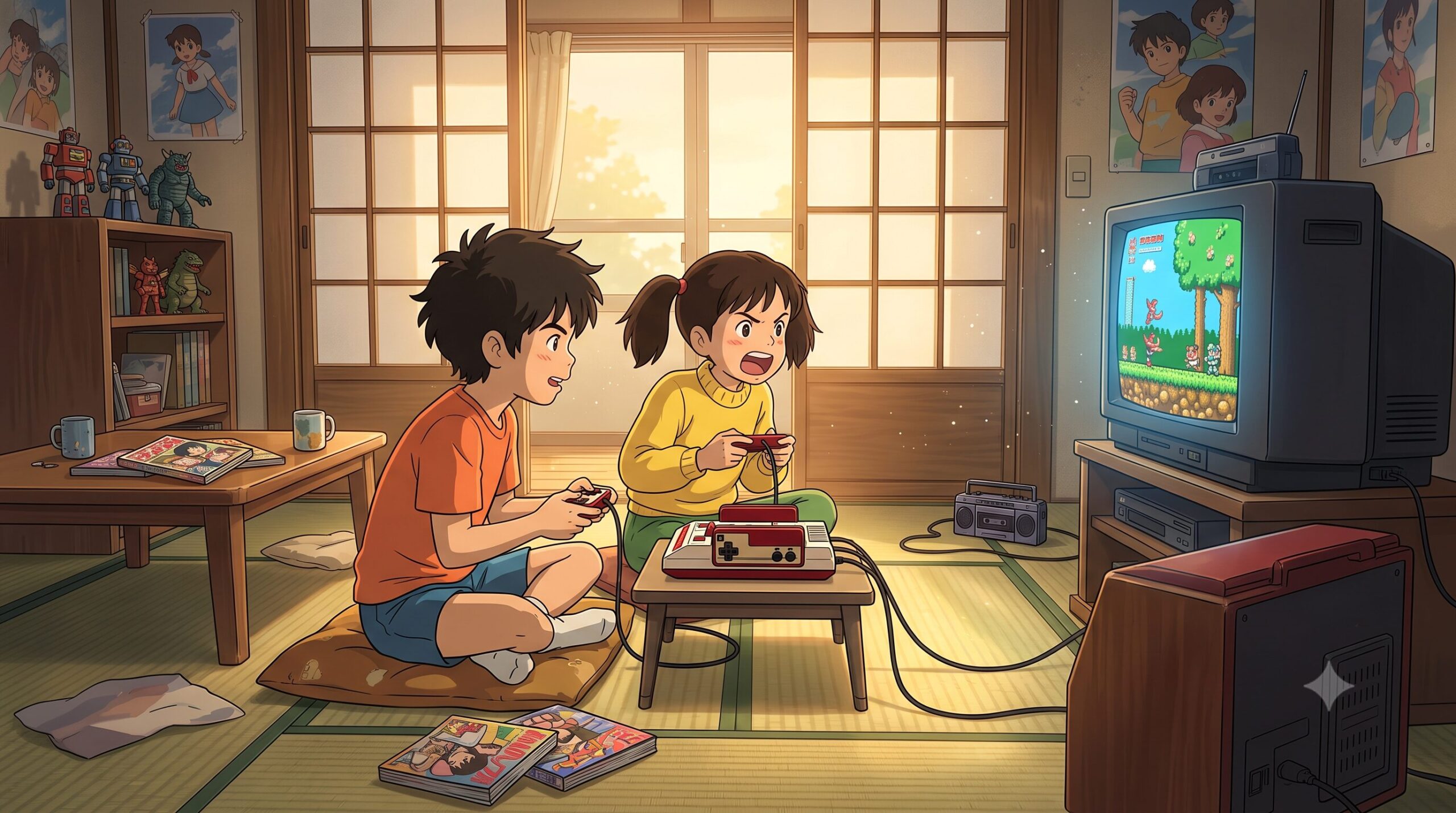
Every year on July 15th, Japan celebrates “Famicom Day,” a date of monumental significance in the history of technology and entertainment. On this day in 1983, Nintendo released the Family Computer, universally known as the Famicom. This compact machine, featuring a sleek red and white design, quickly took over Japanese living rooms. It eventually crossed the ocean as the Nintendo Entertainment System (NES), effectively saving and completely redefining the global video game industry.
The Miracle of 1983: Birth and History of the Famicom
In the early 1980s, the pinnacle of video gaming was found in bustling arcades. While home consoles existed, their quality was a far cry from the arcade experience. Nintendo’s development team set an incredibly ambitious goal: to bring the genuine excitement and quality of arcade games directly into the home living room. Given the technological limitations and cost constraints of the era, this was a monumental challenge.
However, through the development of custom microchips and relentless cost-reduction strategies, Nintendo achieved the impossible. Priced at an astonishingly affordable 14,800 yen, the console delivered smooth graphics and rich sound that rivaled arcade machines. Early titles like “Donkey Kong” and “Mario Bros.” left children in absolute awe. The release of “Super Mario Bros.” in 1985 pushed the Famicom beyond the realm of mere toys, turning it into an unprecedented cultural phenomenon.
Interpreting Japanese “Monozukuri” (Craftsmanship) Culture Through the Famicom
The Famicom’s triumph was not merely a technological victory. It was deeply rooted in Japan’s traditional “Monozukuri” (craftsmanship) spirit and unique aesthetic sense.
First is the “Aesthetics of Subtraction.” The memory capacity of a standard Famicom cartridge was mere kilobytes—less than a single photo on a modern smartphone. Developers had to express character movements, complex music, and engaging game mechanics within these extreme limitations. This mirrors traditional Japanese minimalism, much like “Bonsai” (expressing vast nature in a small pot) or “Haiku” (capturing deep emotions in a few words). By stripping away the unnecessary and extracting only the pure essence of fun, they created timeless masterpieces.
Second is the interface of “Omotenashi” (hospitality) and “Omoiyari” (consideration). The D-pad (cross-shaped directional pad) adopted for the Famicom controller was a revolutionary invention. It was so intuitive that anyone could play without reading a manual. This dedication to ensuring the player could navigate the game comfortably and without confusion is an early, masterful example of modern User Experience (UX) design.
Third is its integration with the Japanese family culture centered around the “Chanoma” (living room). The Famicom was not designed to be played alone in a private bedroom; it was meant to be connected to the main television. This created a new communal space where siblings and friends gathered around the screen, taking turns and sharing the experience. This culture of sharing a single screen and dividing joy and frustration is the very foundation of modern multiplayer gaming.
What Was Your First Video Game?
The Famicom is not just a relic of the past. The game design philosophies and iconic characters born in that era are vibrantly alive in today’s most advanced consoles. The daring challenge that began in a small Japanese corporate office forever altered humanity’s concept of “play.”
Did this article give you a sense of how Japanese technological prowess and cultural philosophy combined to create global innovation? What was the very first video game that completely absorbed you? How did that game shape your childhood experiences? I encourage you to reflect on your own memories and gaming journey.
Reference Links
- External Reference: Nintendo Co., Ltd. Corporate History
- Internal Category: What’s Today’s Special Day Series
7月15日は「ファミコンの日」!世界を変えた日本のゲーム機
毎年7月15日は、日本のテクノロジーとエンターテインメントの歴史において極めて重要な意味を持つ「ファミコンの日」です。1983年のこの日、任天堂株式会社から「ファミリーコンピュータ(Family Computer)」、通称「ファミコン」が発売されました。赤と白の洗練されたデザインを持つこの小さな機械は、瞬く間に日本中の家庭を席巻し、やがて「Nintendo Entertainment System (NES)」として海を渡り、世界のビデオゲーム産業そのものを救い、再定義することになります。
1983年の奇跡:ファミリーコンピュータの誕生と歴史
1980年代初頭、ビデオゲームと言えばゲームセンターで遊ぶアーケードゲームが主流でした。家庭用ゲーム機も存在していましたが、アーケードゲームのクオリティには遠く及ばないものでした。任天堂の開発チームは、「ゲームセンターの興奮を、そのまま家庭のテレビで再現する」という野心的な目標を掲げました。当時の技術とコストの制約のなかで、これは極めて困難な挑戦でした。
しかし、カスタムチップの開発や徹底的なコスト削減によって、14,800円という当時の常識を覆す低価格でありながら、アーケードゲームに匹敵する滑らかなグラフィックと豊かなサウンドを実現しました。『ドンキーコング』や『マリオブラザーズ』といった初期のタイトルは、子供たちに圧倒的な衝撃を与えました。そして1985年に発売された『スーパーマリオブラザーズ』によって、ファミコンは単なる玩具の枠を超え、社会現象へと昇華したのです。
ファミコンから読み解く日本の「モノづくり」精神と文化
ファミコンの成功は、単なる技術的勝利ではありません。その背景には、日本の伝統的な「モノづくり」の精神と、独自の美意識が深く根付いています。
第一に、「引き算の美学」です。当時のファミコンのメモリ容量は、現在のスマートフォンの画像1枚分にも満たない、わずか数キロバイトでした。開発者たちは、この極限の制約の中で、キャラクターの動き、音楽、ゲームのルールを表現しなければなりませんでした。これは、限られた空間に大自然を表現する「盆栽」や、短い言葉で情景と感情を描き出す「俳句」に通じる、日本特有のミニマリズムの極致です。無駄を極限まで削ぎ落とし、本質的な面白さだけを抽出するプロセスが、色褪せない名作を生み出しました。
第二に、日本の「おもてなし」と「思いやり」のインターフェースです。ファミコンのコントローラーに採用された「十字キー」は、直感的で誰もが説明書なしで操作できる画期的な発明でした。プレイヤーがどうすれば迷わず、快適に楽しめるかを徹底的に考え抜く姿勢は、現代の優れたユーザーエクスペリエンス(UX)デザインの先駆けと言えます。
第三に、「茶の間」を中心とした日本の家族文化との融合です。ファミコンは個室で一人で遊ぶものではなく、リビングルーム(茶の間)のテレビに接続するものでした。これにより、兄弟や友人が画面の前に集まり、順番を交代しながら遊ぶという、新しいコミュニケーションの場が誕生しました。一つの画面を共有し、喜びや悔しさを分かち合う文化は、現代のオンラインマルチプレイの原点でもあります。
あなたにとっての「初めてのゲーム」は何ですか?
ファミコンは、単なる過去の遺物ではありません。そこで培われたゲームデザインの哲学や、キャラクターたちの魅力は、現代の最新ゲーム機にも色濃く受け継がれています。日本の小さな町工場から始まった挑戦が、世界中の人々の「遊び」の概念を変えたのです。
この記事を通じて、日本の技術力と文化がどのように結びついて世界的なイノベーションを生み出したかを感じていただけたでしょうか。あなたにとって、人生で初めて夢中になったビデオゲームは何ですか?そのゲームは、あなたの子供時代にどのような影響を与えましたか?ぜひ、あなたの思い出や考えを振り返ってみてください。
参考リンク
- 外部参考リンク: 任天堂株式会社 会社情報の歴史
- 内部カテゴリーリンク: What’s Today’s Special Day Series

コメント