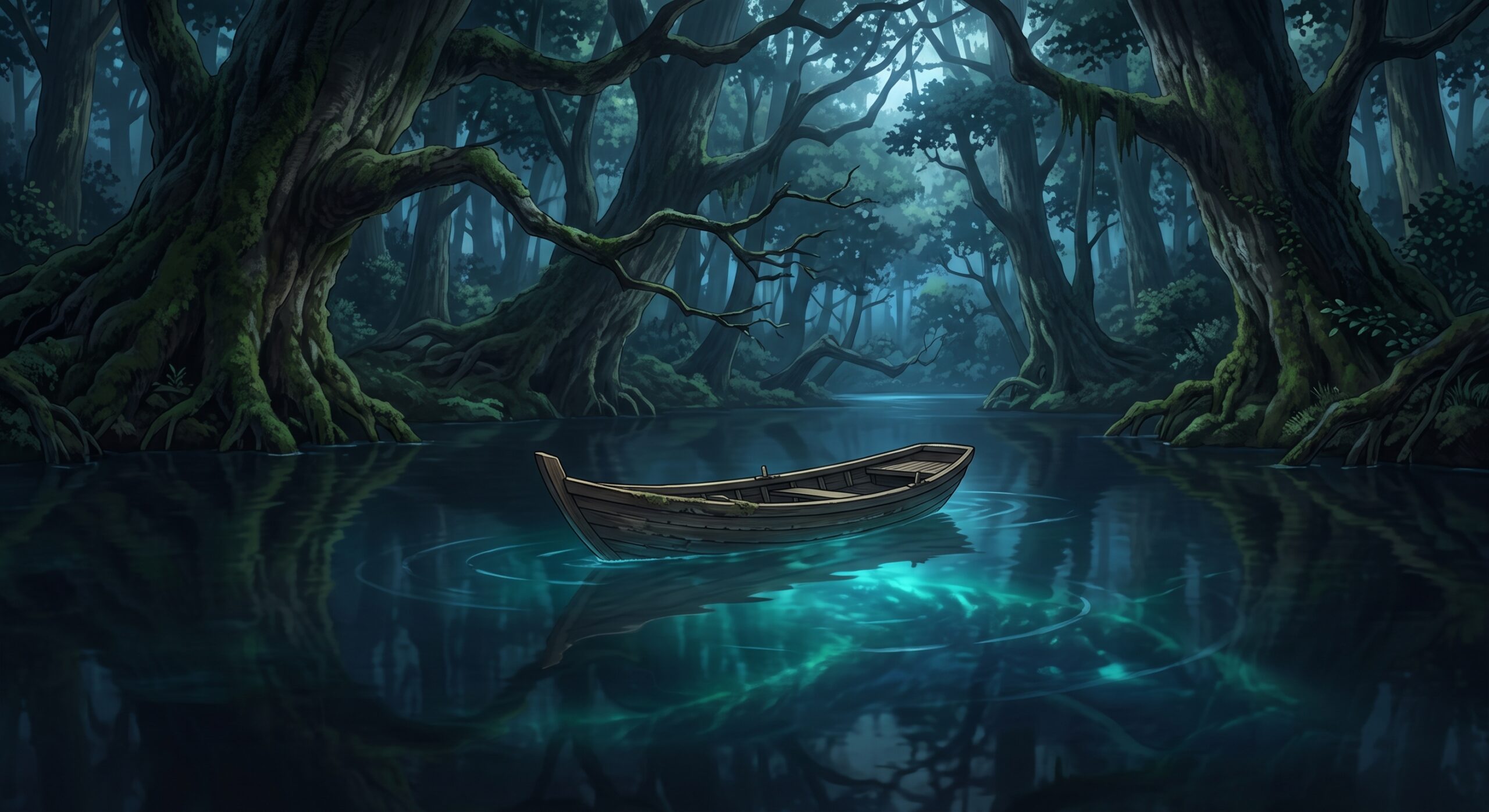
Located at the southern tip of Japan, surrounded by abundant nature, Koshikijima Island in Kagoshima Prefecture is home to countless ancient legends. Among them, the folktale “Mifunegawa” (The Honorable Boat River), which brilliantly depicts human courage and a profound awe for nature, is an essential story for understanding Japanese spirituality. In this article, I will introduce the full picture of this terrifying yet beautiful legend and deeply explore the unique Japanese culture and philosophy hidden within it.
The Story of the Folktale “Mifunegawa”
Long, long ago, in the middle reaches of the Nakatsugawa River flowing through Koshikijima, Kagoshima Prefecture, there existed a massive pond. Surrounded by giant camphor trees that were hundreds of years old, it was a dense, eerie place where sunlight could not reach even during the day.
A giant eel, so massive that it could swallow a human whole, lived in this deep pond. The giant eel dragged anyone who approached the pond down to the bottom of the water, plunging the villagers into the depths of terror. Hearing rumors of this terrifying monster, strong samurai and brave men confident in their skills went to exterminate it one after another. However, not a single one returned alive. Human strength was powerless against the giant eel’s monstrous power and the magic of the bottomless pond.
One day, as the villagers were in despair, a Shinto priest from a shrine on an island called Higasayama decided to exterminate the giant eel. As a man who served the gods, he devised a plan to confront this monster not with military force, but with wisdom and sacred power.
On the day of the execution, a large crowd of villagers gathered around the pond, watching with bated breath. Surprisingly, the priest, known as “Higasayama-don,” carried no weapons. He quietly stepped into the pond wearing nothing but an exceptionally long fundoshi (traditional Japanese loincloth). In Shinto rituals, a fundoshi is a sacred garment used to purify oneself. Using his own body and this long fundoshi skillfully, he engaged in a fierce struggle to the death with the giant eel underwater.
Violent splashes of water rose, and the pond water swirled. Eventually, the water surface broke wide open, and Higasayama-don successfully dragged the giant eel up onto the land. The invincible great monster finally breathed its last before the wisdom and courage of the priest.
News of this great achievement instantly reached the lord who ruled the island. The lord summoned Higasayama-don to his castle and asked, “That was magnificent work. I wish to give you a reward. What is your desire?” Everyone thought he would ask for vast amounts of gold, silver, treasure, or a large territory.
However, the words that came out of Higasayama-don’s mouth were unexpected. “I would like to receive one fine boat, my lord.”
Given a beautiful boat by the lord, Higasayama-don never used it for fishing or transportation. He securely moored the boat in the middle of the pond where the giant eel once lived. Then, he simply stood on the shore and quietly stared at the boat. This was an act of “Kuyo” (memorial service) to comfort the soul of the giant eel—a terrifying monster that had taken people’s lives, but was nevertheless the former master of that pond.
Years passed, and the boat, which no one ever rode, was beaten by rain and wind, eventually rotting away and sinking to the bottom of the pond. However, the villagers never forgot the priest’s noble act. They affectionately called the river “Ofune-gawa” (The River of the Boat), and eventually, the name settled as “Mifunegawa.”
Analysis: Why a “Boat” and Why Fight with a “Fundoshi”?
This story hides several deep mysteries. The first mystery is, “Why did he use a long fundoshi?” In Japanese Shinto, water is a symbol of “purification,” and a fundoshi (especially white) represents the purification of one who serves the gods. Higasayama-don suppressed the fury of nature (the giant eel) not by physical violence like swords or spears, but by the power of a sacred ritual.
The second mystery is, “Why did he leave the reward boat to rot away?” A boat with no practical value, meant only to float on the pond. This serves the role of a “spirit boat” (often seen in events like Shorou Nagashi), meant to carry souls to the afterlife. He did not simply cut down the giant eel as a “villain,” but respectfully mourned it as a single “life” or perhaps a “rough god” (Araburu Kami).
Connection to Japanese Culture: Awe for Nature and the Spirit of “Kuyo”
The most important core of Japanese culture to decipher from this story of “Mifunegawa” is the spirit of “Animism” (belief in spirits in all things) and “Kuyo” (memorial service).
In Western monster-slaying stories (such as dragon slayers), the hero who defeats the monster typically gains wealth and honor, and the monster is destroyed as an absolute evil. However, in Japanese stories, “prayer” and “requiem” are always offered to the defeated existence. The giant eel was a terrifying entity that attacked humans, but at the same time, it was the master representing the nature of the Nakatsugawa River. In Japanese culture, nature is a god that bestows blessings, but also a rough god that brings disasters. Defeating the giant eel was necessary for human survival, but one must not forget the apology and respect for taking its life. That is “Kuyo.”
The act of Higasayama-don floating the boat and watching over it until it rotted can be said to be the ultimate Japanese humanism, preserving the boundary between humans and nature and showing deep compassion for a lost life.
What Would You Do?
What would you do if you defeated an object of absolute terror? If you could receive any reward you liked from a lord, could you ask for a “boat” to mourn the soul of your enemy instead of gold or status? And could you take the time to simply and quietly watch that boat rot away?
This story is packed with the “respect for others” and “awe for the unseen” that we are beginning to forget in modern society. I strongly urge you to deeply imagine what you felt from this story and what you would have wished for if you were in Higasayama-don’s position.
Reference Links:
External Reference: Japanese Folktale Mifunegawa
Read More Japanese Folktales: Japanese Folktale Series
日本の神秘を紐解く:「御船川」と鎮魂の文化
豊かな自然に恵まれた日本の南端、鹿児島県の甑島(こしきじま)には、数多くの伝承が眠っている。その中でも、人間の勇気と自然への畏敬の念を見事に描き出した「御船川(みふねがわ)」という昔話は、日本人の精神性を理解する上で極めて重要な物語である。本記事では、この恐ろしくも美しい伝説の全貌を紹介し、そこに隠された日本特有の文化や思想を深く掘り下げていく。
昔話「御船川(みふねがわ)」の物語
昔々、鹿児島県の甑島を流れる中津川の中流に、巨大な池が存在した。周囲を樹齢何百年という巨大な楠(くすのき)が取り囲み、昼間でも太陽の光が届かない、うっそうとした薄気味悪い場所であった。
この深い池には、人間を丸飲みにするほど巨大な「大ウナギ」が棲み着いていた。大ウナギは池に近づく人々を次々と水底へと引きずり込み、村人たちを恐怖のどん底に陥れていた。この恐ろしい魔物の噂を聞きつけ、腕に覚えのある屈強な武士や豪傑たちが次々と退治に向かった。しかし、誰一人として生きて帰る者はなかった。大ウナギの怪力と、底なしの池の魔力の前では、人間の力など無力であった。
村人たちが絶望に暮れていたある日、日傘山(ひがさやま)という島にある神社の神主が、大ウナギの退治を決意した。神に仕える身である彼は、武力ではなく、知恵と神聖な力でこの魔物に立ち向かう一計を案じたのである。
決行の日、池の周囲には固唾を呑んで見守る大勢の村人たちが集まった。神主である「日傘山どん」は、驚くべきことに武器を持たず、ただ非常に長いふんどしを身に着けただけの姿で、静かに池の中へと足を踏み入れた。ふんどしは、神事において身を清めるための神聖な衣服である。彼は自身の体とこの長いふんどしを巧みに使い、水中で大ウナギと死闘を繰り広げた。
激しい水しぶきが上がり、池の水が渦を巻く。やがて、水面が大きく割れ、日傘山どんは見事に大ウナギを陸へと引きずり上げることに成功したのである。無敵を誇った大魔物は、神主の知恵と勇気の前に遂に息絶えた。
この大偉業は、瞬く間に島を治める殿様の耳に届いた。殿様は日傘山どんを城に呼び出し、「見事な働きである。褒美をとらせたいが、何が望みか」と尋ねた。誰もが、彼が莫大な金銀財宝や広い領地を望むと考えた。
しかし、日傘山どんの口から出た言葉は、予想外のものであった。「立派な船を、一艘いただきたく存じます」
殿様から美しい船を下賜された日傘山どんは、その船を漁や移動に使うことはなかった。彼はその船を、かつて大ウナギが棲んでいた池の真ん中にしっかりと繋ぎ止めた。そして、岸辺からただ静かに、その船を見つめるだけだった。それは、人々の命を奪った恐ろしい魔物でありながらも、かつてその池の主であった大ウナギの魂を慰めるための「供養(くよう)」の姿であった。
歳月が流れ、誰に乗られることもなかった船は、雨風に打たれて朽ち果て、やがて池の底へと沈んでいった。しかし、村人たちは神主の崇高な行いを忘れることはなかった。彼らはその川を「お船の川」と呼び親しみ、いつしかその名が定着して「御船川(みふねがわ)」と呼ばれるようになったのである。
考察:なぜ「船」を求め、「ふんどし」で戦ったのか?
この物語には、いくつかの深い謎が隠されている。第一の謎は、「なぜ長いふんどしを用いたのか」である。日本の神道において、水は「清め」の象徴であり、ふんどし(特に白)は神に仕える者の潔斎(けっさい)を表す。日傘山どんは、武力(刀や槍)という物理的な暴力ではなく、神聖な儀式としての力を用いて、自然の猛威(大ウナギ)を鎮圧したのである。
第二の謎は、「なぜ褒美の船を放置して朽ち果てさせたのか」である。実用的な価値を持たず、ただ池に浮かべておくための船。これは、精霊流し(しょうりょうながし)などに見られる「魂を乗せてあの世へ送るための船」としての役割を果たしている。彼は大ウナギを単なる「悪者」として切り捨てるのではなく、一つの「命」として、あるいは「荒ぶる神」として丁重に弔ったのである。
日本文化との関連:自然への畏敬と「供養」の精神
この「御船川」の物語から読み解くべき最も重要な日本文化の核心は、「アニミズム(万物への霊魂信仰)」と「供養(くよう)」の精神である。
西洋の怪物退治の物語(例えばドラゴン・スレイヤー)では、怪物を倒した英雄は富と名誉を得て、怪物は絶対悪として滅ぼされるのが一般的である。しかし、日本の物語では、退治された存在に対して必ず「祈り」や「鎮魂」が行われる。大ウナギは人間を襲う恐ろしい存在であったが、同時に中津川の自然を象徴する主(ぬし)でもあった。日本の文化では、自然は恵みを与える神であると同時に、災害をもたらす荒ぶる神でもある。大ウナギを倒すことは人間の生存のために必要であったが、その命を奪ったことに対する謝罪と敬意を忘れてはならない。それが「供養」である。
日傘山どんが船を浮かべ、それが朽ちるまで見守った行為は、人間と自然の境界線を守り、失われた命への深い思いやりを示す、究極の日本的ヒューマニズムであると言える。
あなたなら、どうしますか?
絶対的な恐怖の対象を打ち倒したとき、あなたならどうするだろうか。殿様から何でも好きな褒美をもらえるとしたら、黄金や地位ではなく、敵の魂を弔うための「船」を願うことができるだろうか。そして、その船が朽ちていく様をただ静かに見つめる時間を、持つことができるだろうか。
私たちが現代社会で忘れかけている「他者への敬意」や「見えないものへの畏敬の念」が、この物語には詰まっている。ぜひ、あなたがこの物語から何を感じ、もし日傘山どんの立場であれば何を願ったか、深く想像してみてほしい。
コメント