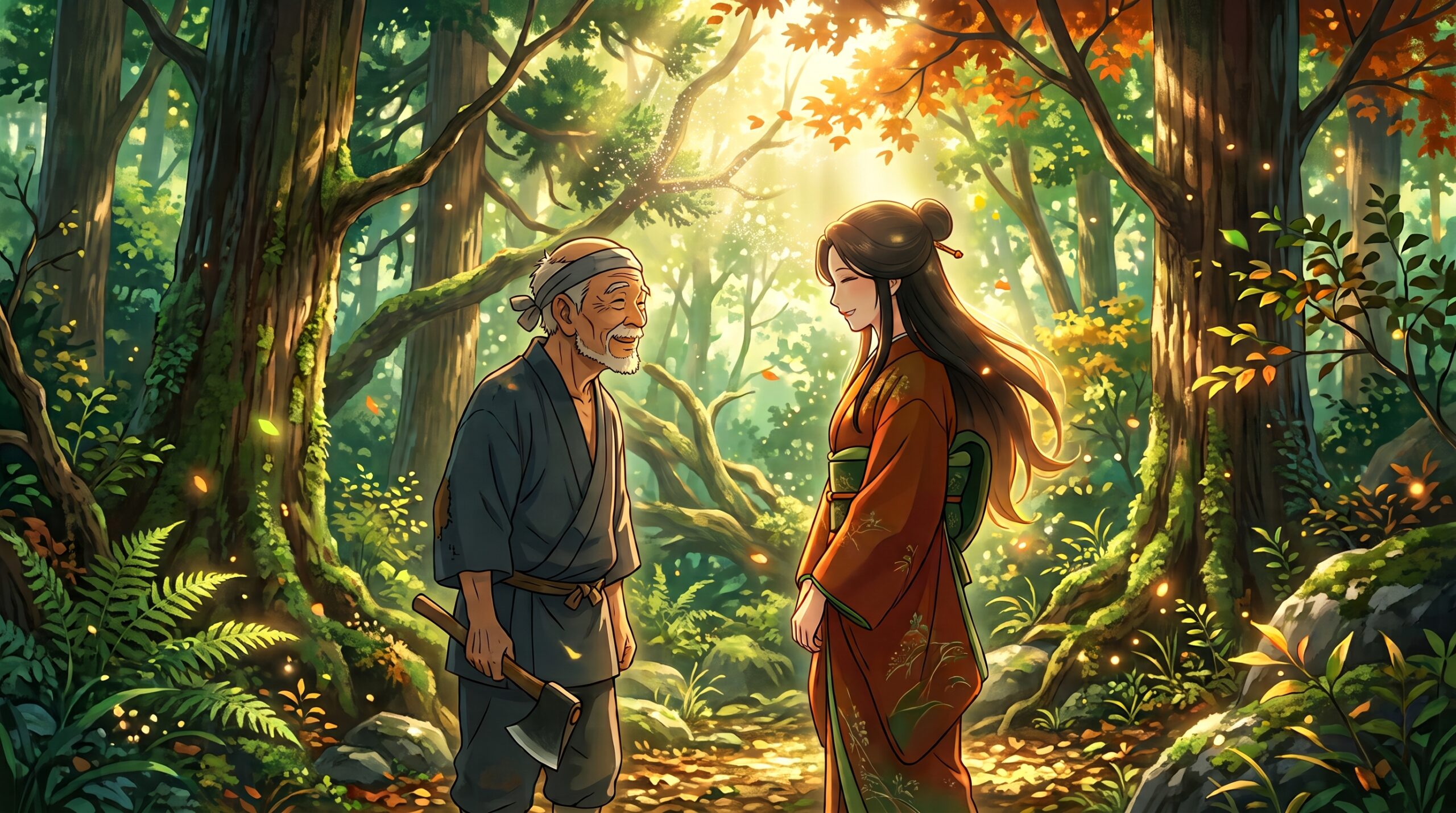
Chapter 1: A Small Life in the Forest and a Spring Promise
In a small village called Uwaoka in Ibaraki Prefecture, surrounded by the rich nature of Japan, lived a kind-hearted old woodcutter named Jinbei. Although he lived alone his entire life, he deeply loved the mountains, caring for the trees and animals as if they were his own family, living a quiet and peaceful life.
One beautiful spring day, as Jinbei was chopping wood deep in the mountains as usual, the bushes suddenly rustled. Turning around, he saw a single fox, panting heavily and trembling with fear. The fox’s fur was messy, and its eyes seemed to be desperately pleading for help.
“What’s wrong? Is someone chasing you?” Just as Jinbei spoke, he heard the footsteps of a hunter and the barking of dogs in the distance. Without a second thought, Jinbei took off his jacket and hid the fox inside it. Soon after, a breathless hunter appeared and asked, “Old man, did you see a fox run this way?” Jinbei, with a calm face, pointed in the completely opposite direction and said, “Yeah, if it’s that fox you’re looking for, it flew off toward that valley.”
After the hunter left, Jinbei removed his jacket and smiled gently, “You’re safe now. Hurry back to the mountain.” Before dashing into the depths of the forest, the fox stopped for a moment, looked deeply at Jinbei, and then disappeared into the sunlight filtering through the trees. For Jinbei, it was just a trivial, everyday occurrence.
Chapter 2: A Harsh Summer and an Unexpectedly Beautiful Visitor
The seasons passed, and the summer of that year brought an unprecedented heatwave to the village. The harsh sunlight and intense heat mercilessly stole the strength of the elderly Jinbei. Eventually, Jinbei fell ill and became bedridden in his lonely, dilapidated hut.
There was no one to nurse the solitary Jinbei. Delirious with a high fever, he was about to give up, thinking, “Ah, is this the end of my life?” At that moment, the door of the hut quietly opened, and a beautiful, unknown young woman appeared.
Without saying much, she wiped Jinbei’s forehead with a cool towel, cooked warm porridge, and began to clean the house. Thanks to the girl’s devoted nursing, Jinbei gradually regained consciousness. “I don’t know who you are or where you came from, but I am truly sorry for the trouble,” Jinbei said with tears of gratitude. The girl just smiled gently and replied, “I am someone whose life you saved, so I am only doing what is natural.” Jinbei searched his memory, but he had no recollection of ever saving such a beautiful girl.
From then on, the girl visited the hut early every morning, chopped wood to sell in the town, picked wild flowers to decorate the room, and served Jinbei with a deep love that even a real daughter might not show. Jinbei’s heart was filled with a warmth and happiness he had never felt before.
Chapter 3: The Final Moments and an Eternal Form of Gratitude
However, as the cold winds of autumn began to blow, Jinbei’s condition rapidly deteriorated. On a night with cold, pouring rain, Jinbei realized that he had very little time left.
“I’m so sorry… for doing all this for an old fool like me. You’re not even my real child…” Jinbei repeated his words of gratitude over and over to the girl who had been holding his hand the whole time. Large tears fell from the girl’s eyes as she squeezed Jinbei’s wrinkled hand tightly back. And then, with a peaceful look on his face, Jinbei quietly passed away from this world.
The villagers, learning of Jinbei’s death, buried him carefully halfway up the mountain. However, after the funeral was over, the beautiful and devoted girl was nowhere to be found. No matter how much the villagers searched, no one knew where she had gone.
At that time, the village elder muttered, “Come to think of it, Jinbei said he saved a fox’s life early this spring. That girl must have been the fox coming to repay her debt of gratitude.”
The villagers nodded deeply, moved to tears by Jinbei’s kindness and the fox’s affection, having risked its life to repay the favor. Since then, the villagers started calling the mountain “Mount Jinbei,” and passed down the story to their children, saying, “Like the fox of Mount Jinbei, you must never forget a favor you have received.”
- Chapter 1: A Small Life in the Forest and a Spring Promise
- Chapter 2: A Harsh Summer and an Unexpectedly Beautiful Visitor
- Chapter 3: The Final Moments and an Eternal Form of Gratitude
- Deeply Analyzing “The Fox of Mount Jinbei”: Selfless Love and the Mystery of Incarnation
- The Intersection of Animals and Humans in Japanese Culture
- What Did You Feel From This Story?
- 甚兵衛山のキツネ:心優しき木こりと不思議な娘の感動的な物語
- 「甚兵衛山のキツネ」を深く考察する:無私の愛と化身の謎
- 日本文化における動物と人間の交差点
- あなたはこの物語から何を感じましたか?
Deeply Analyzing “The Fox of Mount Jinbei”: Selfless Love and the Mystery of Incarnation
Why Did the Fox Transform into a Human Girl?
In Japanese folktales, there are many stories of animals transforming into humans, but the actions of the fox in “The Fox of Mount Jinbei” hide a special meaning. Why did the fox transform into a human girl instead of staying in its true form?
In the form of a wild animal, it cannot provide direct “nursing care” such as cooking or doing housework for a sick human. In order to save the life of her savior, Jinbei, or to let him spend his final moments in peace, the fox used its spiritual power to the absolute limit to maintain a human form. It is not just magical power, but the crystallization of “selfless love” that cares for others.
The Aesthetics of Not Revealing One’s True Identity
Until the very end, the girl only said, “I am someone whose life you saved,” and never revealed that she was a fox. In traditional Japanese virtues, “actions that do not seek reward” and “doing good deeds without giving one’s name (Yintoku)” are considered highly noble. Her attitude of not being patronizing and only wishing for Jinbei’s happiness strongly reflects Japanese spirituality.
The Intersection of Animals and Humans in Japanese Culture
The Japanese Spirituality of “Ongaeshi” (Repaying a Favor)
In Japanese folklore, “Ongaeshi” (repaying a debt of gratitude) is one of the most important themes. Stories of working oneself to the bone to repay a debt, such as the Grateful Crane or Kasa Jizo, are deeply rooted in the hearts of the Japanese people. Duty, compassion, and never forgetting to be grateful. These are values that are highly cherished in building human relationships, even in modern Japanese society.
Coexistence with Nature and the Worldview of Animism
This story is deeply connected to Japan’s ancient “animism” (belief in spirits). In Japan, it has long been believed that sacred spirits dwell in mountains, rivers, and animals. The fox, in particular, is treated as a special entity in Shinto as the messenger of Inari, the god of agriculture and fertility.
The sight of Jinbei, a woodcutter, cherishing the animals of the mountain symbolizes the traditional Japanese view of nature, which is to coexist as a part of nature rather than dominating it. The worldview that the boundary between humans and the natural world is gentle, and that they can help each other, gives this story a warm and moving quality.
What Did You Feel From This Story?
Jinbei’s unconditional kindness and the fox’s deep affection trying to answer it. This story teaches us living in the modern world “the importance of being grateful” once again.
If you were Jinbei, could you have risked danger to save a small life? And if you were in the fox’s shoes, how would you express your gratitude to your savior? Please cherish the thoughts that come to your mind.
If you want to know more about Japan’s rich culture and heartwarming folktales, please enjoy other stories from the links below.
- Internal Link: Read more Japanese Folktale Series
- External Link: Minwa no Heya – Folktales of Ibaraki Prefecture (Japanese)
- External Link: Daigo Town Tourism Association, Ibaraki (The setting of the story)
甚兵衛山のキツネ:心優しき木こりと不思議な娘の感動的な物語
第一章:森の中の小さな命と、春の日の約束
日本の豊かな自然に囲まれた茨城県の上岡(うわおか)という小さな村に、甚兵衛(じんべえ)さんという心優しい木こりのお爺さんが住んでいました。彼は生涯独り身でしたが、山を愛し、木々や動物たちを自分の家族のように大切に思いながら、静かで穏やかな日々を送っていました。
ある春のうららかな日のことです。甚兵衛さんがいつものように山深くで木を切っていると、突然、茂みがガサガサと音を立てました。振り向くと、そこには息を弾ませ、恐怖で震えている一匹のキツネの姿がありました。キツネの毛並みは乱れ、その目は必死に「助けてほしい」と訴えかけているようでした。
「どうしたんだ? 誰かに追われているのか?」甚兵衛さんがそう声をかけた直後、遠くから猟師の足音と犬の吠え声が聞こえてきました。甚兵衛さんは咄嗟に自分の上着を脱ぎ、その中にキツネを隠しました。間もなく息を切らした猟師が現れ、「爺さん、この辺りにキツネが逃げてこなかったか?」と尋ねました。甚兵衛さんは平然とした顔で「ああ、そのキツネなら、あっちの谷の方へ飛んでいったよ」と、全く逆の方向を指差しました。
猟師が去った後、甚兵衛さんは上着をどかし、「もう大丈夫だ。早く山へお帰り」と優しく微笑みかけました。キツネは森の奥へ駆け出す前に、一度だけピタリと立ち止まり、甚兵衛さんを深く見つめ返してから、木漏れ日の中へと姿を消していきました。甚兵衛さんにとって、それは日常のほんの些細な出来事に過ぎませんでした。
第二章:過酷な夏と、予期せぬ美しい訪問者
季節は巡り、その年の夏は村人たちがかつて経験したことのないほどの猛暑となりました。厳しい日差しと熱気は、老齢の甚兵衛さんの体力を容赦なく奪い去りました。ついに甚兵衛さんは病に倒れ、一人きりの荒れ果てた小屋で寝込んでしまったのです。
身寄りのない甚兵衛さんを看病してくれる者は誰もいませんでした。高熱にうなされ、「ああ、わしの命もここまでか」と諦めかけたその時です。小屋の戸が静かに開き、見知らぬ一人の美しい娘が現れました。
彼女は一言も多くを語らず、冷たい手ぬぐいで甚兵衛さんの額を拭い、温かいおかゆを作り、家の中を清潔に整え始めました。娘の献身的な看病のおかげで、甚兵衛さんは少しずつ意識を取り戻しました。「どこの誰かは知らねえが、本当にすまねえな」と甚兵衛さんが涙ぐみながら感謝を伝えると、娘はただ優しく微笑み、「私はあなたに命を助けられた者ですから、当然のことをしているだけです」と答えるだけでした。甚兵衛さんは記憶を辿りましたが、こんな美しい娘を助けた記憶など全くありませんでした。
それからというもの、娘は毎日朝早くから小屋へ通い、薪を割って町へ売りに行き、野の花を摘んで部屋に飾り、実の娘でさえここまでしないだろうというほどの深い愛情をもって甚兵衛さんに尽くしました。甚兵衛さんの心は、これまでに感じたことのない温かさと幸福感で満たされていきました。
第三章:最期の時と、永遠の感謝の形
しかし、秋の冷たい風が吹き始める頃、甚兵衛さんの容体は急激に悪化してしまいました。冷たい雨が降る夜、甚兵衛さんは自分の命が残りわずかであることを悟りました。
「すまねえなあ……わしのような老いぼれのために。実の子供でもねえのによ……」甚兵衛さんは、ずっと手を握り続けてくれていた娘に向けて、何度も何度も感謝の言葉を繰り返しました。娘の目からは大粒の涙が溢れ落ち、甚兵衛さんのしわくちゃの手を強く握り返しました。そして、甚兵衛さんは安らかな顔で、静かにこの世を去りました。
甚兵衛さんの死を知った村人たちは、彼を山の中腹に手厚く葬りました。しかし、葬儀が終わった後、あの美しく献身的な娘の姿はどこにもありませんでした。村人たちがどれだけ探しても、彼女の行方を知る者は誰一人いませんでした。
その時、村の長老がぽつりと口にしました。「そういえば、春先に甚兵衛さんがキツネの命を助けたと言っていたな。あの娘はきっと、そのキツネの恩返しだったに違いない」
村人たちは深く頷き、甚兵衛さんの優しさと、命がけで恩を返したキツネの情愛に涙しました。それ以来、村人たちはその山を「甚兵衛山」と呼ぶようになり、「甚兵衛山のキツネのように、受けた恩は決して忘れてはならない」と、子供たちに語り継ぐようになったのです。
「甚兵衛山のキツネ」を深く考察する:無私の愛と化身の謎
なぜキツネは人間の娘に化けたのか?
日本の昔話には、動物が人間に化ける物語が数多く存在しますが、この「甚兵衛山のキツネ」の行動には特別な意味が隠されています。キツネはなぜ、そのままの姿ではなく人間の娘に化けたのでしょうか?
野生の動物の姿では、病に倒れた人間に対して食事を作ったり、家事をしたりといった直接的な「介護」をすることができません。命の恩人である甚兵衛さんの命を救うため、あるいは最期の時を安らかに過ごさせるため、キツネは自らの持つ霊力を極限まで使い、人間の姿を維持し続けたのです。それは単なる魔法の力ではなく、相手を思いやる「無私の愛」の結晶と言えるでしょう。
正体を明かさない美学
娘は最後まで「私はあなたに命を助けられた者」としか言わず、自分がキツネであることを明かしませんでした。日本の伝統的な美徳において、「見返りを求めない行動」や「名乗らずに善行を行うこと(陰徳)」は非常に尊いものとされています。恩着せがましくならず、ただひたすらに甚兵衛さんの幸せだけを願った彼女の態度は、日本の精神性を色濃く反映しています。
日本文化における動物と人間の交差点
「恩返し」という日本人の精神性
日本の民間伝承において「恩返し」は最も重要なテーマの一つです。鶴の恩返しや笠地蔵など、受けた恩義に対して身を粉にして報いようとする物語は、日本人の心に深く根付いています。義理と人情、そして感謝の念を忘れないこと。これは現代の日本社会においても、人間関係を構築する上で非常に大切にされている価値観です。
自然との共生とアニミズムの世界観
この物語は、日本古来の「アニミズム(精霊信仰)」と深く結びついています。日本では古くから、山や川、そして動物たちには神聖な霊魂が宿っていると信じられてきました。特にキツネは、神道において五穀豊穣の神である「稲荷神(いなりのかみ)」の使いとされ、特別な存在として扱われてきました。
木こりである甚兵衛さんが山の動物を慈しむ姿は、自然を支配するのではなく、自然の一部として共生してきた日本人の伝統的な自然観を象徴しています。人間と自然界の境界線が緩やかで、互いに助け合うことができるという世界観が、この物語に温かい感動を与えているのです。
あなたはこの物語から何を感じましたか?
甚兵衛さんの無償の優しさと、それに応えようとしたキツネの深い愛情。この物語は、現代を生きる私たちに「感謝することの大切さ」を改めて教えてくれます。
もしあなたが甚兵衛さんだったら、危険を顧みずに小さな命を助けることができたでしょうか? そして、もしあなたがキツネの立場だったら、恩人にどのように感謝の気持ちを伝えますか? ぜひ、あなたの心に浮かんだ思いを大切にしてみてください。
日本の豊かな文化や、心温まる昔話をもっと知りたい方は、ぜひ以下のリンクから他の物語も楽しんでみてください。
- 内部リンク:日本の昔話シリーズをもっと読む
- 外部リンク:民話の部屋 – 茨城県の昔話
- 外部リンク:物語の舞台・茨城県大子町観光協会


コメント