The Tale of the Mysterious Japanese Folktale “The Fish Seller and the Fox”
Long ago, near Shinozaki Village in Komatsugawa, located in the eastern part of Edo (modern-day Tokyo), there lived a mischievous fox known for tricking people. Close to this village lived two young men who made their living by selling fish. One of them was very strong-willed and hot-tempered. Every time the fox tricked him out of the dried fish he had carefully prepared, he would become furious.
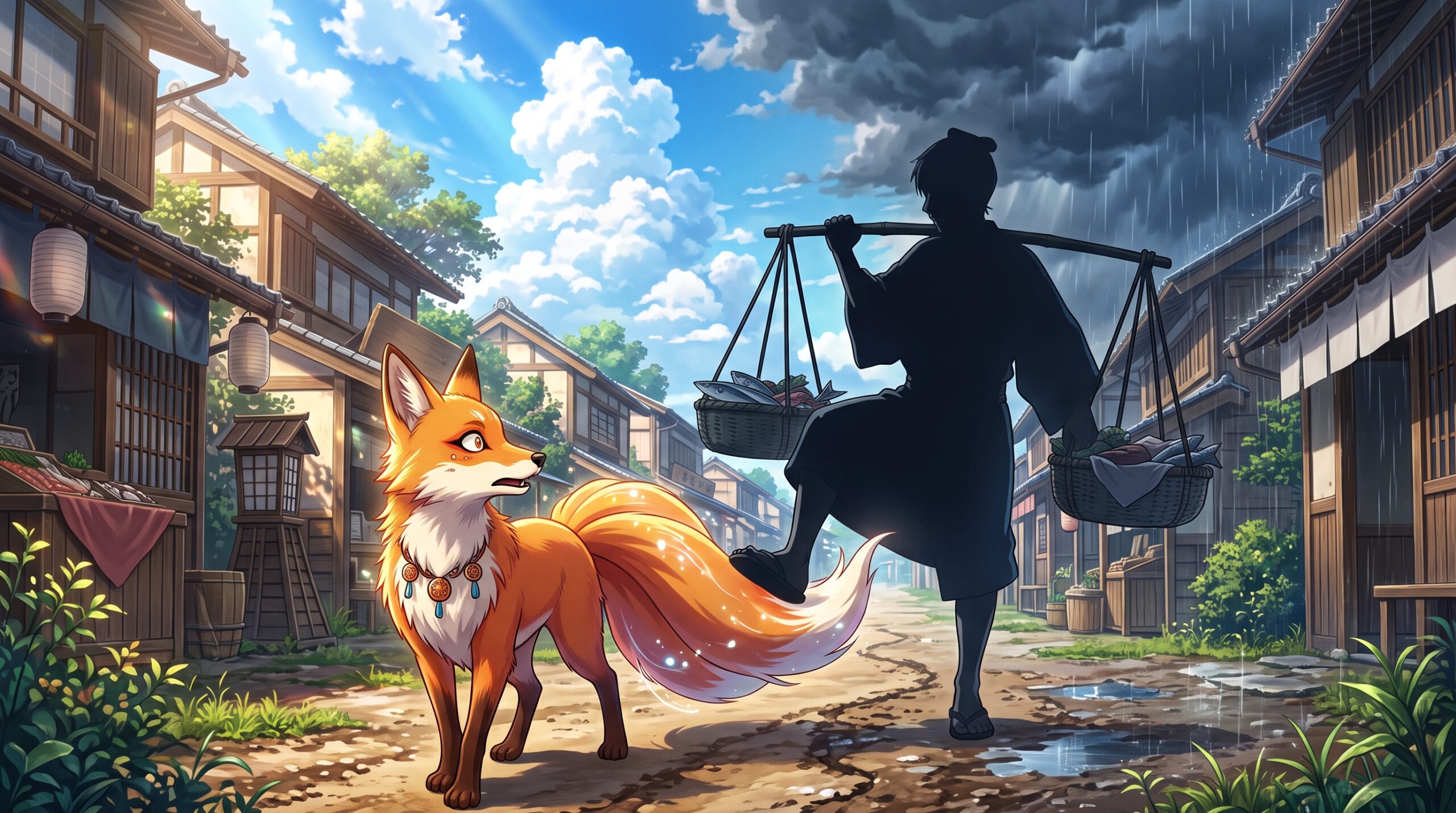
One sunny day, while walking along a path, the strong-willed young man spotted the very same fox sleeping defenselessly in the tall grass. Seeing this as the perfect opportunity to exact revenge for his stolen fish, he silenced his footsteps, snuck up on the fox, and stomped on its tail with all his might. The startled fox bounded away, but immediately after, the clear sky was suddenly engulfed in black clouds, and a torrential downpour began.
Soaked to the bone, the young man rushed to take shelter in the nearby house of an acquaintance. However, the atmosphere inside the house was bizarre and heavy. He learned that his acquaintance’s wife had just passed away. The grief-stricken husband hoisted the coffin onto his shoulders, saying he was going to the funeral procession, and left the young man entirely alone in the house.
Left alone, the young man tried to warm his chilled body and dry his clothes by the fire of the hearth. Suddenly, he felt an eerie presence behind him. Turning around, he saw the wife who was supposed to be dead, standing there as a terrifying ghost. Relying on his strong will, he suppressed his terror and began to fight the ghost head-on. However, fighting a spirit is not like fighting a human, and he was completely outmatched. Grabbing a thick stick from the corner of the room, he swung it wildly with all the strength he had.
Meanwhile, outside in the real world, the village farmers were sweating under a blazing sun, working in the fields. When they glanced at the road, they saw the young man rolling around by himself, swinging a stick at thin air, desperately fighting something invisible. There was no heavy rain; the sky was perfectly clear. Thinking he had lost his mind, the farmers splashed him with a bucket of cold well water. With a gasp, the young man finally snapped back to his senses.
The sudden downpour, the funeral at the acquaintance’s house, and the deadly struggle with the terrifying ghost—it was all an elaborate hallucination created by the fox in retaliation for having its tail stomped on. Realizing his reckless behavior, the young man immediately prepared red bean rice (sekihan) and fried tofu (abura-age), offering them to the fox to respectfully ward off the curse. The violent rain and the ghost were mere illusions, but on the young man’s arm remained a painful bite mark and a sharp, throbbing pain that was entirely real. In ancient Japan, such mysterious and inexplicable events lurked right next to everyday life.
An In-depth Analysis of “The Fish Seller and the Fox”
This story contains a profound lesson that goes beyond a simple “fox’s revenge.” What is particularly noteworthy is the “sudden change in weather” and the “invitation into the realm of death” that occur immediately after the young man stomps on the fox’s tail. In Japanese folk belief, foxes possess a dual nature: they are sacred messengers of the gods (particularly Inari), yet they are also yokai (monsters) capable of shapeshifting and tricking humans. In response to the young man’s violent retaliation, the fox fought back with overwhelming supernatural power (hallucination). This serves as a strict warning against humans acting without respect toward nature and otherworldly beings.
Furthermore, the “ghost” the young man fought in his hallucination was actually a projection of his own fear and anger. To the farmers watching from the outside, he was merely a “madman thrashing about alone.” The fox ruthlessly demonstrates how easily humans can be trapped by their own subjectivity and emotions (illusions). The physical bite mark left at the very end thrusts a harsh reality upon the reader: contact with the supernatural is not a mere dream, but something that brings tangible consequences to the physical world.
Deciphering the Connection to Japanese Culture
From this folktale, we can decipher ancient Japanese animism (the belief that spirits dwell in all things) and the feeling of “awe and fear (osore)” in coexistence with nature. In Japanese culture, animals are not merely creatures under human domination; they are often depicted as neighbors possessing wisdom and power that exceed human capabilities. The fox is a prime example. As seen in the Inari faith, they can bring bountiful harvests, but if treated poorly, they will bring curses.
The young man’s act of apologizing by offering red bean rice and fried tofu at the end of the story symbolizes the Japanese culture of “chinkon” (appeasing spirits) and “reconciliation.” Instead of completely exterminating the monster as often seen in Western tales, the Japanese approach is to acknowledge the opponent’s power, offer tributes, and attempt to repair the relationship. This is deeply tied to the traditional spirituality of appeasing violent nature (gods) and living alongside it in a country prone to natural disasters. The folklore that fried tofu is a fox’s favorite food also illustrates how closely the existence of foxes was intertwined with the daily lives of Japanese people.
What Would You Do?
How did you feel after reading this story? If wild animals repeatedly stole the crops or goods you carefully cultivated, would you let anger take over and lash out like this young man? Or would you try to find a different way to resolve the conflict?
Moreover, the “inexplicable events” or “overwhelming hardships” happening around you might actually be hallucinations created by your own assumptions. If you were ever tricked by a fox and lost sight of the boundary between reality and illusion, who would be the one to “splash cold water” on you and bring you back to your senses? Please take a moment to reflect on your own heart and consider these questions.
Reference URL: Manga Nippon Mukashibanashi Database – The Fish Seller and the Fox
Read more mysterious Japanese folktales: Japanese Folktale Series
さかな売りときつね
日本の不思議な昔話「さかな売りときつね」の物語
昔々、江戸の東に位置する小松川の篠崎村あたりに、よく人をたぶらかす一匹のいたずら好きな狐が住んでいました。この村の近くには、魚を売って生計を立てている二人の若者がおりました。二人のうちの一人は非常に気が強く、丹精込めて作った干し魚を狐に騙し取られるたびに、烈火の如く怒っていました。
ある晴れた日のこと。気の強い若者が道を歩いていると、草むらで無防備に昼寝をしている例の狐を見つけました。日頃の恨みを晴らす絶好の機会とばかりに、若者は足音を殺してそっと狐に近づき、思いっきり狐の尻尾を踏んづけてやりました。狐は驚いて逃げ去りましたが、その直後、晴れ渡っていた空がにわかに黒雲に覆われ、バケツをひっくり返したような大雨が降り出しました。
ずぶ濡れになった若者は慌てて駆け出し、近くに住む知り合いの家に飛び込んで雨宿りをさせてもらうことにしました。ところが、その家の中は異様な空気に包まれていました。なんと、知り合いの女房が亡くなった直後だったのです。亭主は悲しみに暮れながら棺桶を担ぎ、「野辺の送りに行ってくる」と言い残して、若者を一人残したまま家を出ていってしまいました。
若者は一人きりになった家の中で、冷えた体を温めようと囲炉裏の火で着物を乾かしていました。すると、背後に不気味な気配を感じました。振り返ると、そこには死んだはずの女房が恐ろしい幽霊の姿となって立っていたのです。若者は持ち前の気の強さを発揮し、恐怖を押し殺して幽霊と真っ向から格闘を始めました。しかし幽霊は人間相手とは勝手が違い、どうやっても手におえません。若者は部屋の隅にあった棒を掴み、ありったけの力を振り絞って狂ったように棒を振り回し続けました。
ちょうどその頃、外では村の百姓たちが炎天下の中で汗を流しながら畑仕事をしていました。ふと彼らが道端を見ると、若者が一人で転げ回ったり、虚空に向かって棒を振り回したりしながら、見えない何かと必死に格闘しているではありませんか。大雨も降っておらず、空は快晴です。不審に思った百姓たちが若者に冷たい井戸水を勢いよくぶっかけると、若者はハッとしてようやく正気に戻りました。
突然の大雨も、知り合いの家の葬式も、そして恐ろしい幽霊との死闘も、すべては尻尾を踏まれた狐が仕返しのために見せた幻覚だったのです。若者は己の軽率な行動を反省し、すぐに赤飯と油揚げを用意して狐にお供えし、祟りを手厚く祓いました。激しい雨も幽霊も幻覚に過ぎませんでしたが、若者の腕には幻覚の最中に「何か」に噛まれた痛々しい歯型の傷跡と、鋭い痛みだけが本物として残っていました。昔の日本には、このような不思議な出来事が日常のすぐ隣に潜んでいたのです。
「さかな売りときつね」の深い考察
この物語は、単なる「狐の仕返し」という枠に収まらない深い教訓を含んでいます。まず注目すべきは、若者が狐の尻尾を踏んだ直後に起こる「天候の急変」と「死の空間への誘い」です。狐は日本の民間信仰において、神の使い(眷属)としての神聖な側面と、人を化かす妖怪としての側面を併せ持ちます。若者の暴力的な報復に対し、狐は圧倒的な超自然の力(幻覚)をもって反撃しました。これは、人間が自然や異界の存在に対して敬意を欠いた行動をとることへの警告を意味しています。
また、若者が幻覚の中で戦っていた「幽霊」は、実は自分自身の恐怖や怒りが投影されたものであり、外から見た百姓たちには「一人で暴れている狂人」にしか見えませんでした。人間がいかに自らの主観や感情(幻覚)に囚われやすい生き物であるかを、狐は冷酷なまでに見せつけているのです。最後に残った「腕の噛み傷」という現実の痛みは、異界との接触が決して夢物語ではなく、現実世界に明確な代償をもたらすという事実を読者に突きつけています。
昔話から読み解く日本文化との関連性
この物語から読み解けるのは、日本古来のアニミズム(万物にあらゆる魂が宿るという思想)と、自然との共生における「畏れ(おそれ)」の感情です。日本の文化において、動物は人間の支配下にある存在ではなく、時に人間を超える知恵や力を持つ隣人として描かれます。狐はその代表格であり、稲荷信仰にも見られるように、豊穣をもたらす一方で、粗末に扱えば祟りをもたらす両義的な存在です。
物語の結末で若者が赤飯と油揚げを供えて謝罪する行為は、日本の「鎮魂(ちんこん)」と「和解」の文化を象徴しています。西洋の物語のように怪物を徹底的に討伐するのではなく、相手の力を認め、供物を捧げて関係を修復しようとする姿勢です。これは、自然災害の多い日本において、荒ぶる自然(神)を鎮め、共に生きていくための伝統的な精神性と深く結びついています。油揚げが狐の好物であるという民間伝承も、日本人の生活にいかに狐という存在が密着していたかを物語っています。
あなたならどうしますか?
この物語を読んで、あなたはどのような感想を持ちましたか?もしあなたが大切に育てた作物や商品を、野生の動物に何度も奪われたら、この若者のように怒りに任せて手を出してしまうでしょうか。それとも、別の方法で解決を試みますか?
また、あなたの身の回りで起こる「不可解な出来事」や「圧倒的な困難」は、もしかするとあなた自身の思い込みが作り出した幻覚かもしれません。もしあなたが狐に化かされ、現実と幻覚の境界線がわからなくなったとき、あなたを正気に戻してくれる「冷たい水をかけてくれる存在」は誰ですか?ぜひ、あなた自身の心と向き合いながら考えてみてください。
参考URL: まんが日本昔ばなし〜データベース〜 さかな売りときつね
日本の不思議な昔話をもっと読む: Japanese Folktale Series

コメント