Story Summary: The Mountain Hag’s Visit Home
Once upon a time, deep in the mountains of Aomori, there lived an adorable young girl named Osen. She lived peacefully with her family, raising silkworms. One day in early summer, Osen went alone to the mountain mulberry fields to pick leaves to feed the silkworms. However, evening fell, and Osen did not return. Her shocked mother and the villagers lit torches and frantically searched the mountains all night long. But they could not find a single trace of her. The villagers began to whisper, “She has been taken by the mountain gods. It’s Kamikakushi (spirited away).”
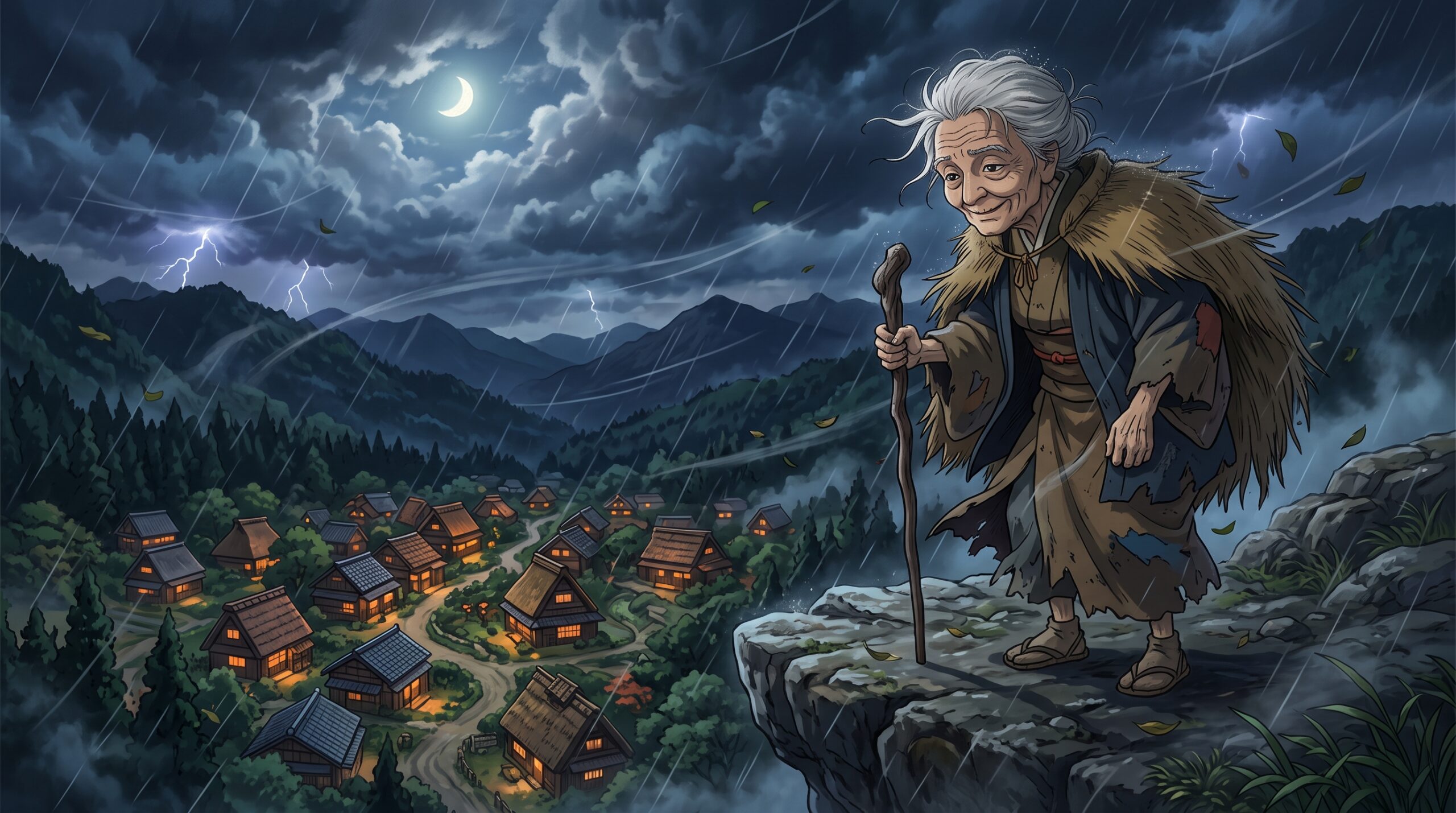
A mind-boggling amount of time passed. Fifty or perhaps sixty years went by, and those who knew Osen had grown entirely old. One year, on a night of a terrible storm so fierce that no one could walk outside, a white-haired old woman with an incredibly terrifying countenance slipped into Osen’s heavily barricaded childhood home. The family almost screamed in terror, but the old woman began to speak quietly. “Do not be alarmed. I am Osen, who was spirited away long ago.”
According to the old woman’s story, she had been married off to a creature of the mountains (a Mountain Man) and had lived deep in the mountains for all this time. Finally granted permission to “visit her earthly home,” she used the cover of the violent storm to come down from the mountain to see the nostalgic faces of her family. Despite her drastically changed appearance, the family rejoiced from the bottom of their hearts at Osen’s return. They stoked the hearth and prepared a lavish feast using all the bounty of the mountains and sea they had to welcome her.
However, to Osen, who had become a Mountain Hag, the food of the human village was far too salty and completely unpalatable. Her long, simple, and natural life in the mountains had fundamentally altered her sense of taste. After staying at her family home for about two days, she gently said, “I will come again,” and returned to the deep mountains, vanishing into the driving wind and rain. From then on, whenever there was a violent storm, the Mountain Hag would unfailingly visit the village. Out of fear, the villagers would lock their doors, saying, “The Mountain Hag comes on stormy days.” Yet, the morning after the hag departed, fresh mountain vegetables and mushrooms were always left quietly at the front door of her family’s house—a loving gift from the mountain.
Folktale Analysis: Fear of the Otherworld and Family Ties
“The Mountain Hag’s Visit Home” tackles “Kamikakushi” (spiriting away), a highly significant theme in Japanese folklore. In ancient Japan, the sudden disappearance of a person was interpreted as being “taken away by inhabitants of a different realm (the Otherworld).” The most striking aspect of this story is that the abducted young girl returns to the human world as a “terrifying Yamauba (Mountain Hag).”
Typically, Yamauba and mountain apparitions are depicted as malevolent entities that harm humans, but this story is entirely different. Though she appears as a frightening old woman, the human heart of “Osen,” full of love for her family, remains firmly intact. The detail where she finds the village feast “too salty” is a cruel reality check indicating she has fully become an inhabitant of the Otherworld (the mountain). Nevertheless, her actions of always appearing during storms and leaving mountain delicacies at her family’s doorstep prove that the resilient love and bonds of family transcend the uncrossable boundary between the human world and the Otherworld.
Connection to Japanese Culture: Coexistence with Nature and Mountain Gods
Much of Japan’s land is covered by rugged mountains and forests. Since ancient times, Japanese people have held reverence for mountains as “sacred places” and simultaneously feared them as “terrifying realms where the dead and spirits dwell.” As seen in Kunio Yanagita’s “Tono Monogatari” (Tales of Tono), legends of Mountain Men and Mountain Hags exist all over Japan.
The element of “appearing on stormy days” in this story strongly reflects the Japanese view of nature. The raw power of nature, such as storms and typhoons, symbolizes the untamed force of the mountain gods that humans cannot control. Osen arriving with the storm signifies that she has elevated into a part of nature’s power itself—a sacred mountain spirit. Furthermore, the mountain bounty she leaves behind represents “the blessings of nature.” The Japanese people have always coexisted with nature, fearing its threats while expressing deep gratitude for its abundant gifts. This folktale brilliantly encapsulates the spirit of Japanese animism, where terror and benevolence are two sides of the same coin.
To Our Readers
After many long years, a family member returns, having lost all traces of her former beauty and transformed into a terrifying figure. How would you welcome this “Mountain Hag”? Even if appearances and the worlds we live in change, the deep-rooted love for family remains eternal. Who did you think of while reading this bittersweet, heartwarming Japanese tale? Please share your thoughts and feelings with us!
Reference: Manga Nippon Mukashibanashi Database (The Mountain Hag’s Visit Home)
Click here for more Japanese Folktale Series
山のばばさの里がえり:失われた時と家族の絆
昔話のあらすじ:山のばばさの里がえり
昔々、青森の深い山奥に、おせんという名のとても可愛らしい娘が住んでいました。おせんは家族とともに蚕を飼い、穏やかで平和な日々を送っていました。初夏のある日、おせんは蚕の餌となる桑の葉を摘むため、一人で山の桑畑へと出かけました。しかし、夕暮れになってもおせんは帰ってきません。驚いた母親や村人たちは松明を掲げ、夜通し山の中を必死に探しまわりました。しかし、手ぬぐい一つ見つけることはできず、村人たちは口々に「山の神に魅入られたのだ、神隠しだ」と囁き合いました。
それから気が遠くなるような年月が流れました。五十年、あるいは六十年が経ち、おせんを知る者もすっかり年老いたある年のことです。外を歩くこともできないほどの恐ろしい嵐の夜、戸締りをしっかりとしていたはずのおせんの生家に、世にも恐ろしい形相をした白髪の老婆がすうっと入り込んできました。家族は悲鳴を上げそうになりましたが、老婆は静かに語り始めました。「驚かせてすまない。私は昔、神隠しに遭ったおせんだよ」
老婆の話によると、彼女は山のモノ(山男)のところに嫁入りし、長い間深い山奥で暮らしていたのだと言います。そしてついに「里帰りをしてもよい」という許しが出たため、懐かしい家族の顔を見るために、この激しい嵐に乗じて山を降りてきたのです。変わり果てた姿とはいえ、家族はおせんの帰還を心から喜びました。囲炉裏に火をくべ、ありったけの山の幸や海の幸を使って、精一杯のご馳走を作って彼女をもてなしました。
しかし、山の婆さまとなったおせんにとって、人間の里の食事はあまりにも塩辛く、口に合わないものでした。山での質素で自然そのままの生活が、彼女の味覚を完全に変えてしまっていたのです。彼女は二日ほど実家に滞在すると、「また来るからね」と優しく言い残し、激しい風雨に紛れるようにして再び深い山へと帰っていきました。それ以来、激しい嵐の日になると、山の婆さまは必ず里を訪れるようになりました。村人たちは「嵐の日には山の婆さまが来る」と恐れて戸を閉ざしましたが、婆さまが帰った翌朝の家の前には、いつも新鮮なキノコや山菜といった山の幸が、家族への贈り物としてそっと置かれていたのです。
昔話の考察:異界への恐れと家族の絆
「山のばばさの里がえり」は、日本の伝承において非常に重要なテーマである「神隠し」を扱った物語です。突然人が消える現象を、昔の日本人は「人間界とは異なる領域(異界)の住人に連れ去られた」と解釈しました。この物語の特筆すべき点は、連れ去られた少女が「恐ろしい姿の山姥(山の婆さま)」となって再び人間界に帰還するということです。
通常、山姥や山の怪異は人間に害をなす存在として描かれることが多いですが、この物語では全く異なります。見た目は恐ろしい老婆であっても、その心には家族を愛する「おせん」の人間性がしっかりと残っています。里のご馳走を「塩辛い」と感じる描写は、彼女がすでに完全に異界(山)の住人になってしまったことを示す残酷な事実です。しかし、嵐の日に必ず現れ、家族の家の前に山の幸を残していくという行動は、異界と人間界という決して交われない二つの世界を越えた、強靭な家族の愛と絆を証明しています。
日本文化との関連:自然との共生と山の神
日本の国土の多くは険しい山林で覆われており、古来より人々は山を「神聖な場所」であると同時に「死者や精霊が住む恐ろしい場所」として畏敬の念を抱いてきました。柳田国男の『遠野物語』にも見られるように、山男や山姥の伝承は日本全国に存在します。
この物語に登場する「嵐の日に現れる」という要素は、日本の自然観を色濃く反映しています。嵐や台風という自然の猛威は、人間には制御できない山の神の荒ぶる力の象徴です。おせんが嵐とともに現れることは、彼女がすでに自然の力の一部、すなわち神聖な山の精霊に昇華したことを意味しています。そして、残された山の幸は「自然からの恵み」そのものです。日本人は自然の脅威を恐れながらも、同時に自然がもたらす豊かな恵みに感謝し、共生してきました。この昔話は、恐怖と恩恵が表裏一体となった日本の自然崇拝(アニミズム)の精神を見事に表しています。
読者の皆様へ
長い歳月を経て、かつての美しい面影を完全に失い、恐ろしい姿となって帰ってきた家族。あなたなら、この「山の婆さま」をどう迎え入れますか?見た目や住む世界が変わってしまっても、心の奥底にある家族への愛は永遠に変わらない。この切なくも心温まる日本の物語を読んで、あなたは誰の顔を思い浮かべましたか?ぜひ、あなたの考えや感想を教えてください。
コメント