1. An Unexpected Visitor Falling from the Sky
Once upon a time, on a lonely mountain pass deep in the rugged mountains of Japan, there stood a small soba (buckwheat noodle) shop. The shop was run entirely by a beautiful young woman who had no family. Surrounded by the deep silence of nature, she worked hard every day making handmade noodles to heal the fatigue of passing travelers. The savory aroma of the dashi (soup stock) was the only oasis on that mountain trail.
One summer day, the unpredictable mountain weather suddenly changed. Pitch-black clouds quickly covered the sky, swallowing the surroundings in darkness, accompanied by a freezing gust of wind. Soon, with deafening roars of thunder—”Rumble! Crash!”—a violent thunderstorm began. Terrified by the terrifying sound, the girl hastily locked the shop’s doors and trembled in the corner of her room.
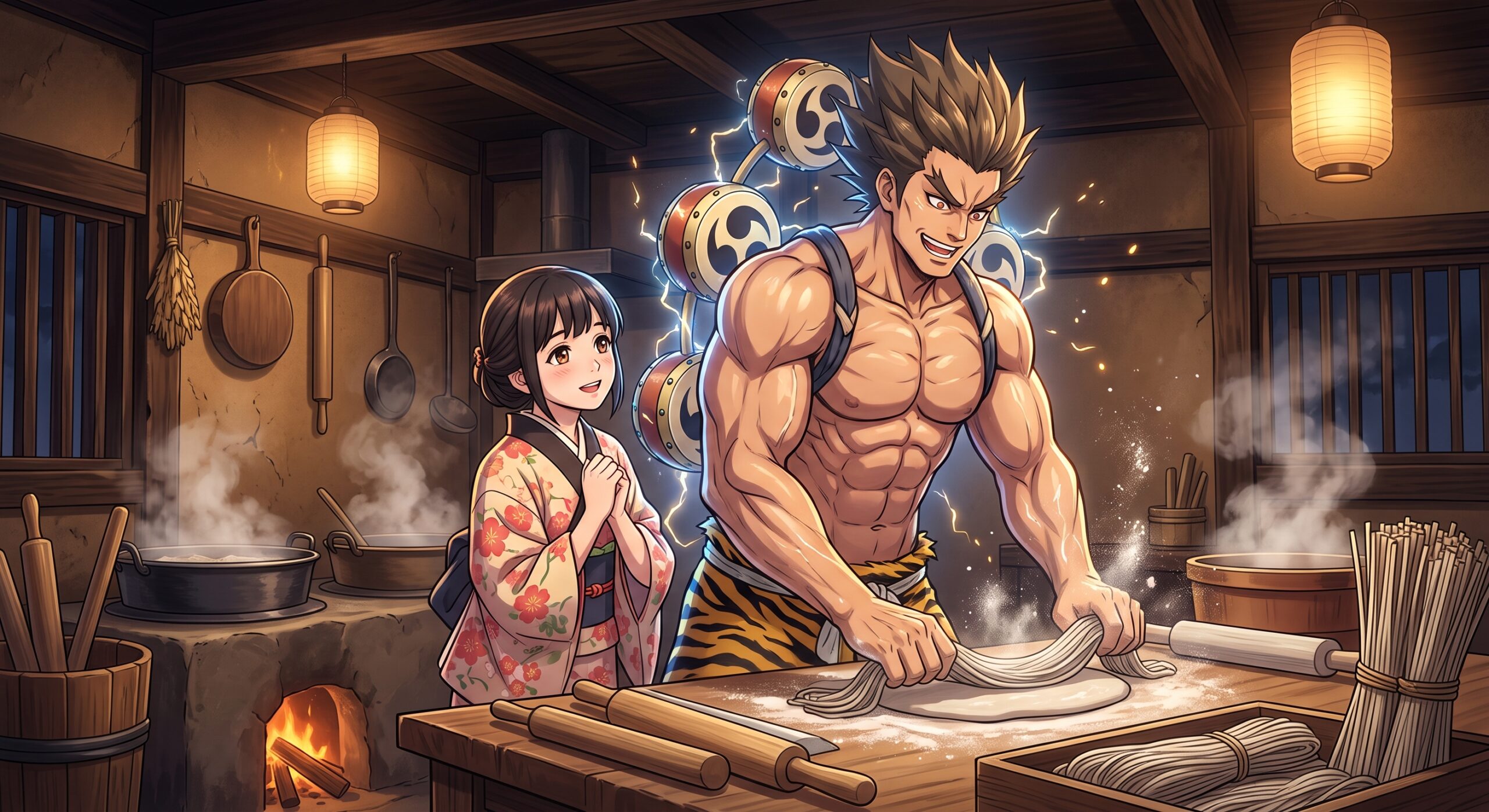
At that exact moment, with a massive earthquake-like thud that shook the entire house, a real Kaminari-sama (Thunder God) fell straight from the sky! He was a fearsome deity wearing a tiger-skin loincloth and carrying a ring of thunder drums on his back. However, as the Thunder God stood up, he stared intently at the shop’s noren (curtains) swaying in the wind. It seemed the savory smell of the dashi had completely distracted him, and he suddenly felt an unbearable craving for soba noodles.
The Thunder God violently banged on the door, shouting, “Feed me soba!” The girl was half-dead from fear, thinking, “If I refuse, he might eat me alive.” Trembling, she invited the terrifying god inside and served him her special, piping-hot soba noodles.
Slurp, slurp! The Thunder God devoured the noodles with great enthusiasm and instantly got into a fantastic mood. Looking up, he noticed the cute girl trembling all alone. When he asked, “Don’t you have a father or a mother?” she explained her lonely circumstances.
Hearing this, the Thunder God felt deep pity for her—or perhaps he was simply captivated by her beauty and her amazing cooking. He made an astonishing proposal: “Will you make me your husband and let me marry into this shop?” It was a sudden marriage proposal from a divine being. Too terrified to refuse, the girl instinctively nodded in agreement.
Thus, the god of the sky became the husband of a humble mountain soba shop. With his incredible superhuman strength, the Thunder God kneaded the most exceptional soba dough. Rumors quickly spread across the villages: “There is a delicious soba shop run by a Thunder God!” Customers flooded in from every direction, and the once-lonely shop became incredibly prosperous every single day.
2. Visits from the Moon and Sun, and a Brilliant Wordplay
The rumors of this booming business eventually reached the heavens. One night, the Moon, who illuminates the night sky, came down saying, “I want to try this Thunder God’s soba.” The Moon happily ate three bowls, paid “30 mon” (traditional currency), and returned to the night sky highly satisfied.
Next to hear the rumor was the Sun, who lights up the day. The Sun visited the shop and, with a monstrous appetite, asked for refill after refill, ultimately eating 30 bowls of soba! However, the payment the Sun left on the table was a mere “1 mon.”
A single mon for 30 bowls was a massive loss. Flustered, the Thunder God stopped him, crying out, “Mr. Sun, 1 mon is far too cruel!” But the Sun calmly replied with a question: “How much did Mr. Moon pay?” “He paid 30 mon,” answered the Thunder God. “Exactly,” said the Sun. “If the Moon (Tsuki) pays 30 mon, shouldn’t the Sun (Hi) pay 1 mon?”
Hearing this, the Thunder God crossed his arms and thought deeply. “I see! A month (Tsuki) has 30 days. If the Moon is 30, then the Sun (Hi / Day) being 1 makes perfect mathematical sense! Alright, I’m convinced! Thank you for your patronage!” The good-natured Thunder God was completely tricked by the Sun’s clever pun. However, the Thunder God wasn’t the type to sweat the small stuff. He continued to work hard for his beloved wife, and the soba shop flourished forever.
3. Deep Analysis: The Japanese Mindset of Coexisting with Fearsome Nature
This story is a type of “Irui Konin-tan” (tales of marriage between humans and non-humans), a common motif in Japanese folklore. Usually, such stories (like the Crane Wife or the Snow Woman) end in a tragic separation. However, “The Thunder God Who Married into a Soba Shop” is entirely different. His true identity is known from the start, and the story remains humorous and heartwarming until its happy ending.
The greatest charm of this tale is the massive gap between a terrifying natural force and a hardworking, apron-wearing, loving husband. By bringing a supreme god down to earth as a somewhat goofy and gullible character, the story brilliantly showcases the resilience and humor of common people. It also offers a fascinating perspective: even mighty gods cannot resist the allure of “delicious food” and a “warm family.”
4. Cultural Connection: The Traditional Calendar and Agricultural Gods
To fully appreciate this folktale, one must understand the traditional Japanese lunar calendar (Taiin-Taiyoreki). The Sun’s riddle, equating “Moon = 30 mon” and “Sun = 1 mon,” is rooted in the Edo-period commoner’s knowledge that one lunar month consisted of about 30 days. This sophisticated wordplay using homophones—Tsuki (Moon/Month) and Hi (Sun/Day)—is a proud symbol of Japan’s rich linguistic culture.
Furthermore, we must note the deep connection between thunder and Japanese culture. In ancient Japan, thunder was called “Kami-nari” (the sounding of the gods) and was deeply feared. At the same time, years with many thunderstorms were believed to yield rich rice harvests, and lightning was called “Inazuma” (the spouse of the rice plant). Thus, the Thunder God is not just a god of destruction, but an agricultural god bringing rain and prosperity. The fact that the Thunder God brought ultimate prosperity to the shop beautifully reflects the dual nature of “fear” and “gratitude” that the Japanese hold toward nature.
5. What Would You Do? A Question to the Reader
The adaptability of the young girl, who accepted a terrifying god of nature into her family and thrived alongside him, is truly astonishing. If a fearsome deity suddenly fell from the sky in front of you and said, “Marry me!”, what would you do? Would you run away in terror? Or would you, like the girl, tame him with a delicious home-cooked meal?
A gullible, hardworking Thunder God and his strong, supportive wife. This story teaches us the power of turning even terrifying troubles into laughter and everyday happiness. Please let us know what you felt after reading this story, and how you would have answered the Sun’s tricky riddle!
6. References and Links
- External Reference: Manga Nihon Mukashibanashi Database (Japanese)
- Internal Link: Japanese Folktale Series
- 1. An Unexpected Visitor Falling from the Sky
- 2. Visits from the Moon and Sun, and a Brilliant Wordplay
- 3. Deep Analysis: The Japanese Mindset of Coexisting with Fearsome Nature
- 4. Cultural Connection: The Traditional Calendar and Agricultural Gods
- 5. What Would You Do? A Question to the Reader
- 6. References and Links
- 日本の昔話「そば屋にむこ入りした雷」〜空から落ちてきた雷神と人間のユーモラスな物語〜
日本の昔話「そば屋にむこ入りした雷」〜空から落ちてきた雷神と人間のユーモラスな物語〜
① 空から降ってきた予期せぬ訪問者
昔々、日本の険しい山奥にある寂しい峠道に、一軒の小さなそば屋がありました。その店を切り盛りしていたのは、身寄りのない一人の若く美しい娘です。大自然の静寂に包まれた峠で、彼女は毎日一生懸命にそばを打ち、道行く旅人の疲れを癒やしていました。そばつゆの香ばしいダシの匂いが、峠における唯一のオアシスでした。
ある夏の日のことです。山の天気は変わりやすく、にわかに真っ黒な雲が空を覆い尽くしました。周囲はあっという間に闇に包まれ、冷たい突風が吹き荒れます。やがて、「ゴロゴロ!ピシャーン!」という耳をつんざくような轟音とともに、激しい雷雨が降り始めました。恐ろしい雷の音に怯えた娘は、急いで店の戸締まりをし、部屋の隅で小さく震えていました。
その時です。「ドスーン!」という家全体を揺るがすような凄まじい地響きとともに、なんと空から本物の雷様(雷神)が落ちてきたのです。トラの毛皮のふんどしを締め、背中には雷太鼓を背負った、恐ろしい姿の神様です。しかし、雷様は立ち上がると、風に揺れるそば屋の暖簾(のれん)をじっと見つめました。どうやらダシの匂いに誘われ、無性にそばが食べたくなってしまったようです。
雷様は「そばを食わせろ!」と激しく戸を叩きました。娘は生きた心地がしませんでしたが、断れば頭から食べられてしまうかもしれないと恐怖に震えながら、雷様を店内に招き入れ、熱くて美味しい特製のそばを振る舞いました。
ズズッ、ズズズッ!と豪快な音を立ててそばを平らげた雷様は、すっかりご機嫌になりました。ふと目の前を見ると、そこには一人ぼっちで震えている可憐な娘がいます。雷様が「お前、おっとうやおっかあ(両親)はいないのか?」と尋ねると、娘は孤独な身の上を語りました。
それを聞いた雷様は、娘を不憫に思ったのか、彼女の美しさと美味しいそばにすっかり惚れ込んでしまったのか、驚くべき提案をします。「俺をこの店の婿(夫)にしてくれないか」。神様からの突然のプロポーズです。娘は恐ろしさのあまり断ることもできず、思わず頷いてしまいました。
こうして、空の神様である雷様は、峠のそば屋に婿入りすることになりました。強靭な腕力を持つ雷様が打つそばは絶品で、たちまち「雷様が打つ美味しいそば屋がある」という噂が村中に広まりました。あっちの村からもこっちの村からも客が押し寄せ、寂しかった峠の店は連日大繁盛するようになったのです。
月と太陽の訪問、そして見事な言葉遊び
この大繁盛の噂は、なんと天界にまで届きました。ある夜、夜空を照らすお月様が「雷の打つそばを一度食べてみたい」と空から降りてきました。お月様はそばを美味しそうに3杯も平らげると、代金として「30文」を支払い、満足げに夜空へと帰っていきました。
続いてその噂を聞きつけたのは、昼間を照らすお日様(太陽)です。お日様も店を訪れ、凄まじい食欲で次から次へとそばをおかわりし、なんと30杯も食べてしまいました。しかし、お日様がテーブルに置いた代金は、たったの「1文」でした。
さすがに1文では大赤字です。慌てた雷様が「お日様、いくらなんでも1文はひどいじゃありませんか!」と呼び止めると、お日様は涼しい顔でこう問い返しました。「お月様はいくら払っていった?」「30文です」「そうだろう。月に30文なら、日に1文ではないか?」
これを聞いた雷様は腕組みをして考え込みました。「なるほど、1ヶ月(月)は30日ある。お月様が30なら、お日様(日)は1で計算が合うな!よし、納得だ!毎度あり!」お人好しの雷様は、お日様の巧妙な言葉遊び(ダジャレ)にまんまと騙されてしまったのです。しかし、雷様はそんな小さなことを気にするような神様ではありません。その後も愛する妻のために一生懸命そばを打ち続け、店はいつまでも末長く繁盛しました。
② 昔話の深い考察:恐ろしい自然と共生する日本人の精神性
この物語は、日本の民話に多く見られる「異類婚姻譚(いるいこんいんたん:人間と人間以外の存在が結ばれる物語)」の一種です。通常、鶴の恩返しや雪女のように、異類との結婚は正体がバレるなどの理由で悲劇的な別れを迎えることが多いのが特徴です。しかし、この「そば屋にむこ入りした雷」は、正体が最初から明かされているうえに、悲劇どころか終始ユーモラスで心温まるハッピーエンドを迎えます。
雷神という本来であれば命を脅かす恐ろしい自然の驚異が、人間の娘に惚れ込み、エプロンをかけて真面目に労働するというギャップが、この物語の最大の魅力です。絶対的な権力を持つ神様を、どこか間抜けでお人好しなキャラクターに引きずり下ろすことで、庶民の逞しさとユーモアのセンスを見事に表現しています。また、神様であっても「美味しい食事」と「温かい家族」には抗えないという、非常に人間臭い一面を描いている点も興味深い考察のポイントです。
③ 日本文化との関連:暦の概念と農耕神としての雷
この昔話を読み解く上で欠かせないのが、日本の伝統的な「太陰太陽暦(旧暦)」の知識です。お日様が使った「月(1ヶ月)=30文、日(1日)=1文」というトンチは、旧暦において1ヶ月が約30日で計算されていたという当時の庶民の生活感覚に根ざしています。月(Moon)と月(Month)、日(Sun)と日(Day)の同音異義語を使った高度な言葉遊びは、江戸時代の落語や狂言にも通じる、日本の豊かな言語文化の象徴です。
さらに、「雷」と「日本文化」の深い関わりにも注目しなければなりません。古代日本では、雷は「神鳴り(神の鳴らす音)」と呼ばれ、畏怖の対象でした。同時に、雷が多い年は稲がよく育つとされ、雷光は「稲妻(稲の夫)」と呼ばれました。つまり、雷は恐ろしい破壊神であると同時に、雨を降らせて豊作をもたらす「農耕神」でもあったのです。雷様がそば屋を繁盛(豊作・商売繁盛)させたという結末は、日本人が自然現象に対して抱いてきた「恐れ」と「感謝」の二面性を見事に表しています。
④ あなたならどうする?昔話からの問いかけ
大自然の驚異である雷神を家族として受け入れ、共に力強く生きていった娘の適応力には驚かされます。もし、あなたの目の前に空から恐ろしい神様が落ちてきて、「結婚してくれ!」と言い出したら、あなたならどうしますか?恐怖で逃げ出しますか?それとも、娘のように美味しい食事を出して手懐けてしまいますか?
お人好しで働き者の雷様と、彼を支えるしっかり者の妻。この物語は、恐ろしいトラブルすらも笑いと日常に変えてしまう力強さを私たちに教えてくれます。ぜひ、あなたもこの物語から感じたことや、「自分ならお日様にどう言い返すか」を考えてみてください。

コメント