Japan is home to countless myths and folktales that have been passed down from ancient times to the present day. These stories are not just mere entertainment; they serve as a crucial key to deeply understanding the Japanese mindset, their relationship with nature, and their unique culture. In our Japanese Folktale Series, we bring these profound Japanese stories to readers all around the world.
Today, we introduce a thrilling folktale from Tanegashima, Kagoshima Prefecture, in southern Japan: “The Demon and the Young Man” (Oni to Wakamono). It features a breathtaking chase between a terrifying giant monster—the “Oni” (demon)—and a young hunter. Hidden behind this action-packed story is remarkable wisdom about how Japanese people have historically interacted with nature and protected themselves from disaster. Let’s step into the mystical Japanese forest together.
- A Terrifying Chase: The Japanese Folktale “The Demon and the Young Man”
- Deep Analysis of the Tale: Why Did the Strongest Monster Fear “Mere Plants”?
- Deep Connection to Japanese Culture: “Tango no Sekku” and Evil-Warding Traditions
- How Can You Apply This? What is Your Modern “Evil Ward”?
- 神秘の国、日本へようこそ:語り継がれる魅惑の昔話
- 恐怖の追走劇:日本の昔話「鬼と若者」
- 物語の深い考察:なぜ最強のモンスターが「ただの植物」を恐れたのか?
- 日本文化との深い繋がり:「端午の節句」と魔除けの風習
- あなたはどう生かす?現代の「魔除け」とは
A Terrifying Chase: The Japanese Folktale “The Demon and the Young Man”
Once upon a time, on the fifth of May, when the essence of spring was still thick in the air, a brave young man from a certain village took his beloved dog and went hunting deep in the forest. However, for some reason, the forest that day was eerily silent. Not a single chirp of a bird could be heard. Thinking, “How strange,” the young man nevertheless pressed deeper into the woods in search of prey.
After a while, a rabbit leaped out from the bushes. Just as the young man shot the rabbit with his bow and arrow and ran toward it, a massive, muscular, naked giant suddenly dropped down from the trees above. The giant had sharp horns on its head, and its eyes glared terrifyingly. It was a terrifying Japanese monster—an Oni. The demon snatched the young man’s hunted rabbit and swallowed it whole in one gulp.
This was the reason all the forest animals were hiding in fear. Meeting the terrifying gaze of the demon, the young man sensed mortal danger and sprinted back the way he came as fast as his legs could carry him. Roaring like an earthquake, the demon chased after him at blistering speed. The young man ran desperately, but he tripped over a rock, was thrown into the air, and tumbled into a field overgrown with Yomogi (Mugwort).
Just as the young man closed his eyes, thinking, “I’m done for, I’m going to be eaten!” something strange happened. The demon just paced around the edge of the Mugwort field, refusing to step inside. Listening closely to the demon’s muttering, the young man heard it say, “Fire, it’s fire! He is in the fire!” To the demon’s eyes, the uniquely scented leaves of the Mugwort looked like roaring flames. Seizing the opportunity while the demon hesitated, the young man burst out of the field and ran with all his might.
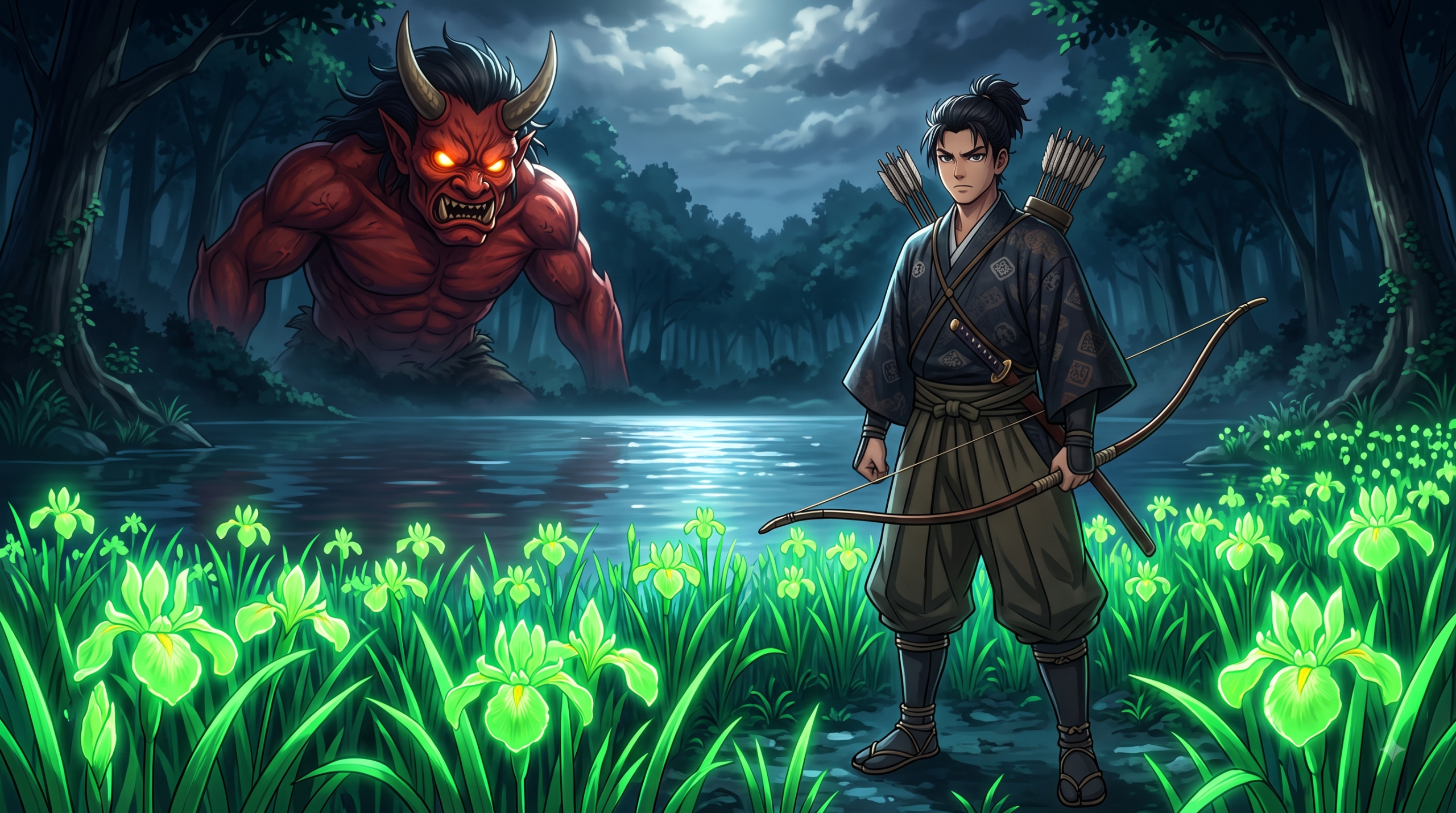
“Wait!” the enraged demon bellowed, giving chase once more. Finally, near a lake where the entrance to his village was visible, the young man tripped again. This time, he fell into a dense cluster of Shobu (Iris) plants. Despairing, the young man thought it was the end, but the demon stopped dead in its tracks again. “Swords! There are swords everywhere! I can’t get through!” To the demon, the sharp, pointed leaves of the Iris looked like countless deadly blades, filling it with terror.
Acting quickly, the young man grabbed handfuls of Iris leaves in both hands and faced the demon, shouting, “These are swords! Watch out for the swords!” Terrified of the Iris, the demon couldn’t attack, and the young man safely made it back to his village. He immediately placed Iris leaves at the doorway of his home and taught everyone in the village to do the same. Seeing the entire village protected by Irises, the demon grew dizzy and frightened. It slinked back into the deep forest and was never seen again.
Deep Analysis of the Tale: Why Did the Strongest Monster Fear “Mere Plants”?
This story is not just a simple action tale. What we must focus on is that the immensely powerful “Oni” was repelled not by swords or magic, but by ordinary plants like Mugwort and Iris. In Japanese folklore, Oni often symbolize plagues, natural disasters, and uncontrollable fears beyond human handling.
Ancient Japanese people held animistic beliefs (rooted in Shinto), believing that spirits dwelled in everything in the natural world. In particular, plants with strong fragrances or medicinal properties, like Mugwort and Iris, were believed to possess immense spiritual power to ward off evil and purify spaces. The depiction of the demon seeing Mugwort as “fire” and Iris as “swords” symbolically expresses just how much of a threat nature’s vitality and purifying power are to disasters (the demon). The approach of protecting oneself not by defeating the demon with brute force, but by borrowing the power of nature and maintaining harmony, is a very distinctly Japanese spirituality.
Deep Connection to Japanese Culture: “Tango no Sekku” and Evil-Warding Traditions
The fact that this story explicitly takes place on “May 5th” holds crucial cultural significance. In modern Japan, May 5th is known as “Children’s Day,” but historically, it was an important traditional event called “Tango no Sekku.”
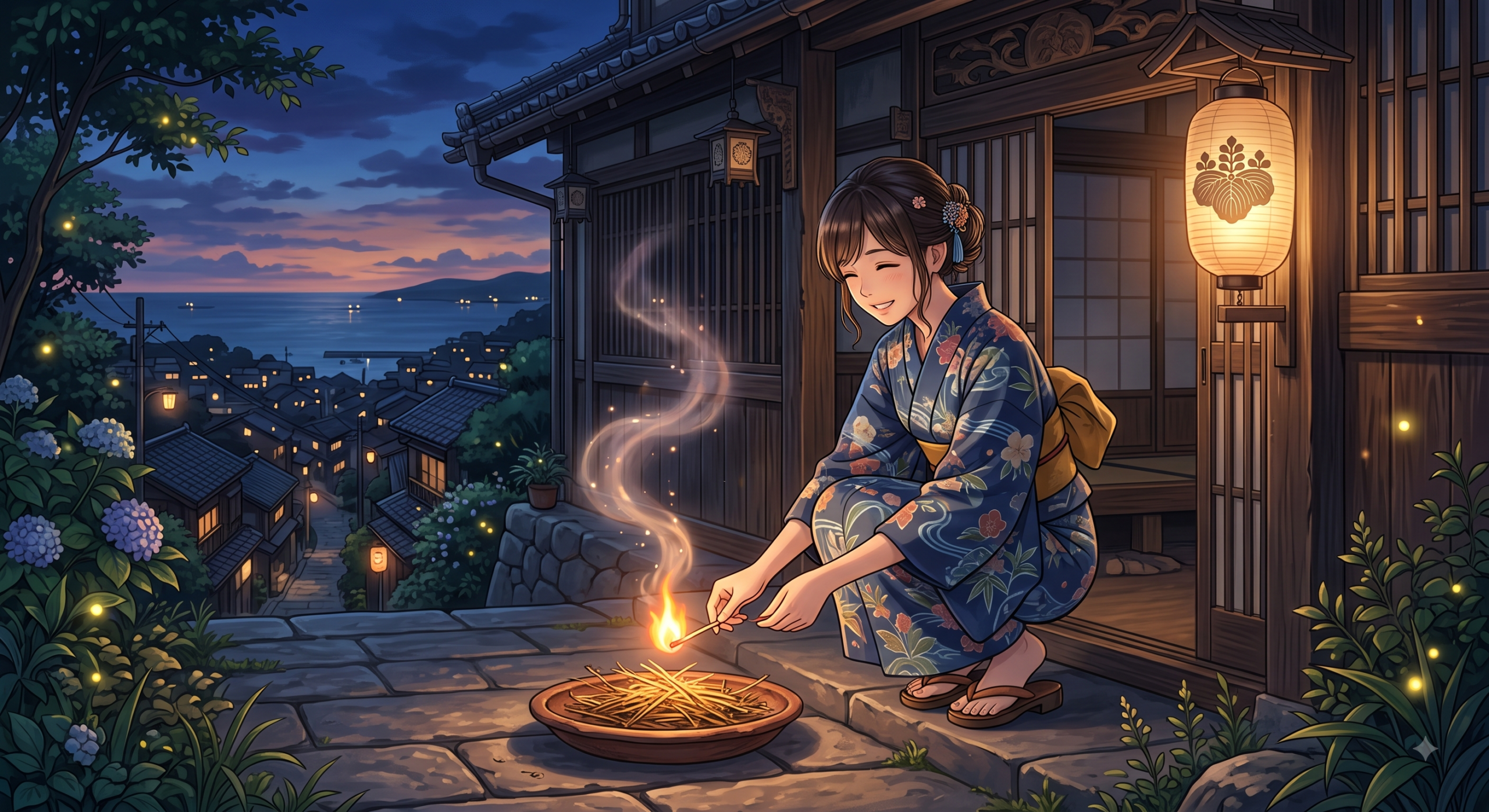
Since ancient times, the changing of seasons during this time of year was thought to be a period when people were susceptible to illnesses and disasters. Therefore, people conducted rituals to ward off evil spirits using strong-scented Iris and Mugwort. Even today in Japan, the custom of taking a “Shobu-yu” (an Iris bath), where Iris leaves are floated in hot water on May 5th, remains. Furthermore, because the pronunciation of Iris (Shobu) is identical to the words for “valuing martial arts” (尚武) and “victory or defeat” (勝負), it became firmly established as an event to pray for the strong and healthy growth of boys.
This folktale has been passed down to explain the origins of why Irises are displayed on May 5th in an entertaining and educational way. If you want to know more about traditional Japanese seasonal festivals and events, please check out the official Children’s Day in Japan page by the Japan National Tourism Organization (JNTO).
How Can You Apply This? What is Your Modern “Evil Ward”?
Through the story of “The Demon and the Young Man,” we hope you felt the beautiful Japanese wisdom of borrowing nature’s power to ward off disaster. Instead of panicking against an overwhelmingly powerful demon, the young man made the most of the “blessings of nature” around him to save himself and his village.
In our modern lives, we too are sometimes suddenly attacked by “demons” such as stress, hardship, and anxiety. When that happens, what do you do? What is the “Iris” or “Mugwort” in your life that calms your mind and protects you from difficulties? It might be strong bonds with your family, a hobby or music you can immerse yourself in, or taking time to walk quietly in nature.
What are your personal tools for protecting your mind? Please let us know in the comments how you felt reading this story and how you would face the “demons” in your own life!
神秘の国、日本へようこそ:語り継がれる魅惑の昔話
日本には、古代から現代へと語り継がれる数多くの神話や民間伝承が存在します。これらの物語は、単なるエンターテインメントにとどまらず、日本人の心や自然観、そして独自の文化を深く理解するための重要な鍵となります。Japanese Folktale Seriesでは、そんな奥深い日本の物語を世界中の皆様にお届けしています。
今回ご紹介するのは、日本の南部に位置する鹿児島県(種子島)に古くから伝わるスリリングな昔話、「鬼と若者(The Demon and the Young Man)」です。巨大で恐ろしいモンスターである「鬼」と、一人の若者の息を呑むような追走劇。この物語の背後には、日本人がどのように自然と向き合い、厄災から身を守ってきたのかという驚くべき知恵が隠されています。さあ、神秘的な日本の森へ一緒に足を踏み入れましょう。
恐怖の追走劇:日本の昔話「鬼と若者」
むかしむかし、春の気配が色濃く残る五月五日のことでした。ある村に住む一人の勇敢な若者が、愛犬を連れて深い森へと狩りに出かけました。しかし、その日の森はどういうわけか気味が悪いほど静まり返っており、小鳥のさえずりひとつ聞こえません。「妙なこともあるものだ」と不思議に思いながらも、若者は獲物を求めて森の奥深くへと進んでいきました。
しばらくすると、茂みから一匹の兎が飛び出してきました。若者が弓矢で兎を射止め、駆け寄ろうとしたその瞬間です。頭上から突如として、巨大で筋骨隆々の赤裸の大男が飛び降りてきました。男の頭には鋭い角が生え、その目は恐ろしくギラギラと輝いています。日本の恐るべき怪物、「鬼」でした。鬼は若者の獲物である兎を掴み取ると、一息に丸呑みにしてしまいました。
森の動物たちが怯えて隠れていた理由はこれだったのです。恐ろしい鬼と目が合った若者は、命の危険を感じて一目散に元来た道を逃げ出しました。背後からは地鳴りのような咆哮を上げながら、鬼が猛スピードで追いかけてきます。若者は必死に走りましたが、石につまずいて宙に放り出され、ヨモギ(Mugwort)が生い茂る草原に転げ落ちてしまいました。
「もう駄目だ、食われる!」と若者が目を閉じた時、不思議なことが起きました。鬼はヨモギの草原の周りをウロウロとするだけで、中に入ってこようとしません。鬼がぶつぶつと呟く声に耳を澄ますと、「火だ、火だ、火の中にいる」と言っています。なんと、鬼の目には独特の香りを持つヨモギの葉が、燃え盛る炎に見えていたのです。鬼が躊躇している隙をついて、若者は再び全力で走り出しました。
「待て!」と怒り狂った鬼が再び追いかけてきます。ついに村の入り口が見えた湖のほとりで、若者は再び足をもつれさせ、今度は菖蒲(しょうぶ / Iris)の群生の中に転げ落ちてしまいました。絶望した若者でしたが、またしても鬼はピタリと足を止めました。「刀だ、刀がいっぱいだ、どうにもならん」。鬼の目には、剣のように鋭く尖った菖蒲の葉が無数の刀に見え、恐れをなしていたのです。
若者はとっさに菖蒲の葉を両手に掴み、「それ刀だぞ!刀だぞ!」と叫びながら鬼に立ち向かいました。菖蒲を恐れた鬼は手出しができず、若者は無事に村へと生還しました。若者はすぐに家の戸口に菖蒲を刺し、村中の人々にも同じようにするよう教えました。村中に張り巡らされた菖蒲を見た鬼は、「目が回る、恐ろしい…」と怯え、すごすごと深い森の奥へと逃げ帰り、二度と姿を見せることはありませんでした。
物語の深い考察:なぜ最強のモンスターが「ただの植物」を恐れたのか?
この物語は単なるアクションストーリーではありません。ここで私たちが注目すべきは、強大な力を持つ「鬼」が、剣や魔法ではなく「ヨモギ」や「菖蒲」といったありふれた植物によって退けられたという点です。日本の民間伝承において、鬼はしばしば疫病や自然災害、そして人間の手に負えない恐怖の象徴として描かれます。
古代の日本人は、自然界のすべてのものに魂が宿るというアニミズム(神道)の考えを持っていました。特に、ヨモギや菖蒲のような香りの強い植物や、薬効のある植物には、邪気を払い、場を清める強力な霊力が宿っていると信じられていたのです。鬼にはヨモギが「火」に、菖蒲が「刀」に見えたという描写は、自然の持つ生命力と浄化の力が、災厄(鬼)にとってどれほど脅威であるかを象徴的に表現しています。武力で鬼を倒すのではなく、自然の力を借りて調和を保ちながら身を守るというアプローチは、非常に日本的な精神性と言えるでしょう。
日本文化との深い繋がり:「端午の節句」と魔除けの風習
この物語の冒頭で「五月五日」という日付が明確に示されていることには、極めて重要な意味があります。現代の日本において、五月五日は「こどもの日」として知られていますが、古くは「端午の節句(Tango no Sekku)」と呼ばれる重要な伝統行事の日でした。
季節の変わり目であるこの時期は、古来より病気や災厄が起こりやすいと考えられていました。そのため、人々は強い香りを持つ菖蒲やヨモギを用いて、邪気を払う儀式を行ってきたのです。現在でも日本では、五月五日にお湯に菖蒲の葉を浮かべた「菖蒲湯(Shobu-yu)」に入る習慣が残っています。また、菖蒲(Shobu)という発音が、武を尊ぶ「尚武」や、勝ち負けを意味する「勝負」と同じであることから、特に男の子が強く健やかに育つことを願う行事として定着しました。
この昔話は、なぜ五月五日に菖蒲を飾るのかという風習の起源を、面白く、そして教訓的に伝えるために語り継がれてきたものなのです。日本の伝統的な節句や行事についてさらに詳しく知りたい方は、日本政府観光局(JNTO)のChildren’s Day in Japanの公式ページもぜひご参照ください。
あなたはどう生かす?現代の「魔除け」とは
「鬼と若者」の物語を通じて、自然の力を借りて厄災を退けるという日本の美しい知恵を感じていただけたでしょうか。若者は、圧倒的な力を持つ鬼に対してパニックに陥ることなく、身の回りにある「自然の恵み」を最大限に生かして自分と村を救いました。
現代を生きる私たちの人生にも、ストレス、困難、不安といった「鬼」が突然襲いかかってくることがあります。そんな時、あなたはどうしますか? あなたにとって、心を落ち着かせ、困難から身を守ってくれる「菖蒲」や「ヨモギ」のような存在は何でしょうか? それは家族との強い絆かもしれませんし、夢中になれる趣味や音楽、あるいは大自然の中を静かに散歩する時間かもしれません。
あなた自身の心を守る「魔除け」のツールは何ですか? この物語を読んで、あなたがどう感じたか、あなたならどうやって自分の中の「鬼」に立ち向かうか、ぜひコメント欄であなたの考えを教えてください!

コメント