The Story of “The Bamboo Shoot That Reached the Sky”
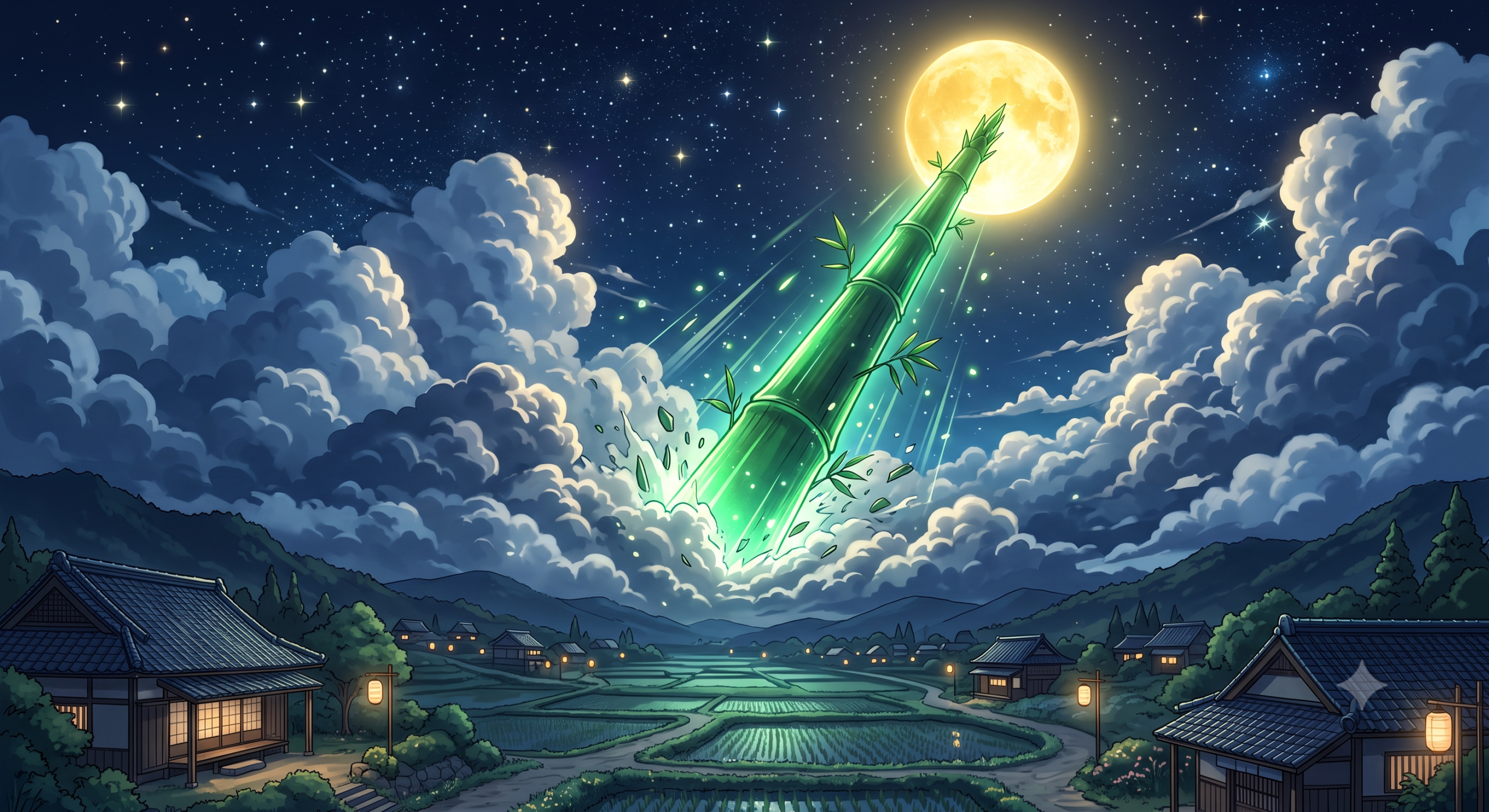
Once upon a time, in a village surrounded by the rich nature of Japan, there lived a kind-hearted old man and his wife. One peaceful day, as they were taking a warm nap in the sunlight on the wooden porch of their house, something miraculous happened. A single, tiny bamboo shoot poked its head out from right beneath the floorboards.
Astonishingly, this was no ordinary plant. It grew at an incredible speed right before their eyes, surpassing the roof, piercing through the clouds, and in the blink of an eye, reaching all the way to the heavens. Even when looking up at the sky, the tip of the bamboo shoot was entirely hidden beyond the clouds.
Filled with burning curiosity, the old man wondered, “Just how far does this bamboo shoot go?” and decided to climb it himself to find out. He began his ascent early in the morning, climbing for hours on end without rest. When he finally reached the very top of the bamboo shoot, he found himself in a beautiful, glowing world—the Moon.
As the old man gazed around this unknown lunar world, he spotted a magnificent mansion in the distance. A brilliantly glowing figure approached him and said, “I am the Star Child. Let me guide you to the mansion, old man.” Led inside, the old man was greeted by an incredibly beautiful Moon Princess. She welcomed him warmly, treating him to a lavish feast unlike anything he had ever seen, accompanied by elegant and joyful dances.
By evening, the old man, having thoroughly enjoyed the lunar world, returned to the earth, where his wife was eagerly waiting. Upon hearing the wonderful tales of the moon, the old woman passionately pleaded, “I absolutely must go there too!” The kind old man agreed to take her with him the next day.
However, the problem was how to carry his wife, who could not climb on her own. The old man came up with a plan to put her inside a large, sturdy leather bag, holding the opening of the bag firmly in his mouth as he climbed. “Grandma, if I open my mouth while climbing, you will fall straight down. Therefore, you must promise absolutely not to speak to me,” the old man warned her sternly before they set off.
At first, everything went smoothly. But halfway up the bamboo shoot, the old woman, confined in the dark bag, became bored and overwhelmingly curious. Unable to hold back, she started talking incessantly to the old man from inside the bag. Unable to open his mouth to reply, the old man desperately grunted “Mhm, mhm” in the back of his throat to acknowledge her.
He continued his silent, arduous climb with the heavy bag in his mouth. Finally, the very moment he spotted the top of the bamboo shoot and the lunar world, it happened. Overwhelmed with a sense of accomplishment and sheer joy, the old man completely forgot his promise and carelessly opened his mouth to shout.
“Grandma, we’ve arrived!”
The moment those words left his lips, the leather bag containing his wife slipped entirely from his mouth and plummeted straight down, plunging into the vast depths back to earth. The panicking old man rushed down as fast as he could, but his wife was nowhere to be found.
However, at the base of the buckwheat field near where she must have fallen, the roots and stems of the plants were dyed a deep, vibrant red. Legend has it that they were stained red by the falling old woman’s blood.
An In-Depth Analysis of the Folktale
This folktale, “The Bamboo Shoot That Reached the Sky,” is highly unique as it sharply shifts from a fantastical adventure in the first half to a deeply shocking and tragic conclusion. Why was such a sorrowful ending prepared for this story?
The ultimate turning point lies in the “old woman’s lack of patience” and the “old man’s momentary lapse of focus.” The old woman broke the absolute rule of silence—a promise that acted as her very lifeline—while the old man lost his concentration right on the verge of success. This carries a strong moral lesson: human weakness and carelessness can invite irreversible tragedies.
Furthermore, the depiction of the buckwheat roots turning red at the end is a mythological approach known as an “etiological myth” (a story explaining the origins of natural phenomena). By connecting the biological fact that buckwheat stems are red to a human tragedy, the story applies a powerful narrative to nature, ensuring the tale is firmly etched into the memories of future generations.
Cultural Connections and Interpretations in Japan
This narrative allows us to deeply understand traditional Japanese perspectives on nature and spirituality. First is the “bamboo.” Bamboo is an essential part of the Japanese landscape, and its growth speed is astonishing. For ancient Japanese people, the vitality of a plant that could grow tens of centimeters in a single day was considered mystical, often revered as a sacred bridge connecting heaven and earth. The famous “Tale of the Bamboo Cutter” (Princess Kaguya) also features a lunar messenger appearing from within a bamboo stalk, highlighting the long-standing cultural link between bamboo and the moon.
Next is “soba” (buckwheat). Because buckwheat can grow in poor soil, it has historically been a crucial famine-relief crop in Japan and remains a beloved national dish today. By linking the characteristics of a familiar crop (its red stems) to a tragic legend, people maintained a sense of awe toward their food, remaining conscious of the delicate balance between the blessings of nature and the fragility of human life.
Lastly, the theme of “journeying to the Otherworld.” In Japanese culture, places like the moon, mountain peaks, and beyond the sea have historically been viewed as the “Otherworld” (the realm of gods and the dead). Crossing this boundary poses immense danger for a human. The underlying animistic philosophy of this tale suggests that if one fails to observe strict taboos in these sacred spaces, they will suffer severe consequences.
What Would You Do?
It was a tragedy brought about by the old man’s kindness, where a single moment of carelessness took everything away. If you were in this old man’s shoes, how would you safely transport a loved one who desperately wanted to visit the moon? And how would you suppress that overwhelming surge of joy at the exact moment the summit came into view? Through this story, please take a moment to reflect on the weight of a promise and the mysteries of nature.
Reference Link: Manga Nippon Mukashibanashi Database: The Bamboo Shoot That Reached the Sky
Read more Japanese folktales: Japanese Folktale Series
天までとどいた竹の子:月への壮大な旅と悲劇の結末
昔話「天までとどいた竹の子」のストーリー
昔々、日本の豊かな自然に囲まれたある村に、おじいさんとおばあさんが住んでいました。ある穏やかな日のこと、二人が家の縁側でぽかぽかと暖かな日差しを浴びながらうたた寝をしていると、不思議なことが起こりました。なんと、縁側の床下から一本の小さな竹の子が顔を出したのです。
驚くべきことに、その竹の子は普通の植物ではありませんでした。見る見るうちにグングンと成長し、屋根を越え、雲を突き抜け、あっという間に天まで届くほどの高さにまで伸びてしまったのです。空を見上げても、竹の子の先端は雲の彼方に隠れて全く見えません。
好奇心旺盛なおじいさんは、「この竹の子は一体どこまで続いているのだろうか」と不思議に思い、自ら竹の子を登って確かめてみることにしました。朝早くから登り始め、休むことなく何時間も登り続けました。そしてようやく竹の子の頂上にたどり着くと、そこはなんと美しく輝く「月の世界」だったのです。
おじいさんが見知らぬ月の世界を見渡していると、遠くに立派な屋敷が見えました。そこから眩い光を放つ者が近づいてきて、「わしは星の子じゃ。じいさまを屋敷へ案内しよう」と声をかけました。おじいさんが星の子に連れられて屋敷へ入ると、そこには息を呑むほど美しい月の姫さまが待っていました。姫さまはおじいさんを大歓迎し、見たこともないような豪華なごちそうと、優雅で楽しい踊りで手厚くもてなしてくれました。
夕方になり、月の世界をすっかり堪能したおじいさんが地上へ帰ってくると、おばあさんが首を長くして待っていました。おじいさんが月の世界の素晴らしい体験を語ると、おばあさんは「私もどうしてもそこへ行ってみたい!」と強く懇願しました。心優しいおじいさんは、おばあさんの願いを聞き入れ、翌日連れて行ってやることにしました。
しかし、自力で登れないおばあさんをどうやって運ぶかが問題です。おじいさんは、おばあさんを大きな丈夫な革袋の中に入れ、その袋の口を自分の口でしっかりとくわえて登るという方法を思いつきました。「おばあさま、登っている途中で私が口を開けたら、お前は真っ逆さまに落ちてしまう。だから、絶対に私に話しかけないでおくれよ」と、おじいさんは固く約束をさせてから出発しました。
最初は順調でした。しかし、竹の子を登っている最中、暗い袋の中にいるおばあさんは退屈と好奇心からどうしても我慢ができなくなり、袋の中からおじいさんに向かって次々と話しかけ始めました。おじいさんは口を開けるわけにはいかないため、返事を堪え、喉の奥で「うん、うん」と必死に相槌を打つしかありませんでした。
重い袋をくわえたまま黙々と登り続け、ついに竹の子の頂上、月の世界が見えたその瞬間でした。おじいさんは達成感と喜びのあまり、約束をすっかり忘れ、うっかり口を開けて叫んでしまいました。
「ばあさま、着いたぞ!」
その言葉を発した拍子に、おばあさんの入った革袋はおじいさんの口からすっぽりと抜け落ち、はるか下方の地上へと一直線に真っ逆さまに落ちていってしまいました。慌てふためいたおじいさんが大急ぎで地上へ戻ってみましたが、おばあさんの姿はどこにもありませんでした。
ただ、おばあさんが落ちたと思われる近くの畑に植えられていた蕎麦(そば)の根元が、真っ赤に、真っ赤に染まっていたのです。それは、落下したおばあさんの血で染まったからだと言い伝えられています。
昔話を深く考察する
この「天までとどいた竹の子」は、前半の幻想的な冒険譚から一転し、非常に衝撃的で悲劇的な結末を迎える特異な物語です。なぜこのような悲しい結末が用意されているのでしょうか。
物語の最大の転換点は、「おばあさんの我慢不足」と「おじいさんの気の緩み」にあります。命綱とも言える絶対的な約束であった「話しかけないこと」を破ったおばあさんと、目的達成の直前で注意力を失ってしまったおじいさん。これは、人間の弱さや油断が、取り返しのつかない悲劇を招くという強い教訓を含んでいます。
また、結末における「蕎麦の根元が赤く染まった」という描写は、植物の形態の由来を語る「由来譚(ゆらいたん)」と呼ばれる神話的アプローチです。実際の蕎麦の茎や根元が赤い理由を、人間の悲劇の血に結びつけることで、自然現象に物語性を与え、後世の人々の記憶に強く刻み込む役割を果たしています。
日本文化との関連と読み解き
この物語からは、日本の伝統的な自然観と信仰を深く読み解くことができます。まず「竹」という植物です。竹は日本の風景に欠かせない植物であり、その成長スピードは驚異的です。一日に数十センチも伸びる竹の生命力は、古代の日本人にとって神秘的であり、天と地を結ぶ架け橋として神聖視されてきました。有名な「竹取物語(かぐや姫)」も、竹の中から月からの使者が現れる物語であり、竹と月には古くから強い文化的な繋がりがあります。
次に「蕎麦(そば)」です。蕎麦は痩せた土地でも育つため、古くから日本の重要な救荒作物であり、現在でも国民食として愛されています。身近な作物の特徴(茎が赤いこと)を悲劇的な伝承と結びつけることで、人々は食べ物に対する畏敬の念を持ち、自然の恵みと人間の命の繋がりを意識してきました。
さらに、「異界への旅」というテーマです。日本文化において、月や山頂、海の彼方などは「異界(神々や死者の住む世界)」とされてきました。人間がその境界を越えることには大きな危険が伴い、禁忌(タブー)を守らなければ手痛いしっぺ返しを食らうというアニミズムの思想が、この物語の根底に流れています。
あなたならどうしますか?
おじいさんの優しさが招いた悲劇であり、ほんの一瞬の油断がすべてを奪ってしまいました。もしあなたがこのおじいさんの立場だったら、月にどうしても行きたいと願う愛する人を、どのようにして安全に連れて行きますか?また、頂上が見えた瞬間の喜びを、あなたならどうやって抑え込みますか?ぜひ、この物語を通じて、約束の重みと自然の神秘について考えてみてください。
参考リンク:まんが日本昔ばなしデータベース「天までとどいた竹の子」
もっと日本の昔話を読む:Japanese Folktale Series
コメント