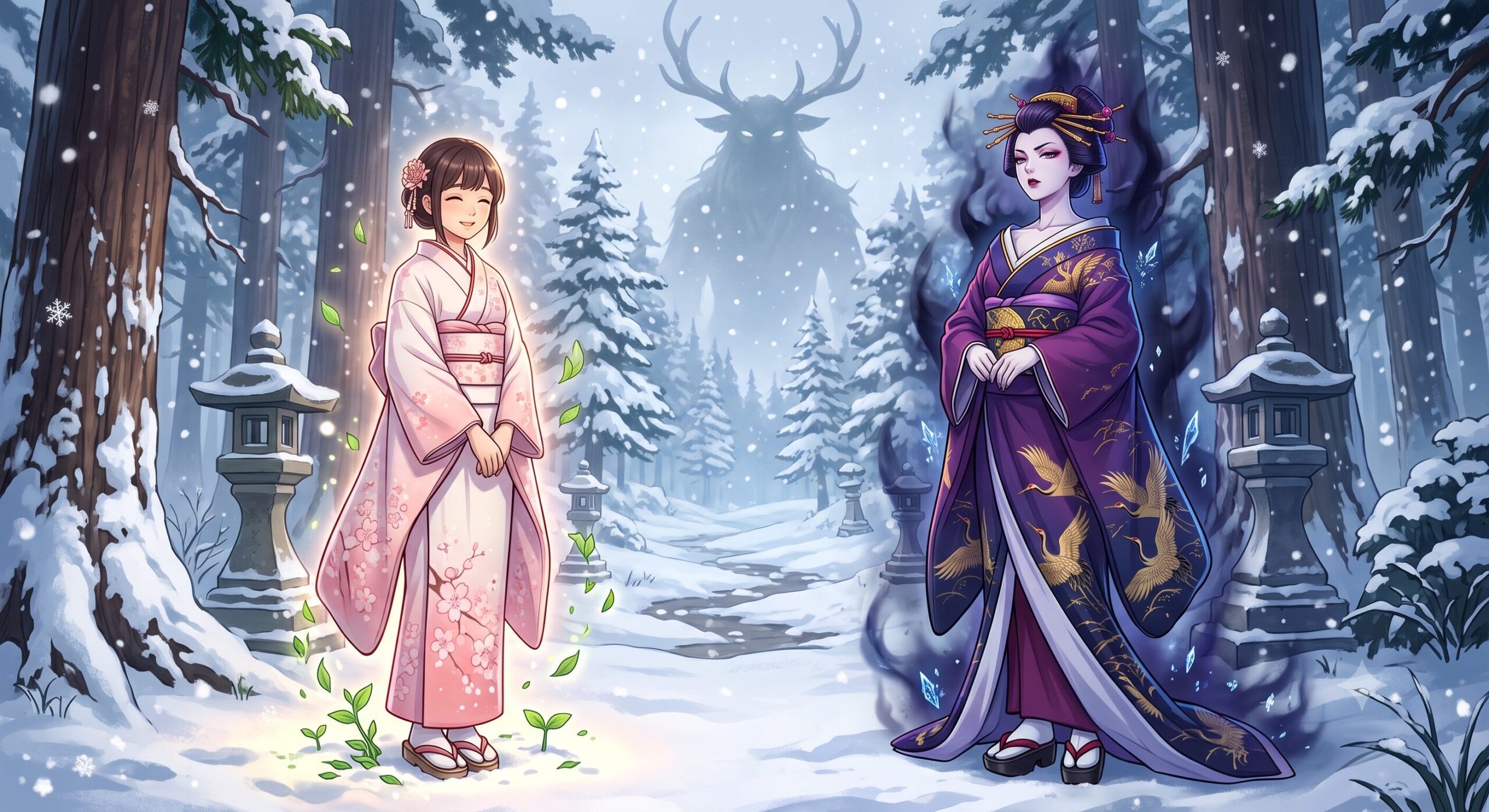
Japan is home to countless folktales that have been passed down through generations. These are not merely children’s entertainment; they are the crystallization of Japanese culture, deeply reflecting the views on life and death, morality, and the profound reverence for nature held by the people of the past. Today, we introduce a masterpiece that brilliantly depicts the contrast between human “goodness” and “ego”: the story of “Asako and Yuko.”
1. The Tale of Asako and Yuko
Once upon a time, in a certain village, there was a household with two daughters. The older sister was named Asako (Child of the Morning), and the younger sister was named Yuko (Child of the Evening). Asako was as bright as the morning sun, kind to everyone, and a very hard worker. On the other hand, Yuko was as dark as the evening shadow, selfish, and lazy, doing nothing all day long.
In truth, Asako was the daughter of the father’s previous wife, while Yuko was the daughter of his second wife. The stepmother doted only on her biological daughter, Yuko, and treated Asako terribly. From morning until night, she forced Asako to do all the housework and field labor, while she and Yuko spent their days in warm rooms eating delicious food.
It happened on a harsh winter day. The snow was falling heavily and piling up, and it was a season when no food could be found outside. The stepmother gave Asako an impossible task.
“Asako, go to the mountains and pick some fresh green leaves. Do not dare return to this house until you have them.”
Of course, there were no green leaves to be found in the snowy mountains. However, without a single word of complaint, Asako headed into the blizzard wearing only a thin, shabby kimono. As she walked, nearly collapsing from the freezing cold and hunger, she found an old man buried in the snow deep in the mountains, shivering violently.
“Old man, what has happened to you in such a place? Here, please use my kimono. And please, eat this small rice ball.”
Even though her own life was in danger, Asako gave the old man her only food and winter clothing.
Suddenly, the old man’s figure shone brightly, and he transformed into a magnificent God of the Mountain.
“Asako, I am deeply moved by your beautiful heart. Now, take this and go.”
With a swing of the god’s staff, fresh, lush green leaves appeared from beneath the snow, and he also bestowed upon Asako a beautiful box filled with gold, silver, and treasures. When Asako returned home, her father was overjoyed, and the family became very wealthy thanks to the treasures.
Seeing this, the stepmother and Yuko were furious with envy.
“Yuko, you go to the mountain and get some treasures too!”
The stepmother dressed Yuko in many layers of warm kimono, gave her a lavish bento box lunch, and sent her off to the mountain.
As Yuko walked through the mountain, she found the old man collapsed in the snow, just as before.
“Old man, you’re the god who gives away treasures, right? Hurry up and hand over the treasure! This bento is mine, so I’m absolutely not giving it to you!”
When Yuko spoke these cold, demanding words, the old man transformed into a terrifying Oni (demon).
“You greedy and thoughtless girl, this is your reward!”
When the Oni blew a breath upon her, Yuko’s beautiful kimonos turned to rags, and the bento she carried turned into cold stones. Then, when she opened the box she had forcibly snatched from the god, countless snakes and centipedes crawled out, driving Yuko and the stepmother out of their home forever. No one knows where the two went after that. Asako, on the other hand, married a kind-hearted young man and lived happily ever after.
2. Analysis of the Tale: The Essence of Humanity
The story of “Asako and Yuko” belongs to the global lineage of the “Cinderella motif” (The Kind and the Unkind Girls). However, it is deeply etched with the climate and spirituality unique to Japan.
The first thing to note is the contrast in their names: “Asako” (Morning) and “Yuko” (Evening). “Morning” symbolizes the breath of new life, diligence, and the blessings of the sun. For the Japanese, historically an agricultural people, waking up early and working hard was the highest virtue. In contrast, “Evening” implies the end of the day, rest, and sometimes stagnation or darkness. These names themselves clearly represent the human duality of diligence and laziness.
Furthermore, the impossible trial forced upon Asako by her stepmother—”picking green leaves in the snowy mountains of winter”—represents the extreme harshness of nature. The fact that Asako, under such unreasonable circumstances, helped a vulnerable person without regard for her own life highlights her “spirit of self-sacrifice” and “unconditional love.”
3. Connection to Japanese Culture: “Karmic Retribution” and “Nature Worship”
There are two core elements of Japanese culture to be deciphered from this story.
First is the spirit of “Inga-oho” (Karmic Retribution). This concept points to the universal law that “good deeds will surely bring good rewards, and bad deeds will bring bad rewards.” The ending, where Asako’s selfless kindness moves the mountain god, and Yuko’s egoism incurs the wrath of the demon, perfectly embodies this karmic retribution. In Japanese society, it has long been said that “The Sun God is always watching,” strongly demanding that people act morally even when no one else is looking.
Second is “Animism” (Nature Worship) and the “Incarnation of Gods.” The old man in the story was actually Yama-no-kami (the God of the Mountain). In Japan, it is believed that gods (Yaoyorozu-no-kami, the eight million gods) reside in all natural things. These gods sometimes borrow the forms of shabby old men or animals to appear in the human world and test people’s hearts. How one treats the weak and poor is directly evaluated as one’s attitude towards the gods. This expresses a profound respect for others.
4. A Question for You
Asako maintained a compassionate heart towards others even in extreme conditions, and as a result, she gained great fortune. In our modern society, are there moments when we prioritize our own profit and self-preservation, acting like Yuko?
If you were placed in an unreasonable situation like Asako, do you think you could be kind to a stranger? After reading this story, how do you feel about your own daily actions? Please let me know your thoughts.
- Read more tales: Japanese Folktale Series
- Reference: Japanese Folktales (Wikipedia)
日本の心に触れる:昔話「あさこ・ゆうこ」から読み解く美徳と報い
日本には、古くから語り継がれてきた無数の昔話が存在します。それらは単なる子供向けのエンターテイメントではなく、当時の人々の死生観、道徳観、そして自然界への畏敬の念が色濃く反映された、日本文化の結晶です。今回は、その中でも人間の持つ「善性」と「エゴ」の対比を見事に描き出した名作、「あさこ・ゆうこ」の物語をご紹介します。
① あさこ・ゆうこの物語
むかしむかし、ある村に二人の娘を持つ家がありました。姉の名前は「あさこ」、妹の名前は「ゆうこ」と言いました。あさこは、朝の陽ざしのように明るく、誰に対しても優しく、働き者の娘でした。一方、ゆうこは夕暮れの影のように暗く、わがままで、一日中何もしない怠け者でした。
実は、あさこは父親の前妻の娘であり、ゆうこは後妻の娘でした。継母である後妻は、自分の実の娘であるゆうこばかりを溺愛し、あさこには辛く当たっていました。あさこには朝から晩まで家事や畑仕事を押し付け、自分たちは暖かい部屋で美味しいものを食べて過ごす毎日でした。
ある厳しい冬の日のことです。雪が深く降り積もり、外には食べ物など何も見当たらない季節に、継母はあさこに無理難題を突きつけました。
「あさこ、山へ行って、新鮮な青い菜っ葉を摘んできなさい。摘んでくるまで、絶対に家に帰ってきてはいけませんよ」
雪山に青い葉などあるはずがありません。しかし、あさこは文句一つ言わず、粗末な着物一枚で吹雪の山へと入っていきました。寒さと飢えで倒れそうになりながら歩いていると、山奥で一人のお爺さんが雪に埋もれて震えているのを見つけました。
「お爺さん、こんな所でどうしたのですか。さあ、私の着物を使ってください。そして、この僅かなおむすびを食べてください」
あさこは自分の命も危ういというのに、持っていた唯一の食料と防寒着をお爺さんに与えました。
すると、お爺さんの姿が光り輝き、立派な山の神様へと変わりました。
「あさこや、お前のその美しい心に感心した。さあ、これを持ってお行き」
神様が杖を一振りすると、雪の中から青々とした立派な菜っ葉が姿を現し、さらには金銀財宝の入った美しい箱をあさこに授けました。あさこが家に帰ると、父親は大変喜び、その宝物で家はとても豊かになりました。
これを見て面白くないのは継母とゆうこです。
「ゆうこ、お前も山へ行って宝物をもらっておいで!」
継母はゆうこに沢山の温かい着物を着せ、豪華な弁当を持たせて山へ送り出しました。
ゆうこが山を歩いていると、先ほどと同じようにお爺さんが倒れていました。
「お爺さん、宝物をくれる神様なんでしょ? さっさと宝物を出しなさいよ! このお弁当は私のものだから絶対にあげないわよ!」
ゆうこがそう言って冷たく言い放つと、お爺さんは恐ろしい鬼の姿へと変わりました。
「強欲で思いやりのない娘め、これがお前の報いだ!」
鬼が息を吹きかけると、ゆうこの着物はボロボロになり、持っていた弁当は石に変わってしまいました。そして、神様から無理やり奪い取った箱を開けると、中からは無数の蛇やムカデが這い出してきて、ゆうこと継母を家から追い出してしまいました。二人はその後、どこへ行ったのか誰も知りません。一方、あさこは心優しい若者と結ばれ、いつまでも幸せに暮らしました。
② 物語の考察:対照的な二人が示す人間の本質
この「あさこ・ゆうこ」の物語は、世界中に見られる「継子いじめ」の系譜に連なる類話(親切な娘と不親切な娘)ですが、日本の風土と精神性が深く刻み込まれています。
まず注目すべきは、「あさこ(朝子)」と「ゆうこ(夕子)」という名前の対比です。「朝」は新しい生命の息吹、勤勉さ、そして太陽の恩恵を象徴します。農耕民族である日本人にとって、朝早く起きて働くことは最も尊い美徳でした。対して「夕」は、一日の終わり、休息、そして時に停滞や闇を暗示します。この二人の名前自体が、勤勉と怠惰という人間の二面性を明確に表しているのです。
また、継母が突きつける「冬の雪山で青い菜っ葉を摘む」という不可能な試練は、自然界の厳しさそのものです。この理不尽な状況下で、あさこが自らの命の危険を顧みず弱者を助けたという事実は、彼女の「自己犠牲の精神」と「無償の愛」を際立たせています。
③ 日本文化との関連:「因果応報」と「自然信仰」
この物語から読み解くべき日本文化の核心は、主に二つあります。
第一に、「因果応報」の精神です。仏教の教えに基づくこの概念は、「善い行いをすれば善い報いが、悪い行いをすれば悪い報いが必ず自分に返ってくる」という法則を指します。あさこの見返りを求めない優しさが山の神を動かし、ゆうこのエゴイズムが鬼の怒りを買った結末は、まさにこの因果応報を体現しています。日本の社会では古くから「お天道様が見ている」と言い伝えられ、誰も見ていない所でも道徳的に振る舞うことが強く求められてきました。
第二に、「アニミズム(自然信仰)」と「神の化身」です。物語に登場するお爺さんは、実は山の神様でした。日本では、山、川、木、岩など、あらゆる自然物に神々(八百万の神)が宿っていると信じられています。神々は時として、みすぼらしい老人や動物の姿を借りて人間界に現れ、人々の心を試します。弱く貧しい存在に対してどう接するかが、そのまま神への態度として評価されるのです。これは、日本の「おもてなし」の精神の源流とも言える、他者への深い敬意を表しています。
④ あなたへ問いかけ
あさこは、極限状態の中でも他者を思いやる心を持ち続け、その結果として大きな幸運を手にしました。現代社会を生きる私たちは、自身の利益や保身を優先し、ゆうこのように振る舞ってしまう瞬間はないでしょうか?
あなたがもし、あさこのように理不尽な状況に立たされた時、見知らぬ誰かに優しくすることはできると思いますか? この物語を読んで、あなたは自分自身の日常の行動についてどう感じましたか? ぜひ、あなたの考えを聞かせてください。
- その他の日本の昔話はこちら:Japanese Folktale Series
- 参考資料:日本の昔話(Wikipedia)
コメント