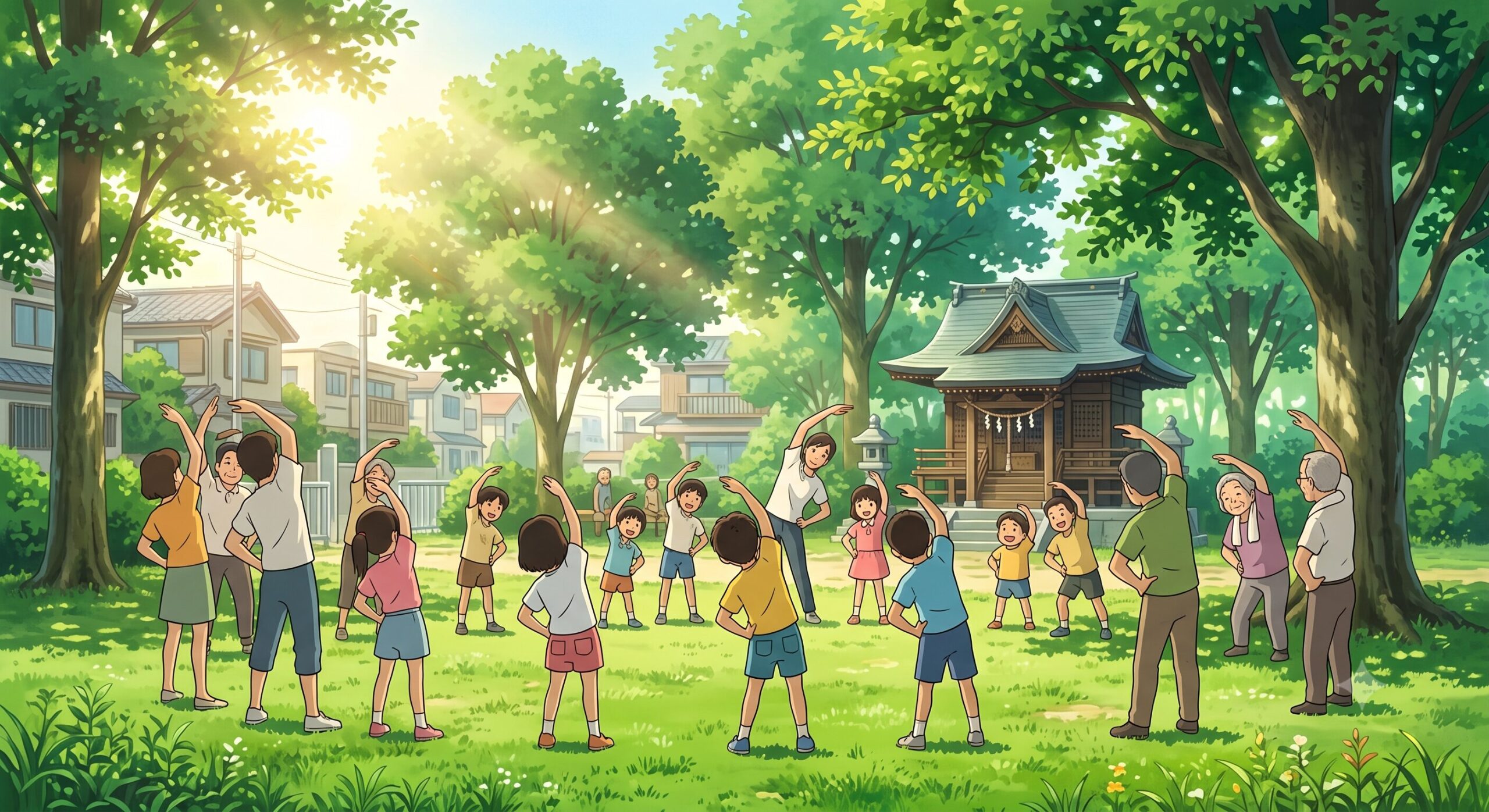
Summer mornings in Japan begin with a very specific melody and a series of energetic counts. When the clock strikes 6:30 AM, the lively piano tune of “Radio Taiso No. 1” (Radio Calisthenics) echoes from parks and schoolyards across the nation. This synchronized morning ritual, known to every Japanese citizen, is far more than a simple health exercise; it is a vital key to understanding the depths of Japanese culture.
Today, we focus on July 21, 1930 (Showa 5). This marks the historic day when the “Early Morning Radio Taiso Gathering,” a quintessential Japanese summer tradition that continues to this day, was held for the very first time.
The Origins of Radio Taiso and the Events of July 21, 1930
The history of Radio Taiso broadcasts in Japan dates back to 1928. Inspired by a radio exercise program broadcast by the Metropolitan Life Insurance Company in the United States, Japan’s Ministry of Communications’ Postal Life Insurance Bureau introduced it to improve the public’s health.
However, the specific cultural phenomenon we envision today—children gathering early on summer mornings to exercise together—was born on July 21, 1930. The mastermind was a police officer named Kenkichi Kurasawa from the Kanda Manseibashi Police Station in Tokyo. Concerned that children would ruin their sleep schedules and fall into bad habits during the long summer vacation, he collaborated with the local neighborhood association to host a morning exercise gathering in a local park.
This localized community effort spread across the country at an astonishing speed. By the following year, similar “early morning Radio Taiso gatherings” were being held nationwide, cementing themselves as the definitive landscape of a Japanese summer morning.
Attendance Cards and Stamps: A Uniquely Japanese System of Motivation
What makes these Radio Taiso gatherings truly special within Japanese culture is the “Attendance Card” system. After completing the routine, children line up to have a local adult stamp their attendance card. The simple act of collecting these stamps serves as a powerful motivation for the kids.
On the final day of summer vacation, children receive small rewards—such as snacks, notebooks, or pencils—based on the number of stamps they collected. This system functions as an excellent educational tool, instilling the virtues of “diligence” and “perseverance” (core values in Japanese society) by rewarding consistent, daily effort toward a goal.
Decoding Japanese Culture Through Radio Taiso: “Wa” and Community
Radio Taiso gatherings carry profound cultural significance that goes far beyond physical fitness.
First, it embodies the spirit of synchronization and “Wa” (harmony). People of different ages, genders, and professions gather at the same time and place to perform the exact same movements in perfect unison. This is a brilliant visual representation of a social structure that values group harmony. The focus is not on individual competitive performance, but on sharing a single rhythm together.
Second, it functions as an essential hub for intergenerational interaction. It is not just children who gather in the park at dawn; parents and local elderly residents join in as well. In modern Japan, where nuclear families are the norm, Radio Taiso continues to serve as a vital piece of social infrastructure, maintaining community bonds and fostering communication across generations.
A Platform for Health Passed Down to the Future
After World War II, Radio Taiso faced a historical crisis when it was temporarily banned by the GHQ (General Headquarters of the Allied Powers) for being “too militaristic.” However, due to strong demand from the public, it was successfully revived. Today, it is broadcast daily without fail on NHK radio and television. It is also actively used to relieve a lack of exercise at evacuation centers during natural disasters and as a pre-work warm-up routine in many Japanese corporations.
What started in the summer of 1930 out of one police officer’s compassion for local youth has grown, over nearly a century, into a massive, sustainable public health system unparalleled anywhere in the world.
What Would You Do?
Waking up at the exact same time every morning to exercise alongside your neighbors—this habit might seem a bit unusual in today’s busy, individualized world. Yet, within this routine lies a undeniable warmth of community and a powerful energy to start the day with discipline.
If you were visiting Japan in the summer and heard that cheerful piano melody drifting from a nearby park at 6:30 AM, would you jump in and join the circle? Does your country have any community-wide morning routines or health rituals? I would love to hear your thoughts.
References & Related Links:
- Japan Post Insurance Official Radio Taiso Page (Japanese): https://www.jp-life.japanpost.jp/radio/
- Read more from our anniversary series: What’s Today’s Special Day? Series
1930年7月21日:日本の夏の風物詩「ラジオ体操会」が始まった日
日本の夏の朝は、ある独特の音楽と掛け声とともに始まります。時計の針が午前6時30分を指すと、全国の公園や学校の校庭から「ラジオ体操第一」のメロディーが一斉に響き渡るのです。この全国民が知る同期された朝の儀式は、単なる健康体操の枠を超え、日本文化の深層を語る上で欠かせない重要な要素となっています。
今日注目するのは、1930年(昭和5年)7月21日。この日は、現在まで続く日本の夏の風物詩「夏期巡回ラジオ体操・みんなの体操会(早起きラジオ体操会)」が歴史上初めて開催された記念すべき日です。
ラジオ体操の起源と、1930年7月21日の出来事
ラジオ体操自体の歴史は、1928年(昭和3年)にまで遡ります。アメリカのメトロポリタン生命保険会社が行っていたラジオ体操の取り組みに感銘を受けた日本の逓信省簡易保険局(現在の日本郵政グループ)が、国民の健康増進を目的として導入しました。
しかし、現在私たちがイメージする「夏休みの朝に子供たちが集まって体操をする」という文化が生まれたのは、1930年7月21日のことです。発案者は、東京・神田万世橋警察署の面高(おもだか)警部補でした。夏休みに入り、夜更かしや朝寝坊など生活リズムが乱れがちな子供たちの健康的な生活習慣を維持し、非行を防止するために、地元の町内会と協力して公園でラジオ体操の会を主催したのです。
この小さな地域コミュニティでの取り組みは、驚くべきスピードで全国に波及しました。翌年には全国各地で同様の「早起きラジオ体操会」が開催されるようになり、日本の夏の朝の定番風景として完全に定着したのです。
出席カードとハンコ:継続を促す日本独自のシステム
このラジオ体操会を日本文化の中で特別なものにしているのが「ラジオ体操出席カード」の存在です。参加した子供たちは、体操が終わると会場の大人からカードにハンコ(スタンプ)を押してもらえます。この「スタンプを集める」という行為は、子供たちにとって強烈なモチベーションとなります。
ラジオ体操の最終日には、集めたスタンプの数に応じて、お菓子やノート、鉛筆などの小さなご褒美が配られます。このシステムは、目標に向かって毎日コツコツと努力を重ねるという、日本人が美徳とする「勤勉さ」や「継続力」を子供のころから育むための優れた教育的装置として機能してきました。
ラジオ体操から読み解く日本文化:「和」とコミュニティ
ラジオ体操会は、単なる運動の時間を超えた深い文化的意味を持っています。
第一に、「同期性」と「和(Wa)」の精神です。年齢も性別も職業も異なる人々が同じ時間に同じ場所に集まり、全く同じ動きを同期して行う。これは、集団の調和を重んじる日本の社会構造を視覚的に表現した見事な例です。個人のパフォーマンスを競うのではなく、全員で一つのリズムを共有することに価値を見出しています。
第二に、多世代交流の場としての機能です。早朝の公園には、子供たちだけでなく、両親、そして地域の高齢者も集まります。核家族化が進む現代日本において、地域コミュニティの繋がりを維持し、世代を超えたコミュニケーションを生み出す貴重なインフラとして、ラジオ体操は機能し続けているのです。
未来へ受け継がれる健康のプラットフォーム
戦後の一時期、GHQ(連合国軍最高司令官総司令部)によって「軍国主義的である」として放送が中止された歴史的危機もありましたが、国民からの強い要望により復活を遂げました。現在でも、NHKのラジオ放送やテレビ放送を通じて毎日欠かさず放送されており、災害時の避難所での運動不足解消や、企業での始業前の体操としても活用されています。
1930年の夏の一人の警察官の思いやりから始まったこの小さな集まりは、1世紀近い時を経て、世界でも類を見ない大規模で持続可能なパブリックヘルス(公衆衛生)のシステムへと成長しました。
あなたなら、どうしますか?
毎朝同じ時間に起きて、地域の人々と一緒に体を動かす。この習慣は、現代の忙しく個人化された社会においては少し奇妙に映るかもしれません。しかし、そこには確かなコミュニティの温かさと、一日を規則正しく始めるための強いエネルギーが存在します。
もしあなたが日本の夏に滞在し、朝6時30分に公園から軽快なピアノのメロディーが聞こえてきたら、あなたもその輪の中に飛び込んでみますか?あなたの国には、地域全体で取り組むような朝の習慣や健康の儀式はありますか?ぜひ、あなたの考えを教えてください。
参考リンク・関連情報:
- かんぽ生命 ラジオ体操公式サイト:https://www.jp-life.japanpost.jp/radio/
- 本ブログの記念日シリーズをもっと読む:What’s Today’s Special Day? Series
コメント