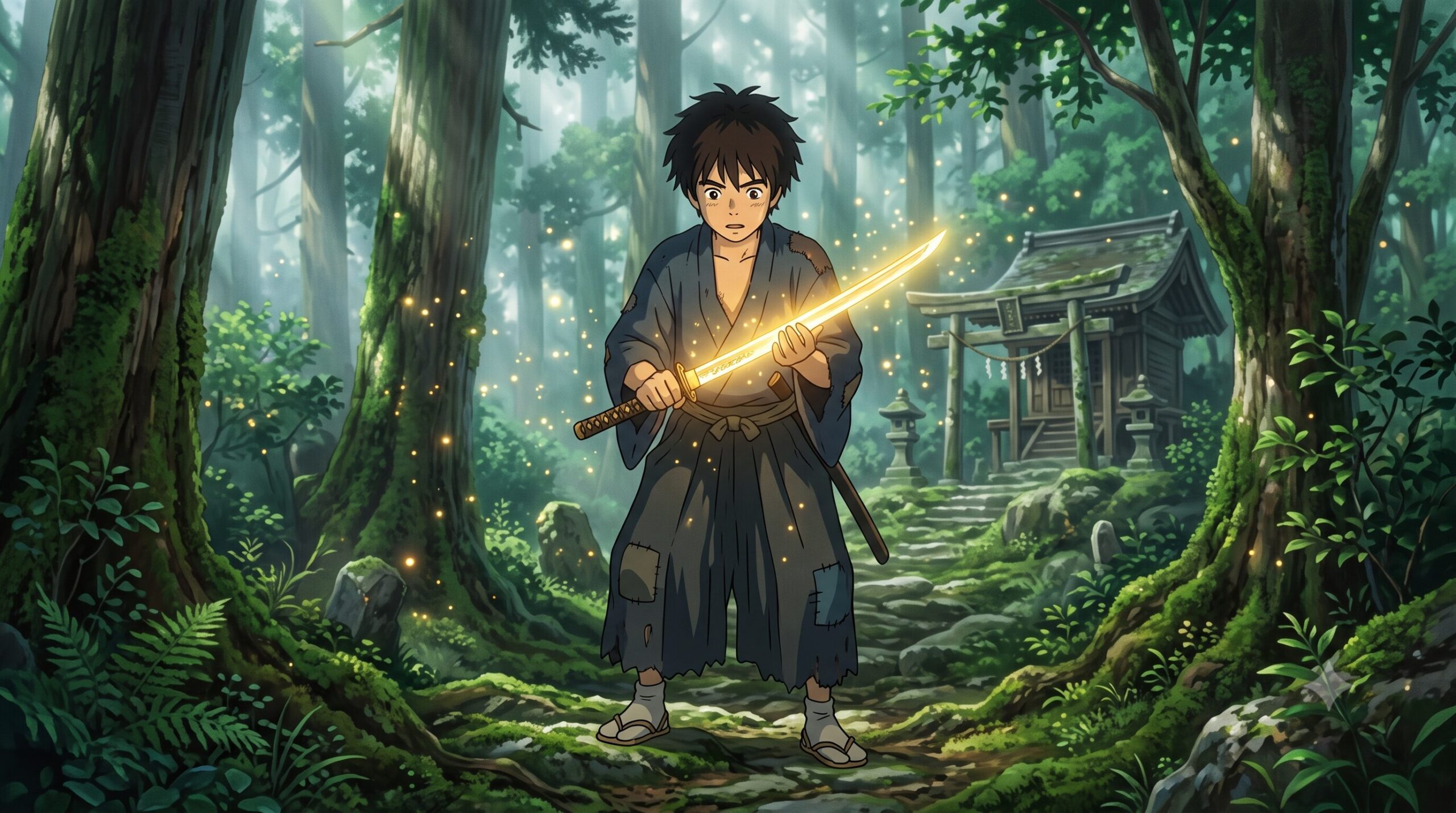
Japan is home to countless legends where ordinary people achieve miracles through unwavering belief. The folktale “Meitou Kisenbamaru” (The Famous Sword Kisenbamaru) from Tokushima Prefecture is not just a simple story of slaying monsters. It is a profound narrative that questions the obsession with singular passion, the power of human dedication, and what constitutes “essential value” untethered by social class.
① The Story: Meitou Kisenbamaru
Long ago, a humble servant named Sakuyan worked at a wealthy master’s large mansion in a rural village. Sakuyan was an incredibly earnest young man, but he harbored an unusual and burning passion: a deep fascination with samurai swords.
The master of the mansion possessed a vast collection of swords and frequently polished them on his veranda. Captivated by the gleam of the beautiful blades, Sakuyan would always hide in the garden, watching intently. Unable to suppress his desire for a sword of his own, Sakuyan finally begged his master, “I will do the hardest of labor. Please, could you spare just one of your swords for me?” However, the master was furious. “What use does a lowly servant have for a sword? Know your place!” he scolded, and subsequently banned Sakuyan from ever entering the garden again.
Yet, Sakuyan’s passion did not cool. He visited the village blacksmith and bowed deeply. “I desperately want a sword. I have no money, but I promise to bring you one bundle of firewood every single day. Please forge a sword for me in exchange.” Moved by the young man’s sheer dedication, the blacksmith agreed. Through rain and storm, Sakuyan never missed a day. Finally, on the 1,000th day, a breathtakingly magnificent Kodachi (short sword) was born from the forge. Having acquired this beautiful blade in exchange for a thousand bundles of wood, Sakuyan named it “Kisenbamaru” (The Sword of a Thousand Bundles of Wood) and cherished it more than his own life.
One day, while Sakuyan was cutting grass deep in the mountains, he took a nap in the shade. Suddenly, a giant snake, native to the deep woods, crept up, intending to swallow him whole. At that exact moment, Kisenbamaru, resting in his robes, emitted an intense, divine light. Terrified by the blinding radiance, the giant snake fled in panic. Rumors of this event eventually reached the master. When the master confiscated Kisenbamaru to inspect it, he was astonished. The blade was a masterwork, far surpassing the hundreds of famous swords hidden in his own storehouse.
The master demanded, “Yield this sword to me.” But Sakuyan stubbornly refused, stating, “This is the one thing I can never give up.” Humiliated and enraged, the master banished Sakuyan from the mansion.
Homeless and wandering, Sakuyan decided to spend the night in an abandoned shrine in a neighboring village. Looking outside, he noticed a delicious feast left as an offering. Unable to bear his hunger, he ate the food. Suddenly, a beautiful village girl emerged from a large wicker basket left beside the offerings. As Sakuyan watched in shock, the tearful girl explained, “Every year, a terrifying monster attacks this village. We must offer a human sacrifice, or the village will be destroyed. This year, I was chosen.”
Hearing this, Sakuyan was outraged. “I will not let such an injustice happen! I will uncover the true identity of this monster and strike it down!” He hid the girl inside the shrine and stood alone against the darkness. Soon, a warm, eerie wind began to howl, and a grotesque monster appeared. Sakuyan stood his ground and drew Kisenbamaru from its scabbard. The blade erupted with a blinding light, as bright as the sun itself. Overwhelmed by the sacred light, the monster let out a dying shriek and vanished into nothingness.
The next morning, the villagers rejoiced upon learning the monster was defeated. They welcomed Sakuyan as a great hero and the savior of their village. He eventually married the girl he had saved, and they lived happily ever after.
② Analysis: The Quest for Essence Beyond Social Status and the Power of Perseverance
The central themes of this story are the “power of continuation” and “the ability to see true value.” Sakuyan performed the seemingly mundane and exhausting task of carrying firewood every day for 1,000 days. There is a Japanese proverb, “Three years on a cold stone” (perseverance brings success). His nearly three years of pure passion and effort infused a mere piece of steel with a sacred soul, creating the miraculous sword Kisenbamaru.
Conversely, the wealthy master was trapped by the rigid stereotypes of the social hierarchy, laughing at a servant’s passion. He owned many swords, but to him, they were merely symbols of authority and wealth. When he realized the true value of Kisenbamaru, he attempted to steal it through power. The story delivers a satisfying catharsis: true power and essential value do not reside in superficial authority or numbers, but in those who possess genuine dedication and a pure heart.
③ Cultural Connection: Sword Worship and the Lineage of Human Sacrifice
The depiction of Kisenbamaru repelling the giant snake and the monster merely with its light strongly reflects Japan’s unique “sword worship” (Token Shinko). Throughout Japanese history, the Katana has never been viewed simply as a weapon for killing. It has been revered as a “sacred vessel” housing divine spirits and a “ward against evil” that purifies malevolence. Much like the “Kusanagi-no-Tsurugi,” one of the Three Sacred Treasures of Japan, this reflects an ancient Japanese animistic worldview where legendary swords possess their own will and spiritual power.
Furthermore, the later plot where a girl is offered as a sacrifice to save a village perfectly mirrors the structure of the “Yamata-no-Orochi” legend in Japanese mythology. The myth of the god Susanoo defeating the eight-headed serpent to save Princess Kushinada was passed down through the ages, transforming into folklore about nameless, heroic servants. In this way, Japanese folktales are deeply intertwined with ancient myths, cultivating the moral compass of the people.
④ To Our Readers: What Would You Do?
If you were in Sakuyan’s position, facing a powerful employer threatening to take your sword, would you have the courage to refuse, knowing you would lose your livelihood? How would you protect the most precious thing you spent 1,000 days working to obtain?
Moreover, if you stumbled upon a strange village and found a young girl waiting to be devoured by a terrifying monster, would you risk your own life to stand and fight? The light emitted by Kisenbamaru might have been the magic of the blade, but perhaps it was also the pure brilliance of the “courage” hidden deep within Sakuyan’s heart. Take a moment to reflect on what you feel and how you would act after reading this tale.
Reference and Related Links
- Japanese Folktale Series (Blog Category)
- Reference: Manga Nihon Mukashibanashi Database – Meitou Kisenbamaru
名刀木千把丸(めいとうきせんばまる)― 徳島県に伝わる真の価値と勇気の物語
日本には、名もなき人々が強い信念によって奇跡を起こす数多くの伝説が眠っています。今回ご紹介する徳島県の昔話「名刀木千把丸(めいとうきせんばまる)」は、単なる化け物退治の冒険譚ではありません。一つのことに情熱を注ぎ続ける人間の執念と、社会的な身分に縛られない「本質的な価値」とは何かを私たちに問いかける、非常に奥深い物語です。
① 昔話のストーリー:名刀木千把丸
昔々、ある村の大きな屋敷に「佐久やん(さくやん)」という下男が働きに出されていました。佐久やんはとても真面目な青年でしたが、彼には一つの変わった情熱がありました。それは「刀」に対する並々ならぬ憧れです。
屋敷の旦那さんは数多くの刀を収集しており、縁側でよく手入れをしていました。佐久やんはその美しい刀身の輝きに魅了され、旦那さんが手入れを始めるたびに庭の陰から食い入るように見つめていたのです。どうしても自分だけの刀が欲しくなった佐久やんは、ある日思い切って旦那さんに頼み込みました。「どんなにきつい仕事でもしますから、どうかその刀を一本、私に分けていただけないでしょうか」。しかし旦那さんは、「身分の低い下男が刀など持ってどうする。身の程を知れ!」と激怒し、彼が庭に出入りすることすら禁じてしまいました。
それでも佐久やんの刀への情熱は冷めません。彼は村の鍛冶屋へ行き、「どうしても刀が欲しいのです。お金はありませんが、毎日必ず薪を一把(ひとたば)運びますから、それで刀を打ってください」と頭を下げました。鍛冶屋はその熱意に心を打たれ、承諾します。雨の日も風の日も、佐久やんは決して休むことなく薪を運び続けました。そしてついに千日目。鍛冶屋の炉から、息を呑むほど見事な小太刀(こだち)が生み出されました。千把の薪と引き換えに手に入れたこの美しい刀を、佐久やんは「木千把丸(きせんばまる)」と名付け、自分の命よりも大切に懐に抱きました。
ある日、佐久やんが山の奥へ草刈りに行き、木陰で昼寝をしていた時のことです。山奥に棲みつく巨大な大蛇が彼を丸呑みにしようと忍び寄りました。しかしその瞬間、懐の木千把丸が凄まじい光を放ちました。神々しい輝きに恐れをなした大蛇は、逃げ帰っていったのです。この噂は屋敷の旦那さんの耳にも入りました。旦那さんが木千把丸を取り上げて鑑定してみると、それは屋敷の蔵にある何百本もの名刀をはるかに凌駕する、見たこともない凄まじい業物でした。
「この刀を私に譲れ」と迫る旦那さんに対し、佐久やんは「これだけは絶対に譲れません」と頑なに拒否します。メンツを潰された旦那さんは激怒し、佐久やんを屋敷から追い出してしまいました。
行く当てを失った佐久やんは、隣村の寂れたお堂で夜を明かすことにしました。ふとお堂の外を見ると、美味しそうなご馳走がお供えされています。空腹に耐えかねた彼はそれを食べてしまいました。ところが、その供え物の隣にあった大きなつづら(籠)から、突然美しい村の娘が現れたのです。驚く佐久やんに、娘は泣きながら語りました。「この村には毎年恐ろしい化け物が現れ、人身御供(ひとみごくう=生贄)を出さなければ村を滅ぼされてしまいます。今年は私がその生贄に選ばれたのです」と。
それを聞いた佐久やんは憤慨しました。「そんな不条理なことがあってたまるか。私がその化け物の正体を見極め、退治してやろう!」。彼は娘をお堂の奥に隠し、一人で夜の闇を見据えました。やがて生暖かい突風が吹き荒れ、巨大で不気味な化け物が姿を現しました。佐久やんが一歩も引かずに木千把丸を鞘から抜くと、刀はまるで太陽のような眩い光を放ちました。その聖なる光の力によって、化け物は断末魔の叫びを上げて消滅したのです。
翌朝、化け物が退治されたことを知った村人たちは歓喜しました。見ず知らずの村を救った豪傑として、佐久やんは村の大恩人として迎え入れられました。そして助け出された娘と結ばれ、二人は末長く幸せに暮らしたということです。
② 昔話を考察する:身分を超えた「本質」の探求と継続の力
この物語の最大のテーマは、「継続する力」と「本当の価値を見極める目」です。佐久やんは毎日一把の薪を運び続けるという、一見地味で途方もない作業を1000日間も続けました。「石の上にも三年」という日本のことわざがありますが、約3年間に及ぶ彼の純粋な情熱と努力が、単なる鉄の塊に神聖な魂を宿らせ、奇跡の名刀「木千把丸」を生み出したのです。
一方で、屋敷の旦那さんは「下男だから」という身分制度の固定観念に囚われ、人間の情熱を鼻で笑いました。彼は大量の刀を所有していましたが、それはあくまで権力や財力の象徴に過ぎず、いざ木千把丸の真の価値に気づくと権力で奪おうとします。物語は、表面的な権威や数に頼る者よりも、ひたむきな努力と純粋な心を持つ者にこそ、真の力(本質的な価値)が宿るという痛快なカタルシスを描いています。
③ 日本文化との関連:刀剣への信仰と「人身御供」の系譜
「木千把丸」が放つ光だけで大蛇や化け物を退けたという描写は、日本特有の「刀剣信仰」を色濃く反映しています。日本の歴史において、日本刀は単なる人斬り用の武器ではなく、神の霊力が宿る「神器」や、邪気を払う「魔除け」として神聖視されてきました。三種の神器の一つである「草薙剣(くさなぎのつるぎ)」に代表されるように、名刀には自らの意思や霊力が備わっているという日本古来のアニミズム的な精神世界が読み取れます。
また、後半に登場する「村を救うために娘が生贄にされる」という展開は、日本神話における「ヤマタノオロチ伝説」と全く同じ構造です。スサノオノミコトがクシナダヒメを救うためにヤマタノオロチを退治した神話が、時代を下り、名もなき下男の英雄譚へと形を変えて民衆の間に語り継がれてきたことがわかります。このように、日本の昔話は古代の神話と深く結びつきながら、人々の道徳観を育ててきたのです。
④ 読者の皆様へ:あなたならどうしますか?
もしあなたが佐久やんの立場だったら、権力者である雇い主から「刀をよこせ」と脅された時、仕事を失う覚悟で拒否できたでしょうか? 自分が1000日もの歳月をかけて手に入れた「最も大切なもの」を、あなたはどうやって守り抜きますか?
また、行きずりの見知らぬ村で、恐ろしい化け物の生贄になろうとしている少女に出会った時、あなたは自分の命を懸けて彼女を助けるために立ち向かえるでしょうか。木千把丸が放った光は、刀自身の力であると同時に、佐久やんの心の奥底にあった「勇気」そのものの輝きだったのかもしれません。この物語を通して、あなたが何を感じ、どう行動するか。ぜひ深く考えてみてください。

コメント