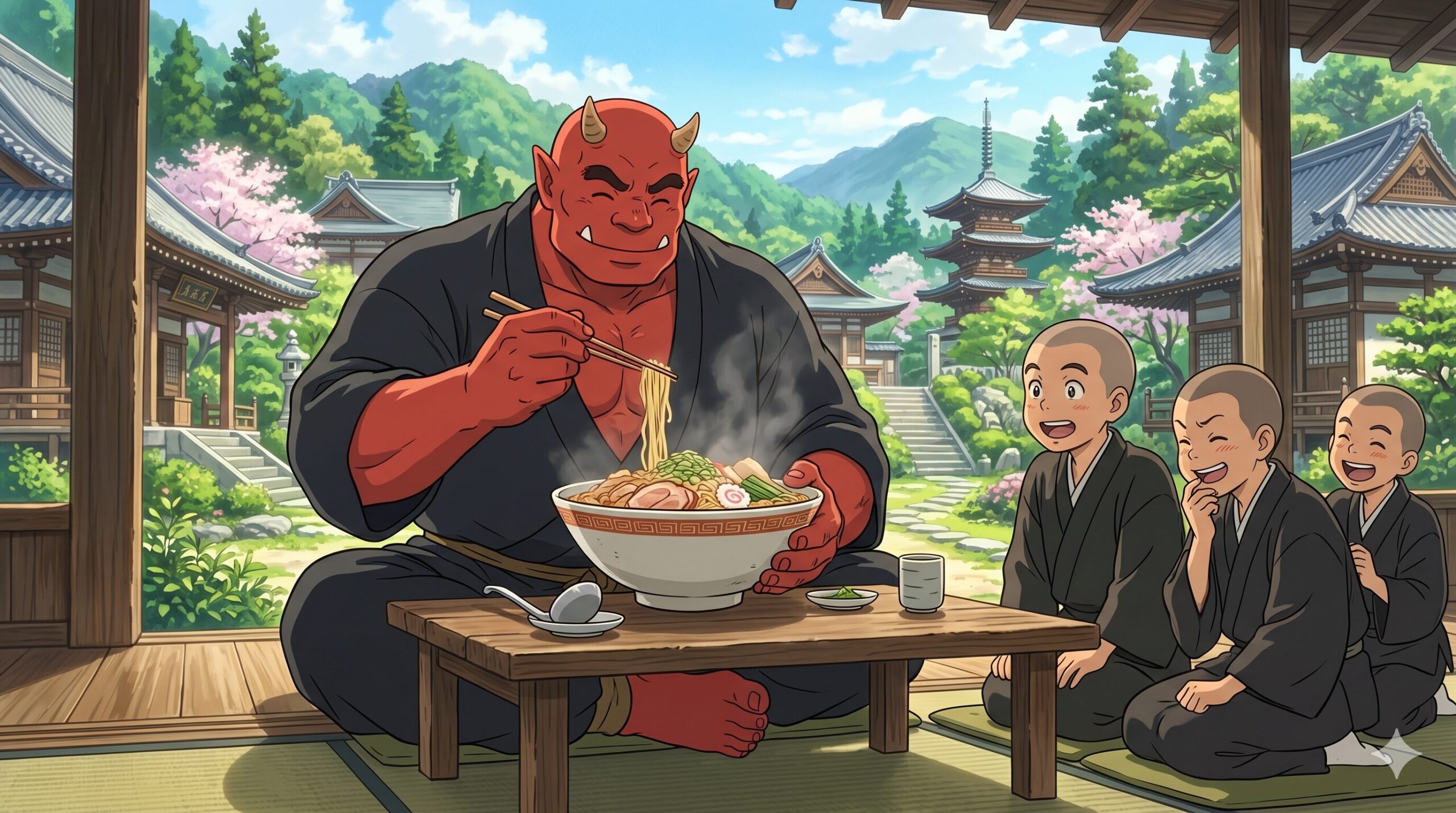
Japan has countless folktales passed down through generations, and some of them serve as the origins of proverbs we use in our daily lives. Today, we introduce “The Story of the Laughing Oni,” a folktale from Mashiki Town in Kumamoto Prefecture. This story is said to be the root of the famous Japanese proverb, “If you speak of next year, the Oni (demon) will laugh” (meaning it is foolish to predict the future since no one knows what will happen). Why did the terrifying Oni laugh? Let’s unravel the full story and the profound Japanese culture hidden within it.
1. The Story of “The Laughing Oni”
Once upon a time, in a place called Mashiki in Kumamoto, there was a temple named Fukuden-ji. The head priest of this temple was renowned for his great wisdom, and monks from all over the country gathered there to train.
One day, a fearsome-looking Oni (a Japanese demon/ogre) came to the temple. The Oni knelt before the priest and pleaded, “I am an Oni, but please make me your disciple.” The broad-minded priest did not reject him; instead, he welcomed the Oni just like any other monk. Despite his terrifying appearance, the Oni was deeply earnest and an incredibly hard worker.
A while later, the temple decided to build a new worship hall nearby. The Oni’s superhuman strength and work ethic were immensely helpful, and the hall was completed much faster than expected. To reward the disciples for their hard work, the priest prepared a massive pot of “Dago-jiru” (a traditional Kumamoto dumpling soup). Everyone began eating joyfully, but the gluttonous Oni devoured bowl after bowl at a tremendous speed, leaving almost nothing for the other monks.
Troubled by this, the monks thought, “If this continues, the Oni will eat everything at our next celebration too.” They came up with a cunning plan. The next time they made Dago-jiru, they mixed in many short, hollow pieces of bamboo. They figured the Oni would have to eat slowly to avoid swallowing the bamboo.
However, their prediction was completely wrong. The Oni enthusiastically scooped up the soup and viciously chewed right through the hard bamboo! As a result, the Oni’s teeth cracked and shattered. “Ouch! It hurts! Now I can never eat my beloved Dago-jiru again!” the giant Oni cried out loud, weeping like a child.
Seeing this, the gentle priest patted the Oni’s head and said, “Do not cry. You have worked so hard for us. By next year, beautiful new teeth will grow back.” Hearing these words of hope, the Oni realized, “I can eat Dago-jiru again next year!” Relieved, he wiped his tears and burst into a huge, beaming smile.
It is said that the proverb, “If you speak of next year, the Oni will laugh,” was born from this exact moment.
2. Deep Analysis of the Folktale
This story offers a fascinating look into human psychology that makes it much more than just a humorous tale. The “Oni” here is not depicted as an evil monster, but rather as an innocent “outsider” or “exceptionally gifted being.” He contributed to the community more than anyone else. Yet, his overwhelming power (and appetite) became a threat and a nuisance to ordinary people (the monks).
The “bamboo trap” set by the monks might have stemmed from a defensive instinct rather than pure malice, but it ultimately hurt the Oni. This serves as a microcosm of social psychology—showing how a group that values harmony often marginalizes or expels outliers. The saving grace of the story is the priest. Instead of blaming the Oni or scolding the scheming monks, the priest resolves the conflict with humor and the hopeful promise of “next year.” This reflects profound Buddhist wisdom: overcoming opposition through tolerance and kindness.
3. Connection to Japanese Culture: The Oni and “Marebito”
In Japanese culture, the “Oni” occupies a complex position. Sometimes they are absolute evils to be defeated (as in the story of Momotaro), but other times, as in this tale, they are highly human-like and somewhat lovable. From a folklore perspective, the Oni often symbolizes a “Marebito” (a sacred guest or outsider) who brings special skills, technology, or strength from the outside world.
The Oni in this story brought advanced building skills and labor. Since ancient times, Japanese people have maintained a unique balance of coexisting with the overwhelming forces of nature and outsiders—fearing them, yet accepting their blessings. Furthermore, the proverb itself reflects a humble Japanese view of life and nature: it is pointless for humans to arrogantly predict the future.
If you are interested in other fascinating stories, please check out our Japanese Folktale Series. Also, if you want to see the actual historical site of Fukuden-ji Temple in Kumamoto where this story took place, you can view it on this Higo Journal article (Japanese).
4. To Our Readers: What Would You Do?
After reading this folktale, who did you empathize with the most? The pure-hearted Oni who worked harder than anyone but was tricked? Or can you understand the feelings of the ordinary monks who just wanted to secure their share of dinner?
If you were the head priest, what rules would you create so that a gluttonous, hard-working giant and ordinary monks could live together in perfect harmony? We hope this story inspires you to think about coexistence with people of different cultures and abilities. Please let us know your thoughts by sharing them on social media!
【日本の昔話】「来年の事を言えば鬼が笑う」の由来とは?『鬼が笑った話』のあらすじと深い考察
日本には古くから語り継がれる無数の昔話が存在しますが、中には私たちが日常的に使う「ことわざ」の由来となった物語もあります。今回は、熊本県益城町に伝わる昔話『鬼が笑った話』をご紹介します。このお話は、「来年の事を言えば鬼が笑う(未来のことなど誰にもわからないのだから、予測してあれこれ言うのは滑稽であるという意味)」ということわざのルーツになったとも言われています。恐ろしいイメージの強い「鬼」が、なぜ笑ったのでしょうか?その物語の全貌と、そこに隠された日本文化の奥深さを紐解いていきましょう。
① 昔話『鬼が笑った話』のストーリー
むかしむかし、熊本の益城(ましき)という場所に、福田寺(ふくでんじ)というお寺がありました。このお寺の和尚さんは非常に知恵者として名高く、教えを乞うために全国から多くのお坊さんが集まって修行をしていました。
ある日のこと、お寺に一匹の恐ろしい顔をした鬼がやってきました。鬼は和尚さんの前にひざまずき、「わしは鬼ですが、どうか弟子にしてください」と懇願しました。心の広い和尚さんは鬼を拒絶することなく、他のお坊さんたちと同じように弟子として迎え入れることにしました。鬼は顔こそ恐ろしいものの、根は非常に真面目で、誰よりも一生懸命に働く素晴らしい弟子でした。
しばらくして、お寺の近くに新しいお堂を建てることになりました。ここでも鬼の怪力と働きぶりが大いに役立ち、お堂は予定よりもずっと早く完成しました。和尚さんは弟子たちの労をねぎらうため、熊本名物の「だご汁(そばきりだんご汁)」をたっぷり振る舞うことにしました。皆は大喜びで食べ始めましたが、食いしん坊の鬼はものすごい勢いで鍋のだご汁を次々と平らげてしまい、他のお坊さんたちの口にはほとんど入りませんでした。
「このままでは、次のお祝いの時も鬼にすべて食べられてしまう」と困ったお坊さんたちは、ある知恵を絞りました。次の機会にだご汁を作る際、汁の中に短く切った「竹の筒」をたくさん混ぜておいたのです。竹が入っていれば、鬼も避けてゆっくり食べるだろうと考えたからです。
しかし、お坊さんたちの予想は外れました。鬼は汁に浮かぶ竹ごと、バリバリと凄まじい勢いで噛み砕いて食べてしまったのです。その結果、硬い竹を無理に噛んだ鬼の歯はボロボロに欠けてしまいました。「痛い、痛い!これではもう大好きなだご汁が食べられない!」と、大きな鬼は子どもようにオイオイと泣き出してしまいました。
それを見た和尚さんは、優しく鬼の頭を撫でてこう言いました。「泣かなくていい。お前はよく働いたのだから、来年になったらまた立派な新しい歯が生えてくるよ」。その言葉を聞いた鬼は、「来年になればまただご汁が食べられる!」とすっかり安心し、涙を拭いてニッコリと満面の笑みを浮かべました。
この時の出来事から、「来年のことを言うと、鬼が笑う」ということわざが生まれたと伝えられています。
② 昔話『鬼が笑った話』の深い考察
この物語は、単なるユーモラスな昔話として片付けるには惜しい、非常に興味深い人間模様が描かれています。ここで登場する「鬼」は、悪逆非道な怪物ではなく、純粋で無邪気な「異邦人」あるいは「規格外の存在」として描かれています。彼は誰よりも働き、コミュニティに貢献しました。しかし、その圧倒的な能力(と食欲)は、普通の人々(お坊さんたち)にとって脅威や迷惑ともなり得たのです。
お坊さんたちが仕掛けた「竹の罠」は、悪意というよりも防衛本能から出たものかもしれませんが、結果的に鬼を傷つけてしまいます。これは、集団の和を重んじる社会において、異端者や突出した存在がどのように扱われ、排除されがちであるかという社会心理の縮図とも言えます。しかし、物語の救いとなっているのは和尚さんの存在です。和尚さんは鬼を責めることも、罠を仕掛けた弟子たちを叱ることもなく、「来年には生える」という未来への希望の言葉で、場を丸く収めました。ここには、物事の対立をユーモアと寛容さで乗り越えようとする、仏教的な深い知恵が隠されています。
③ 日本文化との関連性:鬼と「マレビト」
日本文化において、「鬼」は常に複雑な立ち位置にあります。桃太郎のように退治されるべき絶対悪として描かれることもあれば、この物語のように人間臭く、どこか憎めない存在として描かれることもあります。民俗学的な視点から見ると、鬼は外部からやってきて特別な力や技術をもたらす「マレビト(稀人)」の象徴である場合があります。
『鬼が笑った話』に登場する鬼も、高度な建築技術や労働力をもたらす外部の存在でした。日本人は古来より、自然の猛威や外部からの訪問者に対し、恐れを抱きながらも恩恵を受け取るという、独自のバランス感覚を持って共生してきました。また、「来年の事を言えば鬼が笑う」ということわざ自体が、「人間の浅知恵で未来を予測しても無駄である」という、自然や運命に対する日本人の謙虚な死生観や無常観を反映しています。
このお話に関連する他の昔話にも興味がある方は、ぜひ私たちのJapanese Folktale Seriesをご覧ください。また、この物語の舞台となった熊本の福田寺跡については、こちらの肥後ジャーナルさんの記事で実際の現地の様子を確認することができます。
④ 読者の皆様へ:あなたならどうしますか?
この昔話を読んで、あなたは誰に一番感情移入しましたか?誰よりも働いたのに罠にかけられてしまった純粋な鬼でしょうか。それとも、自分たちの分のご飯を確保したかったお坊さんたちの気持ちが理解できるでしょうか。
もしあなたが和尚さんだったら、大食らいで働き者の鬼と、普通のお坊さんたちが平和に共存できるように、どのようなルールを作りますか?ぜひ、この物語を通じて、異文化や異なる能力を持つ人々との共生について考えてみてください。あなたの考えを、ぜひSNSなどでシェアして聞かせてくださいね。

コメント