1. The Tale of the “Ushioni Fuchi” Lurking Deep in the Mountains
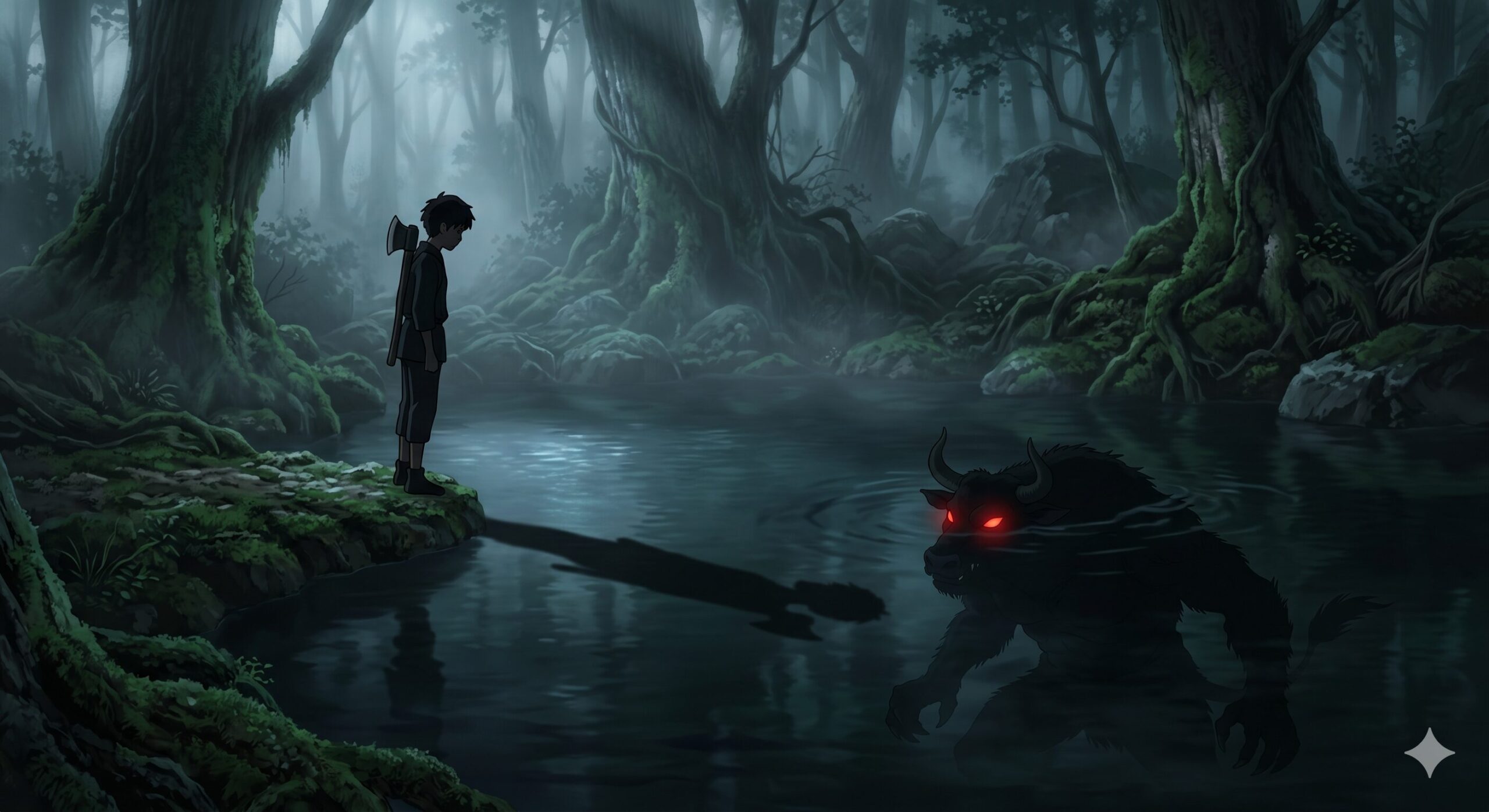
Long ago, deep within the rugged and impenetrable mountains of Ise (modern-day Mie Prefecture), there lay a dark, bottomless pool of water known as “Ushioni Fuchi” (Ushioni Pool). Beneath its eerie, sunlight-starved emerald surface, legends spoke of a bloodcurdling monster lurking in the depths. This beast, the “Ushioni,” possessed the terrifying head of a horned cow and the grotesque, muscular body of a demon. The Ushioni had one particularly horrifying trait: it consumed the “shadows” of humans cast upon the water. It was said that anyone whose shadow was licked by the beast would have their soul drained and inevitably die.
One autumn, two woodcutters ventured into these deep mountains to harvest timber. One was a seasoned old man who intimately knew the laws of the mountain, while the other was a strong, hot-blooded young man who scoffed at ancient folklore. By a stroke of bad luck, they built their camp right next to the dreaded Ushioni Fuchi.
The old man sternly warned his young companion. “Never approach that pool. If you cast your shadow on the water’s surface, the Ushioni will eat it, and you will die. Furthermore, always keep your sharp tools—like your saw and axe—close by as a ward. That monster fears the sharp iron blades forged by human hands more than anything else.”
However, the young woodcutter dismissed the warning as mere superstition. He secretly mocked the old man, thinking, “A demon with a cow’s head? It’s just an old man’s nonsense.” A few days later, the blade of the old man’s saw broke, forcing him to descend to the village alone for repairs. As he left, he repeatedly urged the young man to stay away from the water, but his words fell on deaf ears.
Left alone in the mountains, the young woodcutter grew incredibly bored. Defying the old man’s strict orders, he arrogantly walked right up to the edge of the Ushioni Fuchi. He peered into the depths, casting his shadow directly onto the dark surface. Instantly, the previously dead-still water began to bubble and churn violently.
With an ominous, gurgling sound, a massive black silhouette rose from the abyss. It was undeniably the Ushioni, with its bloodshot eyes, terrifying bovine face, and the hulking body of a demon. Without a sharp blade at hand to protect himself, the young woodcutter was paralyzed by absolute terror, collapsing to the ground. The Ushioni slowly brought its face to the water’s surface, extended a long, black tongue, and sickeningly licked the young man’s reflection.
The next day, when the old woodcutter returned from the village with his repaired saw, the young man was nowhere to be found. Filled with a sense of dread, the old man rushed to the edge of the Ushioni Fuchi. Floating aimlessly on the cold, dark water were only the torn clothes of the young woodcutter. His body and soul had completely fallen prey to the beast. Even today, locals say that on eerie, moonlit nights, the mournful, terrifying cry of the Ushioni echoes through the mountains of Ise: “Woooo, Woooo.”
2. Analyzing the Depths of the Ushioni Legend
The tale of Ushioni Fuchi is a classic “cautionary tale” deeply embedded in Japanese folklore. While the Ushioni is typically known as a Yokai that appears along the coasts or rivers of western Japan, its presence in a deep mountain pool in Ise is significant. It demonstrates how Yokai legends adapt to their environments, embodying the specific, localized threats of untamed nature.
The central focus of this story is the chilling concept of “dying when your shadow is eaten.” Since ancient times, a human’s shadow has not been viewed merely as an absence of light, but as an extension of the soul or the essence of life itself. To have one’s shadow stolen is to lose one’s identity and life force entirely. The imagery of a monster silently licking away a soul, rather than violently attacking the physical body, taps into a profound, primal psychological fear.
Furthermore, the Yokai’s vulnerability to “blades” is a crucial narrative element. Iron tools like saws and axes represent human “civilization,” “order,” and “technology.” In stark contrast, the Ushioni represents raw, chaotic, and untamed nature. The moment the old man takes the broken saw away for repairs, the protective barrier of civilization is lifted. This brilliant structural detail highlights how the arrogant youth is left entirely defenseless against the overwhelming forces of nature.
3. Connection to Japanese Culture: Awe of Nature and Sacred Boundaries
This story provides profound insight into the traditional Japanese spirit of “Animism” (the belief that spirits inhabit all things) and the concept of “boundaries” separating the human world from the supernatural. Historically, deep mountains and dark bodies of water have been revered and feared in Japan as “Iikai” (the Otherworld) or sacred domains where humans are forbidden to trespass.
In Japanese culture, water is both a life-giving blessing and a terrifying, destructive force capable of causing floods and fatal accidents. The bottomless darkness of the Ushioni Fuchi represents this uncontrollable aspect of nature. The old woodcutter’s “fear” and respect showcase the wisdom of his ancestors—a necessity for coexisting with nature. Conversely, the young woodcutter’s “arrogance” is portrayed as “Kegare” (impurity) that disrupts the natural order.
Even in modern Japan, Shinto shrines are often situated at the entrances to deep forests or near waterfalls. These act as definitive markers separating the human realm from the sacred. The Japanese mindset of treating nature not merely as a resource, but with profound awe and reverence, has been passed down through generations via these terrifying Yokai tales.
4. The “Abyss” in Your Heart: A Question for the Reader
The legend of Ushioni Fuchi casts a powerful message to us living in the modern world. No matter how advanced human knowledge and technology become, there remain hidden depths in nature that we must never carelessly disturb.
If you were to stand before a dark, silent, bottomless pool in the heart of an ancient forest, would you sense the unseen warning in the air? If you were the young woodcutter, would you have humbly heeded the elder’s advice and stepped away from the water’s edge? Or would your curiosity and overconfidence push you to cast your shadow upon the abyss? After reading this tale, we invite you to reflect on how humanity should truly interact with the awesome forces of nature. What would you do?
【Reference Link】
External Site: Ushioni Fuchi (Manga Nippon Mukashibanashi Database)
【Related Stories】
Read more Japanese Folktales here: Japanese Folktale Series
日本の恐ろしい妖怪伝説:影を喰らう異形の化け物「牛鬼淵」
① 深い山奥に潜む恐怖「牛鬼淵」の物語
はるか昔、伊勢(現在の三重県)の深く険しい山奥に、「牛鬼淵(うしおにぶち)」と呼ばれる底知れぬ不気味な淵がありました。太陽の光すら届かないその深い緑色の水底には、顔が牛で体が屈強な鬼という、身の毛もよだつ恐ろしい化け物「牛鬼」が棲んでいると語り継がれていました。牛鬼には恐るべき性質がありました。それは、水面に映った人間の「影」を喰らうということです。影を舐め取られた者は、魂を抜かれたように確実に命を落とすと言われていました。
ある秋のこと、二人の木こりが木を切り出すためにこの深い山へ入りました。一人は山の掟を知り尽くした経験豊かな老人の木こり、もう一人は腕っぷしは強いものの、古い言い伝えを鼻で笑う血気盛んな若い木こりでした。二人は偶然にも、恐ろしい牛鬼淵のすぐそばに小屋を構えてしまいました。
老人は若い木こりに厳しく忠告しました。「絶対にあの淵に近づいてはならない。水面に自分の影を落とせば、牛鬼に喰われて命を落とす。そして、魔除けとなるノコギリや斧などの『刃物』を常に手元に置いておくのだ。あの化け物は、人間の打った鋭い鉄の刃を何よりも恐れるからだ」と。
しかし、若い木こりはその警告を単なる迷信だと軽んじました。「牛の頭をした鬼などいるはずがない。老人の戯言だ」と心の中で嘲笑っていたのです。数日後、老人の木こりが使っていたノコギリの刃が欠けてしまい、修理のために一人で麓の村へ下りることになりました。老人は去り際に何度も「淵には近づくな」と念を押しましたが、若い木こりは気にも留めませんでした。
山に一人残された若い木こりは、退屈を持て余し、あろうことか老人の忠告を破って牛鬼淵の縁へと歩み寄りました。そして、水面を覗き込み、自分の影を真っ直ぐに落としたのです。その瞬間、静まり返っていた淵の水が不気味に泡立ち、渦を巻き始めました。
「ゴポァ……ゴポァ……」という水音と共に、深淵から巨大な黒い影が浮上しました。それは紛れもなく、血走った目を持つ牛の顔と、筋肉が隆起した恐ろしい鬼の体を持つ「牛鬼」でした。手元に身を守る刃物を持っていなかった若い木こりは、恐怖のあまり声も出せず、その場にへたり込んでしまいました。牛鬼はゆっくりと水面に顔を近づけ、長く黒い舌を伸ばして、水面に映る若い木こりの影をねっとりと舐め上げました。
翌日、ノコギリの修理を終えた老人が山小屋に戻ると、若い木こりの姿はどこにもありませんでした。不吉な予感を抱きながら牛鬼淵へ向かうと、暗く冷たい水面には、若い木こりが着ていた着物だけがプカプカと空しく浮いていました。彼の肉体と魂は、完全に牛鬼の餌食となってしまったのです。現在でも、月の明るい不気味な夜には、伊勢の山奥から「ウォーン、ウォーン」という牛鬼の悲しげで恐ろしい鳴き声が響き渡ると伝えられています。
② 牛鬼伝説の深層を考察する
この「牛鬼淵」の物語は、日本の民間伝承における典型的な「教訓譚」です。牛鬼は通常、西日本の海岸や川に現れる妖怪として有名ですが、この物語では伊勢の山奥の「淵」に生息しています。これは、妖怪という存在が環境に合わせて形を変え、その土地に潜む特有の自然の脅威を体現していることを示しています。
物語の最大の焦点は「影を喰われると死ぬ」という設定です。古代より、人間の「影」は単なる光の遮断ではなく、その人の「魂」や「生命の分身」そのものと考えられてきました。影を奪われることは、アイデンティティと生命力そのものを喪失することを意味します。物理的に肉体を喰われるよりも、静かに魂(影)を舐め取られるという描写は、人間の根源的な恐怖を強く刺激します。
また、「刃物を恐れる」という妖怪の弱点も極めて重要な要素です。鉄を鍛えて作られたノコギリや斧などの刃物は、人間の「文明」「秩序」「技術」の象徴です。これに対して、牛鬼は「手付かずの混沌とした自然」の象徴です。老人が修理のためにノコギリ(文明の力)を山から持ち去った瞬間に、結界が解け、若い木こりが自然の脅威(牛鬼)に無防備な状態に晒されたという構造は、見事な因果関係を描き出しています。
③ 日本文化との関連:自然への畏怖と境界線
この物語からは、日本の根底に流れる「アニミズム(自然信仰)」の精神と、「異界」に対する明確な境界線の概念を読み解くことができます。日本では古来より、深い山や暗い水辺を、人間が足を踏み入れてはならない「神域」または「異界」として畏れ敬ってきました。
水は命を育む恵みであると同時に、洪水や水難事故を引き起こす恐ろしい力を持っています。牛鬼淵の底知れぬ暗闇は、コントロール不可能な自然の脅威そのものです。老人の木こりが持っていた「畏れ」は、自然と共存するための先人の知恵であり、若い木こりの「傲慢さ」は、自然の秩序を乱す「穢れ(けがれ)」として描かれています。
現代の日本においても、神社が滝や深い森の入り口に建てられているのは、そこが人間界と異界を隔てる境界線だからです。自然を単なる資源として扱うのではなく、畏敬の念を持って接するという日本人の精神性は、このような恐ろしい妖怪伝承を通して、世代から世代へと受け継がれてきたのです。
④ あなたの心に潜む「淵」:読者への問いかけ
牛鬼淵の伝説は、現代を生きる私たちにも強烈なメッセージを投げかけています。人間の知識や技術がどれほど進歩しても、大自然の奥底には決して触れてはならない未知の領域が存在します。
もしあなたが、深い森の中で底知れぬ暗い淵の前に立ったとき、目に見えない何かからの警告を感じ取ることができるでしょうか。あなたがこの若い木こりだったなら、老人の忠告を素直に聞き入れ、水辺から離れることができたでしょうか。それとも、好奇心と過信から、自分の影を水面に落としてしまうでしょうか。この物語を読んで、あなたが自然とどう向き合うべきだと感じたか、ぜひ考えてみてください。
【参考リンク】
外部サイト:牛鬼淵(まんが日本昔ばなしデータベース)
【関連物語】
その他の日本昔話はこちら:Japanese Folktale Series
コメント