April 8th. As Japan is enveloped in pale pink cherry blossoms, celebrating the true arrival of spring, a profoundly beautiful and mystical ceremony takes place at Buddhist temples across the country. This is “Kanbutsue,” an event more affectionately known today as “Hanamatsuri” (The Flower Festival).
Just as Christmas celebrates the birth of Jesus Christ, April 8th is the day we celebrate the birth of Siddhartha Gautama (the Buddha), the founder of Buddhism. However, Japan’s Hanamatsuri goes far beyond a simple religious observance. It is a unique cultural spectacle where Japan’s rich reverence for nature, awe for the changing seasons, and ancient agricultural traditions blend seamlessly. Today, I invite you into the profound world of this special day, the Flower Festival.
The Miracle of Lumbini: The Historical Background Where Legends Breathe
The roots of Kanbutsue trace back approximately 2,500 years to ancient India. Around the 5th century BCE, in the garden of Lumbini (in present-day southern Nepal), it is said that the Buddha was born from the right side of Queen Maya.
According to legend, immediately upon birth, the infant Buddha took seven steps in each of the four cardinal directions, pointed his right index finger to the heavens and his left to the earth, and declared: “Tenjo Tenge Yuiga Dokuson” (I alone am honored in heaven and on earth). This signifies that every single life existing in the world is equally precious and irreplaceable. At this miraculous moment, nine dragons appeared from the heavens, raining down sweet nectar (perfumed water) to bathe and purify the newborn’s body.
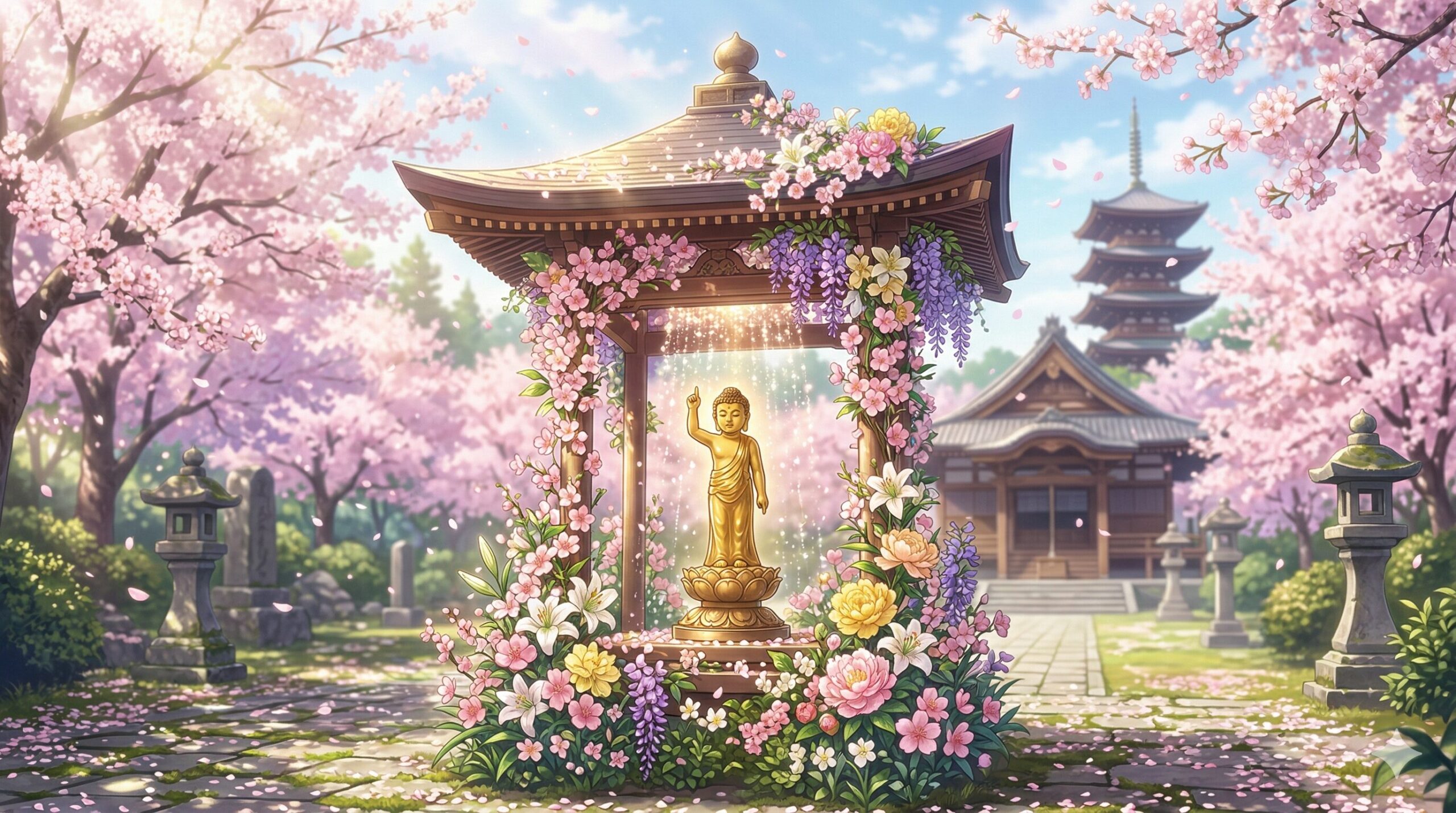
In Japan’s Hanamatsuri, this beautiful legend is visually recreated. A small, beautifully adorned shrine called a “Hanamido” (Flower Pavilion), completely covered in colorful spring flowers, is set up within the temple grounds. In its center stands the “Tanjobutsu” (Birth Buddha), a small statue of the infant Buddha pointing to heaven and earth. Visitors use a small bamboo ladle to gently pour “Amacha” (sweet tea) over the head of the Buddha statue. This act of “Kanbutsu” (pouring water on the Buddha) mimics the sweet rain brought by the nine dragons and gives the ceremony its formal name.
Introduction to Japan and the Secret of “Amacha”
It is said that this ceremony was introduced to Japan during the Asuka period, in the reign of Empress Suiko (early 7th century), shortly after the introduction of Buddhism. At that time, it was a state ceremony held at the imperial court and major temples.
As centuries passed, the event spread among the common people. During the Edo period (17th–19th centuries), the custom of pouring “Amacha” was firmly established. Amacha is a tea made by drying, fermenting, and infusing the leaves of *Hydrangea macrophylla var. thunbergii*. Despite containing no sugar, it possesses a surprisingly strong natural sweetness.
People of that era would take home the Amacha poured over the Buddha on this day, drinking it with their families to pray for good health. A magical custom also emerged: using Amacha to make ink, writing specific protective spells on paper, and pasting them upside down on gates or pillars to ward off evil and insect pests. This is clear evidence of how an imported religion, Buddhism, became deeply intertwined with Japan’s indigenous folk beliefs and practical wisdom.
Fusion with Japanese Culture: Why It Is Called “Hanamatsuri” (Flower Festival)
The affectionate name “Hanamatsuri” actually has a relatively recent origin, dating back to the Meiji era (late 19th to early 20th century). It is said to have been proposed by monks of the Jodo Shinshu sect, inspired by a “flower festival” in Germany. However, there is a deep cultural reason why this name instantly took root throughout Japan.
Since ancient times in Japan, flowers blooming in the mountains in spring were sacred signs heralding the beginning of the agricultural season. It was believed that when the cherry blossoms bloomed, the god of the mountain would descend to the villages, transforming into the “god of the rice paddies” to bring a bountiful harvest. People gathered under the blossoms to eat, drink, welcome, and entertain the gods—the origin of *Hanami* (flower viewing).
April 8th, the Buddha’s birthday, perfectly coincides with the time when cherry blossoms reach full bloom in many parts of Japan. The imported ceremony celebrating the Buddha’s birth synchronized flawlessly with Japan’s ancient nature worship and agricultural rites of admiring flowers, celebrating the arrival of spring, and praying for fertility. The flower pavilion (Hanamido) became a symbol of the mountain of flowers itself, where divine spirits reside. The term “Hanamatsuri” expresses the essence of Japanese culture, where Buddhist teachings and the deep-seated Japanese view of nature harmonize beautifully.
A Message for Us Living Today
“I alone am honored in heaven and on earth.” These words hold an increasingly vital meaning in our modern society. It is a powerful affirmation that, rather than comparing yourself to others, your very existence is absolutely precious and irreplaceable. Hanamatsuri is a day that reminds us to recognize our own dignity and, at the same time, respect the preciousness of every other life.
If you have the opportunity to be in Japan on April 8th, please visit a local temple. Be captivated by the beautiful flowers of the Hanamido, taste the mysterious sweetness of Amacha, and let your thoughts wander to the miracle of Lumbini 2,500 years ago and the rich spring landscape of Japan.
A Question for You
Pouring sweet tea over a shrine decorated with spring flowers. What are your thoughts on this quiet, beautiful Japanese ceremony? Does your country or culture have its own unique customs to celebrate the arrival of spring or the birth of life? If you could participate in Hanamatsuri in Japan, what wish would you make as you pour the sweet tea? I would love to hear your thoughts and learn about your culture.
Reference Links
- Japan Buddhist Federation – Official information on Japanese Buddhist events.
- Read more in the “What’s Today’s Special Day Series”
4月8日は「灌仏会(かんぶつえ) / 花祭り」:日本の春を彩る、仏陀誕生の神秘の祝祭
4月8日。日本が淡いピンク色の桜に包まれ、本格的な春の訪れを祝うこの時期に、全国の寺院では非常に美しく、そして神秘的な儀式が行われます。それが「灌仏会(かんぶつえ)」、現代では親しみを込めて「花祭り(はなまつり)」と呼ばれる仏教行事です。
クリスマスがイエス・キリストの誕生を祝う日であるように、4月8日は仏教の開祖であるお釈迦様(ゴータマ・シッダールタ)の誕生を祝う日です。しかし、日本の花祭りは単なる宗教行事にとどまりません。それは日本の豊かな自然観、季節の移ろいへの畏敬の念、そして古来の農耕文化が見事に融合した、日本独自の文化的スペクタクルなのです。今回は、この特別な日「花祭り」の深淵なる世界へ皆様をご案内します。
ルンビニの奇跡:伝説が息づく歴史的背景
灌仏会のルーツは、およそ2500年前の古代インドに遡ります。紀元前5世紀頃、現在のネパール南部にあるルンビニの園で、マーヤー夫人(摩耶夫人)の右脇からお釈迦様が誕生したと伝えられています。
伝説によれば、お釈迦様は誕生してすぐに東西南北へ7歩ずつ歩み、右手指で天を、左手指で地を指し示し、「天上天下唯我独尊(てんじょうてんげゆいがどくそん)」(世界に存在するすべての命は、それぞれが等しく尊いものである)と宣言しました。この奇跡の瞬間、天上から九頭の龍が現れ、甘露の雨(香水)を注いで赤ん坊の体を洗い清めたとされています。
日本の花祭りでは、この美しい伝説を視覚的に再現します。寺院の境内には、色とりどりの春の花で美しく飾られた小さな堂「花御堂(はなみどう)」が設置され、その中央には天と地を指差すお釈迦様の小さな像「誕生仏(たんじょうぶつ)」が安置されます。参拝者は、柄杓(ひしゃく)ですくった「甘茶(あまちゃ)」を誕生仏の頭上からそっと注ぎかけます。これが、九頭の龍が降らせた甘露の雨を模した「灌仏(仏に水を注ぐ)」という行為であり、この行事の正式名称の由来です。
日本への伝来と「甘茶」の秘密
この儀式が日本に伝わったのは、仏教伝来から間もない飛鳥時代、推古天皇の時代(7世紀初頭)だと言われています。当時は「仏生会(ぶっしょうえ)」と呼ばれ、宮中や大寺院で行われる国家的な儀式でした。
時代を下るにつれ、この行事は庶民の間にも広まっていきます。江戸時代(17世紀〜19世紀)には、現在のように「甘茶」をかける風習が定着しました。甘茶とは、ヤマアジサイの変種である小葉の随菜(こあまちゃ)の葉を乾燥させ、発酵させて煎じたお茶です。砂糖が入っていないにもかかわらず、驚くほど強い天然の甘みを持っています。
当時の人々は、この日に仏に注いだ甘茶を持ち帰り、家族で飲んで無病息災を祈りました。また、甘茶で墨をすり、「千早振る卯月八日は吉日よ 神下げ虫を成敗ぞする」と紙に書いて門口や柱に逆さに貼ることで、厄除けや虫除けのお守りとする呪術的な風習も生まれました。これは、外来の宗教である仏教が、日本の土着の民間信仰や生活の知恵と深く結びついた確たる証拠です。
日本文化との融合:「花祭り」という名の理由
「灌仏会」が「花祭り」という親しみやすい名称で呼ばれるようになったのは、実は比較的最近、明治時代(19世紀後半〜20世紀初頭)のことです。浄土真宗の僧侶たちが、ドイツの「花の祭り」から着想を得て提唱したのが始まりとされています。しかし、この名称が日本中にあっという間に定着したのには、深い文化的理由があります。
日本では古来より、春になり山に咲く花は、農事の始まりを告げる神聖なサインでした。桜の花が咲く頃、山の神が人里に下りてきて「田の神」となり、豊作をもたらすと信じられていたのです。人々は花の下に集い、飲食を共にして神を迎え、慰める「花見」を行いました。
お釈迦様の誕生日である4月8日は、まさに日本の多くの地域で桜が満開を迎える時期と見事に重なります。仏陀の誕生を祝う外来の儀式は、花を愛で、春の訪れと生命の息吹を祝い、豊穣を祈るという日本古来の自然崇拝・農耕儀礼と完璧にシンクロしました。花御堂は、神霊が宿る花の山そのものの象徴となったのです。「花祭り」という言葉には、仏教の教えと日本人の魂の根底にある自然観が見事に調和した、日本文化の真髄が表現されています。
現代を生きる私たちへのメッセージ
「天上天下唯我独尊」。この言葉は、現代社会においてますます重要な意味を持っています。他者と比較するのではなく、あなた自身の存在そのものが絶対的に尊く、かけがえのないものであるという力強い肯定です。花祭りは、私たちが自分自身の尊さに気づき、同時に他者の命の尊さをも敬うことを思い出させてくれる日です。
もし4月8日に日本に滞在する機会があれば、ぜひ近くの寺院を訪れてみてください。花御堂の美しい花々に目を奪われ、甘茶の不思議な甘さを味わいながら、2500年前のルンビニの奇跡と、日本の豊かな春の風景に思いを馳せてみてはいかがでしょうか。
あなたに問いかけたいこと
春の花々で飾られたお堂に甘茶を注ぐ。この静かで美しい日本の儀式について、あなたはどう感じましたか? あなたの国や文化にも、春の訪れや生命の誕生を祝う独自の風習はありますか? もし日本で花祭りに参加できたら、あなたはどんな願いを込めて甘茶を注ぎますか? ぜひ、あなたの考えや文化をシェアしてください。


コメント