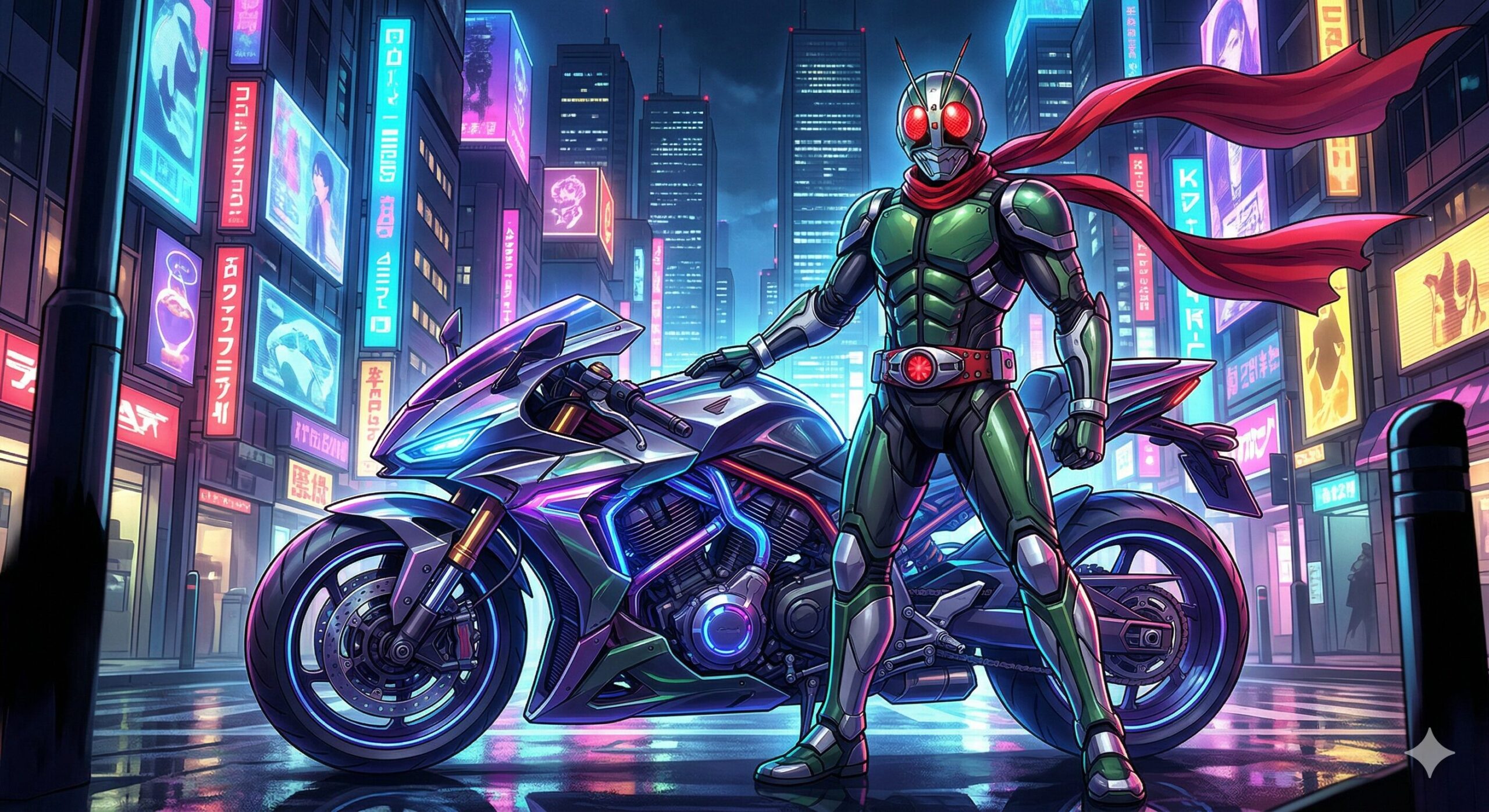
April 3, 1971, stands as a monumental day in Japanese pop culture and the global history of Tokusatsu (special effects). On this day, the first episode of the Tokusatsu television drama “Kamen Rider,” created by Shotaro Ishinomori, was broadcast. This marked the birth of Japan’s unique “Henshin (Transforming) Hero” genre. Let’s delve into the essence of this masterpiece, which transcends simple children’s programming to become deeply rooted in modern Japanese culture.
A Grotesque Hero: The “Shadow” and Deep Sorrow of Kamen Rider
At the time, Western superheroes were generally born with superhuman abilities or were saviors from outer space. However, Takeshi Hongo, the protagonist of Kamen Rider, is different. A brilliant scientist and motorcycle racer, he is abducted by the evil secret society “Shocker” and turned into a “cyborg” (reconstructed human) meant for world domination. Escaping just before his brain is altered, he is burdened with the destiny of fighting the very organization that mutated him.
What exists here is not the shining glory of a champion of justice, but the profound sorrow of “no longer being human.” He faces the contradiction of having to use the weaponized power embedded in his body to defeat his own kind—other cyborgs. This “isolation and conflict” elevated Kamen Rider from a mere action drama to a deep human story. The grotesque, grasshopper-themed design visually emphasizes that he is not a traditional, beautiful hero, but an entity born from the darkness.
The Concept of “Henshin” and Its Connection to Japanese Culture
One of the greatest impacts Kamen Rider had on Japanese culture was the establishment of the concept of “Henshin” (transformation). “Henshin” is not simply changing clothes. By catching the wind in the windmill of his belt and striking a specific pose, he releases his inner energy, performing a ritual that physically and mentally elevates him to a superhuman state.
This approach is deeply linked to traditional Japanese spirituality and aesthetics. For example, in Kabuki, a traditional Japanese performing art, techniques like “Kumadori” (stage makeup) and “Hayagawari” (quick costume changes) are used to present internal emotions and the essence of a character through dramatic changes in appearance. The “Henshin pose” of Kamen Rider functions as a modern Kabuki “Mie” (a powerful pose), serving as a sacred ritual to show his resolve to the world.
Furthermore, the use of a grasshopper—a creature of nature—as a motif reflects the influence of ancient Japanese animism (the belief that spirits dwell in all things). The stance of borrowing the power of nature to fight evil encapsulates themes of technological advancement and harmony with nature, issues that modern Japan continues to face.
The Lineage Leading to Modern “Cool Japan”
The seed of the “Henshin Hero” planted in 1971 has continued to evolve for over half a century. Current Kamen Rider series have grown into massive entertainment franchises that captivate not only children but adults, incorporating complex human relationships, cutting-edge CGI, and themes that reflect the times. This image of a hero who “upholds justice while carrying a shadow” has influenced countless subsequent anime and manga, forming the core of Japan’s “Cool Japan” content.
To Our Readers
Using a “power” that violated him and robbed him of a peaceful human life to protect others. What do you think about this image of a “hero burdened with sorrow” embodied by Kamen Rider? If you suddenly obtained a massive, unwanted power, would you be able to make the decision to use it for the world and for others? Please share your thoughts.
Reference Links
4月3日、1971年:日本のヒーロー文化を変えた「仮面ライダー」放送開始の衝撃
1971年4月3日。この日は、日本のポップカルチャー、そして世界の特撮(Tokusatsu)史において、永遠に語り継がれる記念碑的な日です。石ノ森章太郎原作の特撮テレビドラマ「仮面ライダー」の第1回が放送され、ここから日本独自の「変身ヒーロー」の金字塔が打ち立てられました。単なる子供向けの番組を超え、現代の日本文化に深く根付くこの作品の真髄を、詳細に紐解いていきましょう。
異形のヒーロー:仮面ライダーが持つ「影」と深い悲哀
当時の西洋のスーパーヒーローたちは、生まれながらの超人であったり、宇宙から来た救世主であったりすることが一般的でした。しかし、仮面ライダーの主人公である本郷猛は違います。彼は優秀な科学者でありレーサーでしたが、悪の秘密結社「ショッカー」によって拉致され、世界征服のための「改造人間(サイボーグ)」にされてしまいます。脳を改造される寸前で脱出した彼は、自らを改造した悪の組織と戦う運命を背負います。
ここにあるのは、正義の味方としての輝かしい栄光ではなく、「人間ではなくなってしまった」という深い悲哀です。自分の体に埋め込まれた兵器としての力を使い、同族である改造人間たちを倒さなければならないという矛盾。この「孤独と葛藤」こそが、仮面ライダーを単なるアクションドラマから、深い人間ドラマへと昇華させました。バッタという昆虫をモチーフにした異形のデザインも、彼が「正統派の美しいヒーロー」ではなく、闇から生まれた存在であることを視覚的に強調しています。
「変身(Henshin)」という概念と日本文化との関連
仮面ライダーが日本の文化に与えた最大の影響の一つが「変身(Henshin)」という概念の確立です。「変身」とは、単に服を着替えることではありません。ベルトの風車に風を受け、一定のポーズをとることで、内なるエネルギーを開放し、超人的な姿へと物理的・精神的に昇華する儀式です。
このアプローチは、日本の伝統的な精神性や美学と深くリンクしています。例えば、日本の伝統芸能である歌舞伎における「隈取(くまどり)」や「早替わり」は、内面的な感情やキャラクターの本質を、外見の劇的な変化によって観客に提示する手法です。仮面ライダーの「変身ポーズ」は、現代の歌舞伎の「見得(みえ)」であり、自らの覚悟を世界に示すための神聖な儀式として機能しています。
また、バッタという自然界の生物をモチーフにした点は、日本古来のアニミズム(万物に魂が宿るという思想)の影響を感じさせます。自然の力を借りて悪と戦う姿勢は、テクノロジーの進化と自然との調和という、現代日本が直面し続けているテーマをも内包しているのです。
現代の「クールジャパン」へと続く系譜
1971年に蒔かれた「変身ヒーロー」の種は、その後半世紀以上にわたって進化を続けています。現在の仮面ライダーシリーズは、複雑な人間関係、最先端のCG技術、そして時代を反映したテーマを取り入れ、子供だけでなく大人をも魅了する巨大なエンターテインメントへと成長しました。この「影を背負いながらも正義を貫く」というヒーロー像は、後の多くのアニメや漫画に影響を与え、日本の「クールジャパン」コンテンツの中核を成しています。
読者の皆様へ
自らを傷つけ、人間としての平穏な生活を奪った「力」を、他者を守るために使う。仮面ライダーが体現したこの「悲しみを背負ったヒーロー像」について、あなたはどう思いますか?もしあなたが、望まない強大な力を突然手に入れてしまったとしたら、それを世界のために、他者のために使う決断ができるでしょうか?ぜひ、あなたの考えを教えてください。
コメント