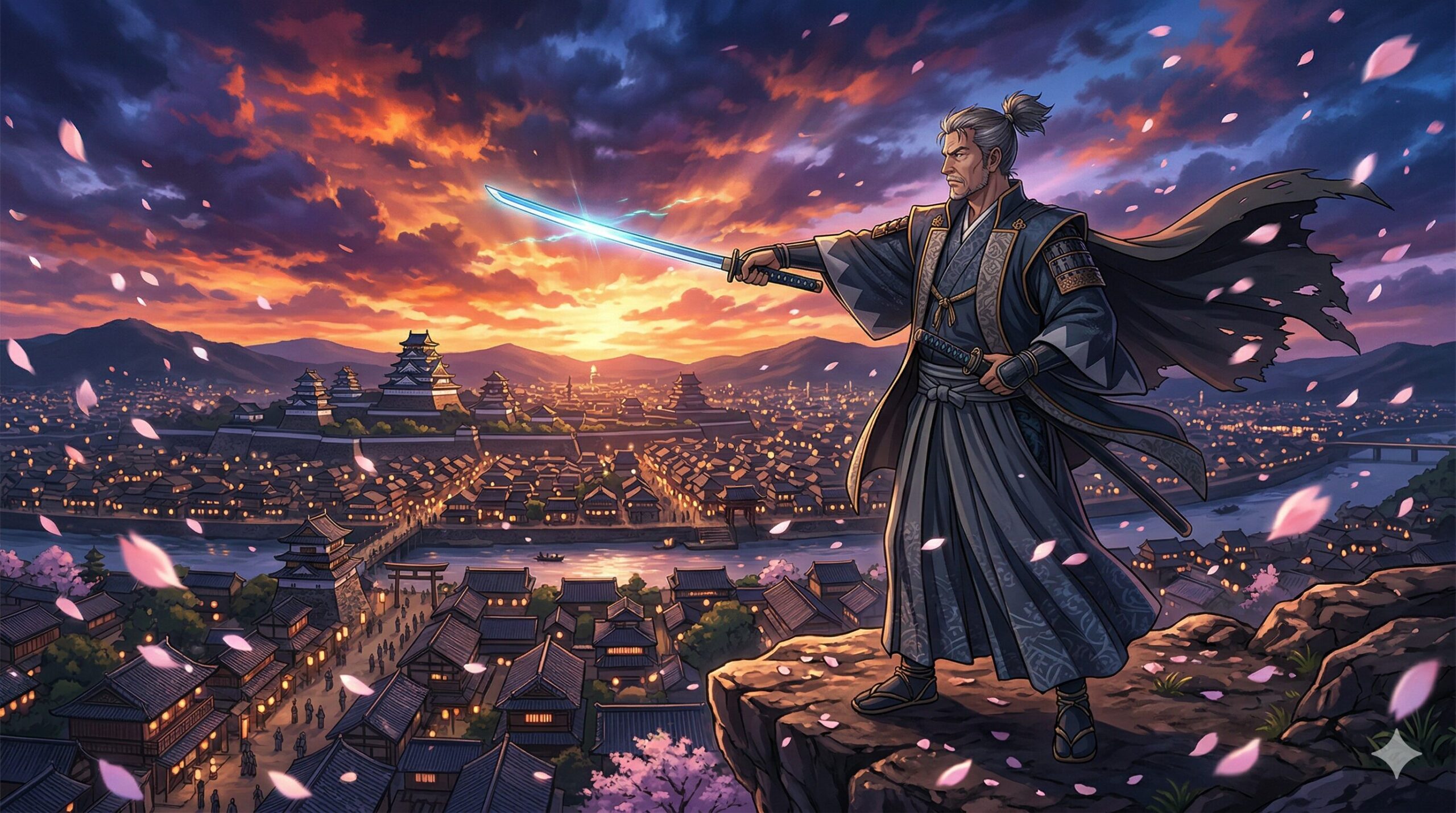
On March 25, 1837, a highly unusual and profoundly significant event erupted in Japanese history: Oshio Heihachiro’s Rebellion. This was no ordinary riot or uprising. It was an exceptionally rare historical moment where a member of the elite class, working within the massive power structure of the Edo Shogunate, bared his fangs at the establishment—risking his status, his wealth, and his life to save the starving masses.
The Resolve of a Former Elite Samurai Against Famine and Corruption
At the time, Japan was suffering from a devastating crop failure known as the “Tenpo Famine.” Relentless bad weather destroyed agricultural yields, leading to mass starvation across the country. Osaka, the economic heart of Japan, was particularly hard hit. Refugees flooded the city in search of food, creating a hellish landscape where the streets were littered with the bodies of those who had starved to death.
In the face of this unprecedented crisis, the authorities and the wealthy merchants who monopolized the nation’s riches were astonishingly cruel. The Osaka City Magistrate’s Office, rather than providing relief, forcibly bought up rice in Osaka to ship to the Shogun in Edo. Furthermore, they colluded with wealthy merchants to artificially inflate the price of rice, lining their own pockets while the people died.
Oshio Heihachiro, a former Yoriki (a high-ranking official serving as both police and judge) at the Osaka City Magistrate’s Office, was engulfed in furious indignation at this utter corruption. He had already retired from his post and was teaching philosophy at his private academy, the Senshindo, but he could not abandon the suffering masses. He sold his entire extensive collection of books to fund relief efforts, but there was a limit to what one individual could do. His repeated desperate petitions to the Shogunate for official relief were completely ignored. Finally, he came to a grim conclusion: “There is no choice left but to correct this regime by force.”
On March 25, raising the banner of “Kyumin” (Saving the People), Oshio launched an armed rebellion with his students and local farmers. They attacked the mansions of wealthy merchants, attempting to seize hidden rice and money to distribute to the commoners. The rebellion itself was suppressed in a mere half-day by the Shogunate’s overwhelming military force, and Oshio was eventually forced to commit seppuku. However, the fact that a former direct vassal of the Shogunate had led an armed revolt sent shockwaves throughout Japan. It shattered the unassailable authority of the Tokugawa regime, becoming a crucial turning point that ultimately paved the way for the Meiji Restoration.
Wang Yangmingism and “Unity of Knowledge and Action”: Justice Without Action is Meaningless
To truly understand Oshio Heihachiro’s actions, we must look at the philosophy he passionately believed in and taught: Yomeigaku (Wang Yangmingism, a school of Neo-Confucianism). One of its most critical concepts is “Chigyo Goitsu” (The Unity of Knowledge and Action). This is a strict doctrine stating: “True knowledge only has meaning when accompanied by action. To know what is right but fail to act upon it means you do not truly know it at all.”
The spirit of Bushido (The Way of the Warrior) is often described as absolute loyalty to one’s master. However, what Oshio embodied was loyalty to the “Law of Heaven” (absolute, universal justice). Innocent people were starving before his eyes, and those in power were corrupt. Having recognized this as pure evil, turning a blind eye would have meant the death of his own spirit as a practitioner of Yomeigaku. He knew from the very beginning that the rebellion would fail and that he would die. Yet, he still chose to act. It was the ultimate proof of his integrity and adherence to his own conscience and philosophy.
This spirit of “helping the weak and crushing the strong,” along with the aesthetic of risking one’s life for one’s beliefs, remains deeply rooted in modern Japanese culture through concepts like “Giri” (duty) and “Ninjo” (compassion). The reason Japanese people are so strongly drawn to stories of individuals sacrificing themselves for others is because figures like Oshio Heihachiro left undeniable, real footprints in the nation’s history.
A Question for You in the Modern World
On this day in 1837, Oshio Heihachiro threw away a life of guaranteed security to stand up for those whose voices had been silenced.
Having read this article, what are your thoughts on his decision? If you were to witness undeniable injustice or people crying out for help in today’s society, would you be able to cast aside self-preservation and take the right action? In our modern era, overflowing with knowledge and information, Oshio’s philosophy that “justice without action is meaningless” poses a heavy question to us all. How will you choose to live your life today?
References & Categories
- Internal Link: Read more from the “What’s Today’s Special Day” Series
- External Link: Oshio Heihachiro (Wikipedia)
- External Link: Tenpo Famine (Wikipedia)
3月25日:大塩平八郎の乱(1837年)〜飢える民を救うため、エリート武士がすべてを捨てた日〜
1837年(天保8年)3月25日、日本の歴史において非常に特異で、かつ重要な意味を持つ事件が勃発しました。「大塩平八郎の乱」です。これは単なる暴動や反乱ではありません。江戸幕府という巨大な権力機構の内部にいたエリート層が、飢餓に苦しむ一般大衆を救済するために、自らの地位、財産、そして命を懸けて体制に牙を剥いた、極めて稀有な歴史的事件です。
飢饉と腐敗に立ち向かった元エリート侍の決断
当時の日本は「天保の大飢饉」と呼ばれる深刻な凶作に見舞われていました。連日の悪天候により農作物は壊滅的な被害を受け、全国各地で餓死者が続出していました。特に、経済の中心地であった大坂(現在の大阪)には、食料を求めて難民が押し寄せ、路上には餓死者の遺体があふれるという地獄のような惨状が広がっていました。
この未曾有の危機に対し、時の権力者である幕府や、富を独占していた豪商たちは、驚くほど冷酷でした。大坂町奉行所は、民衆を救済するどころか、江戸の将軍家へ送るための米を大坂から強引に買い上げ、さらには豪商たちと結託して米の価格を吊り上げ、私腹を肥やしていたのです。
この腐敗しきった状況に激しい怒りを覚えたのが、大坂町奉行所の元与力(警察・裁判官のような上級役人)であった大塩平八郎です。彼はすでに役職を辞し、私塾「洗心洞」で学問を教えていましたが、苦しむ民衆を見捨てることはできませんでした。彼は自身の蔵書をすべて売り払って得た資金で民衆を救済しようと試みましたが、個人の力では限界がありました。幕府への再三にわたる救済の嘆願も無視され、ついに彼は「もはや武力をもって体制を正すほかない」と決断します。
3月25日、大塩は「救民」の旗を掲げ、門下生や農民たちとともに蜂起しました。彼らは豪商の屋敷を襲撃し、隠匿されていた米や金銭を民衆に分け与えようとしました。反乱自体は幕府の圧倒的な兵力の前にわずか半日で鎮圧され、大塩も後に自刃に追い込まれます。しかし、幕府の元直参が反乱を起こしたという事実は、日本全国に多大な衝撃を与え、結果として幕府の権威を大きく失墜させ、後の明治維新へと繋がる歴史の転換点となりました。
陽明学と「知行合一」:行動なき正義は無意味である
大塩平八郎の行動を深く理解するためには、彼が熱心に信仰し、また教えていた「陽明学(ようめいがく)」という哲学を知る必要があります。陽明学の最も重要な教えの一つに「知行合一(ちこうごういつ)」という概念があります。これは、「真の知識とは、行動を伴って初めて意味を持つ。正しいと知っていながら行動しないのは、まだ本当に知っているとは言えない」という厳格な思想です。
日本の武士道精神は、しばしば主君への絶対的な忠誠心として語られますが、大塩が体現したのは「天の理(絶対的な正義)」に対する忠誠です。目の前で無実の民衆が飢えに苦しみ、権力者が腐敗している。それが「悪」であると認識した以上、陽明学を修めた大塩にとって、見て見ぬふりをすることは自分自身の精神を殺すことと同義でした。彼は、反乱が失敗し自分が死ぬことを最初から悟っていました。それでもなお行動を起こしたのは、自らの良心と哲学に対する究極の誠実さの証明だったのです。
この「弱きを助け、強きを挫く」精神と、「自らの信念に命を懸ける」という美学は、現代の日本文化にも「義理と人情」や「滅私奉公」の精神として形を変えて深く根付いています。日本人が自己犠牲を払ってでも他者を助ける物語に強く惹かれるのは、大塩平八郎のような人物が歴史に確かな足跡を残しているからです。
現代を生きるあなたへの問いかけ
1837年のこの日、大塩平八郎は、見て見ぬふりをすれば安泰だった自らの人生を捨て、声を上げられない人々のために立ち上がりました。
この記事を読んだあなたは、彼の決断についてどう思いますか?もしあなたが現代社会で、明らかな不正や、救いを求めている人々を目の当たりにしたとき、保身を捨てて正しい行動をとることができるでしょうか? 知識や情報があふれる現代だからこそ、大塩の「行動なき正義は無意味である」という哲学は、私たちに重く問いかけてきます。あなたなら、今日という日をどう生きますか?
参考リンク・カテゴリー
- 内部リンク:今日は何の日シリーズをもっと読む
- 外部リンク:大塩平八郎の乱(Wikipedia)
- 外部リンク:天保の大飢饉(Wikipedia)

コメント