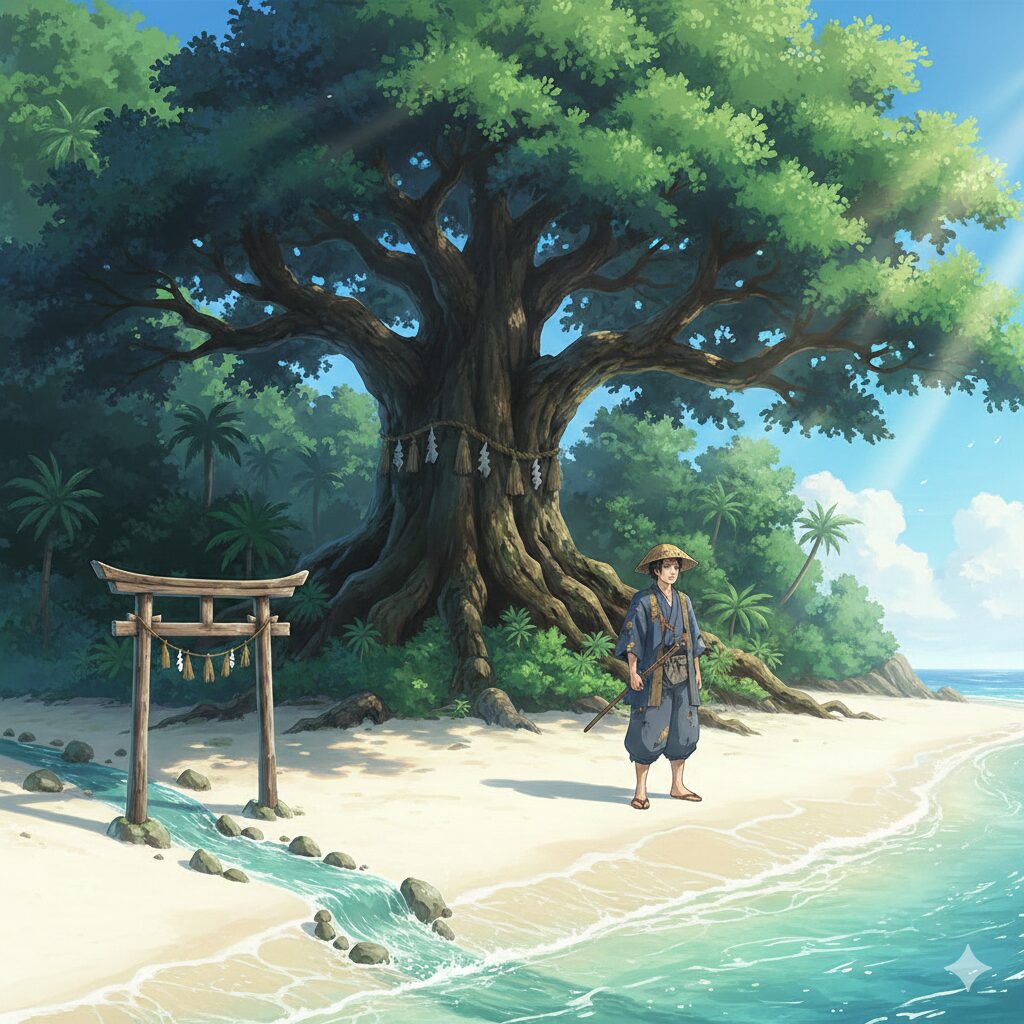
Long ago during the Edo period, a merchant ship was caught in a fierce typhoon off the coast of the Enshu Sea. Battered by the violent winds and waves, the ship was shattered into pieces, and the crew members were swallowed one by one by the dark ocean. Amidst the chaos, only one man, a young sailor named Seikichi, managed to cling to a large piece of driftwood and miraculously survived.
After drifting for several days, Seikichi awoke on a remote, deserted island, surrounded by lush green jungles and white sandy beaches, completely devoid of any human presence. As he wandered the island suffering from intense thirst and hunger, only the sound of the waves and the cries of wild birds echoed around him, as if mocking his misfortune. Initially, Seikichi cursed his fate and screamed in despair at the ocean. However, eventually, the human instinct to “live” drove him into action.
Observing the movements of wild monkeys, Seikichi discovered a spring of fresh water deep within the island. He learned the ancient art of making fire by rubbing branches and dried moss together, a task that took him days to master. He learned to dive into the ocean to spear fish, forage for nuts, and built a small shelter to protect himself from the rain and wind. Within a few months, his despair had vanished, and he had completely acquired the skills to live as a part of the island’s nature.
One day, Seikichi found a magnificent piece of driftwood washed ashore. Using it, he built a small Torii gate and placed it near the freshwater spring. In his solitude, rather than cursing his destiny, he began to offer his deepest gratitude to the unseen gods for keeping him alive on this island. He thanked the sunlight, prayed to the ocean that brought him food, and held deep reverence for the storms that occasionally ravaged the land.
Ten years passed. Seikichi’s original clothes had long rotted away, and he now wore garments woven from grass and tree bark. Yet, his eyes were far clearer than they had ever been in the city. One morning, a foreign trading ship appeared on the horizon. Seikichi raised the smoke of his campfire high into the sky; the ship approached the island, and he was finally rescued.
Returning to civilization and stepping onto the soil of his hometown, people celebrated Seikichi as a “miraculous survivor.” However, his heart remained strangely detached. To him, the people frantically rushing about, obsessed with money, status, and the opinions of others, appeared far less “free” than he had been on his isolated island. For the rest of his life, Seikichi lived simply in a small hut by the sea, gazing at the ocean with the most peaceful smile, holding onto a wisdom that no money could buy.

The True Value of Humanity Tested in Extremes: A Deep Analysis
The story of “The Man Washed Ashore on a Deserted Island” is not merely a survival tale. It asks a profound question: What remains when a human is completely stripped of the framework of society?
At first, Seikichi was crushed by loneliness and despair. This serves as proof of how much we rely on “others” and “tools of civilization” to establish our sense of self. However, instead of trying to dominate his environment, he chose to adapt to it. The core message of this story is the profound truth that the ultimate survival strategy is not “the power to conquer nature,” but “the flexibility to harmonize with it.”
Those ten years stripped the impurities of civilization from his body and sharpened his spirit to its absolute limit. The alienation he felt toward society upon his rescue is a sharp critique of modern life. Have we truly become affluent? Or have we lost our fundamental strength and peace as living beings in exchange for material wealth? Seikichi’s way of life quietly presents us with this question.
Coexistence with Nature: The Essence of Japanese Culture
When compared to the quintessential Western castaway story, “Robinson Crusoe,” the unique cultural values hidden within this Japanese folktale become vividly clear. After washing ashore, Robinson Crusoe uses his intellect to conquer nature, domesticate animals, and “rule” the island. This reflects a Western perspective where nature is a force to be dominated and overcome.
Seikichi’s actions are the exact opposite. He does not rule the island; he feels that he is “allowed to live” by it. Building a Torii gate near the spring perfectly symbolizes this. This is the very essence of Japanese Animism—the belief in “Yaoyorozu no Kami” (the eight million gods), recognizing that spirits reside in all things.
The climate and geography of Japan bring abundant blessings but also frequent, uncontrollable natural disasters like typhoons and earthquakes. Because of this, since ancient times, Japanese people have chosen not to “dominate” nature, but to live in “Kyousei” (coexistence) with it—holding reverence for nature, appeasing its wrath, and giving thanks for its blessings. The reason Seikichi survived the deserted island and found inner peace is precisely because he unconsciously practiced this ancient Japanese philosophy of nature.
How Would You Survive?
If tomorrow you were completely cut off from all civilization and washed ashore alone on an unknown, deserted island, what would be your first thought? How would you act?
Would you scream in despair? Would you fight to conquer the nature around you? Or, like Seikichi, would you listen to the sound of the wind and choose the path of becoming one with the island? This is not just a story of the past. It is a compass for the heart, essential for modern people who are overflowing with information and material goods, yet so often lose sight of their true selves.
What kind of “truth” would you discover on that deserted island?
[Reference & Related Links]
- Reference: Japanese Folktale: The Man Washed Ashore on a Deserted Island (JP)
- Read more fascinating stories: Japanese Folktale Series
【日本昔話】無人島に流された男の数奇な運命
江戸の昔、ある商船が遠州灘の沖合で猛烈な台風に巻き込まれた。激しい波風に船はなす術もなく砕け散り、乗組員たちは次々と暗い海へ飲み込まれていった。その中でただ一人、若い水夫の清吉(せいきち)だけが、大きな木片にしがみつき、奇跡的に一命を取り留めた。
数日間の漂流の末、清吉が目を覚ましたのは、見渡す限り人工物が一切存在しない、鬱蒼とした緑と白い砂浜に囲まれた絶海の孤島であった。喉の渇きと飢えに苦しみながら島を彷徨う清吉を嘲笑うかのように、聞こえるのは波の音と野鳥の鳴き声だけ。最初は自身の不運を呪い、海に向かって泣き叫んだ清吉であったが、やがて「生きる」という人間の本能が彼を突き動かした。
清吉は島の野生の猿の動きを観察し、島の奥深くにある湧き水を発見する。木の枝と乾燥した苔を擦り合わせ、何日もかけて火を起こす術を身につけた。海に潜って魚を突き、木の実を採集し、雨風を凌ぐための小屋を建てた。数ヶ月が経つ頃には、絶望は消え去り、彼は完全にこの島の自然の一部として生きる術を獲得していた。
ある日、清吉は浜辺に打ち上げられた立派な流木を見つけた。彼はそれを使って小さな鳥居を作り、湧き水のそばに立てた。彼は孤独の中、自らの運命を呪うのではなく、その島で生かされていることに対して、見えざる神々への感謝を捧げるようになったのである。太陽の光に感謝し、恵みをもたらす海に祈り、時には猛威を振るう嵐に畏敬の念を抱いた。
それから十年の歳月が流れた。清吉の着物はとうに朽ち果て、草や樹皮を編んだものを身に纏っていたが、その眼差しは都会にいた頃よりも遥かに澄み切っていた。ある朝、水平線の彼方に一隻の異国船が姿を現した。清吉が焚き火の煙を高く上げると、船は島に近づき、ついに彼は救出された。
文明社会への帰還。故郷の土を踏んだ清吉を、人々は「奇跡の生還者」として持て囃した。しかし、清吉の心はどこか冷めていた。金銭や地位、他人の評価に翻弄され、せわしなく生きる人々の姿が、かつて自分がいた孤島よりも遥かに「不自由」に見えたからだ。清吉はその後、海辺の小さな小屋で質素に暮らし、誰よりも穏やかな笑顔で、生涯海を眺めながら生き抜いたのである。
極限状態で試される人間の真価:昔話の深い考察
この「無人島に流された男」の物語は、単なるサバイバルストーリーではない。人間が社会という枠組みから完全に切り離されたとき、何が残るのかを深く問いかけている。
清吉は最初、孤独と絶望に打ちひしがれた。これは、私たちが普段どれほど「他者」や「文明の利器」に依存して自己を確立しているかの証明である。しかし、彼は環境を支配しようとするのではなく、環境に適応することを選んだ。この物語の核心は、「自然をねじ伏せる力」ではなく「自然と調和する柔軟さ」こそが、究極の生存戦略であるという真理だ。
十年という月日は、彼の肉体から文明の垢を削ぎ落とし、精神を極限まで研ぎ澄ませた。救出された後、彼が文明社会に対して覚えた違和感は、現代社会を生きる私たちへの痛烈な批判でもある。私たちは本当に豊かになったのか。それとも、物質的な豊かさと引き換えに、生命としての根源的な強さや安らぎを失ってしまったのか。清吉の生き様は、その問いを静かに突きつけている。
自然との共生:この物語から読み解く日本文化の神髄
西洋の代表的な漂流譚である『ロビンソン・クルーソー』と比較すると、この日本昔話に隠された独自の文化性が鮮明に浮かび上がる。ロビンソン・クルーソーは島に漂着した後、自らの知恵で自然を開拓し、動物を家畜化し、島を「支配」していく。そこには、自然を克服すべき対象と捉える西洋的な自然観がある。
一方、清吉の行動は全く異なる。彼は島を支配するのではなく、島に「生かされている」という感覚を抱く。湧き水のそばに鳥居を建てた行動が、まさにその象徴である。これは、万物に神が宿ると考える日本の「八百万の神(やおよろずのかみ)」というアニミズムの精神そのものだ。
日本の気候風土は、豊かな恵みをもたらす一方で、台風や地震といった抗えない自然災害を頻繁に引き起こす。そのため、日本人は古来より自然を「支配する」のではなく、自然に対して畏敬の念を抱き、その怒りを鎮め、恵みに感謝するという「共生(きょうせい)」の道を選んできた。清吉が孤島で生き延び、そして精神的な平穏を手に入れたのは、この日本古来の自然観を無意識のうちに実践したからに他ならない。
あなたならどう生き抜くか?
もし明日、あなたが一切の文明から切り離され、見知らぬ無人島にたった一人で流されたとしたら、まず何を思い、どう行動するだろうか。
絶望して泣き叫ぶか。それとも、自然を支配しようと闘うか。あるいは、清吉のように風の音に耳を澄まし、その島の一部となる道を選ぶだろうか。この物語は、過去の昔話ではない。情報と物質に溢れ、本当の自分を見失いがちな現代人にこそ必要な、心の羅針盤である。
あなたなら、この孤島でどんな「真実」を見つけるだろうか。
【参考・関連リンク】
- 参考:日本昔話:無人島に流された男
- 日本の不思議な物語をもっと読む:Japanese Folktale Series

コメント