Among all the colors in the world, perhaps none encompasses as many diverse emotions and meanings—and is as frequently misinterpreted across different cultures—as “black.” In many Western cultures, black has often been perceived as a symbol of death, mourning, evil, or a primal fear of the unknown. However, across the ocean in the island nation of Japan, black is never merely a symbol of “darkness” or “negation.” It represents the ultimate beauty, infinite depth, the highest level of dignified respect, and a philosophical existence that encompasses all other colors.
Every year, September 6th is designated as “Black Day” (Kuro no Hi) in Japan. While this day originated from a clever linguistic wordplay—the Japanese word for nine is “Ku” and six is “Ro,” creating “Kuro” (Black)—the true background of this anniversary is deeply rooted in Japan’s traditional dyeing techniques and an unparalleled aesthetic consciousness passed down for over a millennium. In this article, using “Black Day” as our gateway, we will delve deeply into how Japanese culture has confronted, cherished, and elevated the color “black” into high art.
- 1. The Historical Background of Sept 6 “Black Day” and the Essence of Kyoto Black Dyeing
- 2. Story: The Black that Harbors the Sea of Ako by the Kizugawa River
- 3. The Philosophy and Multifaceted Aesthetics of “Black” in Japanese Culture
- 4. Modern Japanese Society and the Black Revolution
- 5. What Does “Black” Mean to You?
- 九月六日は「黒の日」:日本の伝統色「黒」に隠された深淵なる美学と歴史
- 1. 9月6日「黒の日」の歴史的背景と「京都黒染」の真髄
- 2. ストーリー:『木津川のほとり、赤穂の海を宿す黒』
- 3. 日本文化における「黒」の哲学と多角的な美学
- 4. 現代の日本社会と黒の革命
- 5. あなたにとって「黒」とは何ですか?
1. The Historical Background of Sept 6 “Black Day” and the Essence of Kyoto Black Dyeing
“Black Day” was officially established in 1989 by the Kyoto Black Dyeing Industry Cooperative. Kyoto, having flourished as Japan’s capital for over 1,000 years, is a place where the techniques of silk weaving and dyeing have developed to a world-class level. Among these, “Kurozome” (black dyeing) is known as a supreme artisanal craft requiring extraordinary skill and spiritual endurance.
The history of Japanese black dyeing is ancient, tracing its roots back to the Heian period (10th century). At that time, the colors aristocrats could wear were strictly dictated by their social rank. The technique of complexly mixing plant bark, mud, and iron to dye fabric black was highly advanced. In particular, a deep, glossy black known as “Binroji-zome” was an exclusive symbol of authority and nobility, permitted only to those of the absolute highest status. Black possessed a strength that could not be tainted by any other color.
Even in modern Japan, the most formal attire among traditional Japanese clothing (Kimono) is the “Kurotomesode” or “Kuro-montsuki”—kimonos dyed in an absolute, profound black. At weddings and vital ceremonies, relatives invariably wear these black kimonos to show the utmost respect to the other party.
To create “Shikkoku” (absolute black)—a color that absorbs light and never fades—artisans endure an overwhelming process of repeatedly dipping the fabric into vats of dye, drying it, and dipping it again. By alternately soaking the fabric in a broth made from logwood (a plant-based dye) and an iron-rich mordant, they induce a chemical reaction within the fibers to fix the color. They meticulously calculate temperature, humidity that changes with the seasons, and even the rich mineral content of the groundwater, literally “fixing the darkness” into the fabric. September 6, Black Day, is also a day filled with the earnest desire to shine a light on this proud craftsmanship—which is gradually being lost to the waves of mass production—and preserve it for future generations.
2. Story: The Black that Harbors the Sea of Ako by the Kizugawa River
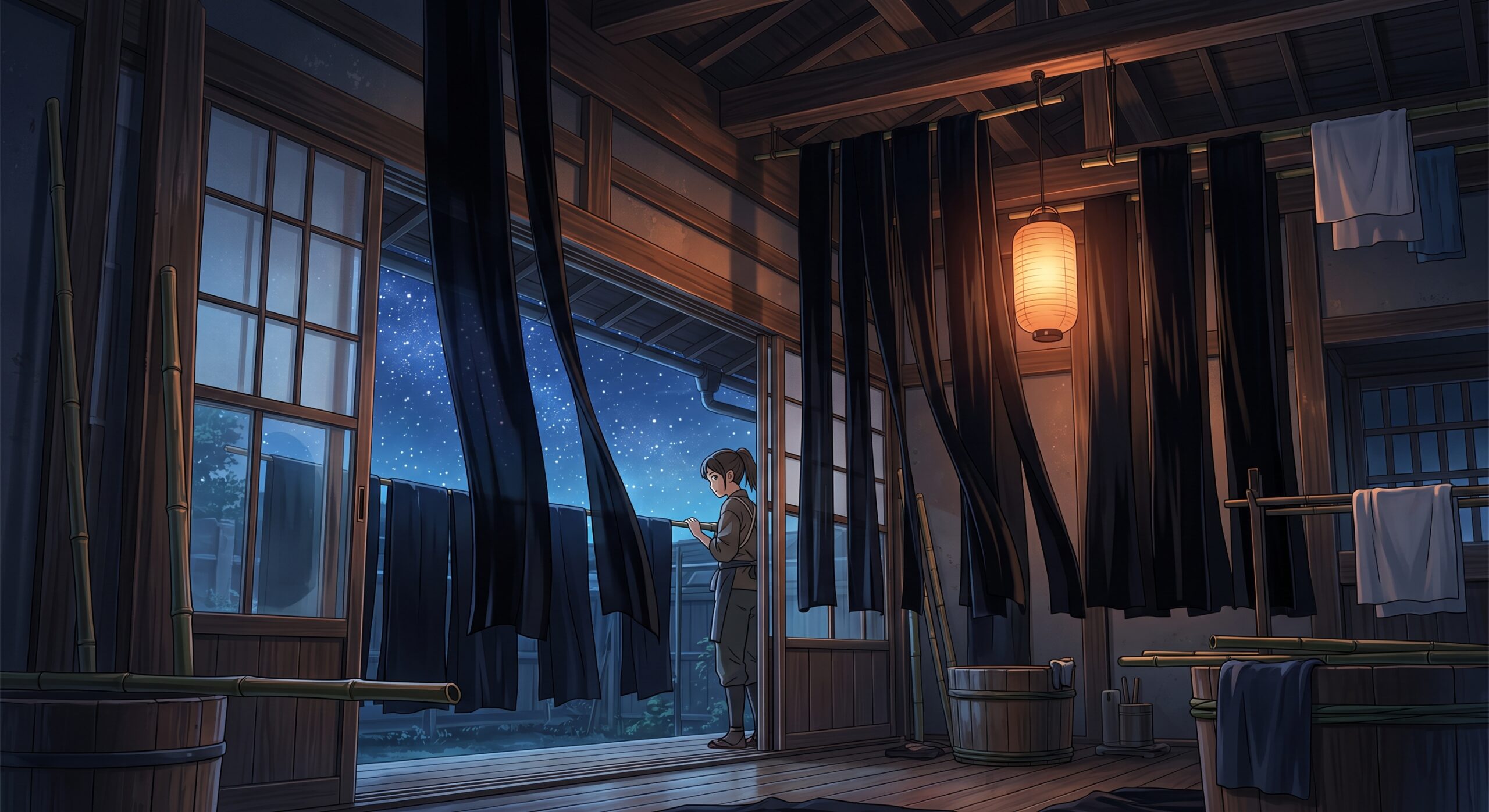
On the banks of the Kizugawa River in the southern reaches of Kyoto, where the water flows gently, stood a quiet, old dyeing workshop. Inside, a young artisan named Kazuya worked alongside his grandfather and master, Genzo.
Genzo had originally grown up in a seaside village in the Ako district of Harima Province, eventually moving to this region in his youth to hone his craft. The black he dyed possessed such a profound depth that even his peers revered and feared it as a “bottomless black.” However, his grandson Kazuya simply could not replicate that “depth.”
“Master, a reddish tint has appeared again. I’ve followed the temperature and dye formulas exactly as you taught me.”
As Kazuya unrolled the freshly dyed bolt of fabric and hung his head, Genzo quietly turned off the fire under the vat and traced the surface of the cloth with his fingertips. At the edge of the fabric, the client’s family crest—the “Go-san no Kiri” (Paulownia)—was beautifully left stark white. Yet, the black surrounding it somehow lacked vitality.
“Kazuya, you are trying to create ‘black’ relying only on numbers and chemical reactions. But true black is not something you can simply manufacture because you want to. Unless you possess the resolve to absorb and accept everything, the fabric will not dye a true black for you.”
Genzo looked out the workshop window at the Kizugawa River bathed in the evening twilight.
“The sea of Ako I used to watch as a child… at night, it became terrifyingly dark. An endless darkness that seemed to swallow even the starlight. But within that darkness, there was the roar of the ocean, the scent of the tide, and countless lives breathing. The darkness was never ‘nothingness.’ It was a ‘vessel’ that embraced everything. Your black lacks that depth of embrace. You are merely layering colors, trying to repel the light.”
That night, Kazuya remained alone in the workshop, ruminating on his grandfather’s words. He realized that he had been solely pursuing the superficial result of “making it look black.” To make the Go-san no Kiri crest stand out, the surrounding black must not assert itself. Black had to be a “silence” that allowed the protagonist—the crest and the inner light of the wearer—to shine brightly.
The next morning, in the cold air before dawn, Kazuya faced the vat once more. Discarding his calculations, he focused all his senses on the faint sound of the cloth absorbing the dye, the coldness of the groundwater, and the moment the fabric breathed upon touching the air. He conversed with the cloth, harmonized with the nature of Kizugawa, and devoted himself purely to dyeing silence into the fabric.
A few days later, after being washed and held up to the autumn sunlight, Kazuya’s fabric softly absorbed the light, brimming with a deep absolute black akin to a night sea. The Go-san no Kiri crest floating within that absolute black shone more nobly and beautifully than any crest he had ever seen. Genzo gazed silently at the fabric and nodded deeply just once. It was the moment Kazuya first touched the “prayer” hidden within Japanese black.
3. The Philosophy and Multifaceted Aesthetics of “Black” in Japanese Culture
As this story illustrates, in Japanese culture, “black” transcends mere color classification to hold profound religious and philosophical meaning. To truly understand Japanese culture, the role of black can be divided into the following vital elements.
① The “Infinite Colors” of Sumi-e (Ink Wash Painting)
The traditional Japanese painting technique of “Sumi-e” depicts nature and the universe using only black ink (Sumi) on white Washi paper. While Western oil painting often attempts to faithfully replicate reality by layering many colors, Sumi-e invokes colors in the viewer’s imagination through the shading of the black ink, the vigor of the brushstrokes, and “Yohaku” (empty, unpainted space). In Zen teachings, black is considered “the ultimate color that contains all colors,” and it is believed that an infinite world of all four seasons expands within a single stroke of black.
② Urushi (Lacquerware) and In Praise of Shadows
Japan’s traditional craft of “Urushi” (Lacquerware) is an art form so representative of the country that it is sometimes simply called “Japan” in English. The black of lacquerware possesses a glossy, wet-like brilliance and a fathomless depth. The great Japanese novelist Junichiro Tanizaki wrote in his world-renowned essay “In Praise of Shadows” (In’ei Raisan) that “the beauty of lacquerware is not found under bright lighting, but truly reveals its worth under the flickering candlelight of a dim traditional Japanese room.” Japanese aesthetics lie not in illuminating everything bluntly, but in appreciating the grace and profound beauty (Yugen) hidden within the shadows.
③ Sen no Rikyu and the Kuro-Raku Tea Bowl
In the 16th century, Sen no Rikyu, the historical figure who perfected the Japanese Tea Ceremony, favored above all else the “Kuro-Raku” tea bowl, which completely eliminated all decoration. While the powerful ruler of the time, Toyotomi Hideyoshi, preferred golden tea rooms and brilliant colors, Rikyu valued the spirit of “Wabi-Sabi.” He found the ultimate beauty in a distorted tea bowl that possessed only the warmth of the clay and a deep black. The color that most beautifully accentuated the vivid green of the Matcha tea was the quiet black, stripped of all excess and self-assertion.
④ Ohaguro (Tooth Blackening) and Samurai Armor
Historically, Japan had a unique custom called “Ohaguro,” where married women and aristocrats dyed their teeth black. Black has the property of “not being dyed by any other color.” Therefore, dyeing one’s teeth black was a vow of eternal love and an expression of unwavering resolve, signaling that one would not be tainted by anyone else. Furthermore, for the Samurai heading to the battlefield, the “Kuro-ito Odoshi” (black-laced armor)—iron plates coated in black lacquer and laced together with black silk cords—was of the highest rank, displaying immense dignity and a solemn readiness for death.
4. Modern Japanese Society and the Black Revolution
This overwhelming aesthetic consciousness regarding black is deeply inherited in modern Japan. In the 1980s, Japanese fashion designers like Yohji Yamamoto and Comme des Garçons challenged the Paris fashion scene with a style unified entirely in black, fundamentally overturning the common sense of the global fashion world. They sublimated Japan’s traditional “aesthetics of shadows” into modern clothing, transforming black from a mere color of mourning into a color of independent, powerful individuality.
Furthermore, in Japanese business scenes and official ceremonies, the black suit is firmly established as the attire demonstrating the most trust and courtesy. This is a fusion of Japan’s spirituality—which suppresses self-assertion and values harmony—and the historical concept of “black as the highest formal attire.”
5. What Does “Black” Mean to You?
September 6, “Black Day,” encourages us to turn our eyes to the beauty found within “darkness” and “shadows.” In a modern society where everything is lit by bright screens and overflowing with information, the aesthetic of “quiet and deep black” that Japan has cherished since ancient times might offer our exhausted minds a gentle peace and a moment to reflect on ourselves.
To you, who have read this article to the end, I would like to pose a final question.
In your country or culture, what meanings and emotions are embedded in the color “black”?
If you were to turn off all the lights in your room tonight and light a single candle, what beautiful things would you find within that darkness and flickering shadow?
Please think deeply about the “charm of black” that you feel and share your thoughts. I hope that the silent message of Japanese black brings a new perspective to your daily life.
Reference Links:
– Traditional colors of Japan – Wikipedia
– Official Kyoto Travel Guide (Discover traditional crafts and culture)
Read more stories about Japanese anniversaries and calendars here:
View the What’s Today’s Special Day Series Category Top
九月六日は「黒の日」:日本の伝統色「黒」に隠された深淵なる美学と歴史
世界中の色彩において、「黒」ほど多様な感情や意味を内包し、また文化によって大きく解釈が異なる色はありません。西洋の多くの文化圏において、黒はしばしば死や喪、悪、あるいは未知への恐怖を象徴する色として捉えられてきました。しかし、海を隔てた島国・日本において、黒は決して単なる「闇」や「否定」を意味するものではありません。それは究極の美であり、無限の深さであり、最も格式高い敬意を表し、そしてすべての色を内包する哲学的な存在なのです。
毎年九月六日は、日本において「黒の日」に制定されています。この日は、「く(9)ろ(6)」という日本語の語呂合わせから生まれましたが、その背景には、日本の伝統的な染色技術と、数百年以上にわたって受け継がれてきた比類なき美意識が存在します。本記事では、この「黒の日」を入り口として、日本文化がどのように「黒」と向き合い、愛し、芸術へと昇華させてきたのかを深く掘り下げていきます。
1. 9月6日「黒の日」の歴史的背景と「京都黒染」の真髄
「黒の日」は、1989年(平成元年)に京都黒染工業協同組合によって制定されました。京都は、1000年以上にわたって日本の首都として栄え、絹織物や染め物の技術が世界最高峰のレベルで発達した場所です。その中でも「黒染め(くろぞめ)」は、特別な技術と精神的な忍耐を必要とする至高の職人技として知られています。
日本の黒染めの歴史は古く、10世紀の平安時代にまで遡ります。当時の貴族たちは、身分によって身につける色が厳密に定められていました。植物の樹皮や泥、鉄分を複雑に調合し、布を黒く染め上げる技術は非常に高度であったため、特に「檳榔子染(びんろうじぞめ)」と呼ばれる深く艶やかな黒は、最上位の身分を持つ者のみが身につけることを許された、権威と高貴さの象徴でした。黒は、他のどんな色にも染まらない強さを持っていたからです。
現代の日本においても、伝統的な衣装である「着物(Kimono)」の中で、最も格式の高い第一礼装は「黒留袖(くろとめそで)」や「黒紋付(くろもんつき)」と呼ばれる、漆黒に染め抜かれた着物です。結婚式や重要な儀式において、親族は必ずこの黒い着物を着用し、相手への最大の敬意を示します。
職人たちは、光を吸収し、決して色あせることのない「漆黒(しっこく)」を作り出すために、布を何度も染め液に浸し、乾かし、また浸すという途方もない作業を繰り返します。植物性の染料であるログウッドの煮汁と、鉄分を含んだ媒染剤を交互に布に含ませることで、繊維の中で化学反応を起こし、色を定着させます。季節によって変化する気温や湿度、そして豊かな地下水のミネラル成分に至るまでを計算し尽くし、布の中に文字通り「闇を定着させる」のです。九月六日の「黒の日」は、大量生産の波に飲まれ、失われつつあるこの誇り高き職人技術に光を当て、後世に残していくための切実な願いが込められた日でもあります。
2. ストーリー:『木津川のほとり、赤穂の海を宿す黒』
京都の南端、穏やかな流れを見せる木津川のほとりに、ひっそりと佇む古い染め物工房がありました。工房の中には、若き職人の和也と、彼の祖父であり師匠でもある源三の姿がありました。
源三はもともと、播磨国・赤穂郡の海辺の村で生まれ育ち、若い頃に職人としての腕を磨くためにこの地へ移り住んできた男でした。彼の染める黒は、同業者の間でも「底なしの黒」と恐れられるほどの深みを持っていました。しかし、孫の和也には、どうしてもその「深さ」を再現することができませんでした。
「師匠、また赤みが出てしまいました。温度も、染料の配合も、すべて教えられた通りにやっているはずなのに」
和也が染め上げたばかりの反物を広げてうなだれると、源三は静かに釜の火を落とし、布の表面を指先でなぞりました。布の端には、依頼主の家紋である「五三の桐」が白く美しく抜かれていました。しかし、その周囲を覆う黒には、どこか生命力が欠けていました。
「和也よ、お前は数字と化学反応だけで『黒』を作ろうとしている。だがな、本当の黒というのは、作ろうと思って作れるものではない。すべてを吸い込み、受け入れる覚悟がなければ、布は黒く染まってはくれないのだ」
源三は、工房の窓から見える夕暮れの木津川に目をやりました。
「わしが子供の頃に見ていた赤穂の海はな、夜になると恐ろしいほど真っ暗になった。星の光すら飲み込むような、果てしない闇だ。だが、その闇の中には、海鳴りの音があり、潮の香りがあり、無数の命が息づいていた。闇は決して『無』ではなかった。すべてを包み込む『器』だったのだ。お前の黒には、その懐の深さがない。ただ色を塗り重ねて、光を弾き返そうとしているだけだ」
その夜、和也は工房に一人残り、祖父の言葉を反芻しました。彼は自分が、いかにして「黒く見せるか」という表面的な結果ばかりを追い求めていたかに気がつきました。五三の桐の紋章を引き立たせるためには、周囲の黒が自己を主張してはならないのです。黒は、主役である紋や、着る人の内面を輝かせるための「静寂」でなければなりませんでした。
翌朝、夜明け前の冷たい空気の中、和也は再び釜に向かいました。計算を捨て、布が染料を吸い込む微かな音、地下水の冷たさ、空気に触れて布が呼吸する瞬間に全神経を集中させました。彼は布と対話し、木津川の自然と調和しながら、ただひたすらに静寂を布に染め込んでいきました。
数日後、洗い上げられ、秋の陽光に透かされた和也の布は、光を柔らかく吸い込み、まるで夜の海のような深い漆黒を湛えていました。その漆黒の中に浮かび上がる五三の桐は、今まで見たどんな紋よりも気高く、美しく輝いていました。源三は黙ってその布を見つめ、一度だけ深く頷きました。それは和也が、日本の黒に隠された「祈り」に触れた瞬間でした。
3. 日本文化における「黒」の哲学と多角的な美学
この物語が示すように、日本の文化において「黒」は単なる色彩学上の分類を超えた、宗教的・哲学的な意味を持っています。日本文化を深く理解する上で、黒という色が果たす役割は以下の要素に分けられます。
① 水墨画(Sumi-e)に見る「無限の色彩」
日本の伝統的な絵画技法である「水墨画」は、白い和紙の上に、黒い墨(Sumi)だけで大自然や宇宙を描き出します。西洋の油絵が多くの色を重ねて現実を忠実に再現しようとするのに対し、水墨画は黒の濃淡、筆の勢い、かすれ、そして「余白(何も描かれていない空間)」を使って、見る者の想像力の中に色彩を呼び起こします。禅(Zen)の教えでは、黒は「すべての色を含んだ究極の色」とされ、たった一つの黒の中に、春夏秋冬の無限の世界が広がっていると考えられています。
② 漆(Urushi)と陰翳礼讃(In Praise of Shadows)
日本の伝統工芸である「漆器(Lacquerware)」は、英語でそのまま「Japan」と呼ばれることがあるほど、日本を代表する芸術です。漆器の黒は、濡れたような艶やかな輝きと、底知れぬ深みを持ちます。日本の偉大な文豪、谷崎潤一郎(Junichiro Tanizaki)は、その世界的名著『陰翳礼讃(In’ei Raisan)』の中で、「漆器の美しさは、明るい照明の下ではなく、薄暗い和室の揺らめくロウソクの灯りの下でこそ真価を発揮する」と記しました。日本の美意識は、光を当ててすべてをあからさまにするのではなく、影(暗闇)の中に潜む奥ゆかしさや幽玄の美を愛でることにあります。
③ 千利休と黒楽茶碗(Kuro-Raku Tea Bowl)
16世紀、日本の茶道(Tea Ceremony)を大成させた千利休(Sen no Rikyu)が最も愛したのが、装飾を一切排除した「黒楽茶碗」でした。当時の権力者である豊臣秀吉が黄金の茶室や華やかな色彩を好んだのに対し、利休は「わび・さび(Wabi-Sabi)」の精神を重んじ、土の温もりと深い黒だけを持つ歪んだ茶碗に、究極の美を見出しました。抹茶の鮮やかな緑色を最も美しく引き立てるのは、自己を主張せず、無駄を削ぎ落とした静寂の黒だったのです。
④ お歯黒(Ohaguro)と武士の甲冑
かつて日本には、既婚女性や貴族が歯を黒く染める「お歯黒」という独自の風習がありました。黒は「他のどんな色にも染まらない」という性質を持ちます。つまり、歯を黒く染めることは「夫以外の誰にも染まらない」という永遠の愛への誓い、そして揺るぎない決意の表れでした。また、戦場に赴く武士たちにとっても、黒い漆で塗られた鉄板を黒い糸で結び合わせた「黒糸威(くろいとおどし)」の鎧は、最も格式が高く、威厳と死への覚悟を示すものでした。
4. 現代の日本社会と黒の革命
この黒に対する圧倒的な美意識は、現代の日本にも色濃く受け継がれています。1980年代、ヨウジヤマモトやコム・デ・ギャルソンといった日本のファッションデザイナーたちは、全身を黒で統一したスタイルでパリ・コレクションに挑み、世界のファッション界の常識を根底から覆しました。彼らは、日本の伝統的な「影の美学」を現代の服飾に昇華させ、黒を単なる喪服の色から、自立した力強い個性の色へと変えたのです。
また、日本のビジネスシーンや公式な式典において、黒のスーツは最も信頼と礼儀を示す服装として定着しています。これは、自己主張を抑え、相手に対する和と敬意を重んじる日本の精神性と、歴史的な「黒=最高礼装」の概念が融合した結果と言えます。
5. あなたにとって「黒」とは何ですか?
九月六日の「黒の日」は、私たちに「闇」や「影」の中にある美しさに目を向けるよう促してくれます。すべてが明るい画面に照らされ、情報に溢れている現代社会において、日本が古くから大切にしてきた「静かで深い黒」の美学は、私たちの疲れた心に穏やかな安らぎと、自分自身を見つめ直す時間を与えてくれるかもしれません。
この記事を最後まで読んでくださったあなたに、最後に問いかけたいと思います。
あなたの国や文化圏では、「黒」という色にはどのような意味や感情が込められていますか?
もしあなたが今夜、部屋の電気をすべて消して、一本のキャンドルだけを灯したなら、その暗闇と揺らめく影の中に、どのような美しいものを見つけるでしょうか?
ぜひ、あなたが感じる「黒の魅力」について深く考え、その想いを教えてください。日本の黒が持つ静寂のメッセージが、あなたの日常に新しい視点をもたらすことを願っています。
その他の日本の記念日や暦の物語はこちらからご覧いただけます:
今日は何の日シリーズ(What’s Today’s Special Day Series)カテゴリートップへ

コメント