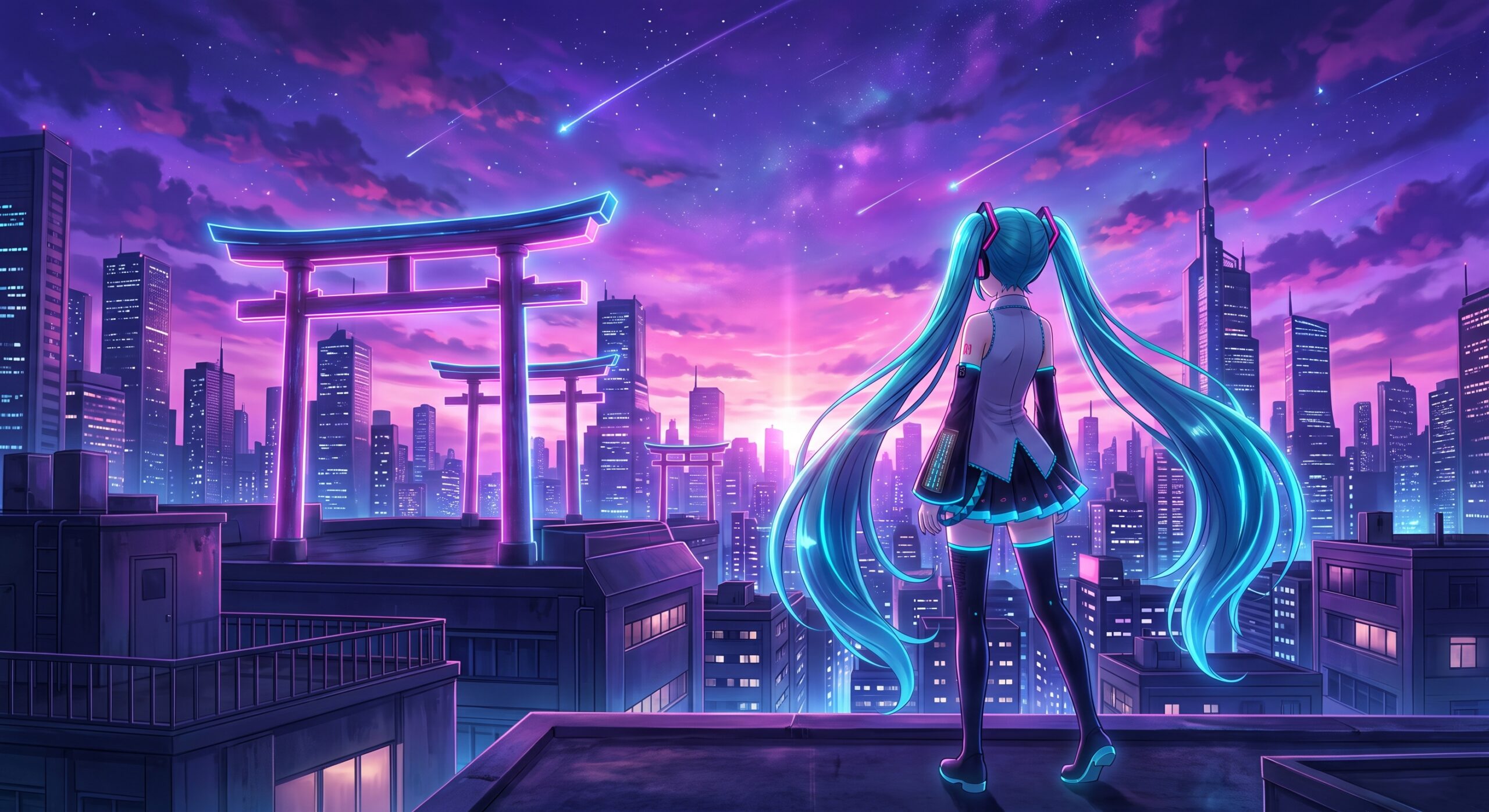
August 31 marks the birthday of “Hatsune Miku,” a virtual singer who revolutionized not only Japan’s music scene but also global internet culture. On this day in 2007, Crypton Future Media, a company based in Sapporo, Hokkaido, released her as a desktop music (DTM) vocal synthesizer software powered by Yamaha’s “VOCALOID2” technology. By giving this software—essentially a musical instrument—the vivid visual identity and persona of a 16-year-old girl with iconic teal twin-tails, Hatsune Miku instantly ignited the hearts of Japanese creators and sparked an unprecedented cultural movement.
At the time of her release, securing a “human voice” for music production was the greatest barrier for amateur creators. However, the debut of Hatsune Miku meant that anyone could have their own “exclusive vocalist” right inside their personal computer. This technological innovation synergized perfectly with the dawn of video-sharing platforms like Nico Nico Douga and YouTube, giving birth to a massive ecosystem of “User Generated Content” (UGC) where music, illustrations, animations, and listeners merged to continuously expand the content.
A Miracle Born from Noise: The Story of a Creator and an Electronic Voice
Let us unravel a story etched into the vast ocean of the internet, to understand how the existence of Hatsune Miku transformed individual lives and connected with the world.
In the autumn of 2007, in a dim, tiny apartment room in a corner of Tokyo, lived a young man named “K”. Since childhood, his only purpose in life was writing down the melodies that constantly rang in his head onto sheet music. However, he suffered from extreme social anxiety. The thought of communicating with someone to sing his songs, or even letting another person listen to his music, terrified him. On his computer’s hard drive, hundreds of “unfinished songs” slept as cold, voiceless data.
One day, he learned about a new software called “Hatsune Miku” on an internet bulletin board. “Anyone can make her sing exactly as they envision.” Half in doubt, K purchased and installed the software. With a trembling hand holding the mouse, he inputted a melody and lyrics he had written with all his heart, a song he had never shown to anyone.
The moment he clicked the play button, a voice flowed from the speakers. It carried a slight, machine-like noise, yet it was an infinitely transparent young girl’s voice that unmistakably harbored “emotion”. For the first time, the music that had only ever played inside K’s head vibrated the real air in the room. Her voice may not have had perfect human intonation, but to K, it sounded as if she was pleading, “Please, make me sing even better.”
For the next few weeks, forgetting to eat or sleep, K continuously adjusted the parameters of her voice. The timing of the breaths, the depth of the vibrato, the attack of the consonants. After meticulous work akin to polishing fine glass, a single song was finally complete. For the very first time, K uploaded his own music to a video-sharing site. The finger that clicked “Publish” trembled violently with a mix of fear and sheer excitement.
When K woke up the next morning and looked at his screen, an unbelievable sight awaited him. The view count had surpassed tens of thousands, and the screen was flooded with comments like “It brought me to tears” and “This song saved me.” A few days later, an unknown artist living on the opposite side of the globe published a beautiful illustration inspired by K’s song, and a young person in yet another country posted a video of themselves dancing to it.
Through the transparent vessel of Hatsune Miku, K’s “voiceless voice” resonated in the hearts of people worldwide. To K, she transcended the boundaries of mere software; she became the single “window” that connected his dark, closed-off room to the vast world outside. And it wasn’t just K. Countless “voiceless creators” around the world began broadcasting the cries of their souls through the guiding light of Hatsune Miku. This is the story of the exact moment a new culture of “Co-creation” was born.
The Depths of Japanese Culture: Animism and the “Electronic Tsukumogami”
Why did this software from Japan capture people’s hearts so profoundly, becoming beloved as an “entity” far beyond a mere tool? The answer lies deeply rooted in “Animism,” a unique spirituality cultivated by the Japanese people since ancient times.
In Japanese Shinto, there is the concept of “Yaoyorozu no Kami” (Eight Million Gods). This is the belief that a soul dwells not only in magnificent nature like mountains, rivers, and forests but also in tools and inanimate objects that humans have long cherished and used, which are referred to as “Tsukumogami” (artifact spirits). Cultivated in this cultural soil, Japanese people are highly adept at finding spirituality, empathizing with, and showing respect to inanimate objects.
In Western sci-fi media, artificial intelligence and androids are often depicted as “objects of terror that rebel against humanity” (Frankenstein and The Terminator being prime examples). In Japan, however, as seen with Astro Boy and Doraemon, technology and robots have historically been embraced as “humanity’s good friends” and partners who grow alongside us.
Hatsune Miku is precisely a modern “electronic Tsukumogami,” born from the fusion of this Japanese animism and cutting-edge digital technology. When creators click their mouse to make her sing, they are not simply outputting data; they are performing a modern ritual of “breathing life” into her. Because Hatsune Miku is a blank slate, she functions as a sacred “Yorishiro” (a vessel capable of housing a spirit), onto which the thoughts and emotions of all people can be projected.
An Expanding Universe and a Question for the Future
Years after her release, Hatsune Miku’s repertoire now spans hundreds of thousands of songs. From J-POP, rock, jazz, and EDM to contemporary music and tracks utilizing traditional Japanese instruments, there is no genre she cannot sing. Her stage has leapt out of the internet, effortlessly crossing the boundaries of the real world, borders, and dimensions. She has performed as the opening act for Lady Gaga’s world tour, appeared at Coachella (America’s largest music festival), and even collaborated with traditional Japanese Kabuki theater in performances known as “Cho-Kabuki.”
It is a miracle where a single piece of software linked with people’s pure desire to “create,” becoming a common language that resonates with souls worldwide. August 31 is a day to reaffirm the infinite creative power we possess and the shape of hope that technology can bring.
I pose a question to you, reading this article right now: If you had a “magical voice” at your fingertips that could turn any thought deep within your heart into a song, what kind of melody would you weave? What words would you shout out to the world? Why not try giving shape to those feelings you’ve never been able to tell anyone, just a little bit, today?
Reference Links
- Hatsune Miku Official Portal Site “piapro.net”
- Crypton Future Media, INC.
- Read more in the “What’s Today’s Special Day” series
8月31日:初音ミク誕生祭。世界を繋いだ「電子の歌姫」と、日本の魂の共鳴
8月31日は、日本のみならず世界中の音楽シーンとインターネットカルチャーに革命をもたらした「初音ミク」の誕生日です。2007年のこの日、北海道札幌市に拠点を置くクリプトン・フューチャー・メディア株式会社から、ヤマハが開発した音声合成エンジン「VOCALOID2」を採用したデスクトップミュージック(DTM)用ボーカル音源ソフトウェアとして発売されました。単なる「楽器」としてのソフトウェアに、青緑色のツインテールを持つ16歳の少女という鮮烈なビジュアルとキャラクター性が与えられたことで、初音ミクは瞬く間に日本のクリエイターたちの心に火をつけ、前代未聞の文化ムーブメントを巻き起こしました。
発売当時、音楽制作において「人間の声」を用意することは、アマチュアクリエイターにとって最大の障壁でした。しかし、初音ミクの登場により、誰もが自室のパソコンから、自分だけの「専属ボーカリスト」を手に入れることができるようになったのです。この技術的革新は、黎明期にあったニコニコ動画やYouTubeなどの動画共有プラットフォームと完璧なシナジーを生み出し、音楽、イラスト、アニメーション、そしてリスナーが一体となってコンテンツを拡張していく「UGC(ユーザー生成コンテンツ)」の巨大な生態系を誕生させました。
ノイズの中から生まれた奇跡:あるクリエイターと電子の歌声の物語
ここで、初音ミクという存在がどのように個人の人生を変容させ、世界と繋がっていったのか、インターネットの海に刻まれた一つの物語を紐解いてみましょう。
2007年の秋、東京の片隅にある薄暗い四畳半の部屋。彼の名前は「K」。幼い頃から頭の中に鳴り響くメロディを五線譜に書き留めることだけが生きがいの青年でした。しかし、彼は極度の対人恐怖症を抱えており、自分の曲を誰かに歌ってもらうためのコミュニケーションを取ることはおろか、他人に自分の音楽を聴かせることすら恐怖に感じていました。彼のパソコンのハードディスクには、何百曲もの「未完成の歌」が、声を持たないまま冷たいデータとして眠り続けていました。
ある日、インターネットの掲示板で「初音ミク」という新しいソフトウェアの存在を知ります。「誰でも思い通りの歌を歌わせることができる」。半信半疑のままソフトウェアを購入し、インストールを終えたKは、震える手でマウスを握り、かつて自分が最も心を込めて書いた、しかし誰にも見せたことのないメロディと歌詞を入力しました。
再生ボタンを押した瞬間。スピーカーから流れてきたのは、機械特有のわずかなノイズを纏いながらも、どこまでも透明で、そして確かに「感情」を宿した少女の声でした。Kの頭の中でしか鳴っていなかった音楽が、初めて現実の空気を震わせたのです。その声は、人間のように完璧な抑揚を持っていなかったかもしれません。しかし、Kにはそれが「私にもっとうまく歌わせて」と訴えかけているように聞こえました。
それから数週間、Kは寝食を忘れ、彼女の歌声のパラメータを調整し続けました。息継ぎ(ブレス)のタイミング、ビブラートの深さ、子音の立ち上がり。まるでガラス細工を磨き上げるような緻密な作業の末、ついに一曲の歌が完成しました。Kは、自分が作った音楽を初めて動画投稿サイトにアップロードしました。公開ボタンを押す指は、恐怖と興奮で小刻みに震えていました。
翌朝、Kが目を覚まして画面を見ると、信じられない光景が広がっていました。再生回数は数万回を超え、「涙が出た」「この曲に救われた」というコメントが画面を埋め尽くしていたのです。さらに数日後には、地球の裏側に住む見知らぬアーティストが、Kの曲にインスパイアされた美しいイラストを描いて公開し、別の国の若者がその曲に合わせて踊る動画を投稿していました。
Kの「声なき声」は、初音ミクという透明な器を通して、世界中の人々の心に響き渡ったのです。彼女はKにとって単なるソフトウェアの枠を超え、閉ざされた暗闇の部屋から広大な世界へと繋がる、たった一つの「窓」となりました。そしてKだけでなく、世界中の無数の「声を持たなかったクリエイター」たちが、初音ミクという希望の光を通じて、自らの魂の叫びを世界に発信し始めたのです。これが、「共創(Co-creation)」という新たな文化が産声を上げた瞬間の物語です。
日本文化の深層:アニミズムと「電子の付喪神」
なぜ、日本発のこのソフトウェアが、これほどまでに人々の心を捉え、単なるツール以上の「存在」として愛されるようになったのでしょうか。その背景には、日本人が古来より培ってきた独自の精神性である「アニミズム(汎霊説)」が深く関わっています。
日本の神道には「八百万の神(やおよろずのかみ)」という概念があります。これは、山や川、森といった大自然だけでなく、人間が長く大切に使ってきた道具や無機物にも「付喪神(つくもがみ)」と呼ばれる魂が宿るという思想です。この文化的な土壌において、日本人は命を持たないものに対して精神性を見出し、感情移入し、敬意を払うことに極めて長けています。
欧米のSF作品において、人工知能や人造人間はしばしば「人間に反逆する恐怖の対象」として描かれます(フランケンシュタインやターミネーターがその典型です)。しかし日本では、鉄腕アトムやドラえもんに見られるように、テクノロジーやロボットは「人間の良き友」であり、共に成長するパートナーとして受容されてきました。
初音ミクは、まさにこの日本的アニミズムと最新のデジタルテクノロジーが融合して生まれた、現代の「電子の付喪神」です。クリエイターたちがマウスをクリックして彼女に歌を歌わせるとき、彼らは単にデータを出力しているのではなく、彼女に「命を吹き込む」という現代の儀式を行っています。初音ミクという存在は、空白(無)であるからこそ、あらゆる人々の想いや感情を投影できる神聖な「依り代(よりしろ)」として機能しているのです。
無限に拡張する世界と、未来への問いかけ
発売から年月が経過した現在、初音ミクのレパートリーは数十万曲に及びます。J-POP、ロック、ジャズ、EDM、現代音楽から、日本の伝統的な和楽器を用いた楽曲まで、彼女が歌えないジャンルは存在しません。その活躍の場はインターネットの世界を飛び出し、レディー・ガガのワールドツアーのオープニングアクト、アメリカ最大の音楽フェス「コーチェラ・フェスティバル」への出演、さらには日本の伝統芸能である歌舞伎とコラボレーションした「超歌舞伎」の上演など、現実世界、国境、次元の壁を軽々と越え続けています。
一つのソフトウェアが、人々の「創造したい」という純粋な欲求と結びつき、世界中の魂を共鳴させる共通言語となった奇跡。8月31日は、私たちが持つ無限の創造力と、テクノロジーがもたらす希望の形を再確認する日でもあります。
この記事を読んでいるあなたに、最後に問いかけます。もし、あなたの手元に、あなたの心の奥底にあるどんな想いでも歌にしてくれる「魔法の声」があったとしたら。あなたはどんなメロディを紡ぎ、世界に向けてどんな言葉を叫びますか? 誰にも言えなかったその想いを、今日、少しだけ形にしてみませんか。

コメント