The Story: The Greatest Bride Under Heaven
Once upon a time, in the castle town of Shuri in Okinawa, a mother and her daughter Tsuruko lived together in modest peace. Tsuruko had porcelain-clear skin, eyes as deep and pure as obsidian, and a natural grace in every movement. Yet her greatest charm was her heart: she cared deeply for her mother and treated every neighbor with effortless kindness.
Word of Tsuruko’s beauty and virtue spread across Shuri like wildfire, soon reaching the ears of every young man on the island. Day after day, marriage messengers crowded her doorstep. Heirs of noble clans, wealthy merchants, and accomplished samurai arrived bearing lavish gifts, all begging for Tsuruko’s hand in marriage.
Yet no matter how prestigious the offer, her mother refused them all. She cared nothing for gold or titles; she wanted only a sincere, gentle husband who would cherish her daughter for life. Overwhelmed by the endless proposals, the mother walked one day to Sonohyan-utaki, a deeply sacred grove standing just beside Shuri Castle.
Kneeling before the ancient limestone gate shaded by dense subtropical trees, she clasped her hands and prayed with all her soul:
“O sacred spirits, please guide us. Grant my daughter a truly kind-hearted husband worthy of her.”
Unbeknownst to her, a man was lurking behind the foliage, listening to every word. His name was Tara, the spoiled son of a wealthy landowner nearby. Though born into riches, Tara was lazy, dim-witted, and notorious throughout the town for his foolishness. Still, he had long coveted Tsuruko’s beauty and was desperate to claim her as his wife.
“What a stroke of luck,” Tara smirked to himself.
Hatching a wicked scheme, he returned early the next morning and hid behind the stone gate of Sonohyan-utaki just before the mother arrived for her daily prayer.
As soon as the mother bowed her head, a booming, artificially solemn voice echoed from behind the sacred stone:
“I am the deity of this grove!”
Startled, the mother pressed her forehead to the ground in awe.
“Your prayers have been heard. Listen well: the very first man you meet on your walk home today is Tsuruko’s fated husband. Marry her to him without hesitation.”
Overwhelmed with gratitude that the gods had spoken directly to her, the mother wept tears of joy and bowed deeply before heading home. Her heart fluttered with hope as she walked down the stone-paved path—until a figure came lumbering around the corner. To her horror, it was Tara.
Tara greeted her with a smug grin. All color drained from the mother’s face. “Of all people, why Tara…?” The shock was so severe that the moment she reached home, she collapsed into bed with a fever.
Yet when Tsuruko heard what had happened, she did not panic or weep. Gently taking her mother’s trembling hand, she spoke with quiet resolve:
“Please do not worry, Mother. If this is the will of the gods, then it is my destiny. I will gladly marry Tara.”
And so, the wedding day arrived. That evening, a luminous autumn full moon hung high over Shuri. Dressed in magnificent traditional Ryukyuan bridal attire, Tsuruko stepped into the palanquin sent by Tara’s household.
The bearers carrying her palanquin, however, had already drunk far too much awamori liquor at the landowner’s mansion. Lulled by the cool night breeze along a quiet tree-lined road, they set the palanquin down for “just a quick rest” and promptly fell fast asleep, snoring loudly under the moonlight.
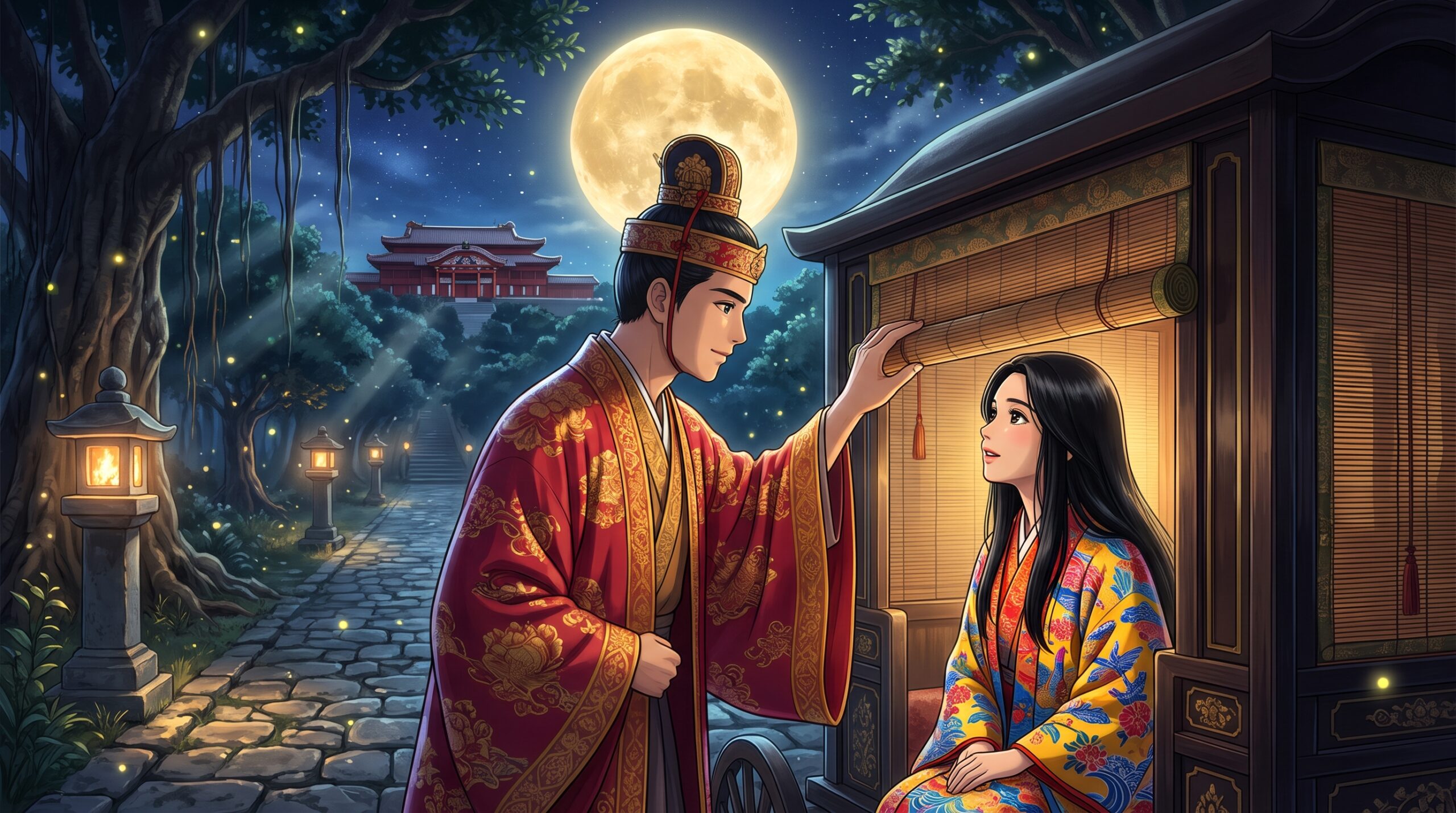
Moments later, an elegant royal procession passed down that very road. It was the young King of the Ryukyu Kingdom, returning to Shuri Castle with his retainers after an autumn moon-viewing banquet. Finding a bridal palanquin abandoned beside drunken bearers, the King grew suspicious and gently lifted the bamboo blind.
The instant moonlight fell upon Tsuruko’s face, the young King caught his breath. Her ethereal beauty, serene dignity, and quiet courage captivated him completely. Learning the full truth—of Tara’s deceitful trick and Tsuruko’s selfless devotion to her mother’s prayer—the King made an immediate decision.
“A woman of such noble spirit shall never be surrendered to a cowardly trickster.”
Ordering his retainers to place a small black calf tethered nearby into the palanquin in her stead, the King escorted Tsuruko into his own carriage and brought her directly to Shuri Castle.
At the break of dawn, the palanquin bearers finally woke up in a panic. Without once checking inside, they hoisted the palanquin onto their shoulders and sprinted straight to Tara’s estate.
Rubbing his hands together in glee, Tara threw open the palanquin door—only to be met not by a radiant bride, but by a lively black calf letting out a loud, cheerful “Moo!”
Tara’s face turned crimson with rage.
“What is the meaning of this?! Are you making a fool of me?! Take this beast back!”
Yanking the rope furiously, he marched to the mother’s house, hurled the calf onto her doorstep, and stormed away.
Knowing nothing of the royal rescue, the mother stared at the black calf in heartbreak.
“Oh, my poor darling… Even though it was the god’s command, the marriage must have been so unbearable that you turned into a calf out of sorrow.”
Weeping bitterly, she threw her arms around the little calf. From that day forward, she treated the animal as her own flesh and blood—washing its coat every day, feeding it the tenderest grass, and whispering loving words to it every night.
Seasons passed, and the gentle warmth of March arrived. At Shuri Castle, a grand royal performance known as Gozen-buyo (classical Ryukyuan court dance) was held before the King, and the castle gates were opened for commoners to watch. Thinking, “At least let Tsuruko enjoy the beautiful dances,” the mother led the black calf by its rope up to the castle courtyard.
As she stood beside the calf watching dancers swirl in vibrant Bingata silk robes, a high-ranking court official approached her and bowed deeply.
“Please come with me to the inner palace. Her Majesty the Queen is waiting for you.”
Bewildered, the mother followed the official into the resplendent royal chambers. Seated there, adorned in dazzling royal robes and wearing a warm, luminous smile, was her own beloved daughter, Tsuruko.
“Mother!”
“Tsuruko…! Is it truly you?!”
The two rushed into each other’s arms, sobbing tears of pure joy. After hearing everything that had happened on that moonlit night, the mother looked up toward the sky and whispered:
“So the deity of Sonohyan-utaki turned even a wicked lie upside down to choose the greatest husband under heaven for you.”
From that day on, the mother was welcomed to live inside Shuri Castle. Surrounded by the love of the King, Queen Tsuruko, and the cherished black calf, they lived out their days in peace and abundance.
Analysis: Why This Tale Still Captivates Hearts Today
Reading The Greatest Bride Under Heaven merely as a story about a pretty girl marrying a king misses its true brilliance. The enduring power of this folktale lies in its sharp contrast of human nature and its masterful use of divine irony.
1. The Fatal Flaw of the “False God”
Tara had wealth, yet he possessed neither respect for others nor awe for the sacred. He exploited a mother’s purest prayer and committed the ultimate hubris: impersonating a god. Notably, his scheme did not collapse because of a dramatic thunderbolt from heaven—it unraveled because the men he hired got drunk and fell asleep on the job.
The lesson is unmistakable: anyone who relies on cheap tricks and money instead of cultivating genuine character will inevitably see their plans crumble from within.
2. Unconditional Maternal Love as the True Catalyst
The emotional centerpiece of this story is not the King’s rescue—it is the mother’s reaction to the black calf. Logically, a human daughter cannot transform into a cow overnight. Another person might have reacted with fury or abandoned the animal. Yet the mother blamed no one. She embraced the calf without hesitation and loved it fiercely.
Had she rejected the calf in anger, she would never have brought it to Shuri Castle in March, and she might never have been reunited with Tsuruko. Unconditional love that transcends outward appearance is the true miracle that bridges their separation.
3. Destiny Turns Malice into Blessing
Tsuruko’s decision to accept the oracle was not blind passivity; it was an act of profound filial devotion and reverence. Ironically, Tara’s deceit was the very catalyst that placed Tsuruko on the moonlit road where the King discovered her. The deity of Sonohyan-utaki did not merely punish malice—it transformed malice into the exact stepping stone needed to deliver Tsuruko to her rightful throne.
Cultural Connections: The Sacred World of Okinawa and Japan
Although Okinawa (formerly the independent Ryukyu Kingdom) developed its own distinct history, it shares with mainland Japan a deep spiritual root: reverence for nature and unseen forces. Three cultural pillars shine brightly through this folktale.
1. Sonohyan-utaki and the Animistic Spirit of “Utaki”
Sonohyan-utaki, where the story begins, is a real UNESCO World Heritage Site still standing today within Shuri Castle Park in Naha, Okinawa.
In indigenous Ryukyuan spirituality, an utaki is a sacred grove where deities descend. Much like Shinto’s sacred forests (chinju no mori) on mainland Japan, Ryukyuan worship venerates nature itself rather than housing gods inside grand man-made buildings. Sonohyan-utaki was the kingdom’s highest national sanctuary—the very place where Ryukyuan kings prayed for safe passage whenever they left the castle. By setting the mother’s prayer here, storytellers immediately signaled to listeners that her wish was linked directly to royal destiny.
- Sonohyan Utaki Stone Gate (Sacred Site) | VISIT OKINAWA JAPAN (Official Travel Guide)
- Sonohyan-utaki – Wikipedia
2. “Gozen-buyo” and the Joy of Ryukyuan Court Dance
The festival where mother and daughter reunite reflects Gozen-buyo, the classical Ryukyuan court dance performed before the King. For the Ryukyu Kingdom, music and dance were vital pillars of diplomacy—used to welcome Chinese envoys—as well as sacred prayers for peace and abundant harvests. Allowing ordinary townspeople into the castle grounds to enjoy the March dances highlights the warm communal bond between ruler and citizens in Ryukyuan culture.
3. Karma and the Quiet Triumph of Sincerity
Japanese folktales consistently teach a timeless truth: how you behave when no one is watching ultimately shapes your fate. In a modern world that often rewards shortcuts and appearances, The Greatest Bride Under Heaven reminds us with gentle humor and warmth that deceit always collapses, while sincerity and unconditional love attract lasting happiness.
Want to explore more enchanting and thought-provoking legends from across Japan? Browse the full collection here:
Japanese Folktale Series
What Would You Have Done?
After reading this Okinawan folktale, what stayed with you the most?
If you were in Tsuruko’s shoes, would you have accepted an oracle that contradicted your own wishes, or would you have defied fate to forge your own path?
And if you were her mother, could you have embraced a black calf returned at your doorstep and loved it unconditionally as your own child?
Share your thoughts and what you would have done in the comments below—I would love to hear your perspective!
かつて南の海に栄えた琉球王国の都・首里(しゅり)。朱色に輝く首里城の城下町に、海を渡る風さえも足を止めて見惚れるほどの美しい娘が暮らしていた。彼女の名は「つる子」。この物語『天下一の花嫁』は、沖縄県首里に古くから伝わる民話(原題『小牛になった花嫁』『牛の嫁入』)であり、単なるシンデレラストーリーではない。そこには、人間の浅ましい欲望と、それを軽やかに跳ね返す純粋な心、そして琉球の人々が千年以上にわたって守り抜いてきた「聖なる祈り」の本質が鮮やかに刻み込まれている。
物語:『天下一の花嫁』
むかしむかし、沖縄の首里の町に、つる子という娘と母親が二人きりで暮らしていた。つる子は抜けるように色が白く、黒曜石のように澄んだ瞳を持ち、立ち居振る舞いまで気品に満ちていた。そればかりか、母親を心から敬い、近所の人々にも分け隔てなく優しく接する、心根の美しい娘であった。
つる子の評判は瞬く間に首里中へと広まり、やがて島中の若者たちの耳に届いた。すると、つる子の家の戸口には、連日のように縁談の使者が押し寄せるようになった。名家の跡取り、財を成した大商人、武芸に秀でた侍——誰もが「ぜひ、つる子殿を我が家の嫁に」と豪華な贈り物を携えて頭を下げるのである。
しかし、母親はどれほど立派な縁談であっても、決して首を縦に振らなかった。母親が望んでいたのは、富でも名声でもない。愛する娘を生涯大切にしてくれる、誠実で温かい伴侶だけであった。あまりに多くの縁談に悩み抜いた母親は、ある日、首里城のすぐそばにある国家の聖地「園比屋武御嶽(そのひゃんうたき)」へと足を運んだ。
鬱蒼と茂る亜熱帯の木々に守られた石門の前で、母親は深く頭を垂れ、心の底から祈った。
「神様、どうかお導きください。あの子にふさわしい、本当に心の優しいお婿さんをお授けください」
ところが、この祈りを茂みの陰からじっと盗み聞いていた男がいた。近くに住む豪農の息子、多良(たらー)である。多良は裕福な家の生まれであったが、働こうともせず、普段から怠惰で思慮に欠け、周囲からも「うすのろ」と陰口を叩かれる男であった。それでもつる子の美しさだけは知っており、なんとかして自分の嫁にしたいと狙っていたのである。
「しめしめ、これは絶好の機会だ」
多良は悪知恵を働かせた。翌朝、母親が再び祈りに訪れる時刻を見計らって、園比屋武御嶽の石門の陰に身を潜めたのである。
やがて母親がやってきて、静かに手を合わせた。その瞬間、石門の奥から低く、わざとらしく威厳を装った声が響き渡った。
「われは、この御嶽の神であるぞ」
母親は驚いて顔を上げ、その場にひれ伏した。
「そなたの祈りは聞き届けた。よいか、今日この帰り道で、一番最初に出会った男こそが、つる子の運命の相手である。迷わずその男のもとへ嫁がせよ」
神様から直接お告げをいただいたと信じた母親は、感極まって涙を流し、何度も頭を下げて帰路についた。胸を高鳴らせながら石畳の道を歩いていると、曲がり角の向こうから、のそのそと歩いてくる男の姿があった。なんと、それは多良であった。
多良はすまし顔で母親に挨拶した。母親の顔から一気に血の気が引いた。「まさか、よりによって多良とは……」。あまりの衝撃に、母親は家へ帰るなり床に伏せってしまった。
しかし、事情を聞いたつる子は、少しも取り乱さなかった。病床の母親の手を優しく握り、穏やかにこう言ったのである。
「お母さん、心配しないでください。神様のお告げならば、それが私の定めです。私は喜んで多良さんのところへお嫁に行きます」
こうして、不本意ながらも婚礼の日取りが決まった。婚礼の夜、空には吸い込まれるような秋の満月が輝いていた。つる子は美しい琉球衣装に身を包み、多良の家から差し向けられた迎えの駕籠(かご)に乗り込んだ。
駕籠を担ぐ男たちは、豪農の家で振る舞われた泡盛をすでにたっぷりと飲んでいた。夜風が心地よく吹き抜ける道中、すっかり酔いが回った男たちは、人通りの絶えた並木道に駕籠を下ろすと、「少しだけ休もう」と言いながら、そのまま大いびきをかいて眠り込んでしまったのである。
そのとき、静まり返った夜道に、優雅な一行が通りかかった。秋の月見を終えて、首里城へと帰る途中の若き琉球国王とその家臣たちであった。王は道端に放置された婚礼の駕籠と、泥酔して眠りこける男たちを見て不審に思い、そっと駕籠の簾(すだれ)を上げた。
月明かりに照らし出されたつる子の姿を見た瞬間、若き王は息を呑んだ。この世のものとは思えない気品と美しさ、そして運命を静かに受け入れる凛とした瞳。王は一目でつる子に心を奪われた。
事情を尋ねた王は、多良の卑劣な計略と、神への敬意から自らを差し出したつる子の純粋さに深く心を打たれた。王は決断した。「このような気高き娘を、卑怯な男に渡すわけにはいかぬ」。王は家臣に命じ、近くに繋がれていた一頭の黒い子牛を駕籠の中へ入れさせると、つる子を自らの馬車に乗せ、そのまま首里城へと連れ帰ったのである。
やがて東の空が白み始めたころ、ようやく目を覚ました駕籠かきたちは、中身を確かめることもせず慌てて駕籠を担ぎ上げ、多良の屋敷へと駆け込んだ。
待ち構えていた多良は、ニヤニヤと笑いながら駕籠の戸を開けた。ところが、中から飛び出してきたのは美しい花嫁ではなく、元気よく「モー!」と鳴く一頭の黒い子牛であった。
多良は顔を真っ赤にして激怒した。
「なんだこれは! わしをバカにする気か! こんな牛など突き返してやる!」
多良は子牛の綱を乱暴に引っ張ると、つる子の母親の家へと怒鳴り込み、子牛を玄関先に放り出して去っていった。
何も知らない母親は、目の前の黒い子牛を見て震え上がった。
「ああ、かわいそうに……。神様のお告げとはいえ、あまりに辛い嫁入りだったから、つる子は悲しみのあまり子牛に姿を変えてしまったんだね」
母親は涙を流しながら、その黒い子牛をきつく抱きしめた。そしてその日から、子牛を本当に自分の娘であるかのように扱い、毎日体をきれいに洗い、一番柔らかい草を食べさせ、夜には優しく語りかけながら大切に育てたのである。
やがて季節は巡り、うららかな三月が訪れた。首里城の庭では、国王の前で華やかな芸能が披露される「御前舞踊(ごぜんぶよう)」が盛大に催され、城下の民にも観覧が許された。母親は「つる子にも、せめて美しい踊りを見せてあげたい」と思い、黒い子牛の綱を引いて首里城へと出かけた。
色鮮やかな紅型(びんがた)の衣装が舞う舞台を、母親が子牛と並んで眺めていたそのときである。一人の立派な役人が母親のもとへ歩み寄り、恭しく頭を下げた。
「どうぞ、奥御殿へお越しください。王妃様がお待ちでございます」
わけもわからぬまま役人に案内され、荘厳な奥御殿へと通された母親。そこに座っていたのは、まばゆいばかりの王妃の衣装をまとい、気品あふれる微笑みを浮かべた、紛れもない愛娘・つる子であった。
「お母さん!」
「つる子……! ほんとうに、つる子なのかい!」
二人は駆け寄り、固く抱き合って涙を流した。つる子から月夜の出来事のすべてを聞いた母親は、空を仰いでこう呟いた。
「そうか……園比屋武御嶽の神様は、悪知恵さえもひっくり返して、本当に天下一のお婿さんを選んでくださったんだねえ」
その後、母親も首里城に迎え入れられ、あの黒い子牛とともに、王と王妃になったつる子に見守られながら、生涯何不自由なく幸せに暮らしたという。
考察:なぜ『天下一の花嫁』は時代を超えて人々の心を打つのか
この物語を単なる「美女が王様に見初められる玉の輿物語」として読むのは、本質を見誤っている。『天下一の花嫁』が持つ真の魅力は、緻密に計算された「人間の性(さが)の対比」と、「神聖なる皮肉(ディヴァイン・アイロニー)」にある。
1. 「偽りの神」を演出した男の決定的な敗因
豪農の息子・多良は、富を持っていながら「他者への敬意」も「神仏への畏怖」も持ち合わせていなかった。彼は母親の純粋な信仰心を利用し、あろうことか神の声を騙るという最大のタブーを犯した。しかし、彼の計略が崩れ去ったのは、雷に打たれたからではない。自らが雇った駕籠かきが酒に酔い潰れるという、極めて人間的でだらしのない綻びからであった。
これは、「自身の徳を磨かず、小手先の悪知恵と金だけで結果を得ようとする者は、必ず足元から崩れる」という普遍的な真理を突きつけている。
2. 母親が示した「無償の愛」こそが奇跡の証明
物語の中で最も胸を打つ場面は、王とつる子の出会いではない。多良から黒い子牛を突き返されたときの、母親の行動である。
常識的に考えれば、嫁に出した娘が子牛になって戻ってくるなどあり得ない。騙されたと怒り狂うこともできただろう。しかし母親は、誰を責めるでもなく、「娘が悲しみのあまり姿を変えてしまった」と受け止め、その子牛を心から愛し、育て抜いた。
もし母親が「こんな牛はいらない」と邪険にして捨てていたら、三月になって子牛を連れて首里城へ行くこともなく、つる子との再会は果たせなかったはずである。姿形がどれほど変わろうとも我が子を愛し抜く「無償の愛」こそが、母娘を再び結びつける鍵となったのである。
3. 神は「悪意」すらも運命の歯車に変える
つる子は「神のお告げなら仕方がない」と静かに運命を受け入れた。それは思考停止の服従ではなく、母親の祈りと神への敬意を裏切らないという強い精神性の表れである。結果として、多良の卑劣な嘘がきっかけとなってつる子は月夜の道へ出ることになり、そこで本物の国王と出会った。
つまり、園比屋武御嶽の神は、多良の悪意を真正面から否定するのではなく、それすらも利用して「天下一の花嫁」を王のもとへ導いたのである。この鮮やかな逆転劇こそ、沖縄の民話特有の明るさとスケールの大きさを象徴している。
日本文化との関連:琉球の祈りと精神世界を読み解く
『天下一の花嫁』の舞台である沖縄(かつての琉球王国)は、日本本土とは異なる独自の歴史を歩みながらも、根底には「自然や見えない存在への深い畏敬の念」という日本文化共通の精神が流れている。この物語から読み解ける3つの重要な文化要素を解説する。
1. 聖地「園比屋武御嶽(そのひゃんうたき)」と御嶽信仰
物語の起点となる園比屋武御嶽(そのひゃんうたき)は、現在も沖縄県那覇市の首里城公園内に実在する世界遺産である。
琉球において「御嶽(うたき)」とは、神が降臨する聖なる森や空間を指す。日本の神道における「鎮守の森」や「磐座(いわくら)」と同じく、立派な社殿を建てるのではなく、自然そのものを神の依り代として崇めるアニミズム(自然崇拝)の結晶である。
特に園比屋武御嶽は、琉球国王が城外へ赴く際に必ず道中の安全を祈願した国家最高の聖地であった。物語の母親がここへ祈りに行ったという設定は、彼女の願いがいかに切実で、かつ王家へと繋がる神聖な意味を持っていたかを当時の聴衆に瞬時に理解させる装置だったのである。
2. 琉球宮廷の華「御前舞踊(ごぜんぶよう)」と民への開放
母娘が再会を果たす舞台となる「御前舞踊」は、琉球王国の宮廷で育まれた古典芸能・琉球舞踊の源流を象徴している。琉球王国は中国からの冊封使(さっぽうし)をもてなす外交手段として、また王国の繁栄と五穀豊穣を祈る儀式として、音楽と舞踊を極めて重視した。
物語の中で、三月という春の節目に城下の民衆も舞踊を見物できたという描写は、王と民が芸能を通じて喜びを分かち合う、琉球ならではの温かな共同体意識を今に伝えている。
3. 日本の昔話に貫かれる「因果応報」と「誠実さの勝利」
日本の昔話は、単なる勧善懲悪にとどまらない。「お天道様が見ている」という言葉に象徴されるように、誰にも見られていない場所での振る舞い——つまり「誠実さ」や「他者への思いやり」が、最終的に人生の明暗を分けるという価値観が貫かれている。
現代社会では、要領の良さや目先の利益がもてはやされがちだ。しかし『天下一の花嫁』は、どれほど時代が変わろうとも、偽りによって手に入れたものは必ず失われ、誠実さと深い愛情だけが真の幸福を引き寄せるという、現代人こそ胸に刻むべき教訓を静かに語りかけている。
日本の不思議で奥深い昔話の世界をもっと知りたい方は、こちらのカテゴリー一覧もぜひご覧ください。
Japanese Folktale Series(日本昔話シリーズ一覧)
あなたなら、どうしますか?
この物語を読み終えて、あなたはどのような感情を抱いただろうか。
もしあなたが「つる子」の立場だったら、自分の意に反する神のお告げを受け入れ、多良のもとへ嫁ぐ決断ができただろうか。それとも、運命に抗って別の道を探しただろうか。
あるいは、もしあなたが「母親」の立場だったら、娘の代わりに突き返された一頭の黒い子牛を、何の疑いもなく抱きしめ、愛情を注ぎ続けることができただろうか。
あなたの率直な感想や、「自分ならこうする」という考えを、ぜひコメント欄で聞かせてほしい。

コメント