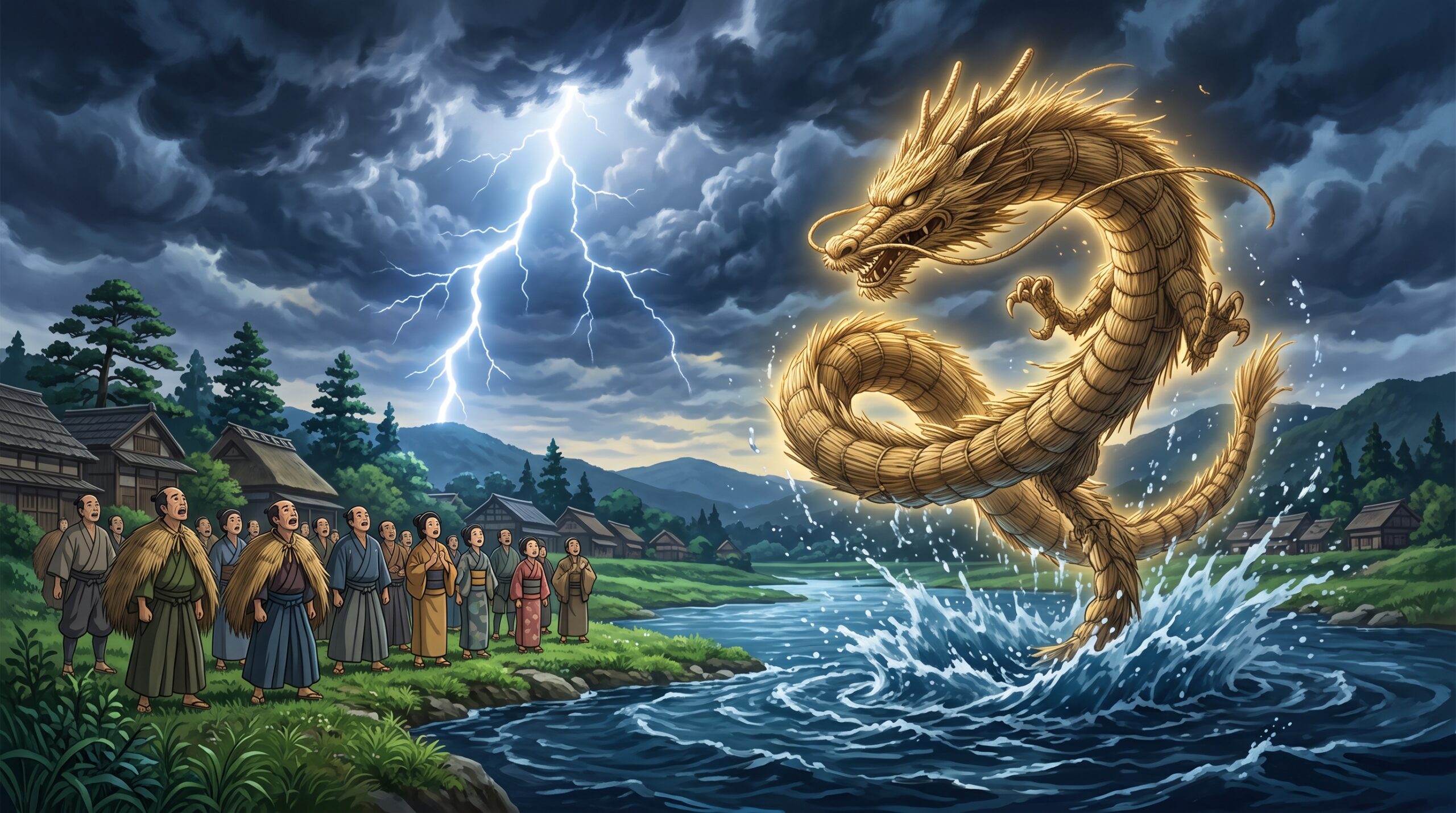
Japan is a country blessed with abundant nature, but it also has a long history of living side by side with natural disasters such as typhoons and droughts. In Japanese folklore, there are many wonderful stories that depict the overwhelming power of nature as “gods” or “dragons,” explicitly teaching us how humans must interact with the natural world.
Today, we introduce a highly fascinating folktale from Gifu Prefecture called “The Straw Dragon for Rainmaking” (Amagoi no Wara no Ryu). Through this story, you will deeply appreciate the unique Japanese view of nature and traditional spirituality.
① The Story: The Straw Dragon for Rainmaking
Once upon a time, in a small village called Gocho in Okumino (present-day Gifu Prefecture), there lived hard-working farmers.
Although the Nagara River, boasting an abundant flow of water, ran right next to the village, the village land was situated higher than the river, making it impossible to draw water. The villagers built terraced fields on the mountain slopes, relying solely on the scarce spring water from Mount Kannon and the rain falling from the sky to grow their crops.
One summer, a terrible drought struck the village. Not a single drop of rain fell for days on end. Under the glaring sun, the crops in the fields withered away one after another. At this rate, the entire village would starve to death.
At their wits’ end, the villagers gathered at the house of the village headman, Yoheiji. While discussing how they could possibly make it rain, a wise old man spoke up.
“When I was a child, I heard that if you make a giant dragon out of straw, offer it to the Suwa Shrine, and pray, it will certainly bring rain.”
Having never performed a formal rainmaking ritual (Amagoi) before, the villagers decided to pin their last hopes on his words. They collected straw from all over the village and worked together to create a massive dragon. It was a magnificent creation, measuring about 5.4 meters (3 ken) long and 90 centimeters (3 shaku) in girth.
The villagers carried the completed straw dragon into the worship hall of the village’s guardian deity, Suwa Shrine, and carefully let it rest for the night. The next morning, they offered the sacred dragon plenty of Omiki (sacred sake) to drink. Then, a large group of men hoisted the dragon onto their shoulders and headed toward the banks of the Nagara River.
“Please, oh please, let it rain!”
As the villagers desperately prayed, they attempted to sink the straw dragon into a deep, blue pool of the Nagara River called “Oyabuchi.” At that very moment, a miracle occurred. The dragon, which was supposed to be made merely of straw, suddenly sprang up as if life had been breathed into it, and plunged into the deep pool all on its own.
Shortly after, the sky changed dramatically. Pitch-black rain clouds welled up from out of nowhere, covering the entire sky, and large drops of rain began to fall fiercely. The parched earth was instantly quenched, and the villagers hugged each other in joy, shouting, “It’s rain! It’s raining!”
However, their joy was short-lived. The rain showed no signs of stopping after three days, or even four. In fact, it continued to pour down harder than ever. The water level of the Nagara River rose to a terrifying height, and muddy torrents threatened to swallow the village whole. The blessed rain was now turning into a deadly flood.
Trembling with fear, the villagers suddenly realized their fatal mistake.
“We forced the rain to fall for our own convenience, without listening to the will of the gods. The gods must be absolutely furious with us.”
The villagers rushed back to the worship hall of Suwa Shrine, prostrated themselves, and prayed with all their might.
“Oh Gods, please forgive our arrogance. We beg you to quell your anger!”
After they had desperately apologized and prayed for about half a day, another miracle occurred. The thick black clouds gradually began to thin, and rays of light broke through. Then, from the deep bottom of Oyabuchi, that same dragon reappeared and ascended high into the sky. At exactly that moment, the relentless rain completely stopped.
When the storm had passed and the villagers fearfully stepped outside, a surprising sight awaited them. The severe floodwaters had completely washed away the terraced fields on the mountain slopes, transforming the land into a flat, vast, and incredibly fertile plain, rich in moisture.
From then on, the village became a blessed land where abundant crops grew, and the villagers never again dared to perform a forced rainmaking ritual driven by human convenience.
② Deep Analysis of the Folktale: Awe of Nature and Human Desire
The greatest charm of “The Straw Dragon for Rainmaking” is that it does not end as a simple “magical success story.” In the first half of the story, the humans’ desperate wish (the need for rain) is fulfilled through prayer, but in the second half, the over-fulfillment of that wish causes an uncontrollable disaster (a flood).
The underlying message here is a strict warning against the arrogance of trying to control nature for human convenience. It clearly depicts the universal truth that if humans forcefully disrupt the balance of the natural world, they will inevitably face severe retaliation. However, at the same time, nature, even while unleashing its fury, ultimately leaves behind a “new blessing” in the form of fertile soil. It is a profoundly deep story that brilliantly captures the duality of nature’s terror and generosity.
③ Connection to Japanese Culture: Animism and Dragon Worship
This story strongly reflects “Animism (nature worship),” which is the traditional spirituality of Japan. Since ancient times in Japan, it has been believed that millions of gods (Yaoyorozu-no-Kami) reside in all natural objects, including mountains, rivers, giant trees, and rocks.
In particular, “Ryu” (Dragons) are worshipped across the country as powerful “Water Deities” that govern water and rain. The depiction of a straw dragon transforming into a real water deity illustrates the Japanese belief that spirituality can dwell even in inanimate objects, and reflects the historical attempts to communicate with gods through sacred rituals. Furthermore, the appearance of Suwa Shrine (a shrine deeply associated with water and agriculture, with its head shrine in Nagano Prefecture) is crucial for understanding the network of indigenous beliefs in Japan.
The philosophy flowing at the very foundation of the Japanese mind—not to dominate nature, but to “coexist with it through prayer, awe, and gratitude”—is perfectly condensed into this short folktale.
④ What Would You Do?
In a life-or-death extremity, the feelings of the villagers who desperately prayed to the gods for rain are painfully understandable. However, as a result, they stepped too far into the “realm of the gods.”
We, living in the modern world, are now able to control nature to some extent with the power of science and technology. Yet, when faced with climate change and natural disasters, we are constantly reminded of how powerless we still are in the face of nature’s fury.
If you were the headman of this village, what decision would you have made when faced with the crisis of a severe drought? And when the heavy rain wouldn’t stop, who or what would you turn to for help? We strongly encourage you to reflect on your own thoughts regarding the relationship between nature and humanity. Let us know your thoughts in the comments below!
Reference Links
- Read More Japanese Folktales (Our blog category)
- Visit Gifu (Official Tourism Website) (Explore the beautiful nature of Gifu Prefecture, the real-life setting of this story)
【日本の昔話】神々への畏怖と恵み:「雨乞いのわらの竜」が教える自然との共生
日本は豊かな自然に恵まれた国であると同時に、古くから台風や干ばつなどの自然災害と隣り合わせの歴史を歩んできました。日本の民間伝承には、自然の圧倒的な力を「神」や「竜」として描き、人間がどのように自然と向き合ってきたかを伝える素晴らしい物語が数多く存在します。
今回は、岐阜県に伝わる「雨乞いのわらの竜」という非常に興味深い昔話をご紹介します。この物語を通じて、日本特有の自然観や精神性を深く味わってください。
① 物語:雨乞いのわらの竜
むかしむかし、奥美濃(現在の岐阜県)にある五町という小さな村での出来事です。
この村は、すぐ近くに豊かな水量を誇る長良川が流れているにもかかわらず、村の土地が川よりも高い位置にあったため、川の水を畑に引き込むことができませんでした。村人たちは山の斜面に段々畑を作り、観音山から湧き出るわずかな清水と、空から降る雨水だけを頼りに作物を育てていました。
ある年の夏、村を恐ろしい日照りが襲いました。何日経っても雨は一滴も降らず、ギラギラと照りつける太陽のもとで、畑の作物は次々と枯れ果てていきました。このままでは村人全員が飢え死にしてしまいます。
困り果てた村人たちは、庄屋(村の長)である与平治の家に集まりました。「どうにかして雨を降らせる方法はないものか」と真剣に話し合っていると、一人の知恵ある老人が口を開きました。
「わしが子どもの頃に聞いた話だが、諏訪神社に藁(わら)で作った大きな竜をお供えして祈ると、雨が降るそうじゃ」
雨乞いの正式な方法を知らなかった村人たちは、その言葉に一縷の望みを託すことにしました。村中の藁を集め、総出で巨大な竜を作り上げました。その大きさは長さ三間(約5.4メートル)、胴回り三尺(約90センチ)にも及ぶ、見事なものでした。
村人たちは完成したわらの竜を村の鎮守である諏訪神社の拝殿に運び込み、一晩丁寧に寝かせました。翌朝、神聖な竜に御神酒(お酒)をたっぷりと飲ませると、大勢の男たちで竜を担ぎ出し、長良川の岸辺へと向かいました。
「どうか、どうか雨を降らせてください!」
村人たちが必死に祈りを捧げながら、長良川の深く青い水をたたえる「大矢渕」という淵にわらの竜を沈めようとしたその瞬間です。なんと、ただの藁で作られたはずの竜が、むっくりと飛び跳ね、まるで命を吹き込まれたかのように自らざんぶりと深い淵の中へ飛び込んでいったのです。
すると間もなく、空の色が急変しました。どこからともなく真っ黒な雨雲が湧き上がり、空を覆い尽くしたかと思うと、大粒の雨が激しく降り始めたのです。干からびた大地は一気に潤い、村人たちは「雨だ!雨が降ったぞ!」と抱き合って喜びました。
しかし、喜びもつかの間でした。雨は三日経っても四日経っても止む気配がなく、それどころかますます激しく降り続いたのです。長良川の水かさは恐ろしいほどに増し、濁流が村を飲み込もうとしていました。恵みの雨が、今度は命を奪う大洪水へと変わろうとしていたのです。
恐怖に震える村人たちはハッと気づきました。
「我々は神様のお考えも聞かずに、人間の都合だけで無理やり雨を降らせてしまった。これは神様がお怒りになっているに違いない」
村人たちは慌てて諏訪神社の拝殿に駆け込み、ひれ伏して一心に祈りました。
「神様、私たちの傲慢をお許しください。どうか怒りをお鎮めください!」
半日ほど必死にお詫びと祈りを続けていると、奇跡が起こりました。分厚い黒雲が徐々に薄れ始め、光が差し込んできたのです。そして、大矢渕の深い水底から、あの竜が再び姿を現し、天高く空へと昇っていきました。それと同時に、あれほど狂ったように降っていた雨がピタリと止んだのです。
嵐が去った後、村人たちが恐る恐る外に出てみると、そこには驚くべき光景が広がっていました。激しい大水によって山の斜面の段々畑がすっかり洗い流され、平らで広大、そして水気をたっぷり含んだ肥沃な土地へと生まれ変わっていたのです。
それ以来、村は豊かな作物が育つ恵まれた土地になり、村人たちは二度と人間の都合で神にすがる無理な雨乞いをすることはなかったそうです。
② 民話の深い考察:自然への畏怖と人間の欲望
この「雨乞いのわらの竜」は、単なる「魔法のような成功談」で終わらないところが最大の魅力です。物語の前半では、人間の切実な願い(雨が欲しい)が祈りを通して成就しますが、後半ではその願いが過剰に叶えられた結果、コントロール不能な災害(洪水)を引き起こします。
ここに込められているのは、「自然を人間の都合でコントロールしようとする傲慢さへの強い戒め」です。人間が自然界のバランスを無理に崩せば、必ず手痛いしっぺ返しを食らうという普遍的な真理をはっきりと描いています。しかし同時に、自然は時に猛威を振るいながらも、結果的に豊かな土壌という「新たな恩恵」をもたらします。自然の恐ろしさと寛大さの二面性を見事に表現した、非常に奥深い物語です。
③ 日本文化との関連:アニミズムと龍神信仰
この物語は、日本の伝統的な精神性である「アニミズム(自然崇拝)」を色濃く反映しています。日本では古来より、山や川、巨木や岩など、あらゆる自然物に八百万(やおよろず)の神が宿っていると考えられてきました。
特に「竜(龍)」は、水や雨を司る強力な「水神」として全国各地で信仰されています。藁で作った竜が本物の水神へと変貌を遂げる描写は、日本人が無機物にも霊性が宿ると信じ、神聖な儀式を通して神と交信しようとしていた歴史を如実に物語っています。また、諏訪神社(長野県に総本社を持つ、水や農耕に関わりの深い神社)が舞台に登場することも、日本の土着信仰のネットワークを知る上で大変重要です。
自然を支配するのではなく、「祈り、畏れ、感謝して共生する」という日本人の根底に流れる哲学が、この短い民話の中に完全に凝縮されています。
④ あなたならどうしますか?
生きるか死ぬかの極限状態のなかで、神にすがる思いで雨乞いをした村人たちの気持ちは痛いほどよくわかります。しかし、彼らは結果的に「神の領域」に踏み込みすぎてしまいました。
現代を生きる私たちは、科学技術の力で自然をある程度コントロールできるようになりましたが、気候変動など、未だに自然の猛威の前では無力な側面も多々あります。
もしあなたがこの村の庄屋だったら、干ばつの危機に直面したとき、どんな決断を下したでしょうか?また、大雨が降り止まなくなったとき、誰に、あるいは何に向かって助けを求めますか?ぜひ、自然と人間の関わり方について、あなた自身の考えを巡らせてみてください。コメント欄で皆さんのご意見をお待ちしています。
参考リンク
- 日本の昔話シリーズをもっと読む(当ブログカテゴリー)
- 岐阜県観光公式サイト「Visit Gifu」(物語の舞台である岐阜県の美しい自然を実際にご覧ください)

コメント