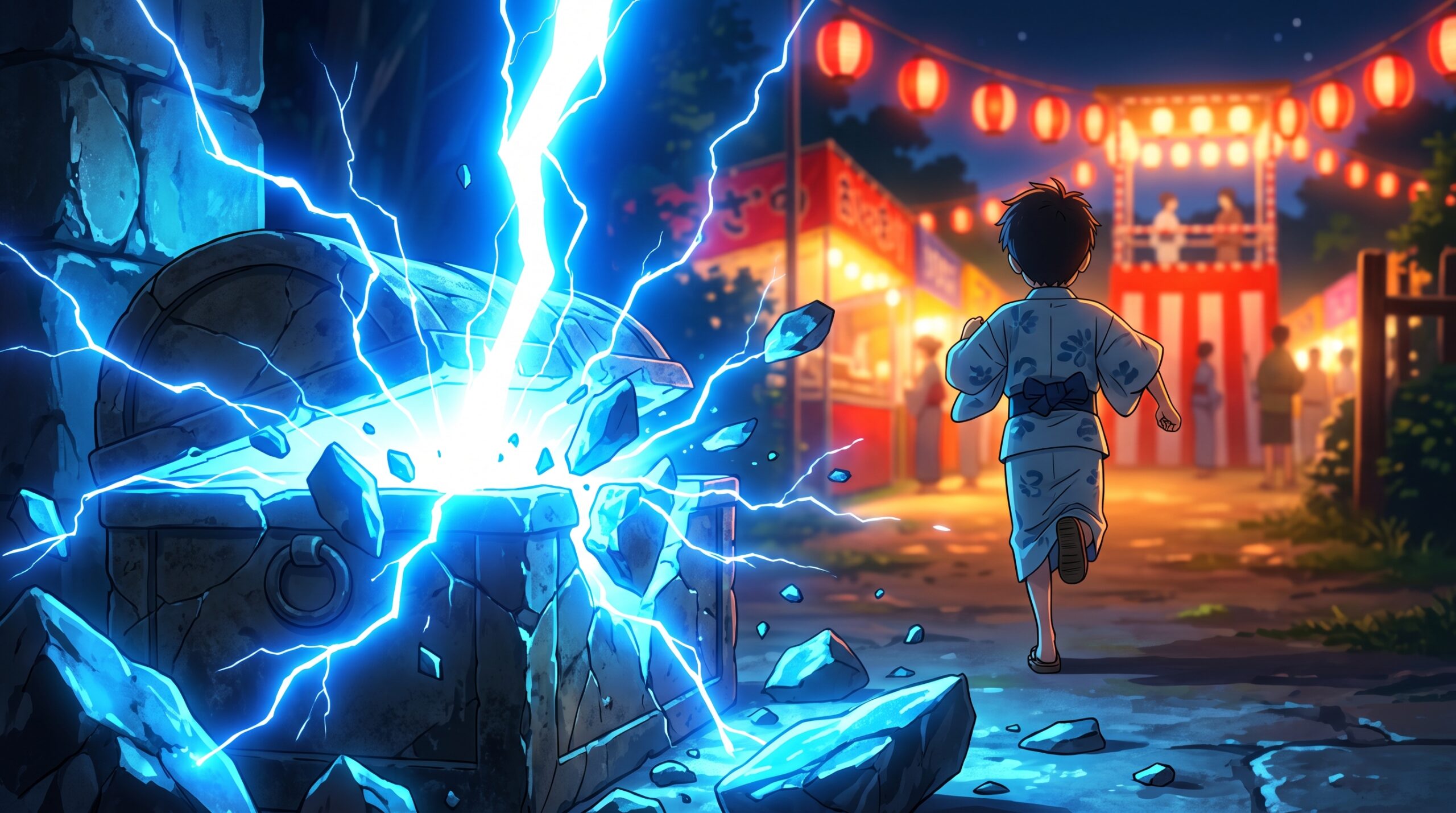
Hidden within Japan’s rich cultural heritage of folktales are profound life lessons and truths that go far beyond mere fairy tales for children. Today, from our Japanese Folktale Series, we introduce a slightly terrifying yet deeply heartwarming story from Shime Town in Fukuoka Prefecture: “The Substitute Stone Coffin” (Migawari no Ishibitsu). This masterpiece intertwines the harsh reality of karma with a human’s desperate love and miracles that transcend human understanding.
The Story of “The Substitute Stone Coffin”
Once upon a time, in the village of Shime in Chikuzen Province (modern-day Fukuoka Prefecture), there lived a man named Genbee. Genbee absolutely loved river fishing. Neglecting his family and his work, he would head to the river to catch fish whenever he had a spare moment.
One day, Genbee’s wife was heavily pregnant and about to give birth at any moment. Enduring the pain, she pleaded with him, “Please, just for today, stop fishing and stay by my side.” However, Genbee coldly replied, “What can a man do watching a birth?” He completely ignored his wife’s desperate wishes, shouldered his fishing rod, and set off for the river as usual.
But on that particular day, he couldn’t catch a single fish. No matter how much he searched the river’s depths, he couldn’t even see the shadow of a fish. Deeply frustrated and annoyed, Genbee decided to take a rest at the village’s local shrine (Chinju-sama). Feeling the cool breeze as he lay down, he quickly fell into a deep sleep.
Genbee then had a mysterious dream. The “Sai no Kami” (God of Boundaries) appeared riding a magnificent horse and called out to the local shrine deity, “A child is about to be born in the village. Won’t you come and witness it with me?” However, the local deity declined, saying, “I cannot leave right now because I have a guest (Genbee) sleeping in the main hall.”
After a while, the Sai no Kami, having witnessed the birth alone, returned. When the local deity asked, “How was the baby?”, the Sai no Kami replied in a heavy tone:
“It was a healthy baby boy. But tragically, that child’s lifespan is a mere seven years. On the night of July 14th in his seventh year, it is his absolute fate to be struck by lightning and die.”
Shocked, the local deity asked why. The Sai no Kami spoke sternly:
“That father is obsessed with river fishing and repeatedly takes the lives of fish needlessly, even when he doesn’t need to eat them. On top of that, just this morning, he abandoned his suffering wife who was begging for help, just to go play. As a punishment for the father’s selfish and cruel deeds, the son’s life has been drastically shortened.”
Hearing this, Genbee woke up with a start. Drenched in a cold sweat, he sprinted all the way home. When he arrived, he found that, exactly as in his dream, a healthy baby boy had been born. Genbee was deeply ashamed, realizing his own foolish actions were going to rob this tiny life. He firmly swore in his heart that he would never let this child die.
From that day on, Genbee completely changed his ways. He stopped fishing entirely and snapped his fishing rod in two. From morning till night, he worked incredibly hard in the fields, cared deeply for his wife, and raised his child with more love than anyone else. The boy was named Genkichi, and he grew up strong and healthy, bathed in his parents’ deep affection.
Years passed, and finally, the terrifying, fateful day arrived: “July 14th of his seventh year.”
To prepare for this day, Genbee had spent a fortune hiring a master stonemason to build an incredibly sturdy “stone coffin” (Ishibitsu). He planned to protect his son by putting him inside it, ensuring that even if a massive lightning bolt struck, it would never break.
When night fell, Genbee placed an unaware Genkichi inside the stone coffin and sealed the heavy lid tightly. Then, he and his wife sat in front of the stone coffin and prayed fervently to the gods and Buddha, pleading, “Please, we beg you, spare our son’s life!”
However, Genkichi, trapped inside the tight, dark stone coffin, was bored to tears. From outside, the lively festival music, the sound of flutes, and the joyful cheers of children from the neighboring village’s summer festival drifted in on the wind. “I want to go to the festival… I have to go.” Unable to bear it any longer, Genkichi took advantage of his parents’ deep concentration in prayer with their eyes closed. He secretly pushed the heavy lid of the stone coffin open with all his might and sneaked out to run off to the festival.
Shortly after Genkichi escaped, the sky suddenly turned pitch black, and a violent thunderstorm rolled in. Following an ear-splitting roar that seemed to tear the air apart, a massive, pale-blue bolt of lightning struck the stone coffin directly. The stone coffin, which was supposed to be indestructible, was blown into thousands of pieces in an instant.
“Genkichi!”
Genbee and his wife screamed in agony as they looked at the charred, shattered stone. Just as they were thrown into the depths of despair, believing their beloved son was dead, a miracle occurred.
“Father, Mother, I’m home!”
A cheerful voice called out from behind them. They turned around to see Genkichi standing there with a huge smile on his face, having thoroughly enjoyed the festival. He was even clutching a souvenir from the festival stalls in his hand.
Because Genkichi had sneaked out of the stone coffin, he had miraculously avoided a direct hit from the lightning. The gods, seeing the father’s desperate prayers and true reformation over those seven years, had used the stone coffin literally as a “substitute” to save Genkichi’s life. Genbee hugged Genkichi tightly, shedding tears of profound gratitude.
In-depth Analysis: Can Fate Be Changed?
The central themes flowing through this story are “Karma” (Inga Oho) and “Evading Fate.” The story begins with a terrifying, seemingly unreasonable divine decree that a father’s evil deeds will shorten his son’s life. However, Genbee does not fall into despair or self-destruction; he faces destiny head-on by correcting his own behavior.
The most fascinating aspect is that what ultimately saved the boy was not the “perfect physical defense (the stone coffin)” prepared by the father, but the “child’s own innocent curiosity and vitality (sneaking out to go to the festival).” If Genkichi had stayed quietly in the stone coffin as his parents told him, he would have undoubtedly been struck by lightning and died.
Human superficial wisdom (trying to prevent a natural threat with a stone box) cannot stop the massive power of fate (lightning). However, we can interpret that Genbee’s earnest way of living and deep love over those seven years moved the hearts of the gods, causing a miracle that transcended the laws of nature. As a result, the story reaches a perfect conclusion where the stone coffin serves as the substitute.
Connection to Japanese Culture: The Prohibition of Senseless Killing and Folk Beliefs
This folktale vividly reflects Japan’s unique religious and ethical views. First, there is the Buddhist value that strongly warns against “senseless killing” (Sessho). Taking life unnecessarily for the purpose of play or entertainment, rather than for food to survive, was considered a severe vice that disrupted the harmony of the natural world.
Second, the story features Shinto-based Japanese folk beliefs, specifically the “Sai no Kami” (God of Boundaries/Dosojin) and the “Chinju-sama” (Local Shrine Deity). The Sai no Kami protects the village boundaries from plagues and evil spirits from the outside, and is also widely worshipped as a guardian deity overseeing the healthy growth of children. The gods of Japan are depicted not merely as beings who hand down absolute punishments. If a person deeply regrets their past mistakes and shows a sincere attitude toward life, the gods are depicted as compassionate beings who can flexibly alter fate.
Furthermore, the fact that a summer festival—a quintessential Japanese local event—serves as the setting that ultimately saves the boy’s life cannot be overlooked. The festival music luring the boy outside seems to symbolize the vitality of life and the strong bonds of the community, creating a highly Japanese and beautiful narrative development.
How Would You Live?
If you were in Genbee’s position and heard a cruel prophecy that “because of your past mistakes, your beloved child will die at the age of seven,” how would you act? Would you accept fate and just break down in tears? Or would you fundamentally change your way of life and resist, believing in miracles, just as Genbee did?
Also, how would you feel if your child broke or sneaked out of the “absolutely safe box” you had prepared to protect them? This story teaches us the truth that sometimes, a child’s own overflowing vitality and natural actions can forge their destiny much better than a parent’s overprotection and control.
Please read “The Substitute Stone Coffin” and take a moment to deeply consider how you feel about it and how you would confront your own destiny. And please continue to explore the profound charm of Japanese folktales.
Reference Links
魅惑の日本昔話:「身がわりの石びつ」が教える運命と命の尊さ
日本の豊かな文化遺産である昔話には、単なる子供向けのおとぎ話にとどまらない、深い教訓と人生の真理が隠されています。今回は、日本の昔話シリーズの中から、福岡県糟屋郡志免町に伝わる少し恐ろしくも心温まる物語、「身がわりの石びつ」をご紹介します。この物語は、因果応報という厳しい現実と、それを乗り越えようとする人間の愛情、そして人智を超えた奇跡が交差する傑作です。
「身がわりの石びつ」のストーリー
むかしむかし、筑前の国(現在の福岡県)糟屋郡の志免という村に、源兵衛という男が住んでいました。源兵衛は大の川釣り好きで、家業や家庭を顧みず、暇さえあれば川へ出かけては魚を釣り上げていました。
ある日のこと、源兵衛の妻は臨月を迎えており、今にも赤ん坊が生まれそうでした。妻は痛みに耐えながら、「今日くらいは釣りをやめて、私のそばにいてください」と懇願しました。しかし、源兵衛は「男がお産を見たところで何もできやしない」と妻の願いを全く聞き入れず、いつものように釣竿を担いで川へ出かけてしまったのです。
ところが、その日に限って魚は一匹も釣れません。川の淀みをいくら探っても、魚の影すら見えないのです。すっかり嫌気がさした源兵衛は、村の鎮守様(神社の拝殿)で一休みすることにしました。涼しい風に吹かれて横になると、いつの間にか深い眠りに落ちていきました。
すると、源兵衛は不思議な夢を見ました。立派な馬に乗った「塞の神(さいのかみ)」が現れ、鎮守様に「村で今からお産があるので、一緒に見に行きませんか」と声をかけました。しかし鎮守様は「今、拝殿に客(源兵衛)が寝ているから留守にはできない」と断ります。
しばらくして、一人でお産を見届けた塞の神が戻ってきました。鎮守様が「赤ん坊はどうだった?」と尋ねると、塞の神は重々しい口調でこう答えます。
「元気な男の子でした。しかし哀れなことに、あの赤ん坊の寿命はわずか7年。7歳になる年の7月14日の夜、雷に打たれて死ぬ運命にあります」
驚いた鎮守様が理由を聞くと、塞の神は厳しく言いました。
「あの父親は、ひどく川釣りが好きで、食べる必要もないのに無益な殺生を繰り返しています。おまけに、今朝も苦しんで助けを求める妻をほったらかして遊びに出かけた。あの父親の身勝手で冷酷な行いの報いとして、息子の命が短くなっているのです」
その言葉にハッと飛び起きた源兵衛は、全身から冷や汗を吹き出しながら、急いで家へ走りました。家に着くと、夢の通りに元気な男の子が生まれていました。源兵衛は自分の愚かな行いがこの小さな命を奪うのだと深く恥じ、この子を絶対に死なせてはならないと固く心に誓いました。
その日から源兵衛は完全に心を入れ替えました。大好きな釣りをピタリとやめ、釣竿をへし折りました。朝から晩まで一生懸命に畑仕事に精を出し、妻を労わり、子供を誰よりも大切に育てました。男の子は「源吉」と名付けられ、両親の深い愛情を受けてすくすくと育ちました。
そして月日は流れ、ついに恐れていた運命の時である「7歳の7月14日」がやってきました。
源兵衛はこの日に備え、大金をはたいて腕利きの石工に頼み、非常に頑丈な「石びつ(石の箱)」を作らせていました。雷が落ちても絶対に壊れないよう、息子をこの中に入れて守り抜こうと考えたのです。
夜になり、源兵衛は何も知らない源吉を石びつの中に入れ、重い蓋をしっかりと閉めました。そして、妻と共に石びつの前へ座り込み、「どうか、どうか息子の命をお助けください」と、神仏に一心不乱に祈り続けました。
しかし、狭くて暗い石びつの中に閉じ込められた源吉は、退屈でたまりません。外からは、隣村で開催されている楽しそうな夏祭りの囃子や笛の音、子供たちの歓声が風に乗って聞こえてきます。「お祭りに行きたいな……どうしても行きたい」。我慢できなくなった源吉は、両親が目を閉じて祈りに夢中になっている隙を狙って、こっそりと石びつの蓋を力いっぱい押し開け、お祭りへと逃げ出してしまいました。
源吉が抜け出してしばらくした直後、空が急に真っ暗になり、激しい雷雨となりました。空気を切り裂くような轟音が響いたかと思うと、巨大な青白い雷が一直線に石びつに落ちたのです。頑丈なはずの石びつは、一瞬にして木端微塵に砕け散ってしまいました。
「源吉!」
源兵衛と妻は、黒焦げになり砕け散った石びつを見て泣き叫びました。最愛の息子が死んでしまったと絶望のどん底に突き落とされたその時です。
「お父さん、お母さん、ただいま!」
背後から元気な声が聞こえました。振り返ると、お祭りを楽しんで満面の笑みを浮かべた源吉が立っていました。手にはお祭りのお土産さえ握りしめています。
源吉が石びつを抜け出していたおかげで、雷の直撃を見事に免れたのです。父親の7年間にわたる必死の祈りと、真に心を入れ替えた生き方を見た神様が、石びつを文字通り「身がわり」にして、源吉の命を救ってくれたのでした。源兵衛は源吉を強く抱きしめ、感謝の涙を流しました。
「身がわりの石びつ」の深い考察:運命は変えられるのか?
この物語の根底に流れる最大のテーマは、「因果応報」と「運命の回避」です。父親の悪行が息子の寿命を縮めるという、理不尽で恐ろしい神の宣告から物語は始まりますが、源兵衛は絶望して自暴自棄になることなく、自らの行いを正すことで運命に立ち向かいます。
非常に興味深いのは、最終的に息子を救ったのは「父親が用意した完璧な物理的防御(石びつ)」ではなく、「子供自身の純粋な好奇心と生命力(祭りに惹かれて抜け出したこと)」であった点です。もし源吉が親の言う通りに石びつの中でじっとおとなしくしていたら、間違いなく雷に打たれて命を落としていたでしょう。
人間の浅知恵(石の箱で自然の脅威を防ぐこと)では運命という巨大な力(雷)を防ぐことはできません。しかし、7年間の源兵衛の真面目な生き方と深い愛情が神々の心を動かし、自然の摂理を超えた奇跡を起こしたと解釈できます。結果として、石びつが身代わりになるという完璧な結末を迎えました。
日本文化との関連:無益な殺生への戒めと民間信仰
この昔話からは、日本特有の宗教観や倫理観を色濃く読み取ることができます。第一に、「無益な殺生」を強く戒める仏教的な価値観です。生きるための食料としてではなく、ただの遊びや娯楽目的で必要以上に命を奪うことは、自然界の調和を乱す重大な悪徳とみなされていました。
第二に、「塞の神(道祖神)」と「鎮守様」という神道に基づく日本の民間信仰です。塞の神は村の境界を守り、外からの疫病や悪霊を防ぐと同時に、子供の健やかな成長を見守る守り神としても広く信仰されています。日本の神々は、単に絶対的な罰を下すだけの存在ではありません。人間が過去の過ちを深く反省し、誠実に生きる姿勢を見せれば、柔軟に運命を変えてくれる慈悲深い存在として描かれています。
また、夏祭りという日本特有の地域行事が、結果として少年の命を救う舞台装置となっている点も見逃せません。祭りの囃子音が少年を外へ誘い出したことは、地域の絆や祭りが持つ「生への活力」を象徴しているようで、非常に日本的で美しい展開です。
あなたならどう生きますか?
もしあなたが源兵衛の立場で、「自分の過去の過ちのせいで、愛する我が子が7歳で命を落とす」という残酷な予言を聞かされたら、どのように行動しますか?運命を受け入れてただ泣き崩れるでしょうか。それとも、源兵衛のように生き方を根本から変え、奇跡を信じて抗うでしょうか。
また、あなたが子供を守るために用意した「絶対安全な箱」を、子供自身が壊したり抜け出してしまった時、あなたならどう感じますか?この物語は、親の過剰な保護やコントロールよりも、子供自身の溢れる生命力や自然な行動が、かえって運命を切り開くことがあるという事実も教えてくれます。
ぜひ、この「身がわりの石びつ」を読んで、あなたがどう感じたか、あなたならどう運命に立ち向かうか、じっくりと考えてみてください。そして、日本の昔話が持つ奥深い魅力に触れ続けてください。

コメント