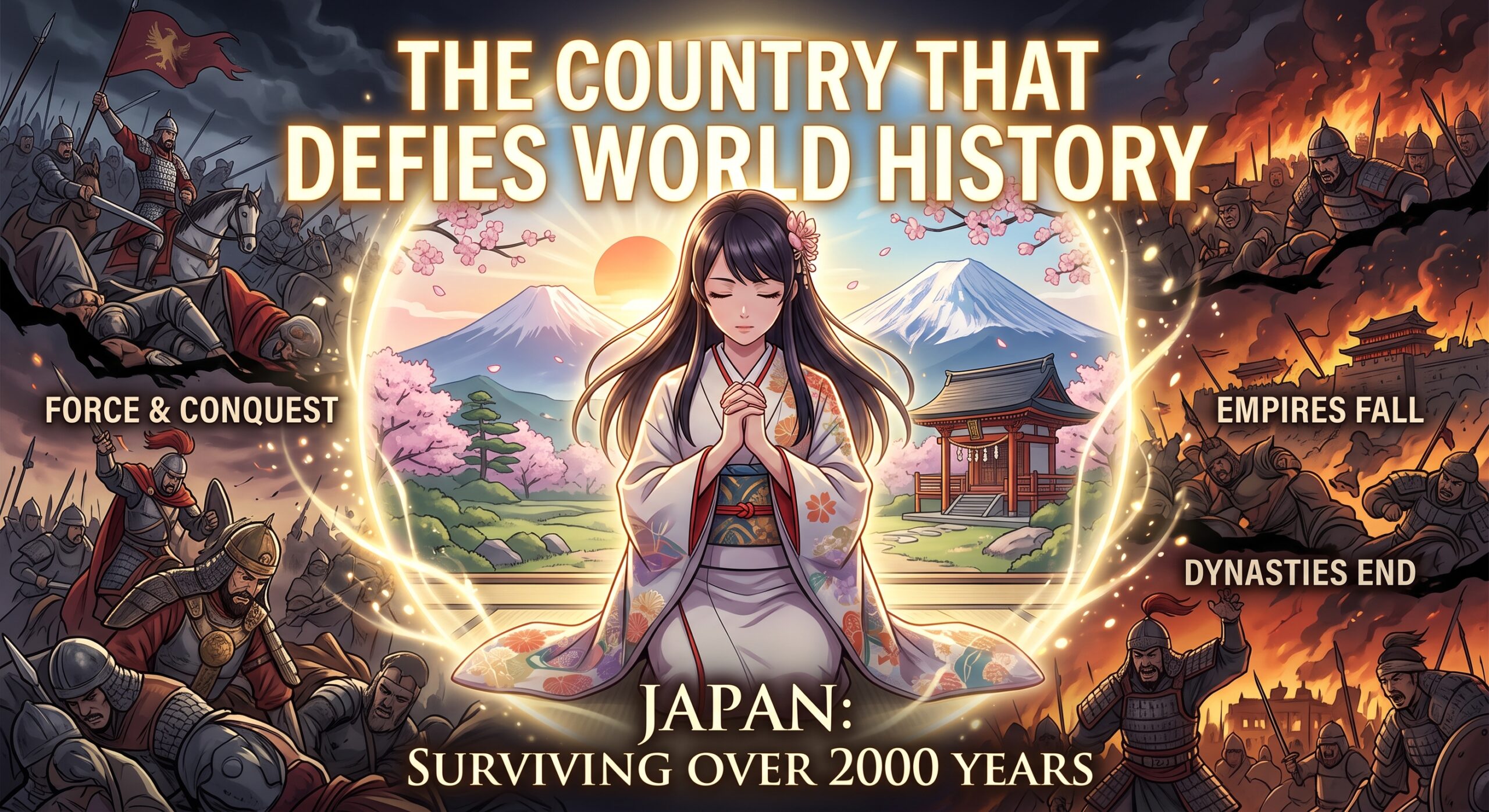
When we look back at world history, there is a clear commonality: a continuous cycle of domination by force and dynastic changes. The ancient Roman Empire, the massive Mongol Empire, or the numerous dynasties across the Chinese continent—no matter how much a nation flourished through military or economic power, it was ultimately overthrown by another leader with stronger forces, reborn as a new country ruled by a new king or emperor. It is the standard path of human history for the victor of war to establish a new dynasty.
However, when looking at the world map, there is exactly one country that does not fit this rule. That is Japan. For over 2,000 years since its founding, Japan has never been taken over by another country or a different dynasty, continuing to the present day as a single nation. This unparalleled miracle in world history cannot be explained merely by coincidence or the geographical condition of being an island nation. It is deeply connected to Japan’s unique governance philosophy of “Shirasu” and “Ushihaku,” and the existence of the “Emperor,” who holds authority without political power.
- The Conqueror’s Logic “Ushihaku” and Japan’s Unique Governance “Shirasu”
- Letting Go of Power to Become Authority: The Exceptional Existence of the Emperor
- Omitakara: The People Are Not Objects of Domination
- Ultimate Governance Through Spontaneous Prayer
- Explore the History Woven by Prayer
- 世界史の常識を覆す国:日本が2000年以上滅びなかった本当の理由
- 覇者の論理「ウシハク」と、日本独自の統治「シラス」
- 権力を手放し、権威となる:天皇という類まれなる存在
- 大御宝(おおみたから):民衆は支配の対象ではない
- 自発的な祈りを通じた究極の統治
- 祈りが紡ぐ歴史の続きを探求する
The Conqueror’s Logic “Ushihaku” and Japan’s Unique Governance “Shirasu”
In the “Kojiki,” the oldest historical book recording the origins of Japan, there are two crucial words that determine the nature of the state: “Ushihaku” and “Shirasu.”
To govern through “Ushihaku” means to possess and rule the land and people as the private property of the ruler. It is a form of governance that forces people into submission through military might, wealth, and personal charisma. Absolute monarchies and dictatorships in world history are built exactly on this logic of “Ushihaku.” It is the way of the conqueror for the strong to exploit and suppress the weak by force.
In contrast, the concept Japan chose as the foundation of its nation is “Shirasu.” The etymology of “Shirasu” is “to know,” meaning that the ruler deeply understands the lives and pain of the people, uniting their hearts to govern the country. It is a highly moral governance where the ruler acts as a mirror to the masses, aligning the will of the gods with the wishes of the people. From the time of its founding, Japan rejected authoritarian rule by military force and chose national management through spiritual empathy and connection.
Letting Go of Power to Become Authority: The Exceptional Existence of the Emperor
The Japanese Emperor has continued to embody this philosophy of “Shirasu” for 2,000 years. In world history, it was standard for the “highest authority” and “supreme power” of a nation to be monopolized by the same person. Emperors and kings wielded immense power, shielded by the authority granted by God. Therefore, when power became corrupt, the only option was to overthrow the authority itself and create a new dynasty.
However, the Japanese Emperor exists as the “highest national authority” without holding state power. Throughout Japanese history, the actual power to run politics and the military has shifted from era to era—from aristocrats to samurai (Shoguns), and to modern Prime Ministers. Power is transient and is sometimes forced to change due to corruption.
Even so, the Emperor has always remained positioned “above power.” Even mighty Shoguns who unified the country by force, such as Minamoto no Yoritomo or Tokugawa Ieyasu, never crowned themselves kings to start a new dynasty. They gained the legitimacy to govern the country only by being appointed to the role of “Seii Taishogun” by the Emperor, who himself held no power. Completely separating power and authority, and having authority monitor power to prevent it from running out of control—this sophisticated system is the biggest reason Japan avoided fatal division.
Omitakara: The People Are Not Objects of Domination
To understand how the Emperor views the citizens, there is the word “Omitakara” (great treasure). In ancient Japan, the Emperor defined the citizens not as slaves or possessions of the ruler, but as the “greatest treasure” in the nation.
The role of the administrator is to prepare an environment where these citizens, the Omitakara, can live richly and peacefully. The citizens do not exist for the ruler; the ruler exists for the citizens. The reason colonialism and dictatorships predicated on exploitation never took root in Japan is that this philosophy of respecting humanity was the foundation of society.
Ultimate Governance Through Spontaneous Prayer
So, how does the Emperor, who holds no power, govern the country? The answer is “prayer.” The Emperor’s most important role is to pray to the gods for the peace of the nation, the happiness of the people (Omitakara), and abundant harvests. Even today, rigorous Shinto rituals are conducted at the Imperial Palace throughout the year, whether late at night or early in the morning. These prayers are not forced by anyone, but are conducted as completely spontaneous acts.
A nation that forces its people into submission through military might or law is fundamentally different from a nation that integrates because its leader prays for the people’s peace through self-sacrificing, spontaneous prayer, thereby gathering their spiritual respect. The Japanese people hold deep affection for the existence that dedicates prayers for their sake, which has created a strong national integration.
Explore the History Woven by Prayer
While world history is a blood-stained history of dynastic changes, there is a clear reason why Japan was able to survive as a single country. It is because they rejected “Ushihaku” (rule by force), chose “Shirasu” (governance by empathy and understanding), and the Emperor continued to love the people as “Omitakara” and offer prayers.
If you would like to know more deeply about this unique Japanese spirituality and history, please visit other articles on kiri53.com. We deliver the profound charm of Japanese culture and history. Additionally, if you wish to learn detailed academic perspectives on the Japanese Emperor system, reading external resources such as the history of the Emperor on Wikipedia will deepen your understanding.
世界史の常識を覆す国:日本が2000年以上滅びなかった本当の理由
世界の歴史を振り返ると、そこには明確な共通点があります。それは「力による支配と王朝交代の連続」です。古代ローマ帝国、巨大なモンゴル帝国、あるいは中国大陸における数々の王朝。どれほど軍事力や経済力で栄華を極めた国家であっても、最終的には別の強力な武力を持つ指導者によって打倒され、新たな王や皇帝が支配する国へと生まれ変わってきました。戦争に勝利した覇者が新たな王朝を立ち上げるのが、人類の歴史の常道です。
しかし、世界地図を眺めたとき、たった一つだけその法則に当てはまらない国が存在します。それが日本です。日本は建国から2000年以上の長きにわたり、一度も他国や別の王朝に国を乗っ取られることなく、一つの国家として現在まで続いています。この世界史における類まれなる奇跡は、単なる偶然や島国という地理的条件だけで説明できるものではありません。そこには、日本独自の「シラス」と「ウシハク」という統治哲学、そして権力を持たない「天皇」という存在が深く関わっています。
覇者の論理「ウシハク」と、日本独自の統治「シラス」
日本の成り立ちを記録した最古の歴史書『古事記』には、国家のあり方を決定づける二つの重要な言葉が記されています。それが「ウシハク」と「シラス」です。
「ウシハク」とは、土地や人民を支配者の私有財産として領有し、支配することを意味します。武力や富、個人のカリスマ性によって人々を力で従わせる統治形態であり、世界史における絶対君主制や独裁制はまさにこの「ウシハク」の論理で成り立っています。強者が弱者を搾取し、力で押さえつけるのが覇者の道です。
これに対して、日本が国家の基盤として選んだのが「シラス(知らす)」という概念です。「シラス」の語源は「知る」であり、統治者が人々の生活や心の痛みを深く理解し、心をひとつにして国を治めることを意味します。統治者が民衆の鏡となり、天地の神々の意思と民衆の願いを一致させるという、極めて高度な道徳的統治です。日本は建国の時点から、武力による強権的な支配を否定し、精神的な共感と結びつきによる国家運営を選択しました。
権力を手放し、権威となる:天皇という類まれなる存在
この「シラス」という哲学を2000年にわたって体現し続けているのが、日本の天皇です。世界の歴史では、国家の「最高権威」と「最高権力」は同一人物が独占するものでした。皇帝や王は、神から与えられた権威を盾にして絶大な権力を振るいました。そのため、権力が腐敗した際には、権威そのものを打倒して新たな王朝を作るしかありませんでした。
しかし、日本の天皇は国家権力を持たない「国家最高権威」として存在しています。日本の歴史上、実際に政治や軍事を動かす権力は、貴族、武士(将軍)、そして現代の総理大臣へと時代ごとに移り変わってきました。権力は移ろいゆくものであり、時には腐敗して交代を余儀なくされます。
それでも、天皇は常にその「権力の上」に位置し続けました。武力で天下を統一した源頼朝や徳川家康のような強大な将軍たちでさえ、自ら王を名乗って新たな王朝を開くことはしませんでした。彼らは、自らは権力を持たない天皇から「征夷大将軍」という役職を任命されることで、初めて国を治める正当性を得たのです。権力と権威を完全に分離し、権力が暴走しないよう権威が監視する。この洗練されたシステムが、日本が致命的な分断を回避できた最大の理由です。
大御宝(おおみたから):民衆は支配の対象ではない
天皇が国民をどのように見ているかを知る上で、「大御宝(おおみたから)」という言葉があります。古代日本において、天皇は国民のことを奴隷でも為政者の所有物でもなく、国家における「最も偉大な宝物」であると定義しました。
為政者の役割は、この大御宝である国民が豊かに、そして平和に暮らせるように環境を整えることです。国民が為政者のために存在するのではなく、為政者が国民のために存在するのです。搾取を前提とした植民地主義や独裁制が日本で根付かなかったのは、この人間尊重の哲学が社会の基盤にあったからです。
自発的な祈りを通じた究極の統治
では、権力を持たない天皇はどのようにして国を治めているのでしょうか。それは「祈り」です。天皇の最も重要な役割は、国家の安泰と国民(大御宝)の幸せ、そして五穀豊穣を神々に祈ることです。宮中では現在でも、深夜や早朝を問わず、年間を通じて過酷な神事が行われています。これらの祈りは誰かに強制されたものではなく、完全に自発的な行為として行われています。
軍事力や法律で民衆を強制的に従わせる国家と、指導者が自己犠牲を伴う自発的な祈りを通じて国民の安寧を願い、その精神的な尊敬を集めることでまとまる国家。この二つは本質が全く異なります。日本人は、自らのために祈りを捧げてくれる存在に対して深い敬愛を抱き、それが強固な国家の統合を生み出してきました。
祈りが紡ぐ歴史の続きを探求する
世界史が血塗られた王朝交代の歴史であったのに対し、日本が一つの国として存続できたのは、明確な理由があります。「ウシハク(力による支配)」を退け、「シラス(共感と理解による統治)」を選び、天皇が国民を「大御宝」として愛し、祈りを捧げ続けてきたからです。
この日本独自の精神性や歴史についてさらに深く知りたい方は、ぜひkiri53.comの他の記事もご覧ください。日本の文化や歴史の奥深い魅力をお届けしています。また、日本の天皇制について学術的な視点から詳細を知りたい方は、天皇に関する歴史的記録(Wikipedia)などの外部資料も併せてお読みいただくと、より理解が深まります。
コメント