In the rich natural landscapes of Japan, animals have coexisted with humans since ancient times. Among them, the “Fox” (Kitsune) is one of the most frequently appearing animals in Japanese folktales and legends. Today, I would like to introduce a traditional folktale titled “The Fox That Could No Longer Move” (Ugokenakunatta Kitsune), a story that paints a vivid picture of Japan’s primal scenery.
- Chapter 1: The Story of “The Fox That Could No Longer Move”
- Chapter 2: Analysis – Why Didn’t the Yamabushi Kill the Fox?
- Chapter 3: Connection to Japanese Culture – Coexistence with Nature and Animism
- Chapter 4: What Would You Do?
- 第1章:「動けなくなった狐」のストーリー
- 第2章:昔話の考察~なぜ山伏は狐を殺さなかったのか~
- 第3章:日本文化との関連~自然との共生とアニミズム~
- 第4章:あなたならどうしますか?
Chapter 1: The Story of “The Fox That Could No Longer Move”
Long, long ago, there was a vast, open field as far as the eye could see. A single straight path cut through this field, making it a busy thoroughfare for villagers and travelers.
However, there was one major problem in this field: a mischievous fox had taken up residence there.
This was no ordinary fox. Like many foxes in Japanese folklore, this one possessed the magical ability to shapeshift. Sometimes, it would disguise itself as a stone by the roadside and snatch away the rice balls of tired travelers seeking a place to rest. Other nights, it would appear as an eerie “fireball” (Hitodama) in front of young men walking home cheerfully intoxicated. Startled out of their wits, the young men would drop their souvenir food boxes, which the fox would cleverly steal.
The fox’s pranks escalated day by day, and the villagers were at their wits’ end, warning each other, “Do not cross that field at night.”
Then one day, a “Yamabushi” (a mountain ascetic monk) happened to pass through the village. Yamabushi are ascetic monks who undergo rigorous training in deep mountains and are believed to acquire mysterious spiritual powers (Houriki). Hearing the villagers lamenting about the fox’s mischief, the Yamabushi smiled quietly and said,
“Do not worry, villagers. I shall subdue that fox with my spiritual power.”
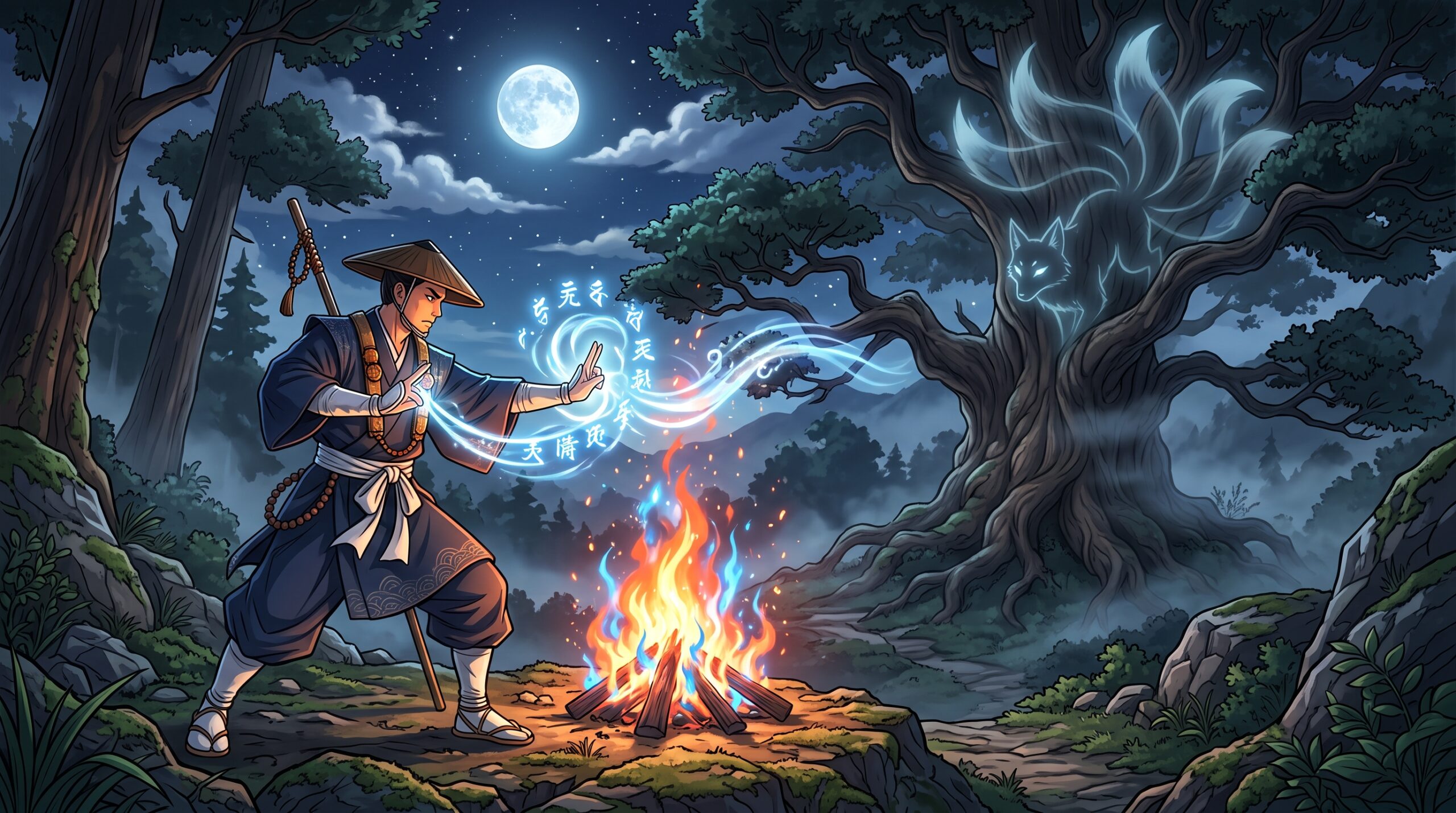
Waiting for the sun to set and darkness to blanket the area, the Yamabushi headed alone to the field where the fox appeared. When he reached the middle of the field, he noticed a large tree standing by the path—a tree that was never there before. The Yamabushi saw right through the illusion, thinking, “Aha, this is the fox’s disguised form.”
The Yamabushi stopped in front of the large tree and lit a fire. As the flames flickered, he formed hand seals and loudly began to chant an esoteric Buddhist spell called the “Spell of Immobility.” This was a terrifying spell; once cast, whether upon a human or an animal, the target would become completely paralyzed, unable to move a single muscle as if bound by invisible chains.
After finishing the chant, the Yamabushi paid no more attention to the large tree and simply returned to the village.
The next morning, after the sun had risen and the surroundings were bright, the Yamabushi returned to the field with the villagers. There, exactly where the large tree had stood the night before, lay an old fox, frozen stiff on the ground. The fox could frantically dart its eyes around, but it could not move even a single fingertip.
The Yamabushi looked down at the old fox and asked solemnly,
“Well, do you now understand the gravity of your sins? Can you swear that you will never deceive humans and cause mischief again?”
Upon hearing this, large tears began to spill from the immobilized old fox’s eyes, dropping one by one. The fox was truly remorseful.
Seeing this, the Yamabushi chanted a spell and released the “Spell of Immobility.” Now free, the old fox repeatedly looked back at the Yamabushi and the villagers as it fled deep into the mountains, tears still streaming down its face.
From that day on, a fox deceiving humans never appeared in that field again, and the villagers were able to travel the path in peace.
Chapter 2: Analysis – Why Didn’t the Yamabushi Kill the Fox?
Looking deeply into this story, several fascinating questions and moral lessons emerge.
First, it is noteworthy that “the fox shed tears of remorse.” The fox is depicted not merely as a pest, but as a being with a heart. As long as its pranks were successful, the fox did not realize how much trouble it was causing others. However, when faced with the overwhelming terror and helplessness of being “unable to move,” it understood the pain of others for the first time and shed tears of repentance.
Another crucial point is that “the Yamabushi did not take the fox’s life.” Although the fox was a despised nuisance to the villagers, the Yamabushi did not kill it; he merely used his magic to teach it a severe lesson. The conclusion, where he releases the spell and lets the fox return to the mountains the moment he sees tears of genuine reform, expresses a traditional Japanese spirit of tolerance: “Hate the sin, but do not hate the fox.”
Chapter 3: Connection to Japanese Culture – Coexistence with Nature and Animism
This folktale strongly reflects Japan’s unique culture and spirituality.
1. Yamabushi and Shugendo
A Yamabushi is a practitioner of “Shugendo,” a religion that blends ancient Japanese mountain worship with Buddhism. Most of Japan’s landmass consists of rugged mountains, which were believed to be the dwelling places of gods and Buddhas. Through severe ascetic training to become one with nature, Yamabushi were thought to gain supernatural powers. In folktales, they often appear as wise figures who solve problems with their mysterious abilities.
2. Foxes (Kitsune) and Shintoism
In Japanese folklore, the fox is a very special animal. While sometimes depicted as a trickster who deceives humans, it is simultaneously revered as the divine messenger of “Inari,” the god of agriculture. Many shrines across Japan feature stone statues of foxes. This duality represents the Japanese people’s mixture of “awe” and “familiarity” toward animals in the natural world.
3. The Boundary Between Nature and Humans
The story concludes with the fox “fleeing deep into the mountains.” This teaches that humans and wild animals should respect each other’s territories and coexist. Rather than destroying nature for being a nuisance, the traditional Japanese value system emphasizes harmony with nature: “maintain an appropriate distance without invading each other’s domain.”
Chapter 4: What Would You Do?
This old folktale poses many questions to us in the modern world.
If you were in the Yamabushi’s position, could you easily forgive and release a fox that had caused so much trouble to your community, simply because it shed tears?
Furthermore, if you, like the fox, were unaware that your selfish desires were causing trouble for others, what would it take for you to reflect on your own actions?
Japanese folktales are not just fairy tales for children; they contain deep philosophies that teach us how to live as human beings and how to interact with nature. After reading the story of “The Fox That Could No Longer Move,” what are your thoughts? I encourage you to reflect on what you would do.
References & Links
External Link: Manga Nippon Mukashibanashi Database – The Fox That Could No Longer Move
Internal Link: Japanese Folktale Series
【日本昔話】いたずら狐と山伏の不思議な物語「動けなくなった狐」から学ぶ日本文化
日本の豊かな自然の中には、古くから多くの動物たちが人間とともに暮らしてきました。その中でも「狐(キツネ)」は、日本の昔話や伝説に最も頻繁に登場する動物の一つです。今回は、日本の原風景が目に浮かぶような昔話、「動けなくなった狐」をご紹介します。
第1章:「動けなくなった狐」のストーリー
昔々、あるところに、見渡す限りの広い原っぱがありました。そこには一本の道が真っ直ぐに通っており、村人や旅人が頻繁に行き交う場所でした。
しかし、この原っぱには一つだけ困ったことがありました。それは、いたずら好きな一匹の狐が住み着いていたことです。
この狐は単なる狐ではありませんでした。日本の昔話に登場する狐の多くがそうであるように、この狐もまた「化ける」能力を持っていたのです。ある時は道端の石に化けて、疲れて休もうとした旅人のおにぎりをかすめ取りました。またある晩は、お酒に酔って機嫌よく歩いている若者の前に不気味な「火の玉」となって現れ、腰を抜かした若者が手放した手土産の折り詰めをまんまと奪い取ったりしていました。
狐のいたずらは日を追うごとにエスカレートし、村人たちは「夜はあの原っぱを通るな」と警告し合うほど、大変困り果てていました。
そんなある日のこと。村へ偶然、一人の「山伏(やまぶし)」が通りかかりました。山伏とは、深い山の中で厳しい修行を行い、不思議な力(法力)を身につけた修行僧のことです。村人たちが狐のいたずらについて嘆いているのを聞いた山伏は、静かに微笑んで言いました。
「村の皆さん、安心しなさい。わしの法力で、その狐を退治してあげましょう」
日が沈み、あたりが深い闇に包まれるのを待って、山伏は一人で狐の出る原っぱへと向かいました。原っぱの真ん中まで来ると、道端にいつもはない大きな木が立っています。山伏は「ははん、これが例の狐の化けた姿だな」と見破りました。
山伏はその大木の前で立ち止まると、火を焚き始めました。そして、炎が揺らめく中、両手で印を結び、声高らかに「足止めの法」という密教の呪文を唱え始めたのです。この「足止めの法」というのは恐ろしい術で、一度この術をかけられると、人間であろうと動物であろうと、金縛りにあったようにピクリとも動けなくなってしまうのです。
呪文を唱え終わった山伏は、大木には目もくれず、そのまま村へと帰っていきました。
翌朝、太陽が昇り、辺りが明るくなってから、山伏は村人たちを連れて再び原っぱへやってきました。すると、昨夜大木があった場所には、一匹の年老いた古狐が、カチコチに固まって倒れていました。狐は目玉だけをギョロギョロと動かしていますが、体は指先一つ動かすことができません。
山伏は古狐を見下ろし、厳かに尋ねました。
「どうだ、自分の犯した罪の重さがわかったか。もう二度と、人間を騙して悪さをしないと誓えるか?」
すると、身動きの取れない古狐の目から、ぽつり、ぽつりと大粒の涙が溢れ落ちました。狐は心から反省していたのです。
それを見た山伏は、呪文を唱えて「足止めの法」を解いてやりました。自由の身となった古狐は、何度も山伏と村人たちの方を振り返り、涙を流しながら深い山奥へと逃げていきました。
それ以来、その原っぱで人間を騙す狐は二度と現れず、村人たちは安心して道を通れるようになったということです。
第2章:昔話の考察~なぜ山伏は狐を殺さなかったのか~
この物語を深く読み解くと、いくつかの興味深い疑問と教訓が浮かび上がってきます。
まず注目すべきは、「狐が涙を流して反省した」という点です。狐はただの害獣ではなく、心を持った存在として描かれています。いたずらが成功している間は自分の行いが他人にどれほどの迷惑をかけているか気付かなかった狐も、いざ自分が「動けない」という圧倒的な恐怖と無力感に直面したことで、初めて他者の痛みを知り、反省の涙を流したのです。
そしてもう一つの重要なポイントは、「山伏は狐の命を奪わなかった」ということです。当時の村人にとって狐は憎き存在でしたが、山伏は狐を殺すのではなく、術によって「お灸を据える」にとどめました。改心の涙を見た瞬間に術を解いて山奥へ帰してやるこの結末には、「罪を憎んで狐を憎まず」という、日本古来の寛容の精神が表れています。
第3章:日本文化との関連~自然との共生とアニミズム~
この昔話には、日本独自の文化や精神性が色濃く反映されています。
1. 山伏(やまぶし)と修験道
山伏とは、日本古来の山岳信仰と仏教が融合した「修験道(しゅげんどう)」の修行者のことです。日本の国土の多くは険しい山であり、山には神仏が宿ると信じられてきました。山伏は自然と一体化する厳しい修行を通じて、超自然的な力(法力)を得ると考えられており、昔話ではしばしば「不思議な力で問題を解決する賢者」として登場します。
2. 狐(キツネ)と神道
日本の民間伝承において、狐は非常に特別な動物です。時には人間を騙すトリックスターとして描かれますが、同時に「稲荷神(いなりのかみ)」という農耕の神様の使い(神使)としても崇められています。全国にある神社の多くには狐の石像が置かれています。この二面性こそが、日本人が自然界の動物に対して抱く「畏敬の念」と「親しみ」の表れなのです。
3. 自然と人間の境界線
物語の狐は、最終的に「山奥へ逃げていった」と結ばれています。これは、人間と自然界の動物たちが、それぞれの領分(テリトリー)を守って共生していくべきだという教えです。「いたずらをするから滅ぼす」のではなく、「お互いの領域を侵さず、適度な距離を保つ」という、自然との調和を重んじる日本の伝統的な価値観がここにあります。
第4章:あなたならどうしますか?
この昔話は、現代の私たちにも多くのことを問いかけてきます。
もしあなたが山伏の立場だったら、散々村人を困らせてきた狐を、涙を流したからといって簡単に許して逃がしてあげることができたでしょうか?
また、あなたがもし狐のように、自分の欲望のままに他人を困らせていることに気付いていないとしたら、何がきっかけで自分を見つめ直すことができるでしょうか?
日本の昔話は、ただの子供向けのおとぎ話ではなく、人間としての生き方や自然との関わり方を教えてくれる深い哲学を含んでいます。あなたはこの「動けなくなった狐」の物語を読んで、何を感じましたか? ぜひあなたの考えをコメントで教えてください。
参考リンク
・外部リンク:まんが日本昔ばなし~データベース~ 動けなくなった狐
・内部リンク:Japanese Folktale Series

コメント