The rich and diverse nature of Japan blesses us with beautiful seasonal landscapes and abundant resources. However, it can also bare its terrifying fangs, unleashing forces far beyond human control. Since ancient times, the Japanese people have held a deep reverence for nature’s threats alongside their gratitude for its blessings, passing down numerous life lessons through folktales.
Today, we introduce “Yamatsunami” (The Mountain Tsunami / Landslide), a folktale passed down in the Tano District of Gunma Prefecture. This story vividly depicts bottomless human greed and the merciless hammer of nature that falls upon it. Let’s delve deeply into this narrative, which carries a profound message that cannot be dismissed as mere fiction and remains highly relevant to modern society.
1. The Story of “Yamatsunami”
Once upon a time, deep in a remote mountain village, lived two woodcutter brothers. As their only remaining family, they went into the mountains together every day to chop wood and make a living. However, despite being blood relatives, their personalities were complete opposites.
The older brother was incredibly earnest and hardworking. He woke up earlier than anyone else, silently swinging his axe until dusk, sweating through his daily labor. In stark contrast, the younger brother was a smooth-talking lazybones. Although he accompanied his brother to the mountain, he would do minimal work before immediately lying down in the grass, snoring loudly as he took endless naps.
One day at noon, they stopped working for lunch. As the younger brother reluctantly opened his lunch wrap, he found the usual plain Soba-dango (buckwheat dumplings). Upon seeing it, his face twisted in disgust, and he shouted, “What? Soba-dango again?! I’m sick and tired of this dry, disgusting food!” With that, he carelessly threw the precious food away into the bushes.
Letting out a massive sigh, the younger brother looked up at the sky and yelled, “Ahhh, I want to eat my fill of delicious food! I want to play every day without working! Money! I just want money!” His complaints echoed loudly throughout the quiet mountain.
At that exact moment, the surroundings were suddenly enveloped in a blinding, intense light. As the astonished brothers stood up, a divine old man with a flowing white beard gently appeared before them, radiating a mystical aura. Smiling quietly at the shocked brothers, the old man spoke.
“I am the spirit of the gold coins. I shall tell you where a massive hoard of gold coins sleeps in this mountain. However, there is a condition. Between these two walnuts here, I will only reveal the location to the one who finds a ‘white seed’ inside.”
Completely blinded by greed, the younger brother snatched the larger walnut before the old man could even finish his sentence and smashed it violently against a nearby rock. However, what emerged from the shattered shell was a pitch-black, shriveled seed.
Following him, the older brother gently and carefully cracked the remaining walnut. From inside, a beautiful seed as white as snow appeared. Seeing this, the younger brother turned red and ground his teeth in intense frustration.
However, the incredibly kind-hearted older brother had absolutely no desire to monopolize the vast wealth. “There, there, no need to be so frustrated. I will ask for the location, but tomorrow, let’s go up the mountain together and dig it up as brothers,” he said. He honestly shared the secret location the old man revealed—at the roots of a giant cedar tree behind the shrine of the Mountain God—with his younger brother.
That night, while the exhausted older brother fell into a deep slumber, the younger brother quietly slipped out of his futon. “Those gold coins are all mine. I’ll never share them with my brother. I’m going to be a rich man all by myself,” he muttered. Grabbing a heavy hoe from the dim shed, he climbed the eerie, dark mountain alone.
Upon reaching the Mountain God’s shrine, the younger brother began to dig frantically, as if possessed by a demon. Suddenly, the sky changed drastically. A fierce gale began to blow, tearing through the trees, and heavy rain poured down like a waterfall. It was a violent storm, as if the Mountain God himself was enraged.
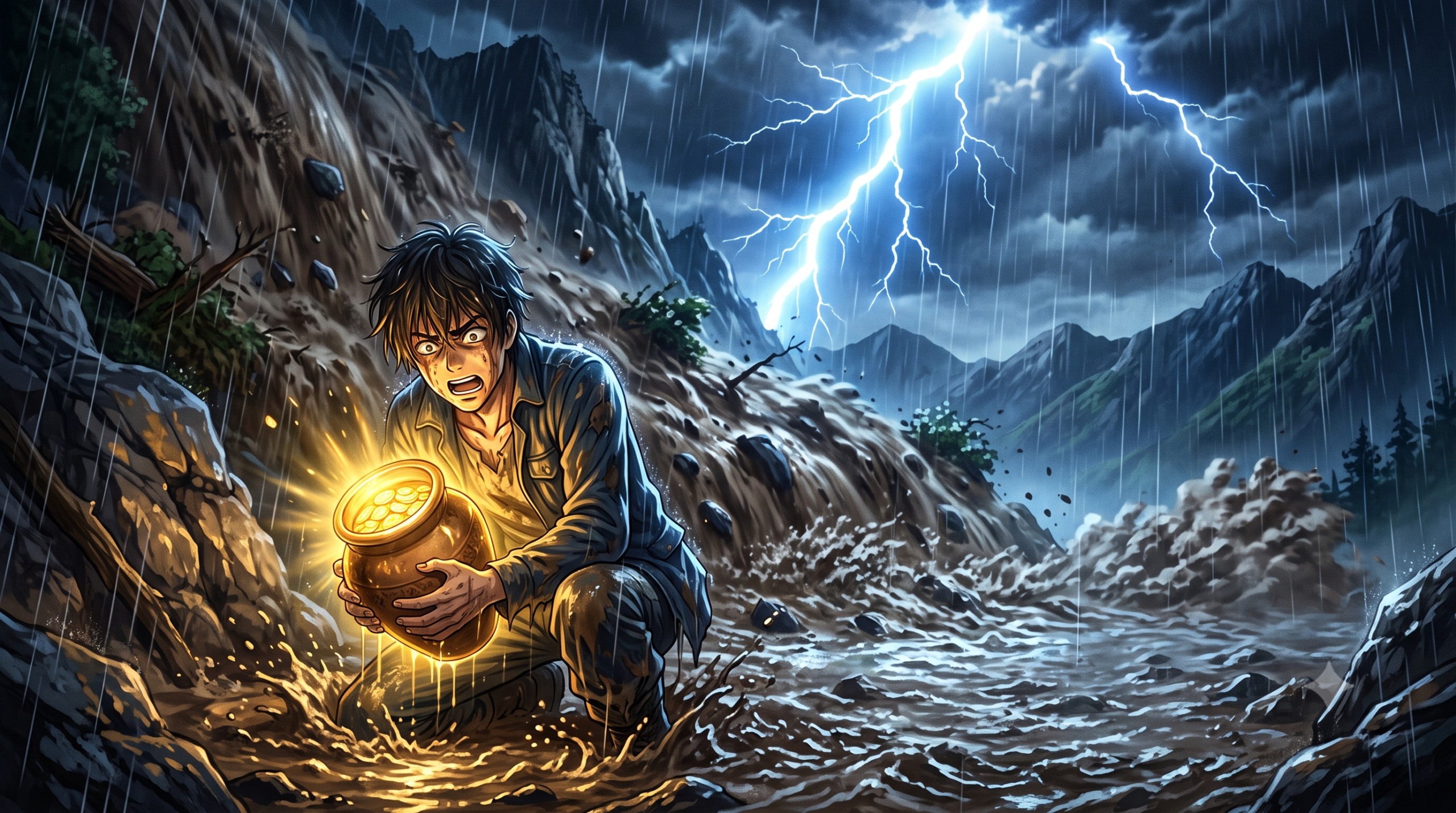
Yet, having turned into a monster of greed, the younger brother did not stop digging for a second. Eventually, his hoe struck something hard with a clink, and he unearthed a massive jar packed tightly with gold coins. His face covered in mud, he laughed maniacally and screamed into the roaring storm, “I did it! I finally did it! This is all my money! I won’t give a single penny to anyone!”
In the very next instant, a massive lightning bolt struck the mountain peak with an earth-shattering roar. As if taking it as a signal, the earth shook violently, and the mountain’s surface collapsed completely. A “Yamatsunami” (mountain tsunami / severe landslide) had occurred. A roaring torrent of muddy water and earth surged down, swallowing the greedy younger brother, the jar of gold, and everything else into the bottomless, pitch-black mud in the blink of an eye.
The next morning, the storm had passed. Standing before the brutally transformed mountain, the sole surviving older brother wept quietly. “I didn’t care about the gold coins at all… It would have been enough if just the two of us could live together, even in poverty. What a cruel, cruel tragedy,” he whispered, consumed by profound sorrow.
2. Deep Analysis of “Yamatsunami”
This story transcends the simple framework of “poetic justice” (good deeds are rewarded, evil deeds are punished) common in folktales, depicting the universal weakness and inevitable tragedies of humanity.
The fundamental cause of the younger brother’s tragedy was not “poverty” itself. It lay in his “greed”—forgetting gratitude for his daily sustenance (the Soba-dango) and craving wealth far beyond his stature—and above all, his “selfishness” in betraying the unconditional love of his older brother, who intended to share the wealth. The “walnut trial” presented by the spirit was not a mere game of luck; it was a mirror reflecting their true moral character. The moment he drew the black seed, the pitch-black desire swirling in his heart was foreshadowed.
Furthermore, the element that weighs heaviest on the heart is the surviving older brother. Even though he drew the white walnut and rightfully earned the wealth, he had zero attachment to it. What truly mattered to him was not “money” but the “bond with his only brother.” However, the deep sorrow and helplessness of this story lie in the fact that his defenseless kindness inadvertently stimulated his younger brother’s dark greed, leading him to his ultimate demise. The tale carries a powerful message that wealth can completely blind a person, causing them to permanently lose what is most precious.
3. Connection to Japanese Culture and Views on Nature
This “Yamatsunami” deeply reflects Japan’s unique views on nature and its religious underpinnings.
First is the spirit of “Animism” (nature worship). In Japan, since ancient times, it has been believed that gods reside in all natural entities, such as mountains, rivers, trees, and giant rocks (the Eight Million Gods). It is no coincidence that the gold was hidden at the “Shrine of the Mountain God.” Desecrating a sacred place for personal greed constitutes a grave blasphemy against the divine. The lightning and the Yamatsunami (landslide) are depicted not merely as overlapping meteorological conditions, but as the “fierce wrath of the Mountain God” against arrogant humans who disrupt the harmony of the natural world.
Second is the connection to Japan’s harsh geographical conditions. About 70% of Japan’s land is rugged, mountainous terrain, meaning people have always lived side-by-side with typhoons, earthquakes, and the terrifying landslides (Yamatsunami) they trigger. By weaving the intense memories of natural disasters that suddenly snatch everything away into these folktales, our ancestors passed down vital survival lessons to future generations: “Never underestimate nature,” and “Selfish and arrogant behavior will invite divine punishment.”
Third is the Japanese virtue of “Knowing when one has enough” (Taru wo shiru). Being satisfied with a life suitable to one’s standing and being deeply grateful for what one currently possesses. The younger brother’s act of throwing away the Soba-dango completely contradicted this virtue. The spirit of “Chisoku” (contentment), which also aligns closely with Zen philosophy, flows quietly yet definitively at the foundation of this story.
4. What Would You Have Done?
If you were in the younger brother’s position, what action would you have taken on the night you heard about the location of the gold coins? Can you say with confidence that you would have completely overcome the temptation of the gold glowing alluringly in the dark and waited quietly until the next morning?
Also, if you were in the older brother’s position, how would you overcome the deep sorrow and guilt when your own kindness backfired, causing your only family member to destroy himself out of greed?
Our modern society is also overflowing with invisible “gold coins”—vast wealth, social fame, and the desire for validation on social media. In the extreme pursuit of these things, have we lost sight of what is “truly important,” such as warm bonds with family and friends, or respect for nature? This ancient Japanese folktale quietly asks us, who live busy modern lives, what true richness really means. Please share your honest thoughts after reading this story.
Reference Links
- Japanese Folktale Series (Category of this blog)
- Reference: Manga Nippon Mukashibanashi Database “Yamatsunami”
【日本昔話】欲と自然の猛威を描いた悲劇「山つなみ」~日本文化が教える自然への畏敬~
日本の豊かな自然は、四季折々の美しい風景や豊富な恵みを私たちに与えてくれます。しかしその一方で、時に荒れ狂い、人間の力を遥かに超える恐ろしい牙をむくことがあります。古来より日本人は、自然の恵みに感謝すると同時に、その脅威に対する深い畏敬の念を抱き、数多くの教訓を昔話として語り継いできました。
今回ご紹介するのは、人間の底知れぬ欲望と、それに下される自然の無慈悲な鉄槌を描いた群馬県多野郡周辺に伝わる昔話「山つなみ」です。ただの作り話として片付けることのできない、現代社会にも通じる深いメッセージを持つこの物語を、じっくりと紐解いていきましょう。
1. 昔話「山つなみ」のストーリー
むかしむかし、ある山深い村に、木こりをして生計を立てている兄弟が住んでいました。二人はたった二人の家族として毎日一緒に山へ入り、木を切って暮らしていました。しかし、この兄弟は血が繋がっているとは思えないほど、性格がまるで正反対だったのです。
兄は非常に真面目で働き者でした。朝は誰よりも早く起き、日暮れまで黙々と斧を振るい、汗水流して働く日々を送っていました。対照的に、弟は口ばかりが達者な怠け者でした。山へ同行はするものの、仕事もそこそこにすぐ草むらにゴロリと横になり、高いびきをかいて昼寝ばかりしていたのです。
ある日の昼時、いつものように仕事の手を止めて昼食の時間になりました。弟が渋々お弁当の包みを開くと、中にはいつもの質素なソバ団子が入っていました。弟はそれを見るなり顔をしかめ、「なんだ、またソバ団子か!こんなボソボソしたまずい物はもう食いあきた!」と大声で叫び、せっかくの食べ物を無造作に草むらへと放り投げてしまいました。
さらに弟は、大きなため息をつきながら天を仰ぎ、「あぁあ、もっと美味い物が腹いっぱい食いたい。毎日遊んで暮らしたい。とにかく金だ、金が欲しいよお~!」と、己の不平不満を大声で山中に響き渡らせました。
するとその時です。周囲が突然、目が眩むような強い光に包まれました。驚いて立ち上がる兄弟の目の前に、神々しいオーラを放つ白髭の老人がふわりと姿を現したのです。老人は静かに微笑みながら、驚愕する二人にこう告げました。
「ワシは小判の精じゃ。お前たちに、山に眠る大量の小判のありかを教えてやろう。しかし、それには条件がある。ここにある二つのクルミの実のうち、見事『白い実』が入っていた方にだけ、その場所を教えよう」
欲に完全に目のくらんだ弟は、老人が言い終わるが早いか、真っ先に大きなクルミをひったくり、近くの石に叩きつけて勢いよく割りました。しかし、彼が手にした殻の中から出てきたのは、真っ黒に干からびた実でした。
続いて、兄が残されたもう一つのクルミをそっと丁寧に割ってみると、中からは雪のように綺麗な白い実が顔を出しました。それを見た弟は、真っ赤になって歯ぎしりをして悔しがりました。
しかし、非常に心の優しい兄は、自分だけが莫大な富を独占することを全く望みませんでした。「なぁに、そんなに悔しがることはないさ。小判の場所は教えてもらうが、明日、一緒に山へ行って二人で仲良く掘り出そうじゃないか」と、老人が教えてくれた小判の隠し場所である『山神さまの祠の後ろにある大杉の根元』を、弟に正直に教えてあげたのです。
その夜のことです。働き詰めで疲れた兄がぐっすりと深い眠りに落ちている隙に、弟はそっと布団を抜け出しました。「あの小判は全部俺のものだ。兄貴なんかに分けてたまるか。俺一人で大金持ちになるんだ」と、薄暗い納屋から鍬を片手に持ち出し、一人で夜の不気味な山へと登っていきました。
山神さまの祠に着いた弟は、取り憑かれたように無我夢中で土を掘り始めました。すると、空の様子が急変しました。激しい大風が木々をなぎ倒すように吹き荒れ、大粒の雨が滝のように降り始めたのです。山の神が怒っているかのような嵐でした。
しかし、黄金の亡者と化した弟は掘る手を全く止めません。やがて、土の中からカチンと固い音がし、小判がぎっしりと詰まった巨大な瓶を掘り当てました。弟は泥だらけの顔で狂ったように笑い、「やったぞ!ついにやった!これは全部俺の金だ!誰にもびた一文渡さんぞ!」と嵐の中で絶叫しました。
次の瞬間、山の頂に凄まじい轟音と共に巨大な雷が落ちました。それを合図にするかのように、大地が激しく揺れ、山肌が大きく崩れ落ちました。「山つなみ(土砂崩れ)」が起こったのです。轟々と音を立てて濁流と土砂が押し寄せ、あっという間に欲深い弟も、掘り出した小判の瓶も、すべてを真っ暗な泥の底へと呑み込んでしまいました。
翌朝、嵐が去り、変わり果てた無残な山の姿を前に、たった一人残された兄は静かに涙を流しました。「小判なんか、本当にどうでもよかったのに……。ただ、貧しくても二人で生きていければそれで十分だったのに、なんという惨いことだ」と、深い悲しみの中でつぶやきました。
2. 「山つなみ」から読み解く深い考察
この物語は、日本の昔話によくある「良いことをすれば報われ、悪いことをすれば罰を受ける」という単純な勧善懲悪の枠を大きく超えた、人間の持つ普遍的な弱さと抗えない悲劇を描いています。
弟の悲劇の根本的な原因は、「貧しさ」そのものではありませんでした。日々の糧である食べ物(ソバ団子)への感謝を忘れ、己の身の丈に合わない分不相応な富を渇望した「強欲さ」、そして何より、自分に富を分け与えようとしてくれた兄の「無償の愛」を裏切った「身勝手さ」にあります。小判の精が提示した「クルミの試練」は、単なる運試しなどではなく、彼らの心根を映し出す鏡でした。黒い実を引き当てた時点で、弟の心の中に渦巻く「真っ黒な欲望」がすでに暗示されていたのです。
また、この物語において最も心に重く残るのは、たった一人生き残った兄の存在です。兄は白のクルミを引き当て、正当に小判を手にする権利を得たにもかかわらず、その富に全く執着しませんでした。兄にとって真に大切だったのは「金」ではなく「たった一人の弟との絆」でした。しかし、その無防備な優しさが、結果として弟のどす黒い欲を刺激し、最悪の死へと向かわせてしまったという点に、この物語の底知れぬ哀愁とやるせなさがあります。富は時に人の目を完全に狂わせ、一番大切なものを永遠に失わせるという強烈なメッセージが込められています。
3. 昔話と日本文化・自然観との関連性
この「山つなみ」には、日本独自の自然観と宗教観が非常に色濃く反映されています。
第一に、「アニミズム(自然崇拝)」の精神です。日本では古来より、山や川、木や巨岩など、すべての自然物に神が宿ると信じられてきました(八百万の神)。小判が隠されていた場所が「山神さまの祠」であったことは決して偶然ではありません。神聖な場所を己の私利私欲のために荒らす行為は、神への重大な冒涜を意味します。雷と山つなみ(土砂崩れ)は、単なる気象条件が重なった自然現象ではなく、自然界の調和を乱した傲慢な人間に対する「山の神の激しい怒り」として描かれているのです。
第二に、日本の過酷な地理的条件との結びつきです。日本は国土の約7割が険しい山林であり、台風や地震、それに伴う恐ろしい土砂災害(山つなみ)と常に隣り合わせで生きてきました。先人たちは、突然すべてを奪い去る自然災害の強烈な記憶を、こうした昔話に織り交ぜることで、「決して自然を甘く見てはいけない」「身勝手な振る舞いをすれば天罰が下る」という生存のための教訓として、後世に強く語り継いできたのです。
第三に、「足るを知る」という日本的な美徳の精神です。分相応の生活に満足し、今自分が持っているものに深く感謝する。ソバ団子を無造作に放り投げた弟の行為は、この美徳に完全に反するものでした。禅の思想にも通じる「知足(ちそく)」の精神が、この物語の根底に静かに、しかし確実に流れています。
4. あなたなら、どう行動しますか?
もし、あなたがこの物語の弟の立場だったら、兄から小判の場所を聞いた夜、果たしてどのような行動をとったでしょうか? 暗闇の中で妖しく光る黄金の誘惑に完全に打ち勝ち、翌朝まで静かに待つことができたと自信を持って言えるでしょうか。
また、もしあなたが兄の立場だったら、己の優しさが仇となり、たった一人の家族が欲のために身を滅ぼしてしまった時、どうやってその深い悲しみと自責の念を乗り越えて生きていきますか?
私たちの生きる現代社会も、目に見えない「小判」にあふれています。莫大な富、社会的な名声、SNSでの承認欲求。それらを極端に追求するあまり、家族や友人との温かい絆、あるいは自然への敬意といった「本当に大切なもの」を見失ってはいないでしょうか。この古い日本の昔話は、現代を忙しく生きる私たちに、真の豊かさとは何かを静かに問いかけています。ぜひ、この物語を読んで感じたあなたの率直な考えを聞かせてください。
コメント