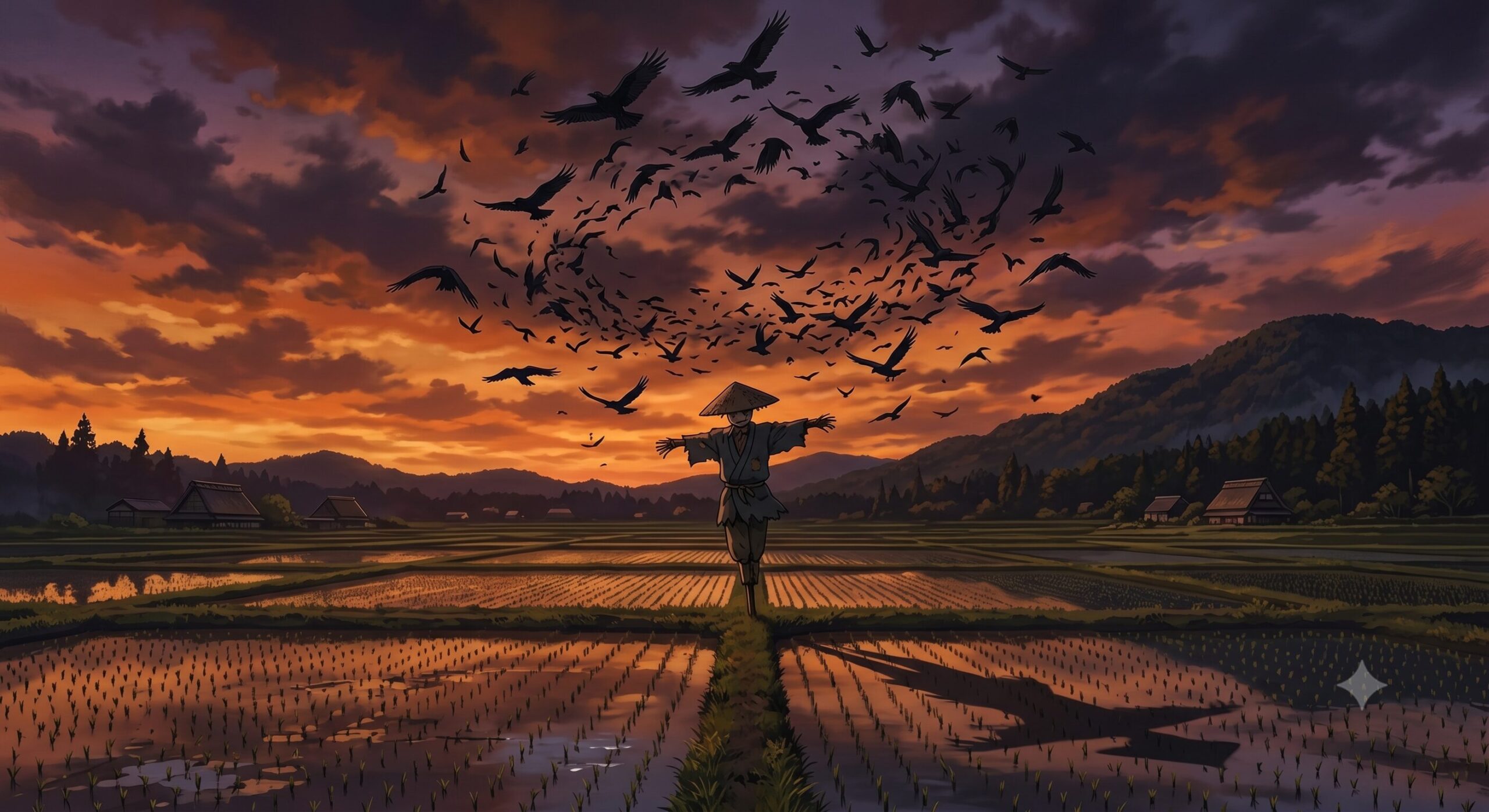
There are countless folktales in Japan, but not all of them end happily ever after. Sometimes, there are dark stories that relentlessly confront the reader with the terrifying power of nature and the sanctity of life. “Gonbei and the Crows” (Gonbei to Karasu), which we are introducing today, is a prime example. This story is not merely about a conflict between birds and humans; it teaches us about ancient Japanese views of nature and the origins of a “certain object” essential to rural landscapes.
The Story of “Gonbei and the Crows”
Once upon a time, there lived a farmer named Gonbei. He worked hard every day plowing his fields and sowing seeds, but he had one major problem. The crows would always come, dig up the seeds he had painstakingly planted, and eat them.
One day, crows built a nest in a tree near the rice field of his neighbor, Rokubei, and seven chicks were born. Gonbei went to Rokubei and pleaded, “Those birds will ruin our crops. We need to get rid of them now.” However, the kind-hearted Rokubei firmly refused, saying, “I could never do something so cruel as killing newborn chicks.”
Unable to contain his anger, Gonbei took his gun early the next morning and went alone to Rokubei’s field. Without mercy, he shot at the mother crow as she flew from her nest. The bullet blew off one of her legs. The young chicks desperately tried to nurse their injured mother, but it was in vain. The mother crow died from the wound inflicted by Gonbei.
Grief-stricken and enraged, the baby crows went deep into the forest to seek the elder of the crows. Upon hearing the situation, the elder was furious. He gathered all the crows in the forest and declared, “We must avenge the mother crow!”
A few days later, completely unaware of the impending doom, Gonbei was sowing seeds in his field as usual. Suddenly, the sky turned pitch black. When he looked up, an uncountable swarm of crows covering the entire sky was descending upon him. The flock attacked Gonbei all at once, violently pecking at him with their sharp beaks. Unable to escape, Gonbei was viciously pecked all over his body. During the onslaught, he lost one of his legs, and ultimately died from his severe injuries.
It is said that ever since this gruesome incident, “one-legged scarecrows” (Kakashi) have been placed in Japanese rice fields. When the crows see the one-legged figure, they are terrified, thinking, “Gonbei’s ghost has appeared!” and they never come near the fields again.
Deep Analysis of “Gonbei and the Crows”
This story heavily reflects the Buddhist value of karmic retribution (what goes around comes around). Gonbei tried to eliminate the crows to protect his crops, but his excessive violence in taking a life ultimately returned to him in the exact same form: losing a leg and dying.
What is noteworthy here is the presence of Rokubei. Rather than trying to control nature (the crows), Rokubei prioritized coexistence and compassion for life. The contrast between Gonbei and Rokubei presents a universal theme of how humans should interact with nature. It serves as a warning that attempting to subdue nature with violence will result in an overwhelming counterattack from nature itself (represented by the massive swarm of crows).
Japanese Culture and the Origin of the “Scarecrow” (Kakashi)
The most fascinating aspect of this folktale is that it tells the origin story of the “Kakashi” (scarecrow), a symbol of Japan’s rural landscape. Since ancient times, Japanese scarecrows have generally been made with “one leg.” Why one leg instead of a two-legged human shape?
In Japanese mythology (Kojiki), a god named “Kuebiko” appears. This deity is described as a god who “cannot walk, but knows everything under heaven,” and is considered the deified form of the scarecrow. Furthermore, in Japanese folk belief, entities with “one leg” or “one eye” have long been symbols of “Mountain Gods” or “Yokai” (supernatural monsters).
“Gonbei and the Crows” brilliantly reconstructs this ancient image of a “one-legged god (or yokai)” as the result of a conflict between humans and animals. To the crows, the one-legged scarecrow is terrifying not because it is merely a doll, but because it looks like the “vengeful spirit of a human who broke the laws of nature” (Gonbei’s ghost). In Japanese culture, a scarecrow is not just a tool to ward off birds; it is a guardian deity standing on the boundary between nature and humans, and a cautionary symbol to ensure we never forget our reverence and fear of nature.
What Do You Think?
How did you feel reading this folktale with such a shocking ending?
Were Gonbei’s actions inevitable for him to survive as a farmer? Or do you think he got what he deserved for disregarding life? If you were in Gonbei’s shoes, what measures would you have taken against the crows ravaging your fields? Please share your thoughts with us!
Japan has many other thought-provoking folktales. Please enjoy our other stories from the link below.
Japanese Folktale Series
Reference:
Manga Nippon Mukashibanashi Database “Gonbei and the Crows”
日本の昔話が教える自然の掟:「ごん兵衛とからす」の恐ろしくも深い物語
日本には数多くの昔話が存在しますが、そのすべてがハッピーエンドで終わるわけではありません。時には自然の恐ろしさや、命の尊さを容赦なく読者に突きつけるダークな物語も存在します。今回ご紹介する「ごん兵衛とからす」は、まさにその代表格です。この物語は、単なる鳥と人間の争いではなく、日本古来の自然観や、農村の風景に欠かせない「ある物」の由来を私たちに教えてくれます。
昔話のストーリー:「ごん兵衛とからす」
昔あるところに、ごん兵衛という名前の百姓が住んでいました。ごん兵衛は毎日一生懸命に畑を耕し、種をまいていましたが、一つ大きな悩みを抱えていました。それは、せっかくまいた種を、カラスたちがやってきてはほじくり返して食べてしまうことでした。
ある日のこと、近所に住む六兵衛さんの田んぼの木の上に、カラスが巣を作り、七羽の雛が生まれました。ごん兵衛は六兵衛さんのところへ行き、「あいつらは畑を荒らすから、今のうちに退治してくれ」と頼み込みました。しかし、心優しい六兵衛さんは「いくらなんでも、生まれたばかりの雛を殺すようなかわいそうなことはできない」と、ごん兵衛の頼みを強く拒絶しました。
怒りが収まらないごん兵衛は、翌朝早くに鉄砲を担ぎ、一人で六兵衛の田んぼへと向かいました。そして、巣から飛び立った母ガラスを容赦なく狙い撃ちにしたのです。銃弾は母ガラスの足を一本吹き飛ばしました。幼い子ガラスたちは必死に傷ついた母親の看病をしましたが、その甲斐もなく、母ガラスはごん兵衛に撃たれた傷が原因で息絶えてしまいました。
悲しみと怒りに暮れた子ガラスたちは、深い森の奥に住むカラスの長老のもとへ向かいました。子ガラスたちから事情を聞いた長老は激怒し、森中のカラスたちを集め、「母ガラスの仇を討とう」と呼びかけました。
数日後、そんなことが起きているとは露知らず、ごん兵衛はいつものように畑で種をまいていました。すると突然、空が真っ暗になりました。見上げると、空を覆い尽くすほどの無数のカラスが押し寄せてきたのです。カラスの群れは一斉にごん兵衛に襲いかかり、鋭い嘴でよってたかってごん兵衛をつつきました。逃げる間もなく全身を激しくつつかれたごん兵衛は、その過程で片足を失い、最後にはその傷が原因で死んでしまいました。
この凄惨な事件以来、日本の田んぼには「一本足の案山子(かかし)」が立てられるようになりました。カラスたちはその一本足の姿を見ると、「ごん兵衛の幽霊が出た!」と恐れおののき、決して近づかなくなったと言われています。
「ごん兵衛とからす」を深く考察する
この物語は、因果応報(自分の行いが自分に返ってくること)という仏教的価値観を色濃く反映しています。ごん兵衛は農作物を守るためにカラスを排除しようとしましたが、命を奪うという行き過ぎた暴力は、最終的に同じ「一本足を失って死ぬ」という形で自身に返ってきました。
ここで注目すべきは六兵衛の存在です。六兵衛は自然(カラス)をコントロールしようとするのではなく、共存、あるいは命への慈悲を優先しました。ごん兵衛と六兵衛の対比は、人間が自然に対してどう向き合うべきかという普遍的なテーマを提示しています。自然を暴力でねじ伏せようとすれば、自然からの圧倒的な逆襲(無数のカラスの襲撃)に遭うという警告なのです。
物語から読み解く日本文化と「案山子(かかし)」の由来
この昔話の最も興味深い点は、日本の農村風景の象徴である「案山子(かかし)」の起源を語っているところです。日本の案山子は古来より「一本足」で作られるのが一般的です。なぜ二本足の人間型ではなく、一本足なのか。
日本神話(古事記)には、「久延毘古(くえびこ)」という神様が登場します。この神は「足は歩けないが、天下のことは何でも知っている神」とされ、案山子の神格化された姿だと言われています。また、日本の民間信仰において、「一本足」や「一つ目」の存在は「山の神」や「妖怪」の象徴とされてきました。
「ごん兵衛とからす」は、この古来からある「一本足の神(または妖怪)」のイメージを、人間と動物の争いの結果として見事に再構築しています。カラスにとって一本足の案山子が怖いのは、それが単なる人形だからではなく、「自然の掟を破って復讐された人間の怨念(ごん兵衛の幽霊)」に見えるからです。日本の文化において、案山子は単なる鳥よけの道具ではなく、自然と人間の境界線に立つ守り神であり、同時に自然への畏れを忘れないための戒めの象徴なのです。
あなたはどう感じましたか?
この強烈な結末を持つ昔話を読んで、あなたはどう思いましたか?
ごん兵衛の行動は農民として生きるために仕方のないことだったのでしょうか。それとも、命を軽視した当然の報いだと思いますか?もしあなたがごん兵衛の立場だったなら、畑を荒らすカラスに対してどのような対策をとりましたか?ぜひ、あなたの考えを教えてください。
日本には、他にも多くの深く考えさせられる昔話があります。以下のリンクから、他の物語もぜひお楽しみください。
Japanese Folktale Series(その他の日本昔話はこちら)

コメント