Once upon a time, in a village buried deep in snow, there lived a man named Tosuke. Tosuke was not an evil man by any means, but he was undeniably greedy. His mind was always occupied with thoughts of how to make a fortune with the least amount of effort.
On one particularly bitter winter morning, Tosuke was walking past the large pond in his village when a spectacular sight caught his eye. The surface of the pond had frozen completely solid overnight, and countless ducks had their feet trapped in the ice, completely immobilized.
“Unbelievable! If I catch all these ducks and sell them in town, I’ll be rich!”
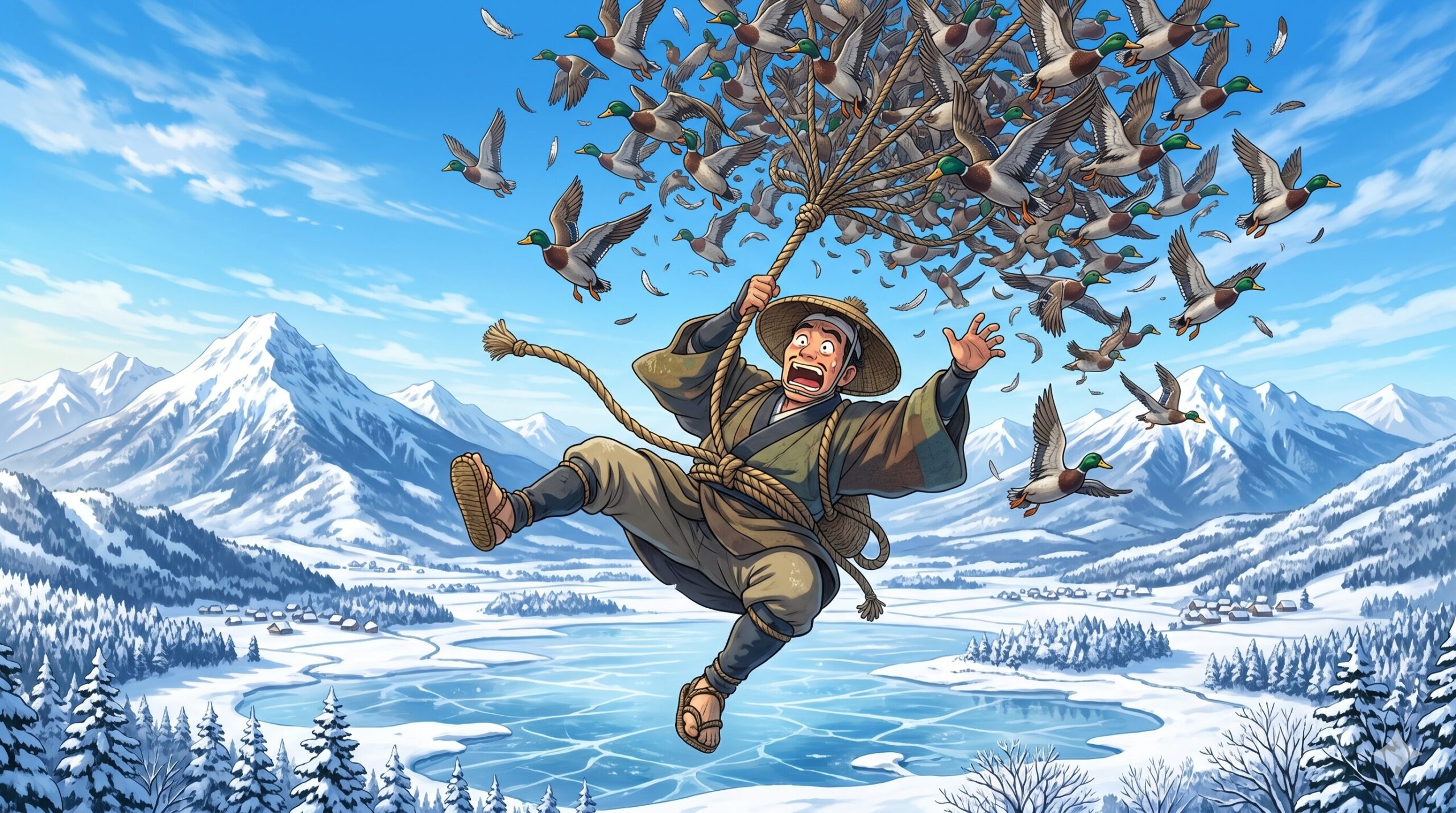
Tosuke’s eyes gleamed with greed. He rushed home, grabbed a long, thick rope, and carefully tiptoed across the frozen pond. One by one, he tied the legs of the helpless ducks to the rope, which he had securely fastened around his own waist. One bird, ten birds, fifty birds, a hundred birds… As the number grew, so did the heavy weight around his waist. When every single duck was tied up, Tosuke’s chest swelled with immense satisfaction.
However, as fate would have it, the winter sun broke through the clouds, shining exceptionally warm that day. As the sun rose higher, the ice on the pond began to make a sharp, cracking sound: Crack, snap, pop… and began to melt.
Freed from the ice, the ducks realized they were tethered to a strange human and panicked. Over a hundred ducks flapped their strong wings simultaneously and took off toward the sky.
“Whoa! Wait! Stop!”
Tied firmly by the waist, Tosuke was immediately yanked upward by the tremendous force of the flock. Despite his desperate screams, the flock of ducks climbed higher and higher, dragging Tosuke up into the cold winter sky. Looking down, his village looked as small as a handful of peas. At first, Tosuke shrieked in terror, but eventually, his greed and ego returned. “Not even the highest-ranking lords get to enjoy flying in the sky!” he thought, starting to enjoy the breathtaking view.
But his aerial journey did not last long. Exhausted from the heavy load, the ducks began to lose altitude. Then, whether the rope snapped from the friction or the ducks finally shook it loose, Tosuke was suddenly thrown into mid-air.
“Heeeelp meeeee!”
Tosuke plummeted toward the earth, the wind rushing past his ears. Just when he thought his life was over, he landed with a soft thud. Miraculously, he had fallen onto a fluffy cloud field cultivated by the Thunder God (some variations say he landed in a giant radish field or on the roof of a pagoda). Having narrowly escaped death as a direct result of his overwhelming greed, Tosuke finally reflected on his foolishness and swore never to let his desires exceed his bounds again.
The Deep Lesson Behind Tosuke’s Story: Mastering Your Desires
The “Tale of Tosuke and the Ducks” is far more than just a comical folktale. At its core, the story serves as a profound warning about the destructive nature of unchecked greed.
Faced with an unexpected stroke of luck (the frozen ducks), Tosuke tried to extract far more profit than he actually needed. Had he taken just a few ducks, he could have returned home safely and comfortably. Instead, by attempting to monopolize the entire flock, he faced the unpredictable consequence of being dragged into the sky. This is a universal lesson applicable to investments, business, and daily life. If you misjudge the risks and pursue gains that exceed your capacity (the rope tied to his waist), you will eventually lose control and invite massive failure, much like being thrown from the sky.
Zen Philosophy and Japanese Humor: The Spirit of “Knowing Enough”
This folktale vividly reflects traditional Japanese cultural backgrounds and philosophies. Particularly noteworthy is the Zen Buddhist concept of “Chisoku” (knowing what is enough). Symbolized by the famous inscription “Ware tada taru wo shiru” (I simply know what is enough) on the stone washbasin at Ryoan-ji Temple in Kyoto, Japanese culture has long esteemed the virtue of being content with one’s current state and avoiding excessive greed. Tosuke’s attempt to hoard nature’s bounty is the exact antithesis of this Chisoku spirit.
Furthermore, the charm of this story lies in its traditional Japanese humor, which neutralizes what could otherwise be a preachy lesson. Similar to Rakugo (traditional comic storytelling), this type of comedic tale avoids a cruel ending where the protagonist is punished with death. Instead, it delivers a bizarre, laugh-out-loud conclusion where he flies through the air and lands in a strange place. The storytelling technique brilliantly uses laughter to instill lessons about the harsh realities of nature and society into the hearts of the people.
What Would You Do?
So, what are your thoughts after reading this tale? If you were in Tosuke’s shoes and found a massive flock of defenseless ducks, how many would you have tried to take home? Have you ever experienced a moment in your own life where you became so greedy that you almost lost control of the situation?
While you might not get dragged into the sky by ducks, the modern world is full of moments where our own desires can sweep us off our feet. Take a moment to reflect: where do you draw your line of “knowing what is enough”?
[Related Links]
- Enjoy more Japanese folktales: Japanese Folktale Series Category
- Learn more about Japanese folklore and mythology: Japanese Folklore (Wikipedia)
空を飛んだ強欲な男:藤助どんの鴨とり話
昔々、ある雪深い村に、藤助という男が住んでいました。藤助は決して悪人ではありませんでしたが、少しばかり欲が深く、常に「どうすれば楽をして大儲けできるか」ばかりを考えているような男でした。
ある厳しい冬の朝のことです。藤助が村の大きな池のそばを通りかかると、驚くべき光景が目に飛び込んできました。池の水面がカチカチに凍りつき、その氷の中に無数の鴨たちが足を挟まれ、身動きが取れなくなっていたのです。
「こいつはたまげた!この鴨を全部捕まえて町で売れば、大金持ちになれるぞ!」
藤助の目は欲でギラギラと輝きました。彼は家から頑丈で長い縄を持ち出すと、凍りついた池の上をそっと歩き、動けない鴨たちの足を一本一本、自分の腰に巻きつけた縄に結びつけていきました。一羽、十羽、五十羽、百羽……。あまりの数の多さに、藤助の腰にはずっしりとした重みが伝わってきます。すべての鴨を結び終えたとき、藤助は満足感で胸がいっぱいになりました。
ところが、運命のいたずらか、その日は冬にしては異常に暖かい日差しが差し込んできました。太陽が昇るにつれて、池の氷が「ピキ、ピキピキ……」と音を立てて溶け始めたのです。
氷から足が抜け、自由を取り戻した鴨たちは、見知らぬ人間に捕らえられていることに気づき、パニックに陥りました。百羽を超える鴨が一斉に力強く羽ばたき、大空へと飛び立ったのです。
「うわあっ!待て、待て!」
腰に縄を結びつけていた藤助は、鴨たちの凄まじい力に引っ張られ、あっという間に宙に浮き上がりました。彼の悲鳴も虚しく、鴨の群れはぐんぐんと高度を上げ、冬の空高くへと藤助を連れ去ってしまいました。眼下には、自分の住む村が豆粒のように小さく見えます。最初は恐怖で叫んでいた藤助ですが、次第に「空を飛ぶなんて、殿様でもできない贅沢だ」と、その絶景を楽しむ余裕すら見せ始めました。
しかし、空の旅は長くは続きません。鴨たちが長旅に疲れ、次第に高度を下げ始めたのです。そして、縄が擦り切れたのか、それとも鴨たちが縄を解いたのか、藤助は突然空中から放り出されてしまいました。
「助けてくれえええ!」
風を切って真っ逆さまに落ちていく藤助。万事休すかと思われたその時、彼はドスンと柔らかい場所に落ちました。そこはなんと、雷様が雲の上で作っていたフワフワの畑だったのです(※落ちた場所には諸説あり、巨大な大根畑や五重塔の屋根とする場合もあります)。欲張った結果、命を落とす寸前までいった藤助は、ようやく自分の愚かさを反省し、二度と身の丈に合わない欲をかかないと誓ったのでした。
藤助の物語が伝える深い教訓:欲望のコントロール
この「藤助どんの鴨とり話」は、単なる滑稽な笑い話にとどまりません。物語の核心にあるのは「過度な欲望がもたらす破滅の危険性」です。
藤助は、目の前にある幸運(凍りついた鴨)を前にして、自分が必要とする以上の利益を得ようとしました。数羽であれば安全に持ち帰ることができたにもかかわらず、すべてを独占しようとした結果、空へ連れ去られるという予想外のしぺ返しを受けます。これは、投資やビジネス、あるいは日常生活においても通じる普遍的な教訓です。リスクを見誤り、自らのキャパシティ(腰に結んだ縄)を超えた利益を追求すれば、最終的には自分自身がコントロールを失い、空中に放り出されるような大失敗を招くという警告が含まれています。
日本文化から読み解く「足るを知る」の精神とユーモア
この昔話には、日本独自の文化的背景と哲学が色濃く反映されています。特に注目すべきは、禅の教えである「知足(足るを知る)」という概念です。京都の龍安寺にあるつくばい(手水鉢)に刻まれた「吾唯足知(われただたるをしる)」という言葉にも象徴されるように、日本文化では古くから「身の丈に合った現状に満足し、過度な欲をかかないこと」が美徳とされてきました。自然の恵みを独り占めしようとした藤助の行動は、この「知足」の精神の対極にあります。
さらに、この物語の魅力は、その説教くささを中和する「日本の伝統的なユーモア」にあります。落語にも通じるこのような滑稽噺(こっけいばなし)は、主人公が罰を受けて死んでしまうような残酷な結末ではなく、空を飛んで見知らぬ場所に落ちるという奇想天外で笑える結末を用意します。厳しい自然や社会の教訓を、笑いを通じて人々の心に浸透させるという、日本独自のストーリーテリングの技術が光っています。
あなたならどうしますか?
さて、この物語を読んで、あなたはどう感じましたか?もしあなたが藤助の立場なら、目の前に無防備な鴨の大群がいたとき、何羽の鴨を持ち帰ったでしょうか。あるいは、日常生活の中で「つい欲張りすぎて、コントロールを失いそうになった」経験はありませんか?
鴨に引かれて空を飛ぶことはないかもしれませんが、私たちが欲望に振り回されて足元をすくわれる瞬間は、現代社会にも溢れています。あなたの「足るを知る」ラインはどこにあるのか、ぜひ考えてみてください。
【関連リンク】
- 日本の昔話をさらに楽しむ:Japanese Folktale Seriesカテゴリー
- 日本の昔話と民俗学について深く学ぶ:日本の昔話(Wikipedia)

コメント