A Peaceful Kotan and Sudden Conflict
Long ago, amidst the vast wilderness of Hokkaido, the indigenous Ainu people lived in settlements known as “kotan.” They thrived peacefully by hunting and foraging in the rich forests. However, a time came when the prey mysteriously vanished, leading to severe food shortages. Driven by the harsh realities of survival, conflicts over hunting grounds frequently erupted with neighboring kotan. The once-peaceful forest was slowly consumed by a tragic cycle of hatred and violence.
The Tragedy Begins and Young Tonkuru’s Resolve
Ekashi, the chief of the kotan, decided to seek a peaceful resolution with the rival settlement to prevent further senseless bloodshed. Unfortunately, his plea for peace was met with a ruthless surprise attack. During the fierce battle, Ekashi suffered a fatal wound. Knowing his end was near, he entrusted his young son, Tonkuru, to an elderly woman in the village, ordering her to flee and protect the boy at all costs.
With their home engulfed in flames, the old woman desperately ran through the forest, pulling Tonkuru along. However, upon discovering the cruel truth of his father’s death, the young boy was consumed by grief and rage. Yelling, “I will avenge my father!” Tonkuru broke free from the old woman’s grasp and sprinted back toward the burning village. Exhausted and overwhelmed by despair, the frail old woman collapsed in the dark forest.
The Journey to Lake Mashu and the Miracle of Kamuinupuri
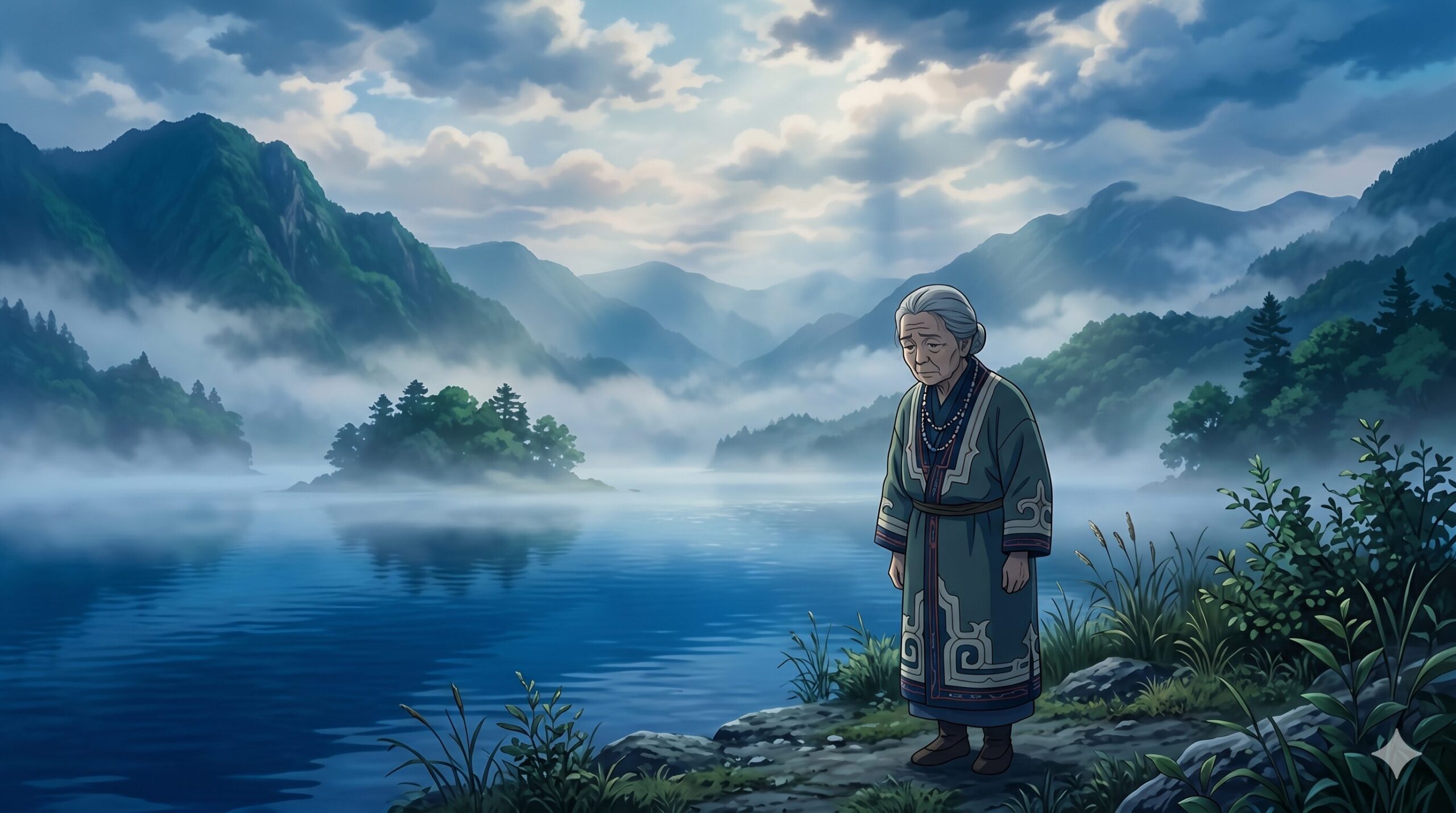
When the old woman regained consciousness the next morning, she dragged her battered body back to her kotan. She found nothing but ashes and ruins; Tonkuru was nowhere to be seen. Driven to the edge of despair, she wandered aimlessly, screaming Tonkuru’s name until her voice gave out. Her wandering eventually led her to the crystal-clear, deep blue shores of Lake Mashu.
As she broke down in tears by the lake, Kamuinupuri, the God of the Mountain, appeared before her. When the deity asked the cause of her profound sorrow, she recounted the tragedy and pleaded, “God of the Mountain, please turn me into an island in this lake. I want to remain here for all eternity, waiting for Tonkuru’s return.”
Deeply moved by her unconditional love and unbreakable devotion, Kamuinupuri granted her wish. By the power of the gods, the old woman transformed into a small rocky island in the center of the lake, now known as Kamuishu Island. Legend says that whenever visitors come to Lake Mashu, the old woman believes Tonkuru has finally returned and sheds tears of joy. This is why, even on the sunniest of days, Lake Mashu is frequently shrouded in fog, rain, or snow.
- A Peaceful Kotan and Sudden Conflict
- The Tragedy Begins and Young Tonkuru’s Resolve
- The Journey to Lake Mashu and the Miracle of Kamuinupuri
- Analysis of the Tale: The Cycle of Conflict and Unconditional Love
- Decoding Japanese and Ainu Cultural Heritage
- What Would You Do?
- 島になったおばあさん:摩周湖に眠る悲しくも美しいアイヌの物語
- 昔話の深い考察:争いの連鎖と無償の愛
- 日本文化とアイヌ神話からの読み解き
- あなたならどうしますか?
Analysis of the Tale: The Cycle of Conflict and Unconditional Love
This story is much more than a tragic myth; it serves as a poignant critique of human nature and the futility of war. A natural hardship—food scarcity—triggered devastating internal conflict. The war initiated by adults ultimately robbed a child of his parent and bred a new generation driven by revenge.
The old woman’s decision to become an island symbolizes the ultimate form of unconditional love. As a mortal human, her time to wait for her grandson was strictly limited by her lifespan. By transforming into an eternal island, she secured the ability to watch over the land forever. While it is a tragic fate, it was her only remaining hope to eternally wait for the one she loved.
Decoding Japanese and Ainu Cultural Heritage
In Ainu culture, a spiritual belief system dictates that “Kamui” (gods or divine spirits) reside in all elements of nature. The deity in this story, Kamuinupuri, corresponds to the real-life Mount Mashu. Furthermore, Lake Mashu is called “Kintan Kamui To” (Lake of the Mountain God) in the Ainu language, and the small island in its center is named “Kamuishu” (Divine Old Woman).
A recurring motif in Japanese and Ainu folklore is the transformation of humans with strong emotional attachments into natural landscapes or weather phenomena. Instead of attributing the famous thick fog of Lake Mashu to simple meteorology, local legends interpret it as the tears of a grieving grandmother. This highlights a unique spiritual connection to nature, merging human emotions with awe for the natural world.
What Would You Do?
If faced with the ultimate choice, would you sacrifice your human existence to become an eternal guardian for the ones you love? How can we as individuals break the tragic cycles of hatred and conflict in our own world? Reflect deeply on this beautiful yet sorrowful legend of Lake Mashu, and share your thoughts on the profound questions it raises.
■Read more related stories here:
Japanese Folktale Series
■Reference Links:
Lake Mashu – Wikipedia
島になったおばあさん:摩周湖に眠る悲しくも美しいアイヌの物語
平和なコタンと突然の争い
はるか昔、北海道の大自然の中に、アイヌの人々が暮らす「コタン(集落)」がありました。人々は森の恵みを受け、動物を狩猟しながら平和に生活していました。しかし、ある時期を境に森から獲物が姿を消し、食糧不足が深刻化します。生き残りをかけた過酷な環境のもと、隣接する別のコタンとの間で獲物を巡る争いが頻発するようになりました。平和だった森は、徐々に憎しみと暴力の連鎖に飲み込まれていきました。
悲劇の始まりと幼きトンクルの決意
コタンの長老であるエカシは、これ以上の無益な血が流れるのを防ぐため、相手のコタンへ話し合いを求めようと決意します。しかし、平和的解決を望むエカシの願いも虚しく、相手のコタンは容赦ない奇襲を仕掛けてきました。激しい戦いの末、エカシは致命傷を負ってしまいます。死を悟ったエカシは、一人の老女(おばあさん)に自身の幼い息子・トンクルを託し、「この子を連れてコタンから逃げ延びてくれ」と最後の命令を下しました。
燃え盛る故郷を背に、おばあさんは必死にトンクルの手を引いて走り出しました。しかし、父親が殺されたという残酷な真実を知った幼いトンクルは、悲しみと怒りに支配されます。「お父さんの仇をとる!」と叫び、トンクルはおばあさんの手を振りほどき、炎に包まれた元のコタンへと走って戻ってしまったのです。高齢のおばあさんはトンクルを追いかける気力も体力も限界に達し、深い森の中で意識を失って倒れ込みました。
摩周湖への道のりとカムイヌプリの奇跡
夜が明け、意識を取り戻したおばあさんは、満身創痍の体を引きずりながら元のコタンへと戻りました。しかし、そこに残っていたのは無惨に焼け落ちた村の残骸だけであり、愛するトンクルの姿はどこにもありませんでした。絶望の淵に立たされたおばあさんは、声を枯らしてトンクルの名前を叫びながら、当てもなく彷徨い歩きました。そして、たどり着いたのが、深く青く澄み切った摩周湖のほとりでした。
湖畔で泣き崩れるおばあさんの前に、山の神である「カムイヌプリ」が姿を現します。神が悲しみの理由を尋ねると、おばあさんは涙ながらに事の顛末を語り、こう懇願しました。「山の神様、どうか私をこの湖の島にしてください。私は永遠にここで、トンクルの帰りを待ち続けたいのです。」
おばあさんの無償の愛と深い悲しみに心を打たれたカムイヌプリは、その願いを聞き入れました。神の力により、おばあさんは湖の中央に浮かぶ小さな島(カムイシュ島)へと姿を変えたのです。それ以来、摩周湖に人が訪れると、おばあさんは「トンクルが帰ってきた」と勘違いして嬉し泣きをします。そのため、摩周湖はどんなに晴れた日であっても、必ず霧に包まれ、雨や雪が降るのだと言い伝えられています。
昔話の深い考察:争いの連鎖と無償の愛
この物語は、単なる悲しい昔話にとどまらず、人間の本質と戦争の愚かさを鋭く突きつけています。食糧不足という自然の試練が引き金となり、同族同士の争いが生まれました。大人の都合で始まった戦争は、結果として未来ある子供(トンクル)から親を奪い、復讐というさらなる悲劇を生み出しました。
おばあさんが島になることを選んだ行動には、肉体を捨ててでも愛する者を待ち続けたいという、究極の「無償の愛」が表現されています。人間の姿のままでは寿命があり、いずれトンクルを待つことができなくなります。永遠の存在である「島」になることは、悲劇的な結末に見えますが、彼女にとっては愛する孫を永遠に見守り続けるための唯一の希望の形だったのです。
日本文化とアイヌ神話からの読み解き
アイヌ文化において、自然界のすべてのものには「カムイ(神)」が宿っているとされています。この物語に登場する「カムイヌプリ(山の神)」は、現在の摩周岳を指します。また、摩周湖はアイヌ語で「キンタン・カムイ・トー(山の神の湖)」と呼ばれ、中央にある島は「カムイシュ(神の老婆)」と呼ばれています。
日本の伝統的な考え方において、強い想いを残した人間が自然の地形や天候そのものに変化するというモチーフは頻繁に登場します。摩周湖が「霧の摩周湖」と呼ばれるほど霧深い理由を、気象学的な事実として片付けるのではなく、「おばあさんの流す涙」として解釈する点に、自然現象に対する日本特有の情緒的で霊的な結びつきが見て取れます。自然への畏敬の念と、人間の深い感情を一体化させる神話的思考が、この物語の根底に流れています。
あなたならどうしますか?
最愛の家族を守るため、あなたは自分の全てを捨てて永遠の存在になることを選べますか?憎しみの連鎖を断ち切るためには、私たち一人ひとりがどのような選択をすべきなのでしょうか。この悲しくも美しい摩周湖の伝説を読んで、あなたは心に何を感じましたか?ぜひ、あなたの考えや想いを深く見つめ直してみてください。
■関連記事はこちら
Japanese Folktale Series(日本の昔話シリーズ)
■参考・関連リンク
摩周湖 – Wikipedia
コメント