- Introduction: Japan, the Country Where a Nameless Tree Becomes a God
- The Story of “The Nanjamonja Tree”
- Analysis: Why Was a Nameless Tree Feared?
- Connection to Japanese Culture: Animism and “Yaoyorozu no Kami”
- What Would You Do?
- はじめに:名もなき木が神になる国、日本
- 昔話「なんじゃもんじゃの木」の物語
- 考察:なぜ名もなき木は恐れられたのか?
- 日本文化との関連:アニミズムと「八百万の神」
- あなたならどうしますか?
Introduction: Japan, the Country Where a Nameless Tree Becomes a God
Japan is home to countless traditional folktales that have been passed down through generations. Most of these are not merely fairy tales for children, but valuable cultural heritage that deeply reflects the lifestyle, view of nature, and moral values of the people of those times. Today, we introduce a fascinating story called “The Nanjamonja Tree,” which perfectly symbolizes Japan’s unique nature worship and religious philosophy. By reading this story, you will gain a profound understanding of the awe and reverence Japanese people have historically held toward nature, as well as the animistic spirit known as “Yaoyorozu no Kami” (the eight million gods).
The Story of “The Nanjamonja Tree”
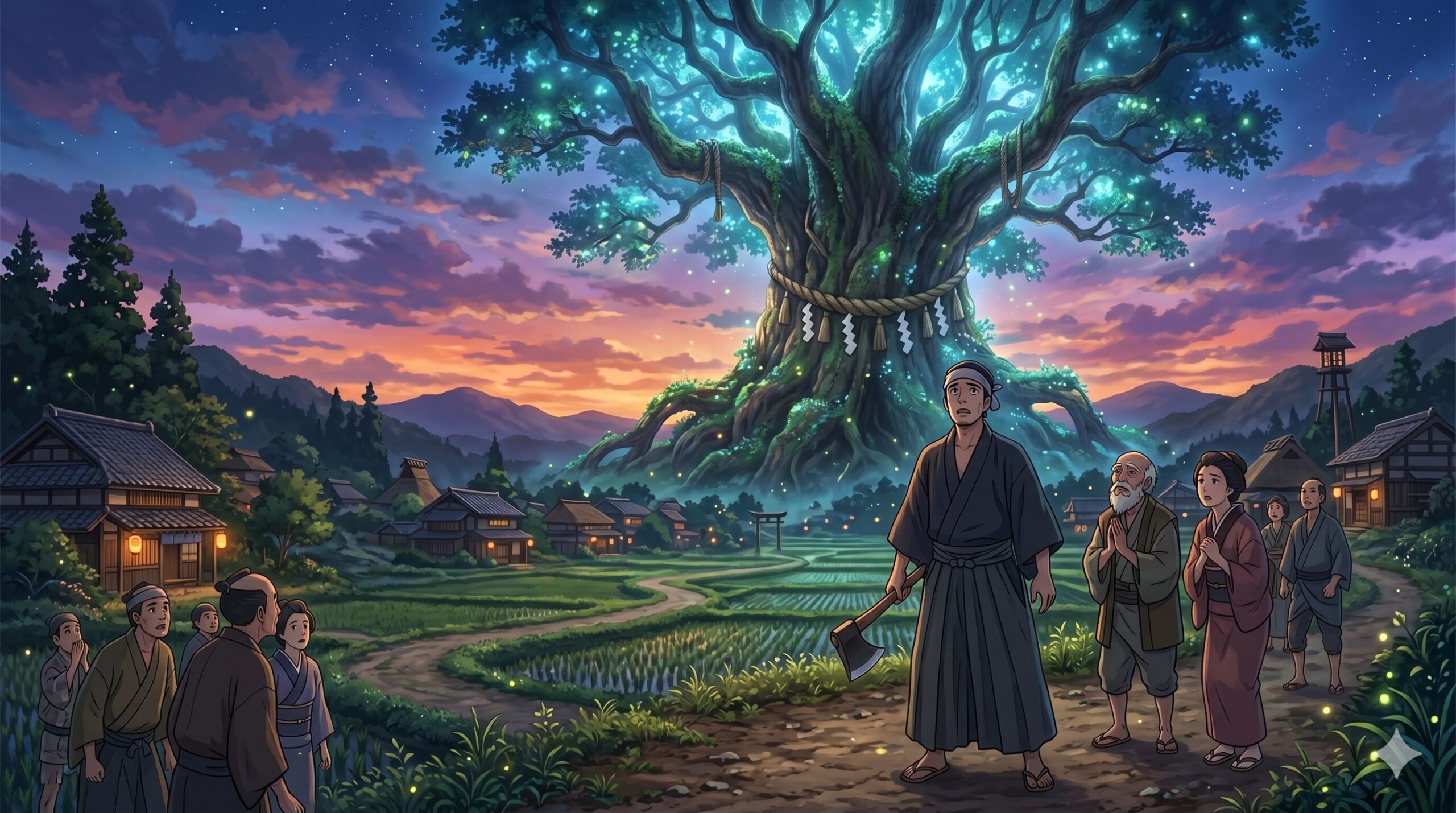
Once upon a time, right in the middle of a field in a small village, a single, strange tree stood alone. It had a mysterious appearance unlike anything anyone had ever seen. It was not a mulberry tree, nor was it a zelkova tree. It never bloomed with beautiful flowers in the spring, nor did it bear any fruit in the autumn. Furthermore, its leaves never withered and fell, even in the harsh winter.
It was of no use for timber, nor did it provide any harvest. It was a completely unremarkable tree that simply existed there. However, instead of feeling creeped out by this unknown entity, the villagers felt a strange sense of attachment to it. They affectionately gave it a humorous name, calling it the “Nanjamonja Tree” (which roughly translates to “What-is-it Tree”).
However, one day, a father in the village began to view this tree as a nuisance. He thought, “It doesn’t bloom, it doesn’t bear fruit, it just takes up space in the middle of my field as a useless piece of wood. I’m going to chop it down.” The father brought out a sharp axe and swung it down with all his might against the trunk of the Nanjamonja Tree.
Then, something terrifying happened. The next morning, the father was found collapsed under the Nanjamonja Tree. His entire body broke out in strange, round sores, and he became bedridden with a delirious, scorching fever.
Witnessing this inexplicable event, the villagers were terrified. They whispered among themselves, “That nameless tree harbors a terrifying power beyond human comprehension,” and “If we recklessly harm the tree, we will surely face the wrath of Lord Nanjamonja.” From that day on, no one in the village ever dared to chop it down. Instead, they revered it as a “Tree God” and carefully enshrined it. The Nanjamonja Tree continued to stand quietly as the guardian deity of the village ever after.
Analysis: Why Was a Nameless Tree Feared?
At first glance, this folktale might seem like a simple moral lesson that “punishment comes to those who destroy nature.” However, a deeper analysis reveals a profound underlying theme. The most notable point is how the tree is described as “completely useless.”
In human society, the value of things is often judged by their “usefulness.” If a tree provides edible fruit or timber to build houses, humans will value it. But the Nanjamonja Tree completely lacked this human-centric value. It was an unknown entity without even a proper name.
Humans tend to fear “the unknown” that falls outside their knowledge and control. The father’s attempt to chop down the tree represents the arrogance of trying to control nature through human reason and dominance. However, the fact that the father collapsed from the tree’s “divine punishment” shows that there is a greater power in the natural world that cannot be measured by narrow human standards. Because it is unknown, it is terrifying; and because it is terrifying, it is sacred. The story masterfully depicts human psychology, where fear and faith are two sides of the same coin.
Connection to Japanese Culture: Animism and “Yaoyorozu no Kami”
This story perfectly encapsulates the concept of “Animism,” which is the foundation of Japan’s traditional indigenous religion, Shinto. In Japan, it has long been believed that gods reside in all things in the universe—not only in natural objects like mountains, rivers, oceans, rocks, and trees, but even in words and tools. This is the concept of “Yaoyorozu no Kami” (countless gods).
While in Western religious views, God is often seen as the absolute creator and humans are positioned as managers of nature, the Japanese view of nature is entirely different. Humans are merely a part of nature; nature is not something humans can control, but an entity to coexist with in awe and respect.
The Nanjamonja Tree was enshrined as a “God” not because it bestowed blessings upon humans, but simply because “it existed there and possessed power beyond human understanding.” Japanese gods are not always kind to humans; they sometimes display a violent, destructive power (Aratama) in the form of natural disasters. To calm this violent power and coexist peacefully, Japanese people have built shrines, held festivals, and offered prayers. This folktale points to the origin of the “humble attitude toward nature” that continues to pulse through modern Japanese society.
What Would You Do?
What do you think? The Japanese spirituality of elevating a nameless tree to the status of a god might seem strange from a modern, rationalist perspective. However, in our current era, where the destruction of the natural environment is becoming increasingly severe, the lesson taught by the story of the “Nanjamonja Tree” carries more significance than ever before.
If a mysterious, seemingly useless tree whose name nobody knew suddenly grew right in the middle of your garden, what would you do? Would you immediately chop it down because it’s in the way? Or would you pay respect to that unknown existence and simply watch over it? Please take a moment to reflect on your thoughts and how your own culture interacts with nature.
Reference Links & Recommended Articles
- Reference: Manga Nihon Mukashibanashi Database – The Nanjamonja Tree
- Read more Japanese folktales: Japanese Folktale Series
名もなき木が神になる不思議な日本昔話「なんじゃもんじゃの木」とアニミズムの世界
はじめに:名もなき木が神になる国、日本
日本には、古くから伝わる数多くの昔話が存在します。その多くは、単なる子供向けのおとぎ話ではなく、当時の人々の生活様式や自然観、そして道徳観が色濃く反映された貴重な文化遺産です。今回は、日本の独特な自然崇拝や宗教観を象徴する、非常に興味深い昔話「なんじゃもんじゃの木」をご紹介します。この物語を読むことで、日本人が古来より自然に対して抱いてきた畏敬の念や、「八百万の神(やおよろずのかみ)」というアニミズムの精神を深く理解することができるでしょう。
昔話「なんじゃもんじゃの木」の物語
昔々、ある村の畑のど真ん中に、ぽつんと一本の奇妙な木が生えていました。その木は、誰も見たことがないような不思議な姿をしていました。クワの木でもなく、ケヤキの木でもありません。春になっても美しい花を咲かせることはなく、秋になっても実をつけることもありません。さらには、冬になっても葉が枯れ落ちることさえありませんでした。
木材として役に立つわけでもなく、果実をもたらすわけでもない、本当に何の変哲もない、ただそこにあるだけの木でした。しかし、村人たちはこの得体の知れない木に対して不気味さを感じるどころか、不思議な愛着を抱き、「なんじゃもんじゃの木(なんだかわからない木)」というユーモラスな名前をつけて呼び親しんでいました。
しかし、ある時、一人の父親がこの木を邪魔に思い始めました。「花も咲かず、実もならず、畑の真ん中で場所を取るだけの役立たずな木だ。切り倒してしまおう」と考えたのです。父親は鋭い斧を持ち出し、なんじゃもんじゃの木に向かって力いっぱい振り下ろしました。
すると、恐ろしいことが起こりました。翌朝、父親はなんじゃもんじゃの木の下で倒れているのを発見されたのです。父親の体中には奇妙な丸いブツブツができ、うなされるほどの高熱を出して寝込んでしまいました。
この不可解な出来事を目の当たりにした村人たちは、震え上がりました。「あの名もなき木には、人間の理解を超えた恐ろしい力が宿っているのだ」「むやみに木を傷つけたりすれば、なんじゃもんじゃ様のバチが当たるに違いない」と口々に言い合いました。それ以来、村人たちはその木を切り倒そうとする者など一人もおらず、むしろ「木の神様」として畏れ敬い、大切にお祀りするようになりました。なんじゃもんじゃの木は、その後も村の守り神として静かに立ち続けたのです。
考察:なぜ名もなき木は恐れられたのか?
この昔話は、一見すると「自然を破壊すると罰が当たる」という単純な教訓話に見えますが、深く考察すると非常に奥深いテーマが隠されています。最も注目すべき点は、この木が「何の役にも立たない」と描写されていることです。
人間の社会において、物事の価値はしばしば「役に立つかどうか(有用性)」で判断されます。果実が食べられる、木材として家を建てられるといった明確なメリットがあれば、人間はその木を大切にします。しかし、このなんじゃもんじゃの木にはそういった人間中心の価値が一切ありません。名前すら存在しない未知の存在です。
人間は、自分の知識や支配の及ばない「未知なるもの」に対して恐怖を抱きます。父親が木を切り倒そうとした行動は、人間の理性と支配力で自然をコントロールしようとする傲慢さの表れです。しかし、木からの「バチ(罰)」によって父親が倒れたことは、人間の矮小な物差しでは測りきれない大いなる力が自然界に存在していることを示しています。得体が知れないからこそ恐ろしく、恐ろしいからこそ神聖であるという、恐怖と信仰が表裏一体となった人間の心理を見事に描いています。
日本文化との関連:アニミズムと「八百万の神」
この物語は、日本の伝統的な信仰である「神道(Shinto)」の根幹をなす「アニミズム(精霊信仰)」の概念を完璧に表現しています。日本では古くから、山、川、海、岩、そして木々などの自然物はもちろんのこと、言葉や道具に至るまで、森羅万象すべてに神が宿っていると信じられてきました。これが「八百万の神(800万もの無数の神々)」という考え方です。
西洋の宗教観では、神は唯一絶対の創造主であり、人間は自然を管理する立場にあるとされることが多いですが、日本の自然観は全く異なります。人間も自然の一部であり、自然は人間がコントロールできるものではなく、畏敬の念を持って共存すべき対象なのです。
なんじゃもんじゃの木が「神様」として祀られたのは、その木が人間に恩恵を与えたからではありません。「ただそこに存在し、人間の理解を超えた力を持っているから」です。日本の神々は必ずしも人間に優しいわけではなく、時に自然災害という形で荒ぶる力(荒魂)を見せます。日本人はその荒ぶる力を鎮め、平和に共存するために、神社を建て、祭りを行い、祈りを捧げてきました。この昔話は、現代の日本社会にも脈々と受け継がれている「自然への謙虚な姿勢」の原点を示しているのです。
あなたならどうしますか?
いかがでしたでしょうか。名もなき木を神として祀り上げる日本人の精神性は、現代の合理主義的な視点からは不思議に思えるかもしれません。しかし、自然環境の破壊が深刻化する現代において、この「なんじゃもんじゃの木」の物語が教えてくれる教訓は、これまで以上に重要な意味を持っています。
もし、あなたの家の庭のど真ん中に、誰も名前を知らない、役に立ちそうもない不思議な木が突然生えてきたら、あなたはどうしますか?邪魔だからとすぐに切り倒してしまいますか?それとも、その未知なる存在に敬意を払い、そのまま見守りますか?ぜひ、あなたの考えや文化における自然との向き合い方について、深く考えてみてください。
参考リンク・おすすめ記事
- 参考:まんが日本昔ばなし〜データベース〜 なんじゃもんじゃの木
- その他の日本の昔話を読む:Japanese Folktale Series

コメント