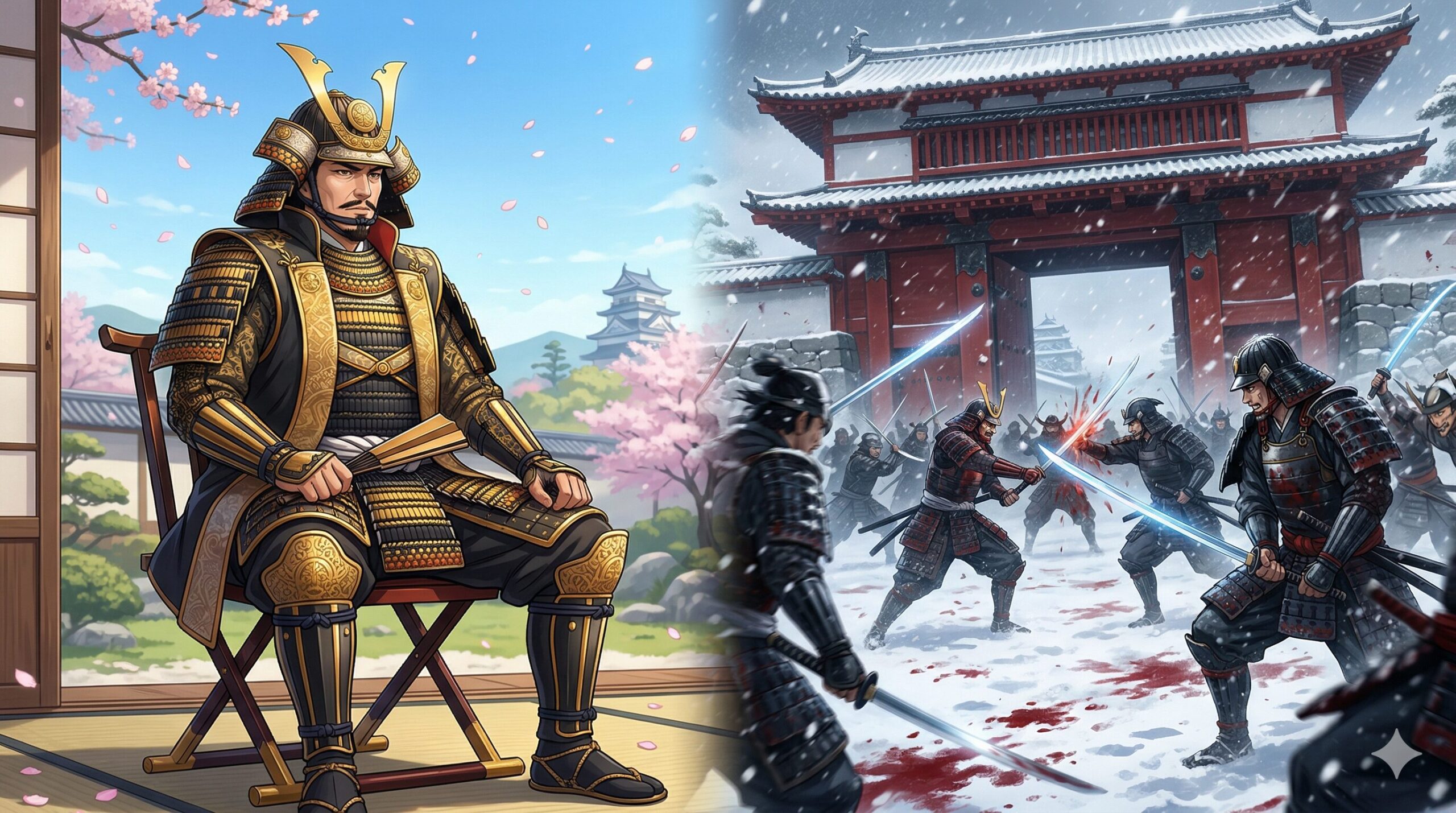
In Japanese history, perhaps no other day carries as dramatic and contrasting a significance as March 23. This is the day that brought 260 years of absolute peace to Japan, and ironically, it is also the day that drowned that very peace in a sea of blood, tearing open the doors to modernization.
Today, we unravel two monumental events that defined Japan’s destiny: Tokugawa Ieyasu’s appointment as Shogun, and the Sakuradamon Incident. Through these historical milestones, we will explore the deep aesthetics and the concept of impermanence rooted in Japanese culture.
The Foundation of Eternal Peace: Tokugawa Ieyasu Becomes Shogun (1603)
On this day in 1603 (while lunar and solar calendars cross paths, it is remembered as a historical milestone), the Imperial Court appointed Tokugawa Ieyasu as “Seii Taishogun” (Great General Subduing the Barbarians). This marked the end of over a century of bloody civil wars (the Sengoku period) and the birth of the Edo Shogunate, a formidable samurai government.
Ieyasu did not rule by brute force alone. He implemented a meticulous legal code, a strict class system, and used the philosophy of Confucianism to control society. This system worked astonishingly well, resulting in the “Pax Tokugawa”—a period of nearly 260 years of profound peace, unparalleled in world history.
This era of peace became the cradle of the “Japanese culture” we love today. Ukiyo-e woodblock prints, Kabuki theater, sushi, tempura, and the refinement of tea ceremonies and flower arrangements—all of these blossomed simply because there was no war, allowing people to pour their passion into art and culture.
Snow Stained with Blood: The Sakuradamon Incident (1860)
However, the Tokugawa peace that seemed destined to last forever began to crumble on the very same calendar date (March 3 in the lunar calendar) due to a single assassination. This was the Sakuradamon Incident.
The stage was set outside the Sakurada Gate of Edo Castle. Amidst an unseasonal, heavy snowstorm, the procession of Ii Naosuke—the Chief Minister and the most powerful man in the Shogunate—was ambushed by masterless samurai (ronin) from the Mito and Satsuma domains. It was an act of terrorism by radical loyalists seeking to expel foreigners, in retaliation against Ii Naosuke, who had forced the opening of Japan to the West and ruthlessly purged his political opponents.
As pure white snow was stained with bright red blood, the fact that the head of the government was assassinated in broad daylight sent a shockwave across Japan: the authority of the Shogun had fallen to the earth. This incident served as the definitive catalyst, plunging Japan into the chaotic Bakumatsu period, eventually leading to the Meiji Restoration and the birth of a modern nation.
Interpreting Japanese Culture: Creation, Destruction, and Impermanence
These two events, etched into the same date, teach us the underlying philosophy of Japanese culture.
One is the spirit of “Wa” (Harmony). The system Ieyasu built prioritized the harmony and stability of the entire society over the outstanding desires of the individual. This is the root of the cooperativeness deeply embedded in modern Japanese society.
The other is the aesthetics of “Bushido” (The Way of the Warrior) and “Mujo” (Impermanence). Both the assassins who scattered their lives at the Sakurada Gate and the assassinated Ii Naosuke died for what they believed was “justice for Japan.” The idea that nothing lasts forever, and that there is beauty in the fleeting moment of falling—much like cherry blossoms—is profound. The fact that the regime which built an era of peace was brought to an end by the flash of a katana in the snow is frighteningly poetic, a truly “Japanese” conclusion to the story.
Which Era Would You Choose to Live In?
The “ultimate stable society” built by Tokugawa Ieyasu, where freedom was restricted but everyone could live in peace? Or the “era of chaos and innovation” following the Sakuradamon Incident, where death was a daily risk, but you had the chance to forge a new nation with your own hands?
If you could travel back in time, which Japan would you want to live in, and what would you want to achieve? Please let me know your thoughts in the comments.
Explore More
- Read more from the “What’s Today’s Special Day Series” (Internal Link)
- Edo-Tokyo Museum (Deep dive into Edo period culture)
- Wikipedia: The Sakuradamon Incident
3月23日:サムライの時代の「幕開け」と「終焉」が交差する運命の日
日本の歴史において、3月23日ほど劇的で、対極的な意味を持つ日は他にありません。この日は、日本に260年にも及ぶ絶対的な平和をもたらした日であり、同時に、その平和な時代を血の海に沈め、近代化への扉をこじ開けた日でもあります。
今日は、日本の歴史を決定づけた2つの大事件、「徳川家康の征夷大将軍就任」と「桜田門外の変」を紐解き、日本文化の深淵にある「美学」と「無常観」に迫ります。
天下太平の礎:徳川家康、征夷大将軍に就任(1603年)
1603年のこの日(旧暦と新暦の概念が交差しますが、歴史の記念日として)、徳川家康は朝廷から「征夷大将軍」に任命されました。これは、100年以上続いた血みどろの戦国時代に終止符が打たれ、「江戸幕府」という強固な武家政権が誕生した瞬間です。
家康は単なる武力による支配ではなく、緻密な法制と身分制度、そして「儒教」の精神を用いて社会を統制しました。このシステムは驚くほどうまく機能し、「パクス・トクガワーナ(徳川の平和)」と呼ばれる、世界史上でも類を見ない約260年間の長期平和状態を実現したのです。
この平和な時代こそが、現代の私たちが愛する「日本文化」のゆりかごとなりました。浮世絵、歌舞伎、寿司、天ぷら、そして茶道や華道の洗練。これらすべては、戦(いくさ)がなくなり、人々が文化や芸術に情熱を注ぐことができるようになったからこそ開花したのです。
血塗られた雪:桜田門外の変(1860年)
しかし、永遠に続くと思われた徳川の平和は、皮肉にも同じ3月23日(旧暦3月3日)に起きた一つの暗殺事件によって、崩壊への坂を転がり落ち始めます。それが「桜田門外の変」です。
舞台は江戸城の桜田門外。季節外れの大雪が降る中、幕府の最高権力者であった大老・井伊直弼の行列が、水戸藩と薩摩藩の脱藩浪士たちによって襲撃されました。黒船来航による日本の開国を強引に進め、反対派を弾圧(安政の大獄)した井伊直弼に対する、過激な尊王攘夷派のテロルでした。
純白の雪が鮮血に染まる中、幕府のトップが白昼堂々暗殺されたという事実は、徳川幕府の権威が地に墜ちたことを日本中に知らしめました。この事件を決定的な契機として、日本は幕末の動乱期へと突入し、やがて明治維新という壮大な国家の変革へと繋がっていきます。
歴史から読み解く日本文化:「創造」と「破壊」、そして「無常」
同じ日付に刻まれたこれら2つの事件は、日本文化の根底に流れる哲学を私たちに教えてくれます。
一つは「和(Wa)」の精神です。家康が築いたシステムは、個人の突出した欲望よりも、社会全体の調和と安定を最優先するものでした。これは現代の日本社会にも深く根付いている協調性のルーツです。
もう一つは「武士道(Bushido)」と「無常(Mujo)」の美学です。桜田門外の変で命を散らした暗殺者たちも、暗殺された井伊直弼も、それぞれが己の信じる「日本のための正義」に殉じました。永遠に続くものなどなく、散り際こそが美しいとする桜の花のような無常観。平和を築いた幕府が、雪の日の刀の煌めきによって終わりを告げたことは、恐ろしいほどに詩的であり、日本的な物語の結末だと言えます。
あなたなら、どちらの時代を生きたいですか?
徳川家康が築いた、自由は制限されるものの、誰もが平穏に暮らせる「究極の安定社会」。それとも、桜田門外の変以降の、命の危険と隣り合わせでありながら、自らの手で新しい国を創り上げる「混沌と革新の時代」。
もしあなたがタイムスリップできるとしたら、どちらの日本に生き、何を成し遂げたいですか? ぜひ、あなたの考えを聞かせてください。
関連情報へのリンク
コメント