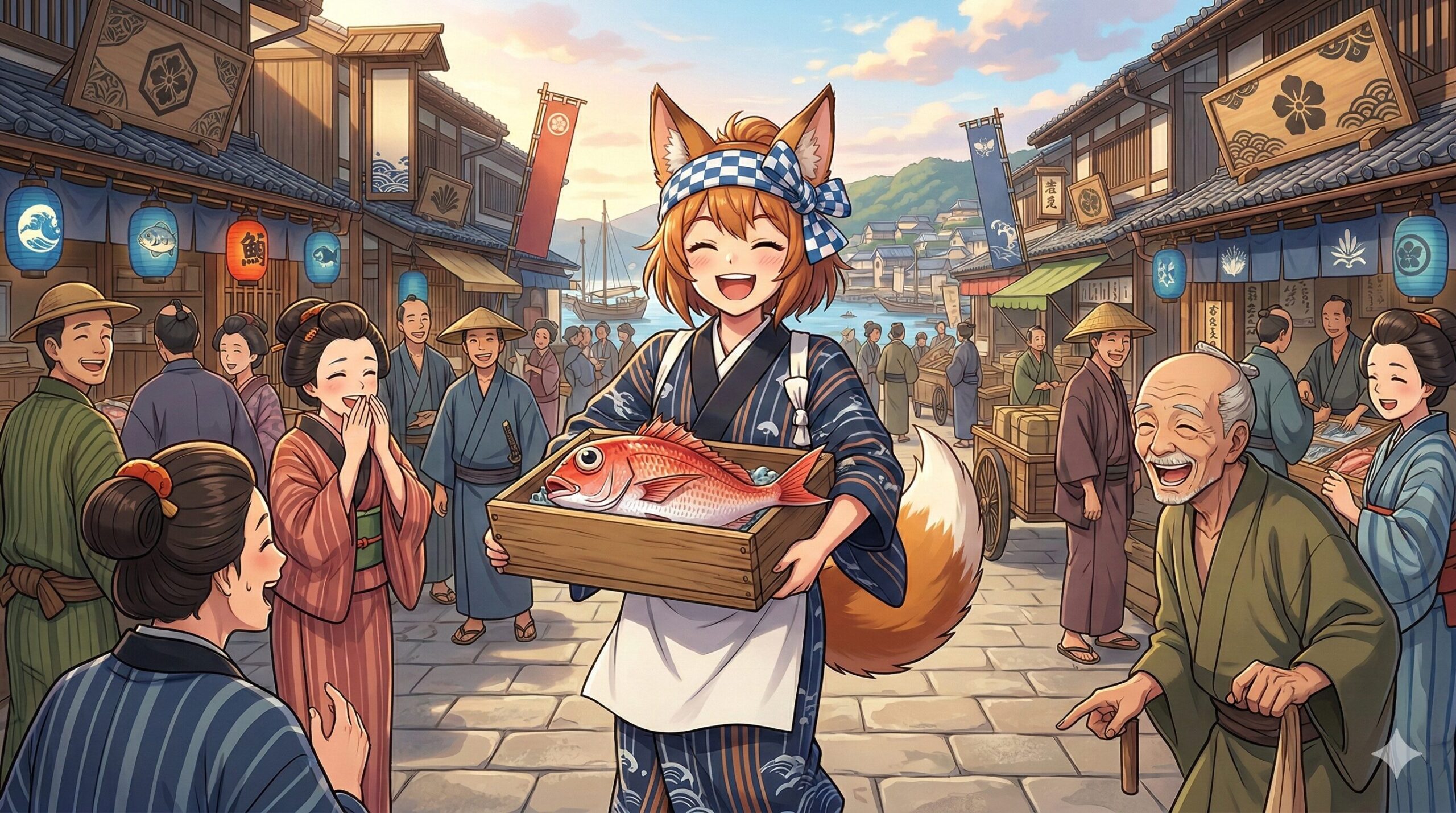
Japan has a rich tradition of folktales nurtured by its stunning nature and deep history. Many of these stories go beyond simple fantasy; they depict the robust wisdom of the people and the resilience required to turn a crisis into an opportunity. Today, we introduce a highly humorous folktale set against the backdrop of the Seto Inland Sea and the bustling city of Osaka: “Osan Fox and the Medetai (Auspicious Sea Bream).”

The Story of “Osan Fox and the Medetai”
Long, long ago, on the beautiful island of Nomijima in the Seto Inland Sea, lived a hardworking boatman named Grandpa Rihei. His job was to load his boat with goods once a month and transport them to the thriving port city of Osaka.
One autumn day, Grandpa Rihei loaded his boat to the brim with magnificent sea bream (Tai) that his son had caught. He set sail for Osaka for the first time in two months, feeling extremely cheerful. “If I sell these splendid sea bream in Osaka, I can buy wonderful souvenirs for my grandchildren,” he thought, a broad smile spreading across his face.
As the boat sailed smoothly across the Seto Inland Sea, a strange “chu, chu” sound echoed from the bottom of the boat. Suspicious, Grandpa Rihei quietly went down to the hold, only to find a shocking sight: the eyes of every single magnificent sea bream in the wooden crates were bizarrely bulging out.
The culprit was a mischievous fox named “Osan,” who had secretly sneaked onto the boat before departure. Osan Fox had a bizarre craving for the eyeballs of sea bream and had sucked them out one by one during the voyage.
Grandpa Rihei was devastated. “What a disaster! I can’t sell these at all!” he lamented. Seeing his despair, Osan Fox actually felt a pang of guilt and resolved to make amends for the ruined cargo.
Upon arriving at the port of Osaka, Osan Fox used magic to transform into a lively human fishmonger. Carrying the ugly, bug-eyed sea bream on a shoulder pole, the disguised fox set out into the streets of Osaka to sell them. However, passersby recoiled, saying, “Ew, those bulging eyes are creepy,” or “Are these old and rotting?” Not a single fish was sold.
At her wit’s end, Osan Fox prayed desperately to the Fushimi Inari Daimyojin in Kyoto, the supreme deity and boss of all foxes. “Oh Inari Deity, please grant me the wisdom to sell these fish!”
A divine voice echoed from Fushimi Inari. “Do not worry, Osan. Since the eyes are popping out (Me-ga-deteiru), you should sell them by calling them ‘Me-de-tai’ (which sounds exactly like the word for ‘auspicious’ or ‘joyous’). Kon!”
Blessed with this brilliant idea, Osan Fox rushed back to the streets of Osaka and began shouting loudly: “Come and get your Medetai! These are auspicious sea bream raised in the rough waves of the Seto Inland Sea! Their eyes are popping out, so they are Medetai! Eat this, and your luck will pop out too!”
The result was miraculous. Attracted by the highly auspicious words, the people of Osaka flocked to the fox. “That sounds like great luck! Give me one!” they cried. The ugly, bug-eyed sea bream sold out in a flash, and at a much higher price than regular sea bream!
Having sold every last fish, Osan Fox triumphantly returned to the docks with a huge pile of money. Grandpa Rihei was overjoyed when he received the cash. He bought a mountain of souvenirs for his grandchildren and sailed safely back to Nomijima.
Analyzing the Tale: The Formula of Turning Failure into Success
While this story seems like a slapstick comedy starting with a fox’s prank, it holds a profound lesson. The core message is the power of transforming a “defect” into “value.”
Bulging eyes are a fatal flaw for a fish on the market, normally earning it the label of “creepy, old fish.” However, following Fushimi Inari’s advice, the fox redefined this flaw. In Japanese, “eyes popping out” implies “sprouting” or “achieving success,” linking it to the word “Medetai” (auspicious). By simply shifting the perspective and using a clever play on words, a worthless item was reborn as a highly sought-after product.
This is a highly advanced way of thinking that applies directly to modern business and marketing. Instead of despairing over a disadvantage, we must ask: how can we frame this to make it appealing? Osan Fox’s merchant spirit teaches us the critical importance of a shift in perspective.
Discovering Japanese Culture: Kotodama, Lucky Charms, and Fox Worship
We can unravel several traditional Japanese cultural aspects and values from this folktale.
- The Power of Kotodama (Spirit of Words): Since ancient times, Japanese people have believed in “Kotodama,” the spiritual power residing in words. It is believed that spoken words can influence reality. The fish wouldn’t sell under the negative label of “creepy,” but by using the auspicious word “Medetai,” they transformed into bringers of good fortune. Wordplay and puns in Japan are not just jokes; they are cultural practices meant to attract good luck.
- Sea Bream (Tai) as a Lucky Charm: In Japan, the sea bream (Tai) is considered the ultimate lucky charm due to its red color and its name, which rhymes with “Medetai” (joyous). It is an essential dish for New Year’s celebrations and weddings. This folktale masterfully utilizes the deep-rooted Japanese association that “Tai = Auspicious.”
- Fushimi Inari and the Fox Network: Fushimi Inari Daimyojin, mentioned in the story, is the head shrine of all Inari shrines in Japan, attracting massive worship as the deity of business prosperity and abundant harvests. Foxes are considered the “Kenzoku” (divine messengers) of the Inari deity. The dynamic of a fox consulting the ultimate boss beautifully and humorously depicts both human social structures and the intimate relationship between Japanese gods and animals.
What Would You Do? A Question for Our Readers
How did you like the story of “Osan Fox and the Medetai”? When you make an irreversible mistake, how do you navigate your way out of the crisis?
If you were tasked with selling bug-eyed fish, what kind of catchphrase would you invent? Please imagine your own creative ideas and reflect on what you felt reading this story. We hope that this unique Japanese wisdom—overcoming fear of failure with humor and a shift in perspective—will provide a hint of inspiration for your daily life.
References & Links
If you want to dive deeper into Japanese folktales, please check out our dedicated category here:
Internal Link: Japanese Folktale Series
Here is the valuable database that served as a reference for this folktale:
External Link: Manga Nihon Mukashibanashi Database – Osan Fox and the Medetai (Japanese)
Learn more about Fushimi Inari Taisha, one of Japan’s most famous tourist destinations where foxes are worshipped as divine messengers:
External Link: Fushimi Inari Taisha Official Website
日本の昔話「おさん狐とめで鯛」が教える、逆境を跳ね返す知恵と笑い
日本の豊かな自然と歴史の中で育まれてきた数々の昔話。その中には、単なるファンタジーにとどまらず、人々の力強い生きる知恵や、ピンチをチャンスに変える逞しさが描かれているものが多く存在します。今回は、瀬戸内海と活気あふれる大阪の街を舞台にした、ユーモアたっぷりの昔話「おさん狐とめで鯛」をご紹介します。
昔話「おさん狐とめで鯛」のあらすじ
むかしむかし、瀬戸内海に浮かぶ能美島(のみじま)という美しい島に、利平爺さんという真面目な船頭が住んでいました。利平爺さんの仕事は、月に一度、船にたっぷりと荷物を積み込んで、大都会である大阪の港まで運ぶことでした。
ある秋の日のこと。利平爺さんは、息子が大漁で獲ってきた立派な鯛を船いっぱいに積み込み、二ヶ月ぶりに大阪に向けて意気揚々と船を出しました。「この立派な鯛を大阪で売れば、孫に良いお土産が買えるぞ」と、利平爺さんの顔はほころんでいました。
波に揺られながら順調に瀬戸内海を進んでいたその時、船底から「チュウ、チュウ」という奇妙な音が聞こえてきました。不審に思った利平爺さんがそっと船底へ降りてみると、なんと魚箱の中の立派な鯛たちの目ん玉が、どれもこれも不気味に飛び出しているではありませんか。
実は、船が出発する前に、イタズラ好きの「おさん」という狐が一匹、こっそりと船底に忍び込んでいたのです。おさん狐は鯛の目ん玉が大好物で、船旅の間に次々と鯛の目ん玉を吸って食べてしまっていたのでした。
「なんてことだ!これでは売り物にならない!」と嘆き悲しむ利平爺さん。その姿を見たおさん狐は、さすがに申し訳なく思い、なんとかして罪滅ぼしをしようと決心しました。
大阪の港に到着すると、おさん狐はポンッと化けて、人間の威勢の良い魚屋の姿になりました。そして、目ん玉の飛び出した不格好な鯛を天秤棒で担ぎ、大阪の街へと売りに出かけたのです。しかし、道行く人々は「うわっ、目ん玉が飛び出して気色悪い鯛やなぁ」「古くなって腐ってるんとちゃうか?」と気味悪がり、鯛は一匹も売れませんでした。
ほとほと困り果てたおさん狐は、狐たちの総元締めである京都の伏見稲荷大明神に向かって、必死に祈りました。「お稲荷様、どうかこの鯛を売る知恵を授けてください!」
すると、伏見稲荷大明神から声が響きました。「おさんよ、案ずることはない。目が出ている鯛なのだから、『目が出た鯛』すなわち『目出鯛(めでたい)』と言うて売り歩くが良い。コ~ン!」
素晴らしい知恵を授かったおさん狐は、すぐさま大阪の街に戻り、大声で叫びながら歩き始めました。「さあさあ、めで鯛じゃ!瀬戸内の荒波で揉まれて育った、縁起の良いめで鯛じゃぞ~!目が出ているからめで鯛!これを食べれば運が開けるぞ~!」
するとどうでしょう。「めでたい」という縁起の良い言葉に惹きつけられ、大阪の人々は「そりゃあ縁起がええ!」「わしにも一匹くれ!」と群がり、目ん玉の飛び出した不格好な鯛は、なんと普通の鯛よりも高い値段で飛ぶように売れていきました。
おさん狐は鯛をあっという間に全部売りつくし、大量のお金を持って意気揚々と船着き場へ戻りました。そのお金を受け取った利平爺さんは大喜びし、孫のためにたくさんのお土産を買って、無事に能美島へと帰っていったのです。
「おさん狐とめで鯛」を深く考察する:失敗から生まれる成功の法則
この物語は、一見すると狐のイタズラから始まるドタバタ劇ですが、非常に深い教訓を含んでいます。最大のポイントは、「欠点」や「失敗」を「価値」に転換した点にあります。
「目玉が飛び出している」というのは、商品としては致命的な欠陥です。そのままでは「気味の悪い古い魚」という評価しか得られません。しかし、伏見稲荷のアドバイスにより、その「飛び出した目」を「目が出ている=芽が出る(成功する)=めでたい」というポジティブな意味へと再定義しました。視点と言葉を変えるだけで、価値が全く無いと思われていたものが、人々の心を掴む大人気商品へと生まれ変わったのです。
これは現代のビジネスやマーケティングにも通じる非常に高度な思考法です。逆境や失敗を嘆くのではなく、それをどのような切り口で見せれば魅力に変わるのか。おさん狐の商売魂は、私たちに「視点の転換」の重要性を教えてくれます。
昔話から読み解く日本文化:言霊と縁起物、そしてキツネの信仰
この物語からは、日本の伝統的な文化や価値観をいくつも読み取ることができます。
- 言霊(ことだま)の力: 日本には古くから、言葉には霊的な力が宿っており、口にした言葉が現実の事象に影響を与えるという「言霊」の信仰があります。「気味が悪い」という言葉のままでは売れませんでしたが、「めでたい」という吉言葉(よきことば)を使うことで、人々に幸運をもたらすものへと変化しました。言葉遊びやダジャレ(語呂合わせ)は、単なる冗談ではなく、運気を引き寄せるための文化的な実践だったのです。
- 縁起物としての「鯛」: 日本において鯛(タイ)は、「めでたい」という言葉の響きと、その美しい赤い体色から、最高級の縁起物として扱われてきました。お正月やお祝い事の席には欠かせない魚です。この昔話は、その「鯛=めでたい」という日本人の根強い価値観を巧みに利用しています。
- 伏見稲荷とキツネのネットワーク: 物語に登場する伏見稲荷大明神は、日本全国にある稲荷神社の総本宮であり、商売繁盛や五穀豊穣の神様として絶大な信仰を集めています。キツネは稲荷神の「眷属(けんぞく=神の使い)」とされています。おさん狐が困ったときに総元締めに相談する構図は、人間社会の組織や、日本の神様と動物たちの密接な関係性を面白おかしく描いています。
あなたならどうする?読者の皆様への問いかけ
「おさん狐とめで鯛」の物語、いかがでしたか?取り返しのつかない失敗をしてしまった時、あなたならどうやってそのピンチを切り抜けますか?
もしあなたが、目玉の飛び出した魚を売らなければならないとしたら、どんなキャッチコピーを考えますか?ぜひ、あなたのクリエイティブなアイデアや、この物語を読んで感じたことを想像してみてください。失敗を恐れず、ユーモアと視点の転換で乗り切る日本ならではの知恵が、あなたの生活のヒントになれば幸いです。
関連情報・リンク
より深く日本の昔話を学びたい方は、ぜひこちらのカテゴリー記事もご覧ください。
内部リンク:Japanese Folktale Series(日本の昔話シリーズ)
今回の昔話の参考となった貴重なデータベースはこちらです。
外部リンク:まんが日本昔ばなしデータベース – おさん狐とめで鯛
狐が神の使いとして祀られている、日本屈指の観光名所である伏見稲荷大社についてもチェックしてみてください。
外部リンク:伏見稲荷大社 公式サイト
コメント