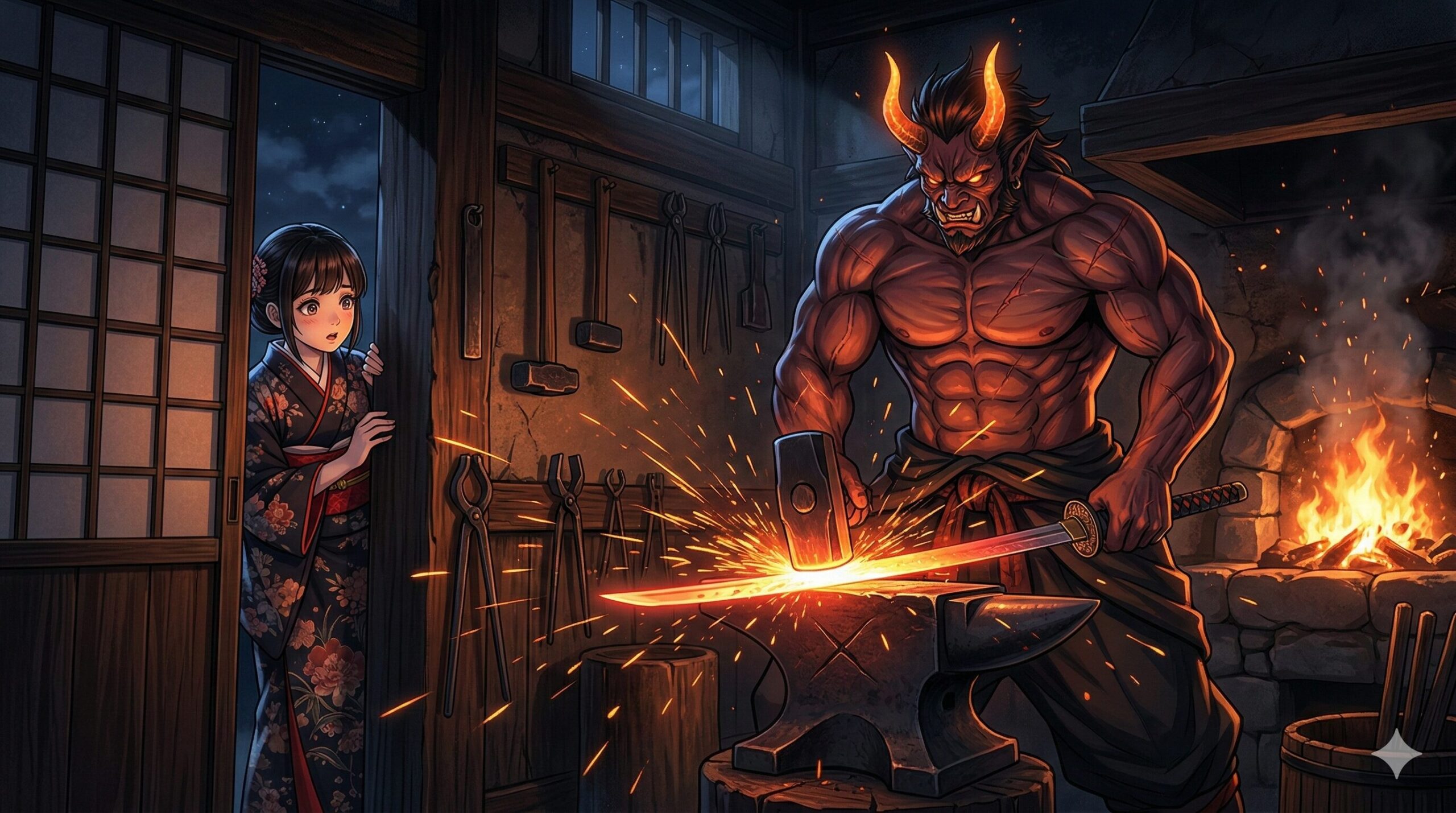

1. The Story of “The Demon Blacksmith” (Oni no Katanakaji)
Long ago, in a village by the northern sea, lived a highly skilled but aging katana blacksmith. This old man had a beautiful, fair-skinned daughter with a very gentle and kind heart. Many young men sought her hand in marriage, but the stubborn old man refused them all. He set a seemingly impossible condition: “Whoever wishes to marry my daughter must forge one thousand swords in a single night.”
Young men from the village tried and failed, realizing that forging a thousand swords before dawn was beyond human capability. One evening, a handsome, well-dressed young stranger arrived at the forge. “I am from a distant land, but I fell in love with your daughter at first sight. Please let me marry her,” he pleaded. When the old man presented his impossible condition, the young man accepted, but added one condition of his own: “While I am in the forge, no matter what happens, you must promise never to look inside.”
That night, the tremendous sound of hammering echoed from the forge, shaking the very foundation of the house. The daughter and the old man’s wife were terrified by the deafening noise, but the old blacksmith merely smiled in satisfaction, thinking, “Now that is the sound of a true blacksmith.” The next morning, at the crack of dawn, the old man opened the doors to find exactly one thousand flawlessly forged katanas, and the young man fast asleep from exhaustion. Overjoyed, the old man welcomed him as his son-in-law.
The swords forged by the young man were frighteningly sharp, and his reputation spread rapidly. The old man retired, leaving the forge entirely to the young man. However, a strange phenomenon occurred. The beautiful daughter grew thinner and weaker day by day, losing her life energy. When the worried father confronted her, she trembled and confessed, “He is no ordinary human. Please, you must look inside the forge.” Breaking the promise, the old man peeked into the forge, only to see a terrifying “Oni” (Japanese demon) striking the steel amid the roaring flames.
Furious, the old man burst in, shouting and driving the Oni away. His true identity revealed, the panicked Oni grabbed the swords and fled. But the greedy old man yelled at the fleeing demon’s back, “We lived together under one roof! Leave at least one sword behind!” The Oni reluctantly threw down a single blade, but it had no signature. “A katana without a maker’s mark is useless!” the old man roared again. Astonishingly, the Oni returned, used his sharp claws to scratch the name “Kijin Daio Naminohira Yukiyasu” (Great Demon King Naminohira Yukiyasu) into the metal, and then vanished across the sea.
2. In-Depth Analysis of “The Demon Blacksmith”
This tale is not merely a story of monster slaying; it brilliantly depicts the intersection of human greed and supernatural power. The most striking element is the condition set by the young man (the Oni): “Do not look.” This is an absolute rule when otherworldly entities interact with the human realm. The moment the taboo is broken, the connection is severed. Interestingly, the daughter’s declining health wasn’t caused by the Oni’s malice. Rather, she was overwhelmed by the intense “yokai miasma” (supernatural energy) that humans are too frail to withstand. The Oni himself is depicted as a pure being who truly loved the daughter and diligently forged swords.
Equally fascinating is the intense character of the old blacksmith. In typical folklore, humans cower in fear upon discovering a monster. Yet, even after driving the terrifying Oni away, this old man boldly demands a sword, and then a signature. His unyielding audacity and prioritization of craftsmanship over fear perfectly symbolize the boundless greed and resilience of human nature.
3. Decoding the Connection to Japanese Culture
This story offers deep insights into Japanese traditional culture and spirituality. First is the “Taboo of Looking” (Miruna no Taboo). Seen in other famous tales like “The Crane’s Return of a Favor,” the rule against looking represents a profound respect for sacred rituals and the secrets of the spirit world. In Japanese culture, profound truth and divinity are often considered most valuable when kept hidden.
Second is the sacred nature of Katana forging. Since ancient times, working with iron to create swords was not merely an industry, but a sacred Shinto ritual dedicated to the gods. Blacksmiths with overwhelming skill were sometimes viewed as transcending humanity, often represented metaphorically as “Oni.” In this context, an Oni is not simply an evil beast, but a symbol of foreigners or outcasts possessing exceptional, almost magical metallurgical technology.
Lastly, the name inscribed by the Oni, “Naminohira Yukiyasu,” refers to an actual, highly respected lineage of swordsmiths from Satsuma (modern-day Kagoshima in southern Japan). The fact that the name of a southern swordsmith appears in a northern village’s legend demonstrates the fascinating nature of Japanese oral tradition, where rumors of legendary blades evolved and intertwined with yokai myths over centuries.
4. Conclusion: What Would You Do?
A pure-hearted demon who forged a thousand swords for love, and a resilient old blacksmith whose obsession with a legendary blade outweighed his fear of the supernatural. This story reminds us that the boundary between humans and yokai is often blurred and filled with dark humor.
If you were the daughter, would you have kept your promise, accepting your mysterious fate, or would you have broken the taboo to uncover the truth? And if you were the old blacksmith, would you have the courage to shout at a fleeing demon to leave a sword behind? Let us know what you would do in the comments below!
Reference: Manga Nihon Mukashibanashi Database – The Demon Blacksmith
Discover more stories here: Japanese Folktale Series
【日本の昔話】鬼の刀かじ:禁忌と伝説の名刀に隠された真実
① 昔話「鬼の刀かじ」のストーリー
むかしむかし、北の海辺の村に、腕の立つ一人の老いた刀鍛冶が住んでいました。この爺には、色白で非常に気立ての良い美しい娘がおりました。娘を嫁に欲しいという若者は後を絶ちませんでしたが、頑固な爺は決して首を縦に振りません。爺が出した結婚の条件は、「一晩のうちに、刀を千本鍛え上げることができる者」という、人間の技では到底不可能なものでした。
村の若者たちは次々と挑戦しましたが、夜明けまでに千本の刀を打つことなどできるはずもなく、皆諦めていきました。そんなある日の夕暮れ時、見知らぬ立派な身なりの若者が鍛冶場を訪ねてきました。「私は遠い国から来た者ですが、娘さんに一目惚れをしてしまいました。どうか婿にしていただきたい」と申し出たのです。爺がいつものように「一晩で千本の刀を打つこと」を条件に出すと、若者は一つだけ条件を返しました。「私が鍛冶場にこもっている間、何があっても絶対に中を覗かないでください」。
その夜、鍛冶場からは家が揺れるほどの凄まじい鉄を打つ音が響き渡りました。娘と老婆はあまりの豪音に震え上がりましたが、爺だけはその力強い音を聞いて「これこそ真の鍛冶屋だ」と満足げに微笑んでいました。翌朝、一番鶏が鳴く頃に爺が鍛冶場を開けると、そこには見事に打ち上げられた千本の刀と、疲れ果てて眠る若者の姿がありました。大喜びした爺は、若者を婿として迎え入れました。
若者が打つ刀は「恐ろしいほどよく切れる」と瞬く間に評判となり、爺は鍛冶場を若者に任せて悠々自適な生活を送り始めました。しかし、不思議なことに、美しい娘は日に日に痩せ細り、生気を失っていくのです。心配した爺が問い詰めると、娘は怯えながら「あの人はただの人間ではありません。どうか鍛冶場を見てください」と訴えました。爺が娘に案内されて、約束を破り鍛冶場をこっそり覗き込むと、そこには若者ではなく、恐ろしい姿をした「鬼」が炎の中で刀を打っていました。
驚いた爺は激怒し、鬼を怒鳴りつけて追い出しました。正体を暴かれた鬼は、慌てて刀を抱えて逃げ出します。しかし、欲深い爺は逃げる鬼の背中に向かって「一緒に暮らした仲だろう!せめて一本くらい置いていけ!」と叫びました。鬼は仕方なく一振りの刀を投げ置きましたが、それには銘(作者の名)がありませんでした。爺が「銘がない刀など使い物にならん!」と再び怒鳴ると、鬼はわざわざ戻ってきて、自らの鋭い爪で刀に「鬼神大王波平行安(きじんだいおうなみのひらゆきやす)」と削り刻み、そのまま海の彼方へと逃げ去っていきました。
② 「鬼の刀かじ」の深い考察
この物語は、単なる怪物退治の物語ではなく、人間の「欲望」と「異界の力」の交差を見事に描いています。まず注目すべきは、若者(鬼)が提示した「絶対に覗いてはいけない」という条件です。これは異界の存在が人間の世界に介入する際の絶対的なルールであり、それを破った瞬間に異界との繋がりは絶たれます。しかし、この物語において娘が衰弱していった理由は、鬼が意図的に危害を加えていたからではなく、人間が受け止めるには強すぎる「妖怪の気(エネルギー)」に当てられてしまったからです。鬼自身は娘を愛し、真面目に刀を打っていた純粋な存在として描かれています。
さらに興味深いのは、爺の強烈なキャラクター性です。普通の昔話であれば、鬼の正体を知った人間は恐怖して逃げ惑うか、退治して終わります。しかし、この爺は鬼を追い出した後も、「刀を一本置いていけ」「銘を刻め」と堂々と要求します。異界の恐ろしい存在に対しても怯まず、職人としての価値(名刀)を最優先する爺の図々しさと逞しさは、人間の持つ果てしない欲望と生命力を象徴していると言えるでしょう。
③ 昔話から読み解く日本文化との関連性
この物語からは、日本の伝統文化や精神性を深く読み解くことができます。第一に「見るなのタブー」です。「鶴の恩返し」などにも見られるように、日本の神話や民間伝承において「見てはいけない」という禁忌は、神聖な儀式や異界の秘密を守るための重要な要素です。日本文化において、真理や神聖なものは「隠されている」ことに価値があるとされてきました。
第二に、日本刀と「鍛冶(かじ)」の神聖性です。古来より、鉄を鍛えて刀を作る行為は、単なる工業ではなく、神仏に祈りを捧げる神聖な儀式とされてきました。圧倒的な技術を持つ鍛冶職人は、時に人間を超越した存在と見なされ、それが「鬼」という形で表現されることがありました。「鬼」は単なる悪者ではなく、人間にはない規格外の力と技術をもつ「異邦人」や「卓越した技術者」の暗喩でもあるのです。
最後に、鬼が刻んだ「波平行安(なみのひらゆきやす)」という銘は、実在した薩摩(現在の鹿児島県)の名刀匠の名前です。北の海辺の村の伝説に、はるか南の国の刀匠の名前が登場するのは、名刀の噂が日本全国に轟き、それが時を経て妖怪伝説と結びついた日本の口承文学の面白さを表しています。
④ 最後に:あなたならどうしますか?
愛する娘のために千本の刀を打った純粋な鬼と、恐怖よりも名刀への執着を優先した逞しい老鍛冶屋。この物語を通して、人間と妖怪の境界線が非常に曖昧で、ユーモアに満ちていることに気づかされます。
もしあなたが娘の立場だったら、約束を守って何も見ずに衰弱していく運命を受け入れますか?それともタブーを破って真実を確かめますか?また、もしあなたが老鍛冶屋だったら、逃げていく鬼に向かって「刀を置いていけ」と叫ぶ勇気はあるでしょうか?ぜひ、あなたの考えを聞かせてください。
参考リンク:まんが日本昔ばなし〜データベース〜 鬼の刀かじ
その他の昔話はこちら:Japanese Folktale Series(日本昔話シリーズ)
コメント