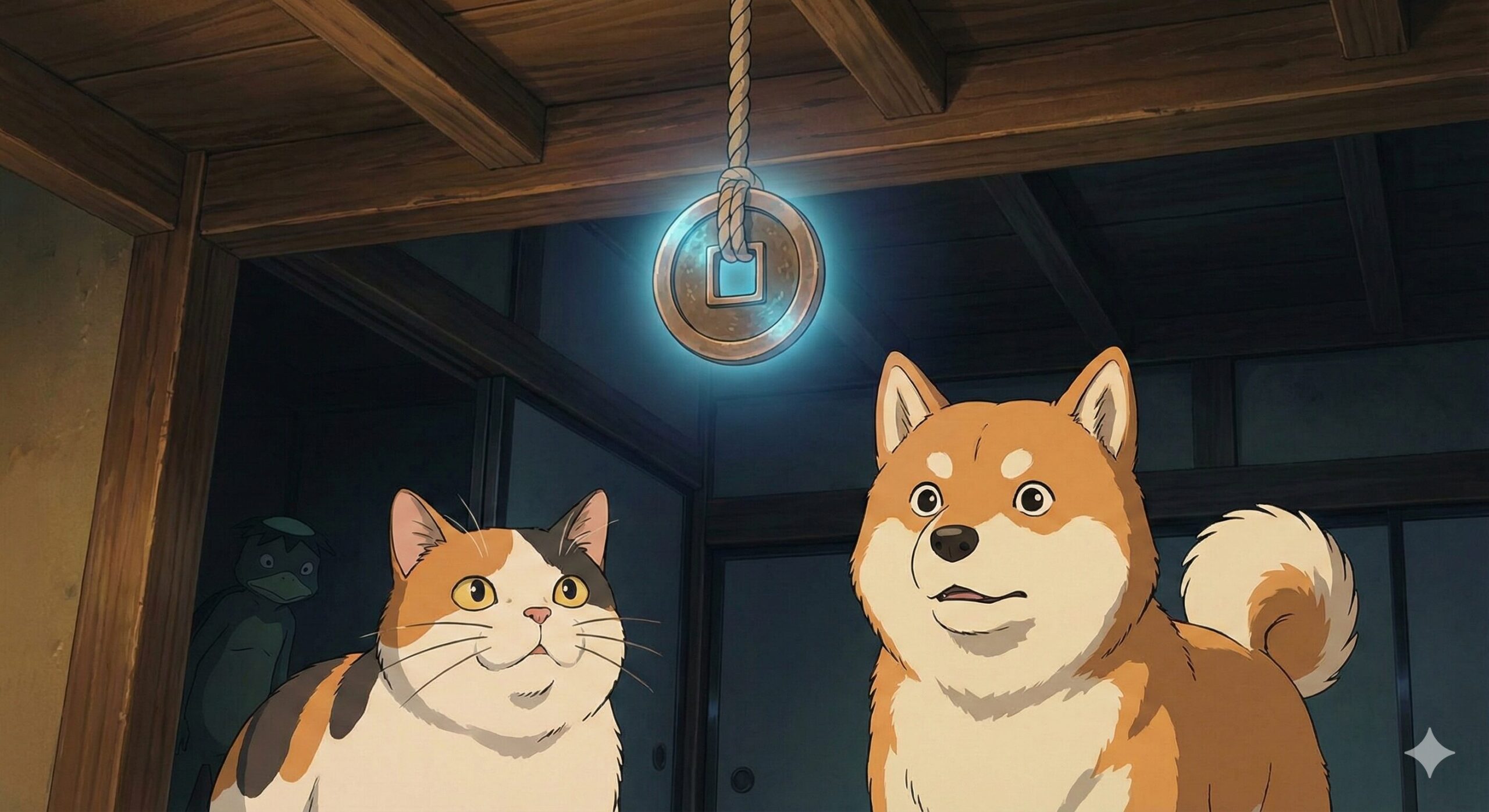
Japan has countless fascinating folktales where nature spirits, yokai (monsters), and animals deeply interact with human society. Today, we introduce a story passed down in Yamaguchi Prefecture, located in the Chugoku region of Japan, called “Enko’s One Mon Coin.” “Enko” is a regional name for the “Kappa,” Japan’s most famous water sprite. This story is not just about a magical item; it is a highly entertaining “origin story” that explains exactly why dogs and cats still fight to this day. Please enjoy this tale packed with Japanese spirituality and humor until the very end.

[The Story] Enko’s One Mon Coin
Once upon a time, there were two houses located on the east and west banks of a large river.
In the house on the east bank lived an honest and kind-hearted old man and his wife. They kept a single cat, but they were so poor that they struggled with their daily meals and could barely give their beloved cat enough food. Despite this, the old couple loved the cat like their own child and never let it go.
One night, “Ryugu-sama” (the Dragon King, or the water Yokai Enko) appeared in the old man’s dream and declared, “I admire your honest hearts. I will grant you ‘Enko’s One Mon Coin.’ Hang this from the ceiling of your house and worship it.”
When the old man woke up the next morning, miraculously, an old One Mon Coin (an ancient Japanese copper coin) was resting by his pillow. He followed the divine message and hung the coin from the ceiling. Instantly, a miracle occurred. The east house, which had always been poor no matter how hard they worked, suddenly saw their business thrive and quickly became wealthy. Their storehouse overflowed with rice, and they could finally feed their cute cat plenty of delicious fish every day.
Meanwhile, an extremely greedy and cunning old man and woman lived in the house on the west bank. The old woman on the west bank heard rumors that the east house had suddenly become rich and discovered that the secret was “Enko’s One Mon Coin.” Hearing this, the greedy old man from the west immediately rushed to the east house and begged, “Please let me borrow that coin, just for a little while.”
The honest and overly trusting old man from the east suspected nothing and lent the coin, saying, “Only for a short time.”
When the west old man took the coin home and hung it from his own ceiling, his house began to grow wealthy. However, in stark contrast, the east house, having lost the magical coin, reverted to its original impoverished life. At his wit’s end, the honest old man went to the west house numerous times to ask for the coin back, but the greedy old man made every excuse in the book and completely refused to return it.
Seeing this, the cat of the east house decided to take a stand. “Now is the only time to repay them for feeding me delicious food every day!” The cat resolved to infiltrate the west house and take the coin back. However, a huge river stood before the cat. Cats cannot swim.
So, the cat called out to a passing dog. “Please, I beg you, let me ride on your back across to the opposite shore!” The cat rode on the dog’s back and successfully crossed over to the west bank.
Sneaking into the west house, the cat caught a mouse. Holding the mouse down with its sharp claws, the cat threatened, “I will spare your life on one condition: bring me the One Mon Coin from the ceiling.” Valuing its life, the mouse frantically scrambled up into the ceiling and successfully returned carrying “Enko’s One Mon Coin” in its mouth.
Having reclaimed the coin, the cat once again asked the dog for a ride back across the river to the east bank. Having accomplished its great mission, the cat proudly began to sing a song of gratitude to the animals who had cooperated.
“The cat, the mouse, the kite flying in the sky, the cormorant in the river, the sweetfish~♪”
Hearing this, the dog stopped dead in its tracks and became furious. “Hey! I carried you on my back across the river, so why isn’t the dog in the song?! You ungrateful cat!”
The dog was enraged and chased the cat around violently. It is said that this very incident is the reason why dogs and cats always fight whenever they see each other.
Afterward, the honest old man and woman of the east house, having safely regained their coin, restored their wealthy life and lived happily ever after with their cat.
[Analysis] Human Psychology and Animal Action Hidden in the Tale
This story features the classic “Neighboring Old Men” structure (the contrast between the honest and the greedy), which is a royal road pattern in Japanese folktales. It contains the moral that honest people are blessed with treasures by gods or Yokai, while greedy people who try to imitate or steal them ultimately face punishment or failure.
However, the most unique and wonderful aspect of this story is its realistic depiction of the “animal society.” To fulfill its duty to its owner, the cat compensates for its weakness (inability to swim) by borrowing the dog’s power and smartly utilizes its natural enemy, the mouse, to achieve its goal. This is not just magic; it is a brilliant problem-solving process using wisdom and negotiation. Finally, the cat makes the mistake of “forgetting to include the dog in its song of gratitude,” which shows a charming flaw rather than absolute perfection, serving as brilliant foreshadowing to realistically explain the modern “bad relationship between dogs and cats.”
[Culture] Japanese Culture and Animism Read from Folktales
“Enko” (Kappa) is a waterside Yokai, but in agricultural Japan, “water” is both a blessing that brings good harvests and a terrifying force that causes floods. “Enko’s One Mon Coin” symbolizes the “wealth and blessings” that great nature capriciously bestows upon humans. The greedy heart that tries to monopolize it is warned against as an act that destroys the balance of nature.
Furthermore, this story deeply involves the important Japanese spiritual concept of “On” (Debt of gratitude). Even in poverty, the cat risked its life to “repay the favor” to the owner who raised it. At the same time, by forgetting the “On” received from the dog, it invited eternal conflict. In Japan, “returning a favor once received” is considered a virtue, and “forgetting a favor” is strongly criticized. With a touch of humor, this folktale clearly conveys to overseas readers the deep moral view of Japanese society: “Never forget a heart of gratitude.”
To Our Readers: What Would You Do?
If you were the honest old man of the east, would you lend the magical coin you finally obtained to your greedy neighbor? Or would you firmly refuse? Also, do you sympathize with the dog’s anger, or would you forgive the cat who simply forgot?
Japanese folktales look completely different depending on the reader’s values. Please share your opinions and thoughts in the comments section or on SNS!
Reference Link: Manga Nippon Mukashibanashi Database – Enko’s One Mon Coin (Japanese)
Read more stories here: Japanese Folktale Series
日本の不思議な昔話:「えんこうの一文銭」が教える自然の魔法と動物たちの秘密
日本には、自然界の精霊や妖怪、そして動物たちが人間社会と深く関わり合う魅力的な昔話が無数に存在します。今回は、日本の中国地方・山口県に古くから伝わる「えんこうの一文銭(えんこうのいちもんせん)」という物語をご紹介します。「えんこう」とは、日本の代表的な水辺の妖怪「河童(かっぱ)」の地方での呼び名です。この物語は、単なる魔法のアイテムの物語にとどまらず、なぜ犬と猫が現代でも仲が悪いのかという「動物の由来譚」も含んだ、非常にエンターテインメント性の高い作品です。日本の精神性やユーモアが詰まったこの物語を、ぜひ最後までお楽しみください。
【物語】えんこうの一文銭
昔々、ある大きな川を挟んで、東の岸と西の岸にそれぞれ一軒ずつ家がありました。
東の岸の家には、とても正直で心優しいお爺さんとお婆さんが住んでいました。二人は一匹の猫を飼っていましたが、日々の食事にも困るほどの貧乏暮らしだったため、愛する猫に十分なエサを与えることすらできませんでした。それでも、お爺さんとお婆さんは猫を我が子のように可愛がり、決して手放すことはありませんでした。
そんなある日の夜、お爺さんの夢枕に「竜宮さま(または水の妖怪えんこう)」が立ち、こうお告げをしました。「お前たち夫婦の正直な心を愛でて、『えんこうの一文銭』を授けよう。これを家の天井裏に吊るして祀りなさい」
翌朝、お爺さんが目を覚ますと、不思議なことに枕元には本当に古びた一文銭(昔の日本の銅貨)が置かれていました。お告げの通りに一文銭を天井裏に吊るすと、奇跡が起こりました。それまでどんなに働いても貧しかった東の家が、その日から嘘のように商売が繁盛し、みるみるうちに豊かになっていったのです。蔵には米が溢れ、可愛い猫にも毎日お腹いっぱい美味しい魚を食べさせることができるようになりました。
一方、西の岸の家には、とても欲張りでずる賢いお爺さんとお婆さんが住んでいました。西の家のお婆さんは、東の家が急にお金持ちになった噂を聞きつけ、その秘密が「えんこうの一文銭」にあることを突き止めました。これを聞いた西の欲張り爺さんは、すぐに東の家へ押しかけ、「その一文銭を少しの間だけでいいから貸してくれ」と頼み込みました。
正直で人が良すぎる東のお爺さんは、疑うこともせず「一時だけなら」と一文銭を貸してしまいました。
西のお爺さんが持ち帰った一文銭を自宅の天井裏に吊るすと、今度は西の家がどんどん裕福になっていきました。しかしその反面、魔法の硬貨を失った東の家は、再び元の貧乏な生活に逆戻りしてしまったのです。困り果てた東のお爺さんは、西の家へ一文銭を返してほしいと何度も催促に行きましたが、欲深い西のお爺さんはあの手この手と言い訳をして、決して硬貨を返そうとはしませんでした。
これを見て立ち上がったのが、東の家で飼われていたあの猫です。「毎日美味しいご飯を食べさせてくれた恩返しをするのは今しかない!」と決心した猫は、自ら西の家へ乗り込んで一文銭を取り返す作戦を立てました。しかし、猫の目の前には大きな川が立ちはだかっています。猫は泳ぐことができません。
そこで猫は、通りかかった一匹の犬に声をかけました。「お願いです、私を背中に乗せて川の対岸まで渡してください」と頼み込み、犬の背中に乗って見事に西の岸へと渡りました。
西の家に忍び込んだ猫は、そこで一匹のネズミを捕まえました。そしてネズミを鋭い爪で押さえつけながらこう脅しました。「お前の命を助けてやる代わりに、天井裏にある一文銭を取ってこい」。命惜しさから、ネズミは慌てて天井裏に駆け上がり、見事に「えんこうの一文銭」をくわえて戻ってきました。
一文銭を取り返した猫は、再び犬にお願いして背中に乗り、川を渡って東の岸へと帰還しました。大役を果たした猫は、協力してくれた動物たちへの感謝の気持ちを込めて、川を渡りながら誇らしげに歌を歌い始めました。
「猫にネズミに空飛ぶトンビ、川には鵜の鳥、鮎の魚〜♪」
これを聞いた犬は、ピタリと足を止めて激怒しました。「おい!俺が背中に乗せて川を渡してやったのに、なぜ歌の中に犬が入っていないんだ!この恩知らずの猫め!」
犬は怒り狂い、猫を激しく追いかけ回しました。犬と猫が顔を合わせれば必ず喧嘩をするようになったのは、この出来事が原因だと言われています。
その後、無事に一文銭を取り戻した東のお爺さんとお婆さんは、再び豊かな生活を取り戻し、猫と一緒に末長く幸せに暮らしました。
【考察】物語に隠された人間の心理と動物たちの活躍
この物語は、日本の昔話における王道パターンである「隣の爺型(正直者と欲張り者の対比)」の構造を持っています。正直者が神仏や妖怪から宝物を授かり、欲張り者がそれを真似て失敗する、あるいは奪って最終的に罰を受けるという教訓が含まれています。
しかし、この物語の最もユニークで素晴らしい点は「動物たちの社会」がリアルに描かれていることです。猫は飼い主への恩義を果たすため、自分の弱点(泳げないこと)を犬の力を借りて補い、さらには自分の天敵であるネズミを巧みに利用して目的を達成します。これは単なる魔法の力ではなく、知恵と交渉術を使った見事な問題解決のプロセスです。最後に猫が「犬への感謝を歌に入れ忘れる」というミスを犯すことで、完全無欠ではない愛嬌と、現実世界の「犬と猫の不仲」を見事に説明する伏線回収が行われています。
【文化】昔話から読み解く日本文化とアニミズム
「えんこう(河童)」は水辺の妖怪ですが、農耕社会である日本において「水」は豊作をもたらす恵みであると同時に、洪水を引き起こす恐ろしい存在でもあります。「えんこうの一文銭」は、大自然が人間に気まぐれに与える「富と恵み」の象徴です。それを独り占めしようとする欲張りな心は、自然のバランスを崩す行為として戒められています。
また、この物語には日本の重要な精神性である「恩(On / Debt of gratitude)」が深く関わっています。貧しい中でも自分を育ててくれた飼い主に対し、猫は命懸けで「恩返し」をしました。しかし同時に、犬から受けた「恩」を忘れてしまったことで、永遠の争いを招く結果となりました。日本では「恩を受けたら必ず返すこと」が美徳とされ、「恩を忘れること」は強く批判されます。この昔話は、ユーモアを交えながら「感謝の心を忘れてはいけない」という日本社会の深い道徳観を海外の読者にも分かりやすく伝えています。
読者の皆様へ:あなたならどうしますか?
もしあなたが東の正直なお爺さんだったら、せっかく手に入れた魔法の一文銭を、隣の欲張りなお爺さんに貸してあげますか?それともきっぱりと断りますか?また、あなたは犬の怒りに共感しますか、それともうっかり忘れてしまった猫を許してあげますか?
日本の昔話は、読む人の価値観によって全く違う見え方をしてきます。ぜひ、あなたの意見や感想をコメント欄やSNSでシェアしてください!
参考リンク: まんが日本昔ばなし〜データベース〜 えんこうの一文銭
その他の物語はこちら: Japanese Folktale Series(日本の昔話シリーズ)
コメント