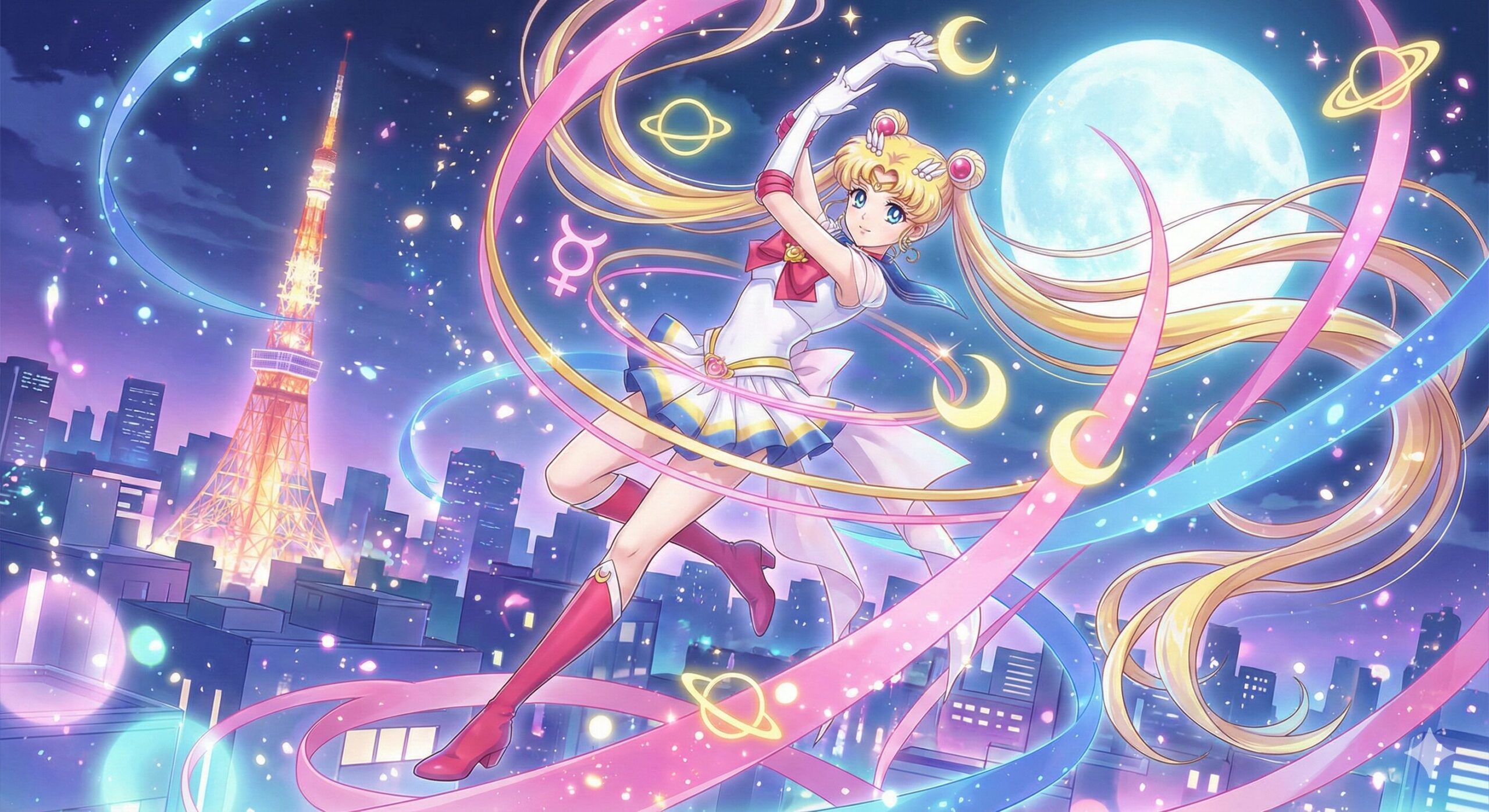
To anime fans worldwide, and to every adult who was once a dreaming young girl: let’s talk about one of the brightest, most influential legends ever born from Japanese pop culture. Its name is Sailor Moon (known in Japan as Bishōjo Senshi Sailor Moon). Originating in Japan in the early 1990s, this work transcended the boundaries of a mere “magical girl anime” to become a global social phenomenon. Why has this story about Japanese middle school girls been so beloved across borders, languages, and cultures for decades? In this article, we will delve into the core of its appeal and the profound cultural significance it holds.

- 1. Series Overview: An Ordinary Girl Saves the World!? A Story of Love and Justice
- 2. Critical Reception and Background of Explosive Popularity in Japan: A New Heroine Image Born from the Era
- 3. Why Was the World Enthusiastic? Universal Appeal Transcending Borders
- 4. Why You Should Watch It Now! Recommended Points
- Conclusion
- 1. 作品概要:普通の少女が世界を救う!?愛と正義の物語
- 2. 日本での評価と爆発的人気の背景:時代が生んだ新しいヒロイン像
- 3. なぜ世界は熱狂したのか?国境を越える普遍的な魅力
- 4. 今こそ見るべき!おすすめポイント
- まとめ
1. Series Overview: An Ordinary Girl Saves the World!? A Story of Love and Justice
The protagonist of the story is Usagi Tsukino, a perfectly ordinary middle school girl living in the Azabu-Jūban district of Tokyo. She is a bit clumsy, a crybaby, not great at studying, and loves eating and sleeping above all else—a relatable girl you might find anywhere. Her everyday life changes drastically one day when she meets a mysterious black cat named Luna, who has a crescent moon mark on her forehead.
Luna informs Usagi that she is the reincarnation of Princess Serenity of the ancient Moon Kingdom and a “Sailor Guardian” destined to fight against the “Dark Kingdom,” an evil organization threatening Earth. Though bewildered, Usagi transforms into the pretty guardian of love and justice, “Sailor Moon.”
The story depicts the process of Usagi meeting her fellow Sailor Guardians who also awaken to their destinies—the genius girl Ami Mizuno (Sailor Mercury), the passionate Rei Hino (Sailor Mars), the strong and gentle Makoto Kino (Sailor Jupiter), and the beautiful idol Minako Aino (Sailor Venus)—and forming deep bonds of friendship with them. A romance that transcends time and space with Mamoru Chiba, also known as the mysterious gentleman “Tuxedo Mask” who supports Usagi from the shadows, also forms a major pillar of the narrative.
While living the lives of ordinary students, they confront powerful enemies that appear one after another, fighting to protect the Earth and the people they love. Through these battles, Usagi grows from a mere crybaby girl into a leader possessing true strength and kindness.
2. Critical Reception and Background of Explosive Popularity in Japan: A New Heroine Image Born from the Era
As soon as the anime began broadcasting in 1992, Sailor Moon sparked a massive boom in Japan that could be called a social phenomenon. Behind its popularity was the unique atmosphere of Japanese society at the time and the innovative heroine image that the work presented.
A Turning Point in the Era and Female Empowerment
Japan in the early 1990s stood at the entrance of the “Lost Decades” following the collapse of the bubble economy. On the other hand, it was also a period when women’s advancement into society began in earnest due to the influence of the Equal Employment Opportunity Act enacted in 1986. Women were wavering between the traditional stereotype of “good wife, wise mother” and the ideal of the “independent woman” demanded by the new era.
Appearing in such times, Sailor Moon was truly a symbol of the “fighting woman.” They were not existences just to be protected by male heroes. They stood up of their own volition, fought enemies with their own power, and carved out their destinies. Their iconic catchphrase, “In the name of the Moon, I’ll punish you!” seemed to speak for the latent assertions that women held against society.
The Crystallization of “Shojo” (Girl) Culture
While inheriting the tradition of Japanese “shojo manga” (girls’ comics), this work evolved it significantly. The cute sailor-suit-style combat costumes adorned with frills and ribbons, transformation items that sparkled like jewels, and romantic love situations—these were condensations of traditional “shojo” aspirations.
However, at the same time, they incorporated the element of “team combat” like Japanese tokusatsu hero shows (such as the Super Sentai series). The sight of girls with distinct personalities and abilities cooperating to confront mighty enemies created a dynamism absent in previous magical girl anime. The message that “cuteness” and “strength” are not contradictory gave courage to many girls.
3. Why Was the World Enthusiastic? Universal Appeal Transcending Borders
Born in Japan, Sailor Moon crossed the oceans and captured the hearts of people around the world. Especially in North America and Europe, it was enthusiastically received as an icon of the “Girl Power” movement. The reason for its global popularity lies in the universality and progressiveness that the work possesses.
Challenging Gender Norms and Embracing Diversity
Sailor Moon was also groundbreaking in depicting characters unbound by traditional gender roles. For instance, the relationship between Haruka Tenoh (Sailor Uranus), who possesses masculine strength and coolness, and the elegant and feminine Michiru Kaioh (Sailor Neptune), was depicted as a homosexual partnership (although it was subject to censorship in some countries). This conveyed a strong message to many viewers, including the LGBTQ+ community, that their existence was affirmed.
Furthermore, among the enemy characters, there appear those with diverse identities not bound by gender frameworks. This work teaches us that even if one deviates from society’s norms of “how one should be,” that can be one’s individuality and potential strength.
Deep Empathy for Imperfect Heroines
The protagonist, Usagi Tsukino, is by no means a perfect superhero. She immediately whines, is constantly clumsy, and gets bad grades on tests. However, it is precisely because of this that readers can superimpose their own images onto her and empathize deeply.
Her strength lies not in overwhelming combat ability. It lies in her pure heart that trusts her friends and wants to protect her loved ones in any desperate situation, and her “never-give-up heart” that stands up no matter how many times she falls. The figure of this incredibly human heroine snuggles up to and encourages the “weakness” and “strength” that exist in everyone’s heart, transcending cultural differences.
4. Why You Should Watch It Now! Recommended Points
Even now, over 30 years after its birth, the brilliance of Sailor Moon has not faded at all. Rather, its message might resonate even more strongly in modern society.
- Timelessly Beautiful Visuals: The warm colors generated by cel animation unique to 90s anime, the flowing character designs, and the numerous casual outfits that are novel and fashionable even when viewed today can be enjoyed as retro-pop art. Especially the fantastical beauty of the transformation scenes is a must-see.
- A Universal Story of Love and Friendship: The deep bonds of friendship that sprout among the Sailor Guardians, strong enough that they would risk their lives to protect each other, will warm the hearts of viewers. Also, the grand love story spanning time and space between Usagi and Mamoru will be handed down forever as a classic of romance.
- Awakens the “Maiden’s Heart” Sleeping Within You: Regardless of age or gender, everyone holds pure “longing” and the “power to dream” in their hearts. Sailor Moon is a magical work that reawakens those sparkling emotions that we tend to forget in our daily lives.
Conclusion
Sailor Moon is not merely an entertainment work. While born from the specific time and place of 90s Japan, it is a modern myth that sheds light on the universal worries and wishes held by people around the world—to live authentically as oneself, to love, and to join hands with friends. If you have not yet touched the world of this legend, please open that door right now. Surely, you should be able to find the “moonlight” within your own heart.
Related Links
If you want to know more about Japanese anime and culture, please check out this category!
Japanese Culture – Anime Category
【徹底解説】『美少女戦士セーラームーン』が世界を変えた!日本の歴史と文化が生んだ奇跡のアニメ
世界中のアニメファン、そしてかつて少女だった大人たちへ。日本のポップカルチャーが生み出した、最も輝かしく、最も影響力のある伝説について語りましょう。その名は『美少女戦士セーラームーン』。1990年代初頭に日本で誕生したこの作品は、単なる「魔法少女アニメ」の枠を超え、世界的な社会現象となりました。なぜ、日本の女子中学生の物語が、国境や言語、文化の壁を越えて、これほどまでに愛され続けているのでしょうか?この記事では、その魅力の核心と、作品が持つ深い文化的意義に迫ります。
1. 作品概要:普通の少女が世界を救う!?愛と正義の物語
物語の主人公は、東京の麻布十番に住むごく普通の女子中学生、月野うさぎ。彼女はドジで泣き虫、勉強は苦手で、食べる事と寝る事が大好きという、どこにでもいそうな親しみやすい女の子です。そんな彼女の日常は、ある日、額に三日月模様を持つ不思議な黒猫・ルナと出会ったことで一変します。
ルナから、自分が月の王国の王女「プリンセス・セレニティ」の生まれ変わりであり、地球を狙う邪悪な組織「ダーク・キングダム」と戦う使命を持った「セーラー戦士」であることを告げられたうさぎ。戸惑いながらも、彼女は愛と正義の戦士「セーラームーン」へと変身します。
物語は、うさぎが同じくセーラー戦士として覚醒する仲間たち――天才少女の水野亜美(セーラーマーキュリー)、情熱的な火野レイ(セーラーマーズ)、力持ちで優しい木野まこと(セーラージュピター)、そして美しきアイドルの愛野美奈子(セーラーヴィーナス)――と出会い、深い友情で結ばれていく過程を描きます。そして、うさぎを影から支える謎の紳士「タキシード仮面」こと地場衛との時空を超えたロマンスも、物語の大きな軸となります。
彼女たちは普通の学生としての生活を送りながら、次々と現れる強敵に立ち向かい、地球と愛する人びとを守るために戦います。その戦いの中で、うさぎはただの泣き虫な少女から、真の強さと優しさを持ったリーダーへと成長していくのです。
2. 日本での評価と爆発的人気の背景:時代が生んだ新しいヒロイン像
1992年にアニメ放送が開始されるやいなや、『美少女戦士セーラームーン』は日本中で社会現象とも呼べる大ブームを巻き起こしました。その人気の背景には、当時の日本社会特有の空気感と、作品が提示した革新的なヒロイン像がありました。
時代の転換点と女性のエンパワーメント
1990年代初頭の日本は、バブル経済の崩壊とそれに続く「失われた時代」の入り口に立っていました。一方で、1986年に施行された男女雇用機会均等法の影響により、女性の社会進出が本格化し始めた時期でもありました。女性たちは、従来の「良妻賢母」という固定観念と、新しい時代が求める「自立した女性」という理想の間で揺れ動いていました。
そんな時代に現れたセーラームーンは、まさに「戦う女性」の象徴でした。彼女たちは男性ヒーローに守られるだけの存在ではありません。自らの意志で立ち上がり、自らの力で敵と戦い、運命を切り拓いていくのです。「月にかわっておしおきよ!」というアイコニックな決め台詞は、女性たちが社会に対して抱いていた潜在的な主張を代弁するかのようでした。
「少女(Shojo)」文化の結晶
本作は、日本の「少女漫画」の伝統を受け継ぎながらも、それを大きく進化させました。フリルやリボンがあしらわれた可愛らしいセーラー服型の戦闘コスチューム、宝石のように輝く変身アイテム、そしてロマンチックな恋愛模様。これらは伝統的な「少女」の憧れを凝縮したものです。
しかし、同時に彼女たちは、日本の特撮ヒーロー番組(スーパー戦隊シリーズなど)のような「チームでの戦闘」という要素を取り入れました。それぞれ異なる個性と能力を持つ少女たちが協力し、強大な敵に立ち向かう姿は、それまでの魔法少女アニメにはないダイナミズムを生み出しました。「可愛らしさ」と「強さ」は矛盾しない――このメッセージは、多くの少女たちに勇気を与えたのです。
3. なぜ世界は熱狂したのか?国境を越える普遍的な魅力
日本で生まれたセーラームーンは、海を越え、世界中の人々の心を掴みました。特に北米やヨーロッパでは、「ガール・パワー(Girl Power)」ムーブメントのアイコンとして熱狂的に受け入れられました。その世界的な人気の理由は、作品が持つ普遍性と先進性にあります。
ジェンダー規範への挑戦と多様性の受容
セーラームーンは、伝統的なジェンダーロール(性別による役割分担)に縛られないキャラクターたちを描いた点でも画期的でした。例えば、男性的な強さとカッコよさを持つ天王はるか(セーラーウラヌス)と、優雅で女性らしい海王みちる(セーラーネプチューン)の関係性は、同性愛的なパートナーシップとして描かれており(一部の国では検閲の対象となりましたが)、LGBTQ+コミュニティを含む多くの視聴者に、自分たちの存在が肯定されたという強いメッセージを届けました。
また、敵キャラクターの中にも、性別の枠にとらわれない多様なアイデンティティを持つ者が登場します。この作品は、「こうあるべき」という社会の規範から逸脱していても、それがその人の個性であり、強さになり得ることを教えてくれるのです。
完璧ではないヒロインへの深い共感
主人公の月野うさぎは、決して完璧なスーパーヒーローではありません。すぐに泣き言を言うし、ドジばかり踏むし、テストの点数は悪い。しかし、だからこそ読者は彼女に自分自身の姿を重ね合わせ、深く共感することができるのです。
彼女の強さは、圧倒的な戦闘能力にあるのではありません。どんなに絶望的な状況でも、仲間を信じ、愛する人を守りたいという純粋な心、そして何度倒れても立ち上がる「あきらめない心」にあります。この人間味あふれるヒロインの姿は、文化の違いを超えて、誰の心にもある「弱さ」と「強さ」に寄り添い、励ましてくれるのです。
4. 今こそ見るべき!おすすめポイント
誕生から30年以上が経過した今も、『美少女戦士セーラームーン』の輝きは全く色褪せていません。むしろ、現代社会においてこそ、そのメッセージはより強く響くかもしれません。
- 時代を超越する美しいビジュアル: 90年代アニメ特有のセル画による温かみのある色彩、流麗なキャラクターデザイン、そして今見ても斬新でファッショナブルな私服の数々は、レトロポップなアートとしても楽しめます。特に変身シーンの幻想的な美しさは必見です。
- 普遍的な愛と友情の物語: セーラー戦士たちの間に芽生える、命をかけて互いを守り抜くほどの深い友情の絆は、見る者の胸を熱くします。また、うさぎと衛の時空を超えた壮大な愛の物語は、ロマンスの古典として永遠に語り継がれるでしょう。
- あなたの心に眠る「乙女心」を呼び覚ます: 年齢や性別に関係なく、誰もが心の中に持っている純粋な「憧れ」や「夢見る力」。セーラームーンは、日々の生活で忘れかけていたそんなキラキラした感情を、再び呼び覚ましてくれる魔法のような作品です。
まとめ
『美少女戦士セーラームーン』は、単なるエンターテインメント作品ではありません。それは、90年代の日本という特定の時代と場所から生まれながらも、世界中の人々が抱える普遍的な悩みや願い――自分らしく生きること、愛すること、そして仲間と手を取り合うこと――に光を当てた、現代の神話なのです。もしあなたがまだこの伝説の世界に触れていないのなら、今こそその扉を開いてみてください。きっと、あなた自身の心の中にある「月の光」を見つけることができるはずです。
関連リンク(Reference Links)
- 美少女戦士セーラームーン 30周年プロジェクト公式サイト (Official Website)
- 美少女戦士セーラームーン – Wikipedia
- 東映アニメーション作品ラインナップ – 美少女戦士セーラームーン (Toei Animation Page)
もっと日本のアニメや文化について知りたい方は、こちらのカテゴリーもチェックしてください!
Japanese Culture – Anime Category
コメント