Long ago, in a quiet mountain village in Japan, there lived a man named Jubei. The north wind was growing sharper by the day, signaling that the mountains would soon be buried under deep snow. Determined to stock up on supplies before winter hit, Jubei left his house at the crack of dawn and set off for the town at the foot of the mountain.
As he walked along the narrow mountain trail, crunching fallen leaves underfoot, he heard a steady scratching sound coming from the bushes beside the path. Stopping to peek through the foliage, Jubei spotted a red fox with its back turned, furiously digging into the earth. Whether it was hunting for prey or burying food for the winter, the fox was completely absorbed and utterly oblivious to Jubei’s presence.
A mischievous—and rather mean-spirited—idea immediately popped into Jubei’s head.
“This is too good to pass up. Let’s give this little guy the scare of his life.”
Silencing his footsteps, Jubei crept right up behind the unsuspecting fox. He took a deep breath and let out a thunderous roar that echoed across the valley.
“WAAAAAH!!”
The fox leaped straight into the air in sheer panic. Before it could regain its footing, it lost its balance on the steep slope, tumbled head over heels down the hillside, and plunged with a massive SPLASH straight into the deep, freezing river pool at the bottom of the cliff.
Watching the poor creature flail in the water, Jubei clutched his stomach and roared with laughter until tears streamed down his face.
“Ahahaha! What a magnificent fall! That fox must be shivering its tail off down there right now!”
In high spirits, Jubei hummed a cheerful tune all the way to town. He bought plenty of essential winter supplies—rice, salt, lamp oil, and warm clothing—and tied them into a heavy bundle on his back. By early afternoon, his errands were done. Confident that he had plenty of daylight left to make it home before sunset, he started back up the mountain trail.
Then, something bizarre happened. The moment Jubei stepped back onto the mountain path, the afternoon sky—which should have been bright for hours—suddenly turned pitch black, as if someone had spilled ink across the heavens.
“Wait a minute… How did it get this dark so fast?”
Unable to see even an inch in front of his nose, Jubei stumbled forward step by step with his heavy pack weighing down his shoulders. A biting night wind slipped down his collar, sending a chill down his spine. Just as despair began to set in, a tiny, flickering light appeared in the distance. Approaching it, Jubei found a weathered, solitary mountain hut.
“Thank goodness! I never knew a house stood out here. I’ll ask to borrow a lantern.”
Jubei knocked on the sliding door, called out, “Excuse me! I’ve lost my way in the dark,” and stepped inside.
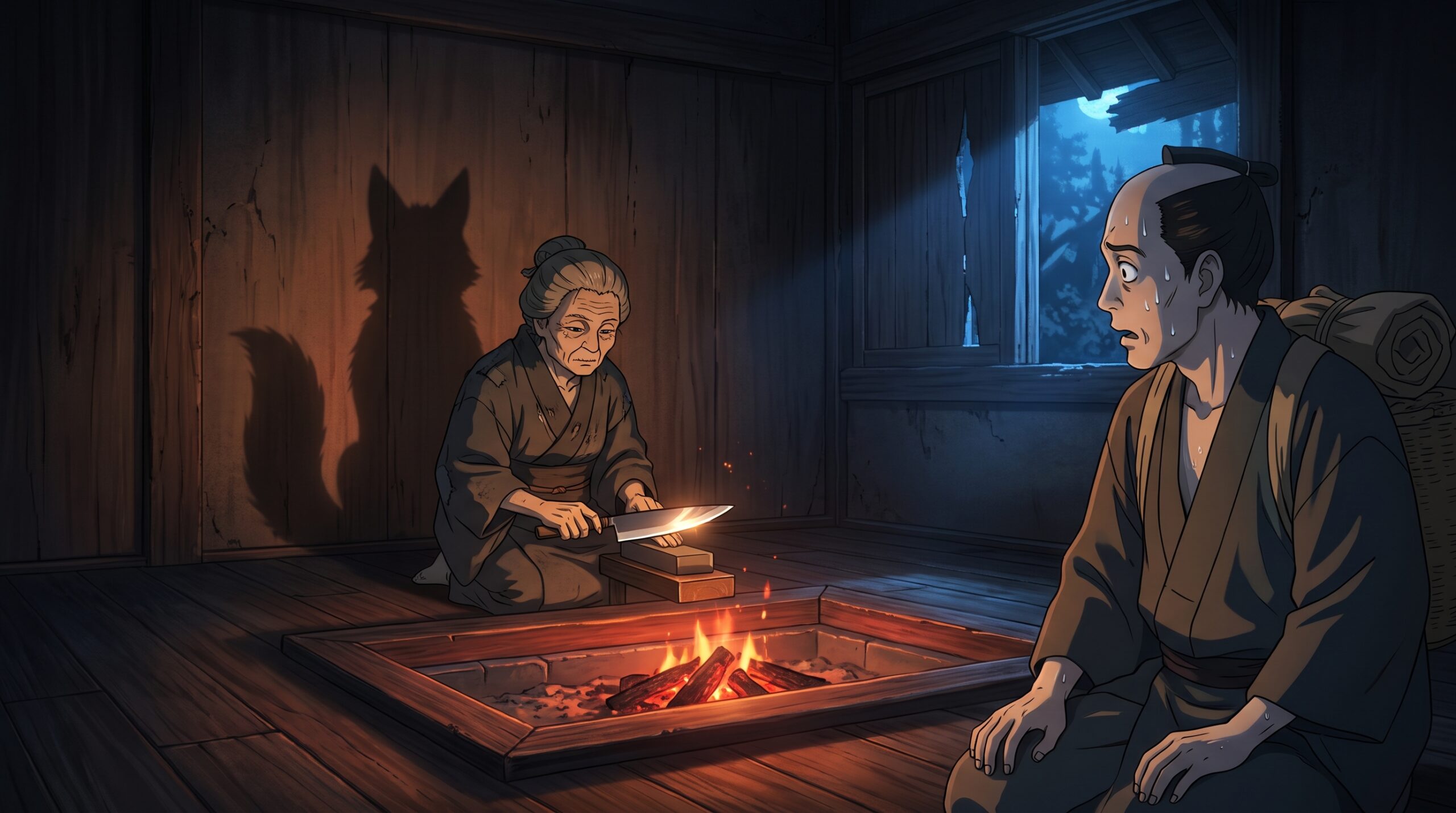
The interior of the hut was cold and dimly lit. In the center, embers glowed faintly red inside an irori (a traditional sunken hearth). Sitting hunched on the far side of the hearth was a solitary old woman.
“Good evening, ma’am. Night fell on me out on the trail. Could I possibly borrow a lantern to get back to my village?”
The old woman did not move a muscle. She didn’t utter a single word.
“Excuse me, grandmother—are you hard of hearing? It’s still a long walk back to my village. Would you mind letting me stay the night?”
Still, not a sound. Like a statue carved from stone, the old woman stared blankly into the dying embers of the hearth.
Unnerved by the suffocating silence, Jubei sat down by the hearth anyway and began chattering nonstop to calm his own nerves.
“Man, you wouldn’t believe the hilarious thing that happened to me this morning! I snuck up on a fox on the mountain trail and scared it so bad it rolled right into the river… Hey, are you listening, old woman? Sure is freezing tonight, isn’t it…”
No matter how much he talked, the old woman gave zero reaction. An eerie, heavy tension settled over the tiny room.
Then, without warning, the silent old woman reached to her side. She picked up a massive kitchen cleaver and a whetstone.
Shing… shing… shing…
Bathed in the dim crimson glow of the hearth, her face utterly devoid of emotion, the old woman began slowly, rhythmically sharpening the gleaming blade.
Jubei’s nervous chatter died instantly in his throat.
(Oh no… This must be the lair of a Yamauba—a mountain witch! She’s going to chop me up and eat me tonight!)
Cold sweat poured down Jubei’s forehead. Paralyzed with terror, he couldn’t even breathe, his eyes locked onto the flashing steel of the knife.
Shing… shing… shing…
Every scrape of the blade sounded like a countdown to his doom. Just when the suspense became unbearable and Jubei felt his heart might burst out of his chest—the sharpening abruptly stopped.
The old woman slowly lifted her head. Locking her eyes straight onto Jubei’s, she opened her mouth impossibly wide, stuck out her tongue, and unleashed an ear-splitting shriek:
“BERO-BERO-BERO, BAAAA!!”
“GAAAAAH!!”
Months of pent-up terror exploded all at once. Jubei shot up like a spring, abandoned his heavy winter pack on the floor, smashed straight through the wooden door, and bolted blindly into the night.
Outside, however, there was only total darkness. Running headlong without seeing the ground beneath him, Jubei tripped, tumbled head over heels down the steep slope, and plunged with a massive SPLASH straight into the deep, freezing river pool at the bottom of the cliff.
Gasping for air in the icy water, Jubei scrambled desperately onto the riverbank. Soaking wet and shivering uncontrollably, he looked back up the hill—only to find that the mountain hut, the glowing hearth, and the old woman had vanished without a trace. Only the cold night wind rustled through the empty bushes.
The hut and the old woman had been nothing more than an illusion conjured by the very fox Jubei had terrified that morning. For its revenge, the fox had served Jubei an exact replica of the fright and icy plunge he had inflicted on it.
With his teeth chattering violently, Jubei limped back to his village. He escaped with his life, but every single supply he had bought to survive the harsh winter was gone forever—swallowed by the dark. Never tease a wild creature for cheap amusement, and above all, never provoke a fox; what you put out into the world will come right back to you.
Story Analysis: The Art of Suspense and Perfect Karmic Mirroring
Among Japan’s vast treasury of folktales, The Old Woman of the Lonely House stands out for its razor-sharp pacing and psychological brilliance. Three structural elements make this tale timeless.
1. The Brilliant Genre Twist: From Folk Horror to Slapstick Comedy
In Japanese folklore, the setup of a lost traveler seeking shelter in a lonely mountain hut where an old woman sharpens a giant knife is the quintessential trope of a Yamauba (man-eating mountain witch) horror story—most famously seen in The Three Magic Charms. Both traditional listeners and modern readers immediately brace themselves for a terrifying life-or-death chase.
Yet at the exact peak of dread, the old woman doesn’t lunge with the knife. Instead, she pulls a grotesque, childish face and screams “Bero-bero-bero, BAAA!”—essentially the Japanese equivalent of “Peek-a-boo!” By building genuine horror tension only to shatter it with absurd comedy, the story triggers both Jubei’s blind panic and the audience’s burst of laughter.
2. Poetic Justice Without Cruelty
Notice how restrained and precise the fox’s retaliation is. The fox does not kill Jubei or even physically attack him. Instead, it mirrors Jubei’s morning prank step by step:
- Catch the target off guard in a moment of vulnerability
- Unleash a sudden, deafening shout
- Startle the target into bolting down a steep slope
- Send the target crashing into the freezing river pool below
By repaying Jubei’s prank in kind—with just a dash of psychological suspense added as interest—the fox displays wit, restraint, and a distinctly Japanese sense of proportional justice.
3. The Steep Real-World Penalty
While the punchline is hilarious, the consequence for Jubei is painfully real. Losing an entire winter’s worth of food, salt, and warm gear in a snowbound mountain village is a devastating blow—akin to losing an entire seasonal bonus in a single night. That tangible loss transforms the story from a mere gag into a memorable warning: careless cruelty toward others always carries a price.
Japanese Cultural Insights: Kitsune, Irori, and Respect for Nature
Beneath its playful plot, this folktale opens a window into three core aspects of traditional Japanese culture.
1. The Dual Nature of the Kitsune (Fox Spirits)
In Western fables, foxes are typically clever tricksters or con artists. In Japanese folklore, however, the kitsune is a supernatural being capable of shapeshifting, warping time, and creating elaborate illusions. Japanese tradition divides foxes into two broad types: sacred white foxes (zenko), who serve as messengers of Inari, the Shinto deity of rice and prosperity, and mischievous wild foxes (nogitsune), who delight in bewitching humans.
The fox in The Old Woman of the Lonely House belongs to the latter category. Crucially, though, it is not an evil monster attacking humans at random. Jubei struck first; the fox merely responded in kind. In Japanese folklore, kitsune often act as mirrors reflecting human arrogance back at us.
2. The Atmospheric Power of the Irori (Sunken Hearth)
The eerie mood of the mountain hut relies heavily on the irori, the traditional sunken floor hearth that served as the center of heating, cooking, lighting, and family life in old Japanese homes. Before electric lighting, an irori cast a warm red glow at the center of a room while leaving the surrounding walls in deep, impenetrable shadow. That dramatic interplay of dim firelight and darkness—illuminating an expressionless face and the glint of a sharpened blade—is a classic visual signature of Japanese ghost stories and folklore.
3. Animism and Inga-oho (Karmic Reciprocity)
Rooted in Shinto animism—the belief that spirits inhabit mountains, rivers, trees, and animals—traditional Japanese culture views humans not as masters over nature, but as cohabitants within it. Mocking a wild animal for laughs violates that unspoken harmony. Combined with the Buddhist principle of inga-oho (karmic cause and effect), the tale delivers a clear cultural ethic: disrespect the natural world, and nature will find a way to humble you.
What Would You Do?
Imagine you are lost on a pitch-black mountain trail, and the silent old woman sharing her hearth with you suddenly begins sharpening a massive cleaver. Would you stay frozen in fear like Jubei, or would you bolt out the door the second you heard the whetstone? And do you think losing all of his winter supplies was fair punishment for Jubei’s prank—or did the fox go too far?
Share your thoughts in the comments below! Does your country’s folklore have a story about a clever animal getting revenge on a thoughtless human? I’d love to hear it.
References & Further Reading
- Explore More Tales: Japanese Folktale Series
- Folktale Database (Japanese): Manga Nihon Mukashibanashi Database – Ikkenya no Baba
- About Japanese Fox Spirits: Kitsune – Wikipedia
- Kitsune in Japanese Mythology: Kitsune | Mythology & Yokai – Encyclopaedia Britannica
- Foxes and Shinto Culture: Foxes, Inari Shrines, and Abe no Seimei – Nippon.com
- Traditional Japanese Hearths: Irori – Wikipedia
物語:一軒屋の婆
むかし、ある山あいの村に、重兵衛(じゅうべえ)という男が暮らしていた。北風が冷たさを増し、もうじき山々が深い雪に閉ざされる季節のことである。重兵衛は冬支度の買い出しを済ませようと、まだ薄暗い早朝に家を出て、麓の町へと向かった。
落ち葉を踏みしめながら山道を歩いていると、道の脇の茂みから「ザク、ザク」と土を掘る音が聞こえてきた。重兵衛が足を止めてそっと覗き込むと、一匹の赤狐がこちらに背を向け、夢中になって地面を掘り返している。獲物を探しているのか、それとも冬の蓄えを隠しているのか、狐は人の気配にまったく気づいていない。
それを見た重兵衛の胸に、たちの悪いいたずら心がムクムクと湧き上がった。
「よし、ひとつ度肝を抜いてやろう」
重兵衛は足音を殺して狐のすぐ背後まで忍び寄ると、大きく息を吸い込み、山じゅうに響き渡るような大声を張り上げた。
「わああああっ!!」
あまりの轟音に、狐は飛び上がるほど驚いた。腰を抜かした狐は体勢を立て直す間もなく、すぐそばの急な坂道をゴロゴロと転がり落ち、そのまま崖下の深い淵へと「ドボーン!」と真っ逆さまに落ちてしまったのである。
その無様なありさまを見た重兵衛は、腹を抱えて涙が出るほど大笑いした。
「あーっはっはっは! 見事な落ちっぷりだ! 狐のやつ、今ごろ冷たい水の中で震えてるだろうよ!」
すっかり上機嫌になった重兵衛は、鼻歌まじりで町へと下りていった。町では米や塩、油、防寒具など、長い冬を乗り切るための大切な品々をたっぷりと買い込み、大きな包みにして背負った。昼過ぎには買い物を終え、「これなら日が暮れる前に村へ戻れるな」と余裕綽々で帰路についた。
ところが、不思議なことが起きた。いつもの山道にさしかかった途端、まだ夕暮れには早いはずの空が、みるみるうちに墨を流したような漆黒の闇に包まれてしまったのである。
「おや、おかしいな。もうこんなに暗くなったか……」
一寸先も見えない真っ暗闇の中、重兵衛は重い荷物を背負ったまま、手探りで一歩ずつ足を運んだ。冷たい夜風が襟元から入り込み、背筋がぞくりと寒くなる。途方に暮れ始めたそのとき、闇の奥にぽつんと、小さな灯りが浮かび上がった。近づいてみると、そこには古びた一軒の山小屋が建っていた。
「助かった! こんなところに家があるとは知らなかった。提灯(ちょうちん)でも借りていこう」
重兵衛は戸を叩き、「ごめんくだされ、道を迷った者ですが」と声をかけて中へ入った。
小屋の中はひんやりと薄暗く、中央の囲炉裏(いろり)では炭火がかすかに赤い光を放っていた。その囲炉裏の向こう側に、一人の老婆が背中を丸めてじっと座っている。
「こんばんは。山道で日が暮れてしまいましてな、提灯をひとつ貸していただけませんか」
しかし、老婆はピクリとも動かない。返事もない。
「お婆さん、耳が遠いのかね? ここから村までまだ遠いんで、もしよろしければ今晩一晩、泊めてもらえませんか」
老婆はやはり、うんともすんとも答えない。まるで石像のように押し黙ったまま、囲炉裏の火を見つめているだけである。
気まずい沈黙に耐えきれなくなった重兵衛は、勝手に囲炉裏の端へ腰を下ろし、自分の気を紛らわせるかのように一人でペラペラとしゃべり始めた。
「いやあ、今朝はとんだ面白いことがありましてね。山道で狐を驚かしてやったら、崖下の淵にドボンと落ちちまって……へへっ、お婆さん、聞いてますかい? なんだか今夜は冷えますな……」
どれほど話しかけても、老婆は一切反応しない。不気味な静けさが小屋の中に重く垂れ込める。
そのとき、無言だった老婆がゆっくりと手を伸ばした。そして、そばに置いてあった大きな出刃包丁と砥石(といし)を取り出したのである。
「シャリ……シャリ……シャリ……」
薄暗い囲炉裏の明かりに照らされながら、老婆は無表情のまま、ぎらりと光る大きな包丁を黙々と研ぎ始めた。
その異様な光景に、重兵衛の軽口はピタリと止まった。
(ま、まずい……ここは噂に聞く山姥(やまんば)の住処かもしれない……! 俺は今夜、この包丁で食われてしまうのか……!)
重兵衛の額から冷や汗が滝のように流れ落ちた。声も出せず、呼吸すら忘れて体を硬直させ、ただただ老婆の手元を見つめるしかない。
「シャリ……シャリ……シャリ……」
包丁を研ぐ音が、まるで死のカウントダウンのように小屋に響き渡る。緊張が限界に達し、重兵衛の心臓が張り裂けそうになった、まさにその瞬間だった。
包丁を研ぐ手がピタリと止まった。老婆がゆっくりと顔を上げ、重兵衛の目を真っすぐに見据えたかと思うと、口を耳まで裂けんばかりに大きく開けて、凄まじい大声を張り上げたのである。
「ベロベロベロ、バァ~!!」
「うわあああああああっ!!」
極限まで張り詰めていた恐怖が一気に爆発し、重兵衛は腰を抜かさんばかりに飛び上がった。荷物も何もかも放り出し、夢中で小屋の戸を蹴破って外へ飛び出した。
だが、外は真っ暗闇。足元など見えようはずもない。勢い余って飛び出した重兵衛は、そのまま急な坂道をゴロゴロと転がり落ち、崖下の深い淵へと「ドボーン!」と真っ逆さまに落ちてしまったのである。
冷たい水の中で必死にもがき、命からがら岸辺へ這い上がった重兵衛が、ずぶ濡れのまま震えながら振り返ると、さっきまでそこにあったはずの山小屋も、囲炉裏の灯りも、老婆の姿も、影も形もなく消え失せていた。ただ冷たい夜風が茂みを揺らしているだけである。
そう、あの山小屋も老婆も、今朝重兵衛が驚かして淵へ落とした狐が化けた幻だったのだ。狐は仕返しとして、重兵衛に自分が味わったのとまったく同じ「恐怖と水落ち」をそっくりそのままお返ししたのである。
重兵衛は歯をガチガチ鳴らしながら、ほうほうの体で村へ逃げ帰った。命だけは助かったものの、せっかく町で買った冬支度の品々はすべて闇の中へ消えてしまった。
面白半分に生き物を驚かしたり、ましてや狐をからかったりしてはいけない。自分の行いは、必ず同じ形で自分に返ってくるのだというお話である。
物語の考察:恐怖の演出と「完璧なミラーリング」の美学
『一軒屋の婆』は、数ある日本の昔話の中でも極めて構成力が高く、人間の心理を巧みに突いた傑作である。この物語が時代を超えて愛される理由は、大きく分けて3つの構造的な仕掛けにある。
1. ホラーからコメディへの鮮烈な反転(ジャンルの裏切り)
日本の昔話には、「夜道に迷った旅人が山中の一軒家に泊まり、老婆が包丁を研ぎ始める」という定番の展開が存在する。これは『三枚のお札』に代表される「山姥(やまんば)譚」の王道であり、当時の聴き手も現代の読者も、老婆が包丁を研ぎ始めた瞬間に「これは恐ろしい人食い鬼の物語だ」と確信する。
ところが、緊張が最高潮に達したクライマックスで老婆が放つのは、襲撃ではなく「ベロベロベロ、バァ~!」という、子どもを驚かすような滑稽極まりない奇声である。極限のホラー演出を徹底的に積み上げた末に、一気にコメディへと突き落とすこの「落差」こそが、重兵衛のパニックと読者の爆笑を同時に引き起こす見事な演出技法だ。
2. 「目には目を」の完璧な因果応報
狐の復讐方法に注目してほしい。狐は重兵衛の命を奪うことも、大怪我を負わせることもしていない。狐が実行したのは以下の4点である。
- 相手が油断している(あるいは緊張で思考停止している)隙を突く
- 突然の「大声」で驚かせる
- 驚いて飛び出させ、坂道を転がり落とす
- 崖下の深い淵へ落とす
これは朝に重兵衛が狐に対して行った行為の、完璧な鏡写し(ミラーリング)である。過剰な暴力に走らず、相手がやったこととまったく同じ罰を、少しだけ「心理的恐怖」という利子をつけて返す。そこに狐の知性とユーモア、そして日本の昔話特有の「やりすぎない正義感」が表れている。
3. 「冬支度の喪失」という現実的なペナルティ
物語の結末は一見するとコミカルだが、重兵衛が被った損害は決して小さくない。彼は雪国で冬を越すための食料や日用品をすべて失ってしまったのだ。現代で言えば、冬のボーナスを全額ドブに捨てたようなものである。「軽い悪ふざけ」が招いた結果としては痛烈であり、この現実的な代償があるからこそ、単なる笑い話にとどまらず「他者(自然の生き物)への無神経な悪意には必ず代償が伴う」という強い教訓が胸に刺さる。
日本文化との関連:狐・囲炉裏・自然観を読み解く
この短い昔話の中には、日本の伝統的な死生観、自然観、そして暮らしの風景が凝縮されている。日本文化を深く理解するための3つのキーワードを紐解こう。
1. 日本における「狐(Kitsune)」の二面性
西洋の童話において、キツネは「狡猾な詐欺師」として描かれることが多い。しかし日本の伝承における狐(Kitsune)は、単なる賢い動物ではなく、超自然的な力を持つ霊獣・妖怪としての側面を持つ。
日本の狐には大きく分けて二つの顔がある。ひとつは稲荷神(Inari)の使いとして五穀豊穣や商売繁盛をもたらす神聖な「善狐(白狐)」、もうひとつは人間を化かして翻弄するいたずら好きな「野狐(Nogitsune)」である。『一軒屋の婆』に登場する狐は後者の典型であり、幻の家を作り出し、時間感覚を狂わせ、人間の姿に化けるという高度な幻術を操る。
しかし重要なのは、この狐が「理由もなく人間を襲う悪魔」ではないという点だ。最初に手を出したのは人間(重兵衛)であり、狐はあくまで自尊心を傷つけられたことへの報復を行ったに過ぎない。日本のフォークロアにおいて、狐は人間の傲慢さを映し出す鏡のような存在なのである。
2. 「囲炉裏(Irori)」がもたらす光と闇の演出
物語の舞台となる山小屋の象徴的な装置が「囲炉裏(Irori)」だ。囲炉裏とは、日本の伝統的な民家の床を四角く切り抜いて灰を敷き、薪や炭を燃やす炉のことである。暖房、調理、照明、そして家族団らんの中心として、日本の暮らしに不可欠な存在だった。
電灯のない時代、夜の囲炉裏は部屋の中央だけを赤々と照らし、その周囲には濃い影を生み出した。赤暗い炎に照らされた老婆の無表情な顔と、光を受けて鈍く光る包丁の刃。囲炉裏という空間が生み出す強烈な「陰影(陰翳)」こそが、日本の怪談や昔話に独特の奥行きと不気味さを与えている。
3. アニミズムと「因果応報(Inga-oho)」の精神
日本には古くから、山や川、動物や草木に至るまで、あらゆるものに霊魂が宿るというアニミズム的な自然観(八百万の神の思想)が根付いている。人間は自然の支配者ではなく、自然の一部として他の生き物と共生しているという感覚だ。
そのため、「たかが野生の動物だから」と面白半分にからかう行為は、自然界の調和を乱す無礼な振る舞いとみなされる。そこに仏教的な「因果応報(自分の行いは善悪ともに自分に返ってくる)」の思想が結びつき、「自然や生き物に敬意を欠いた者は、自然の側から手痛いしっぺ返しを受ける」という倫理観が形成された。重兵衛が失った冬支度の荷物は、自然への敬意を忘れた人間への、もっとも分かりやすい警告なのである。
あなたならどうする?
真っ暗な山道で迷い込み、やっと見つけた一軒家の囲炉裏ばたで、無言の老婆が巨大な包丁を研ぎ始めたとしたら——あなたならどう行動するだろうか? 重兵衛のように恐怖に震えながら座り続けるか、それとも最初から異変を察知して逃げ出すだろうか。
そして、重兵衛が受けた「冬支度の荷物をすべて失う」という罰は、いたずらの代償として妥当だったと思うだろうか、それとも少し厳しすぎたと感じるだろうか。ぜひコメント欄であなたの考えを教えてほしい。あなたの国の昔話にも、人間に仕返しをする賢い動物の物語があれば、ぜひ紹介してほしい。
参考リンク・関連記事
- 関連記事(日本昔話シリーズ一覧):Japanese Folktale Series
- 参考データベース:まんが日本昔ばなし〜データベース〜『一軒屋の婆』
- 日本の狐(Kitsune)について:Kitsune – Wikipedia
- 狐の伝承と妖怪文化:Kitsune | Mythology & Yokai – Encyclopaedia Britannica
- 狐と稲荷信仰:Foxes, Inari Shrines, and Abe no Seimei – Nippon.com
- 日本の囲炉裏(Irori)について:Irori – Wikipedia

コメント