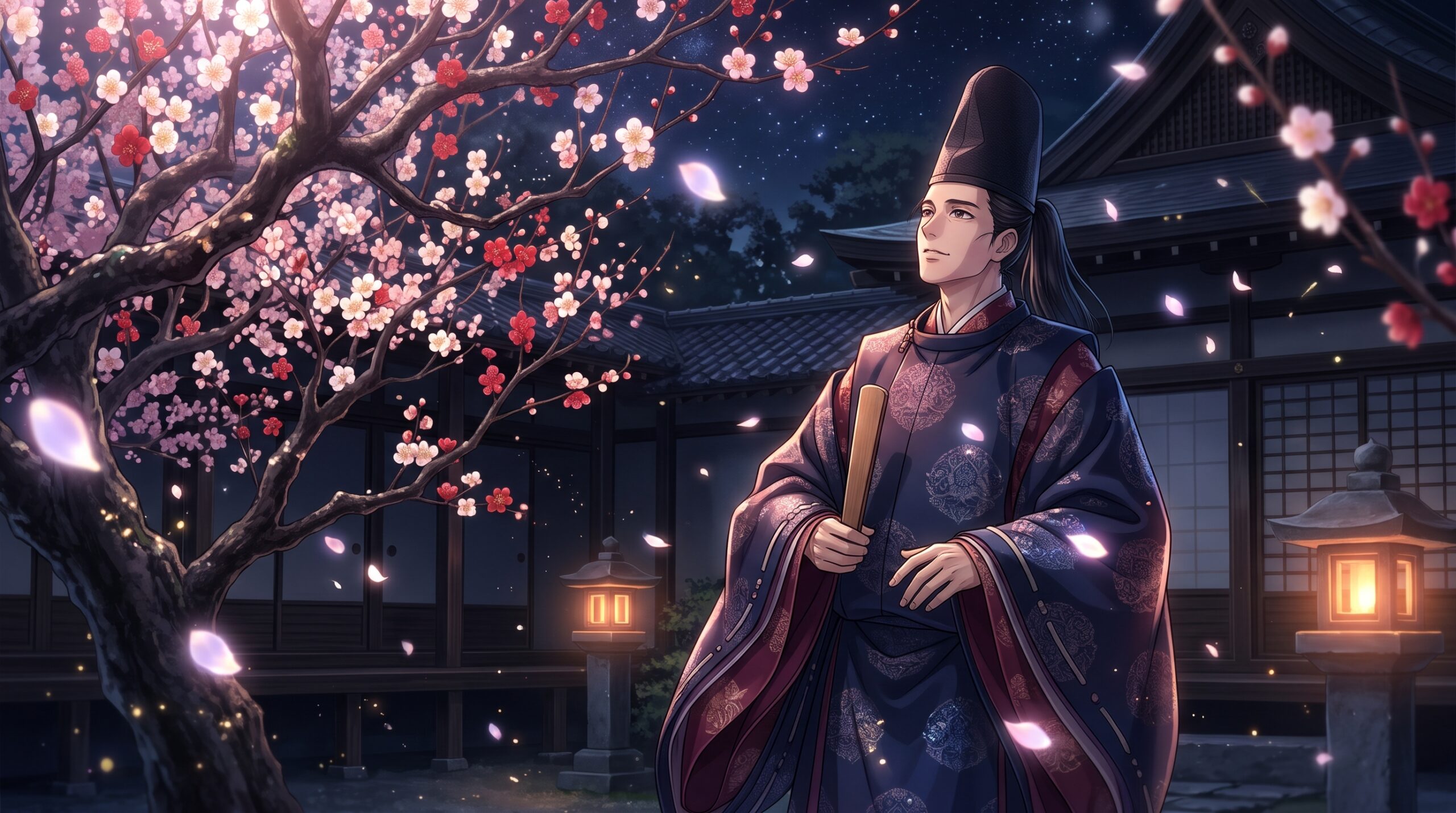
Welcome to another profound journey into the heart of Japanese history, brought to you by kiri53.com. To truly understand Japan is to understand its unbroken continuity—a breathtaking 2,600-year history where the spiritual and the political are deeply intertwined. At the core of this nation’s foundation is a unique and benevolent polity: the Emperor has historically viewed and cherished the people as Ohmitakara (the great treasures). Within this remarkable historical tapestry, we find tales of extraordinary loyalty, heartbreaking betrayal, mystical vengeance, and divine reverence.
Today, we explore the astonishing life of Sugawara no Michizane (845–903). His story is not merely a political biography; it is a legendary saga of a brilliant mortal scholar whose tragic fate transformed him into a terrifying vengeful spirit, and ultimately, into one of Japan’s most universally revered deities.
The Prodigy of the Heian Period
Born in the year 845, during the culturally flourishing Heian period, Sugawara no Michizane hailed from a prestigious lineage of scholars. For generations, the Sugawara clan had served the imperial court as esteemed tutors of history, poetry, and classical Chinese literature. From his earliest years, Michizane proved to be a prodigy whose intellect eclipsed even his illustrious ancestors. Historical records suggest that by the age of eleven, he was composing classical Chinese poetry with a grace and depth that left seasoned courtiers astounded.
His brilliance, however, was not confined to academia. Michizane possessed an unyielding sense of justice, an innate understanding of compassionate governance, and a profound, unwavering loyalty to the imperial throne. He easily passed the notoriously rigorous civil service examinations—an achievement limited to only a brilliant few—and rapidly ascended through the ranks of the government. His unmatched mastery of poetry, calligraphy, and statecraft earned him the prestigious title of Monjo Hakase (Professor of Literature). In the eyes of the court, he was the embodiment of the ideal Confucian scholar-bureaucrat, destined to guide the nation with wisdom and virtue.
A Meteoric Rise and the Emperor’s Vision
During the 9th century, the Japanese imperial court was largely dominated by the immensely powerful Fujiwara clan. The Fujiwara maintained their absolute grip on the state by marrying their daughters into the imperial family and acting as regents (Sessho and Kampaku) to young, often marginalized emperors. However, Emperor Uda, who ascended the throne in 887, possessed a fiercely independent spirit. He sought to dismantle this aristocratic monopoly and restore direct imperial rule. Emperor Uda’s vision was deeply rooted in the ancient Japanese ideal: an Emperor who governs directly to protect and nurture his “Ohmitakara” (the people), free from the self-serving influence of powerful clans.
To realize this noble vision, Emperor Uda needed a brilliant, incorruptible ally with no ties to the Fujiwara clan. He found his perfect minister in Sugawara no Michizane. Recognizing Michizane’s genius and pure-hearted loyalty, Emperor Uda appointed him to vital administrative posts. Michizane enacted just policies that favored the commoners and actively sought to curb the excesses of the aristocracy. The bond of trust between the Emperor and his scholar was absolute. Even when Emperor Uda abdicated in 897 to become a cloistered emperor, he explicitly commanded his successor, the young Emperor Daigo, to rely on Michizane’s counsel above all others. By 899, Michizane was appointed Udaijin (Minister of the Right), making him the second most powerful official in Japan.
Political Intrigue, Betrayal, and Exile
Michizane’s meteoric rise and his monopoly on the Emperor’s trust severely threatened the established aristocratic order. The Fujiwara clan, led by the young and fiercely ambitious Minister of the Left, Fujiwara no Tokihira, began to plot his downfall. Tokihira orchestrated a cunning, ruthless, and baseless political conspiracy.
In the year 901, Tokihira whispered poisonous lies into the ear of the young Emperor Daigo. He accused Michizane of plotting treason—specifically, of conspiring to depose Daigo in order to place his own son-in-law (who was of imperial blood) on the throne. Despite his lifelong dedication, his impeccable character, and his absolute innocence, the political pressure orchestrated by the Fujiwara was too immense.
Michizane was unceremoniously stripped of his prestigious titles and banished to the Dazaifu, a regional government outpost in the remote province of Kyushu. This demotion, disguised as a provincial appointment, was essentially a death sentence. Torn from his beloved family, his cherished plum trees in the capital, and the imperial court he had so faithfully served, Michizane was forced to live his final years in abject poverty and sorrow. Yet, even in the depths of despair, his loyalty never wavered. He composed heartbreakingly beautiful poetry, lamenting his cruel fate but never uttering a word of hatred toward the Emperor. In 903, sick and broken by grief, the great scholar passed away in exile.
The Wrath of the Onryo (Vengeful Spirit)
In many cultures, the story would end with the tragic death of the hero. But in Japan, the boundary between the mortal realm and the spiritual world is remarkably fluid. Shortly after Michizane’s death, an era of unprecedented, terrifying catastrophes descended upon the capital city of Kyoto.
First, his chief rival, Fujiwara no Tokihira, died suddenly of a mysterious and agonizing illness at the young age of 39. Then, epidemics ravaged the capital. Prolonged droughts and violent typhoons decimated the nation’s crops, causing widespread suffering. The climax of this supernatural terror occurred in 930. A massive, unnatural lightning storm engulfed the Imperial Palace. A blinding bolt of lightning struck the Seiryoden (the Emperor’s residential hall), instantly killing several high-ranking courtiers who had been directly involved in Michizane’s false accusation and exile. The young Emperor Daigo, witnessing this horrifying event, fell severely ill from shock and died shortly after.
The capital was thrown into absolute panic. Court diviners, Yin-Yang masters (Onmyoji), and high-ranking Buddhist monks reached a unanimous, terrifying conclusion: these relentless calamities were not natural disasters. They were the physical manifestation of Sugawara no Michizane’s Onryo—a vastly powerful, wrathful spirit seeking retribution for his unjust suffering. This reflected a profound aspect of Japanese spirituality known as Goryo Shinko: the belief that the spirits of those who die from political injustice possess the power to control natural disasters, and that the cosmos itself violently reacts to correct profound moral imbalances.
Deification: From Wrathful Spirit to Tenjin
The imperial court realized that mere earthly pardons were insufficient to pacify a spirit of such catastrophic power. Divine appeasement was the only path to salvation. The court posthumously restored all of Michizane’s titles, promoted him to the highest possible earthly rank of Daijo-daijin (Chancellor of the Realm), and ordered all documents detailing his exile to be burned.
Ultimately, the court elevated him beyond mortal status. They deified the once-mortal scholar as Tenjin (Heavenly Deity), associating his spirit with the Shinto gods of thunder and agriculture. A magnificent shrine, Kitano Tenmangu, was erected in Kyoto in 947, dedicated entirely to his worship. Similarly, Dazaifu Tenmangu was built directly over his humble grave in Kyushu. This incredible transformation from a feared, vengeful ghost to a benevolent, protective deity is a hallmark of Japan’s unique spiritual history.
Eternal Legacy: The God of Academics and Plum Blossoms
Over the centuries, the terrifying memory of his wrath faded, gracefully replaced by the enduring memory of his unparalleled intellect, his pure character, and his poetic soul. Today, Sugawara no Michizane is universally revered across Japan as Tenjin, the Kami (God) of Academics, Scholarship, and Honest Endeavor.
More than a thousand years later, his legacy is vibrantly alive. Every year, millions of students—from young children to university applicants—flock to the thousands of Tenmangu shrines across the country. They purchase amulets (omamori), write their earnest wishes on wooden plaques (ema), and pray to Michizane’s spirit for success in their exams and guidance in their studies.
Michizane’s spirit is also eternally entwined with the ume (plum blossom). Just before his forced departure to Kyushu, he stood in his garden in Kyoto and composed a heartbreaking farewell poem to his favorite plum tree:
“If the east wind blows this way,
Oh blossoms on the plum branch, send your fragrance to me!
Always be mindful of the spring,
Even though your master is no longer there.”
According to beautiful folklore, the plum tree missed its master so dearly that it uprooted itself and flew across the skies of Japan to Dazaifu to be with him—a legendary miracle known as the Tobi-ume (Flying Plum). Because of this deep bond, Tenmangu shrines are always surrounded by expansive plum groves. In late winter, just before the spring arrives, these resilient blossoms bloom brightly in the snow, serving as a fragrant reminder of the scholar’s pure, enduring spirit.
The saga of Sugawara no Michizane is a testament to the enchanting, awe-inspiring depths of Japanese culture. It is a story where political ambition triggers cosmic retribution, where the deepest sorrow transforms into protective divinity, and where a mortal man became the eternal guardian of wisdom. For more fascinating insights and stories exploring Japan’s profound heritage, continue your journey with us at kiri53.com.
References
- Encyclopedia Britannica: Sugawara Michizane
- Official Website of Dazaifu Tenmangu Shrine
- Official Website of Kitano Tenmangu Shrine
菅原道真:悲劇の天才学者、恐るべき怨霊、そして学問の神へ
kiri53.comがお届けする、日本の奥深く魅惑的な歴史の旅へようこそ。日本という国を真に理解することは、その途切れることのない歴史の連続性を理解することに他なりません。それは、精神性と政治が深く結びついた、息を呑むような2600年の歴史です。この国の根幹には、天皇が国民を「大御宝(おおみたから)」として慈しみ、守ってきたという、類まれで尊い国体が存在しています。この素晴らしい歴史のタペストリーの中に、並外れた忠誠心、胸を締め付けるような裏切り、神秘的な復讐、そして神としての崇敬の物語を見出すことができます。
今回は、菅原道真(845年~903年)の驚くべき生涯を探ります。彼の物語は単なる政治家の伝記ではありません。悲劇的な運命によって恐るべき怨霊へと変貌し、最終的には日本で最も広く信仰される神の一つへと昇華した、天才的な人間の伝説的な叙事詩なのです。
平安時代の神童
文化が花開いた平安時代の845年、菅原道真は名門の学者一家に生まれました。菅原氏は代々、歴史、詩、そして漢文学の優れた指南役として朝廷に仕えてきました。道真は幼い頃から、偉大な祖先たちをも凌ぐ天才的な知性を発揮しました。歴史的な記録によれば、彼はわずか11歳にして、経験豊かな廷臣たちを驚愕させるほど優雅で深みのある漢詩を詠んだとされています。
しかし、彼の聡明さは学問の世界にとどまるものではありませんでした。道真は揺るぎない正義感、思いやりのある政治への深い理解、そして皇室への絶対的な忠誠心を持ち合わせていました。彼は、ごく一部の優秀な者しか突破できない過酷な国家試験(方略試)に容易に合格し、政府の階段を急速に駆け上がっていきました。詩、書、そして国政の手腕において並ぶ者のない彼は、当時の最高学位である「文章博士(もんじょうはかせ)」の称号を授けられます。朝廷の目に映る彼は、知恵と徳をもって国を導く運命にある、理想的な儒教的官僚の体現者でした。
異例の出世と天皇の理想
9世紀の日本朝廷は、絶大な権力を持つ藤原氏によって支配されていました。藤原氏は自らの娘を皇室に嫁がせ、幼く、時には実権を持たない天皇の摂政や関白として振る舞うことで、国家の支配権を維持していました。しかし、887年に即位した宇多天皇は、極めて独立心の強い人物でした。彼はこの貴族による独占状態を解体し、天皇の親政を復活させようと試みました。宇多天皇の構想は、権力者の私的な影響を排し、天皇が直接「大御宝」である国民を守り育てるという、古来の日本の理想に深く根ざしたものでした。
この崇高な理想を実現するため、宇多天皇には藤原氏とのつながりを持たない、聡明で清廉潔白な協力者が必要でした。天皇は、菅原道真の中にその完璧な臣下を見出しました。道真の天才的な頭脳と純粋な忠誠心を認めた宇多天皇は、彼を重要な行政ポストに任命します。道真は庶民を重んじる公正な政策を実行し、貴族の行き過ぎた権力を積極的に抑えようとしました。天皇と学者の間の信頼の絆は絶対的なものでした。897年に宇多天皇が譲位して上皇となった際も、彼は後継者である若き醍醐天皇に対し、誰よりも道真の助言を頼るよう明確に命じました。899年には、道真は右大臣に任命され、日本で二番目に影響力のある役人となりました。
政治的陰謀、裏切り、そして左遷
道真の異例の昇進と天皇からの絶対的な信頼は、既存の貴族社会の秩序を著しく脅かしました。若く野心的な左大臣・藤原時平を筆頭とする藤原氏は、道真を失脚させるための陰謀を企て始めます。時平は狡猾で非情な、全く根拠のない政治的陰謀を画策しました。
901年、時平は若き醍醐天皇の耳に毒々しい嘘を吹き込みます。彼は道真が謀反を企てていると告発しました。具体的には、醍醐天皇を退位させ、皇族の血を引く自身の娘婿を皇位に就けようとしているというのです。道真の生涯にわたる献身、非の打ちどころのない人格、そして完全なる無実にもかかわらず、藤原氏が仕組んだ政治的圧力はあまりにも強大なものでした。
道真は唐突にその名誉ある役職を剥奪され、九州の僻地である大宰府へと左遷されました。地方への赴任を装ったこの降格は、事実上の死刑宣告でした。愛する家族、都で大切に育てていた梅の木、そして忠誠を尽くした朝廷から引き離され、道真は極貧と悲哀のなかで晩年を過ごすことを余儀なくされました。しかし、深い絶望の淵にあっても、彼の忠誠心が揺らぐことはありませんでした。彼は自身の残酷な運命を嘆きながらも、天皇への恨み言を一切口にすることなく、胸を打つ美しい詩を詠み続けました。903年、悲嘆に暮れ病に倒れた偉大な学者は、流刑の地でこの世を去りました。
怨霊の怒り
多くの文化圏において、物語は英雄の悲劇的な死をもって幕を閉じます。しかし日本においては、現世と霊界の境界は驚くほど流動的です。道真の死後まもなく、首都・京都に前代未聞の恐ろしい災厄の時代が訪れました。
まず、最大の政敵であった藤原時平が、39歳という若さで謎の苦しい病に倒れ急死しました。続いて疫病が都を襲います。長期にわたる干ばつと猛烈な台風が国の農作物を壊滅させ、人々に甚大な苦しみをもたらしました。この超自然的な恐怖は930年に頂点に達します。巨大で不自然な雷雨が御所を飲み込み、目を射るような落雷が天皇の居室である清涼殿に直撃したのです。これにより、道真の無実の罪と左遷に直接関与した複数の高官が即死しました。この凄惨な出来事を目の当たりにした若き醍醐天皇は、ショックから重病に倒れ、間もなく崩御しました。
都は完全なパニックに陥りました。朝廷の陰陽師や高位の僧侶たちは、恐ろしい、しかし満場一致の結論に達しました。これらの絶え間ない災厄は自然災害ではなく、不当な苦しみに対する報復を求める非常に強力で怒りに満ちた魂、すなわち菅原道真の「怨霊」の物理的な発露であると。これは「御霊信仰(ごりょうしんこう)」と呼ばれる日本の精神性の深い側面を反映しています。政治的な不公正によって命を落とした者の霊は自然災害を操る力を持ち、宇宙そのものが深刻な道徳的不均衡を正すために激しく反応するという信仰です。
神格化:怒れる霊から「天神」へ
朝廷は、これほどまでに破滅的な力を持つ霊を鎮めるには、現世での単なる赦免では不十分であることを悟りました。神として祀り上げることこそが、唯一の救済への道でした。朝廷は死後の道真にすべての官位を返還し、現世における最高位である太政大臣の位を追贈し、彼の左遷に関するすべての文書を焼き捨てるよう命じました。
そして最終的に、朝廷は彼を人間の枠を超えた存在へと引き上げました。かつて人間であった学者を「天神(天の神)」として神格化し、彼の魂を雷神や農耕の神と結びつけたのです。947年、京都に彼を祀る壮麗な北野天満宮が建立されました。同様に、九州の彼のつましい墓所の上には太宰府天満宮が建てられました。恐れられた復讐の霊から、慈悲深く守護的な神へのこの驚くべき変貌は、日本のユニークな精神史の顕著な特徴です。
数世紀の時を経て、彼の怒りに関する恐ろしい記憶は薄れ、その類まれな知性、清らかな人格、そして詩的な魂の記憶へと優雅に置き換わっていきました。現在、菅原道真は、学問、文学、そして至誠の神である「天神様」として、日本中で普遍的に信仰されています。
永遠の遺産:学問の神様と梅の花
千年以上の時を超えて、彼の遺産は鮮やかに息づいています。毎年、小さな子供から大学受験生まで、数百万人の学生たちが全国に数万社ある天満宮を訪れます。彼らはお守りを買い求め、絵馬に切実な願いを書き込み、試験の合格と学業の導きを道真の魂に祈願します。
また、道真の魂は永遠に「梅」と結びついています。九州への強制的な出発の直前、彼は京都の庭に立ち、最も愛した梅の木に向けて胸を締め付けるような別れの詩(和歌)を詠みました。
「東風(こち)吹かば 匂ひをこせよ 梅の花
主(あるじ)なしとて 春を忘るな」
美しい伝承によれば、その梅の木は主人を深く慕うあまり、自ら根を抜き、日本の空を飛んで大宰府まで彼を追いかけていったとされています。これが「飛梅(とびうめ)」として知られる伝説的な奇跡です。この深い絆のため、天満宮の境内は常に広大な梅林に囲まれています。春が訪れる直前の晩冬、雪の中で力強く咲き誇るその花は、学者の純粋で不朽の精神を香りと共に思い出させてくれます。
菅原道真の壮大な物語は、日本の文化の魅惑的で畏敬の念を抱かせる奥深さを証明するものです。それは、政治的野心が宇宙の報復を引き起こし、最も深い悲しみが守護神へと変貌し、一人の人間の男が永遠の知恵の守護者となった物語です。日本の奥深い遺産を探求するさらなる魅力的な洞察と物語は、引き続き kiri53.com の旅でお楽しみください。
コメント