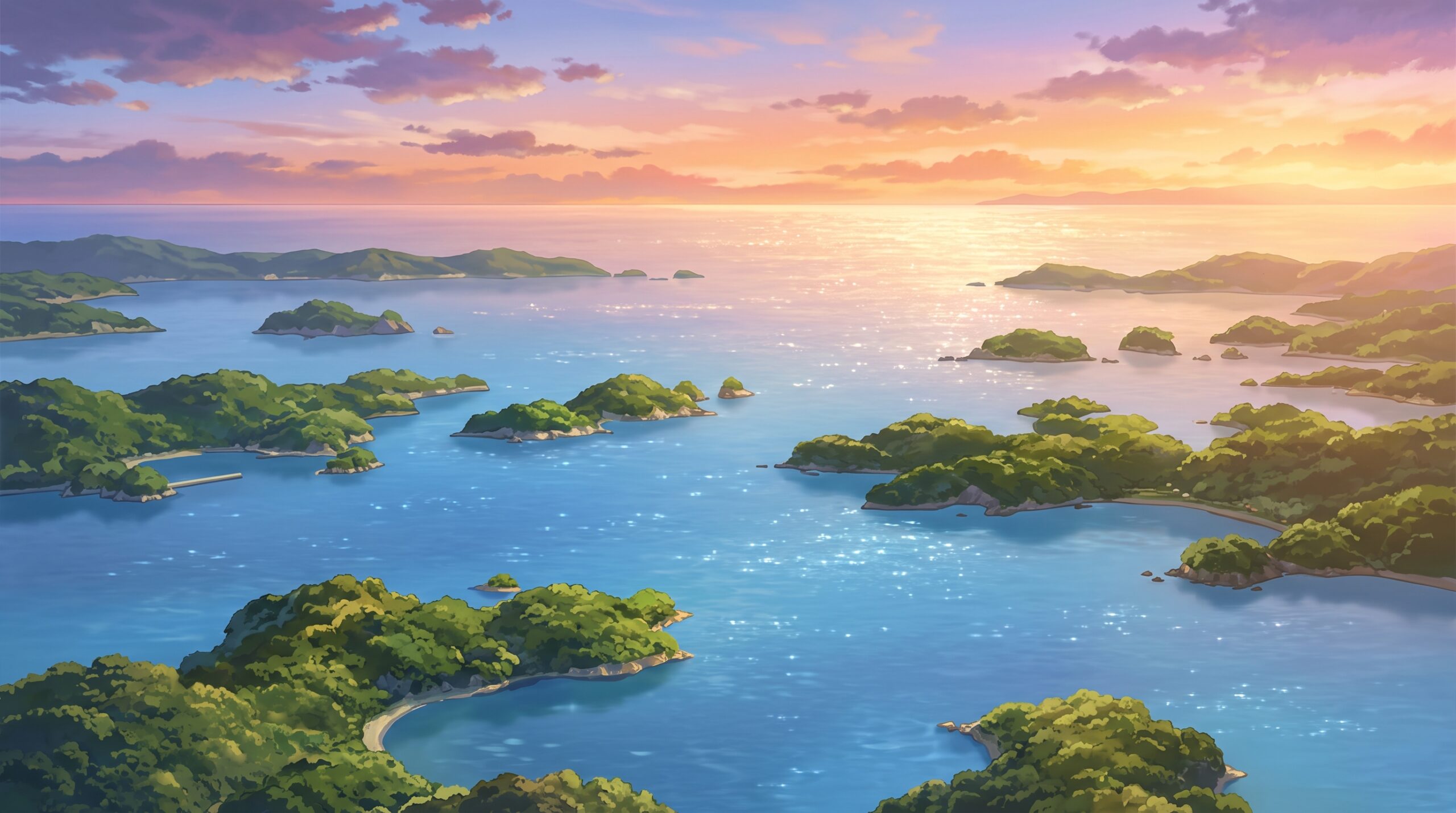
At the westernmost edge of Japan, stretching from Sasebo City to Hirado City in Nagasaki Prefecture, lies a deep blue sea. Scattered across this water are breathtaking views that look as though brilliant green emeralds have been meticulously placed on the ocean’s surface. Every year, September 19th is celebrated as “Kujukushima Day.” This anniversary was established by Sasebo City in 1999, playfully derived from a Japanese wordplay where 9 (Ku) and 19 (Juku) combine to sound like “Kujukushima” (99 islands). It was officially certified and registered by the Japan Anniversary Association in 2019.
A proud member of the “Most Beautiful Bays in the World” club, Kujukushima is a scenic archipelago comprising a winding ria coastline and 208 islands of various sizes. The entire area was designated as Saikai National Park in 1955 and selected as one of the 100 Landscapes of Japan. However, this location is far more than just a beautiful scenery—it is a living testament to the Japanese people’s profound reverence for nature and their rich historical heritage. Today, we invite you on a journey to explore the depths of Japanese culture by unraveling the story of this miraculous seascape.
History and Culture: The Infinite Landscape Loved by Ino Tadataka
In traditional Japanese expression, the word “Kujuku” (99) does not mean the literal count of 99 items; rather, it symbolizes “an extremely large number” or “boundless infinity.” Just as the phrase “Yaoyorozu no Kami” (8 million gods) suggests, Japanese people have historically sensed divinity in the countless, abundant elements of nature. Officially consisting of 208 islands, the very act of calling this place “Kujukushima” (99 islands) is an expression of deep respect for an endlessly continuing beautiful nature.
Many great historical figures have been mesmerized by this land. Among them is Ino Tadataka, a renowned figure from the Edo period who walked across the entire country to survey and create the first highly accurate map of Japan. When he visited this area for surveying, he was so captivated by its immense beauty that he composed a “kyoka” (a comic/satirical tanka poem). He wrote: “Nanjuku ni / chikaki haru ni zo / Ainoura / Kujukushima o / Iki no matsubara”. This roughly translates to: “I have welcomed a spring close to my 70th year here in Ainoura, but looking at these 99 islands, I wish to live as long as 99 years myself.” It was a powerful poem filled with his awe of the scenery and a heartfelt prayer for vitality. Truly, breathtaking landscapes have provided people with the energy to live across all eras.
[Original Tale] The Star Shards and the Dragon’s Prayer: The Secret Birth of Kujukushima
How was this spectacular archipelago actually formed? Here, we present a story inspired by its mystical topography.
Once upon a time, in an era when Japan still breathed alongside the gods, a giant water dragon named “Ao” lived in the western seas of Hizen Province (modern-day Nagasaki). Ao’s scales were the color of the deep sea, and upon his forehead shone the massive “Emerald Star Jewel,” which controlled the ebb and flow of the tides. The local people lived in peace, thanking the ocean, praying to Ao, and receiving the rich bounties of the sea.
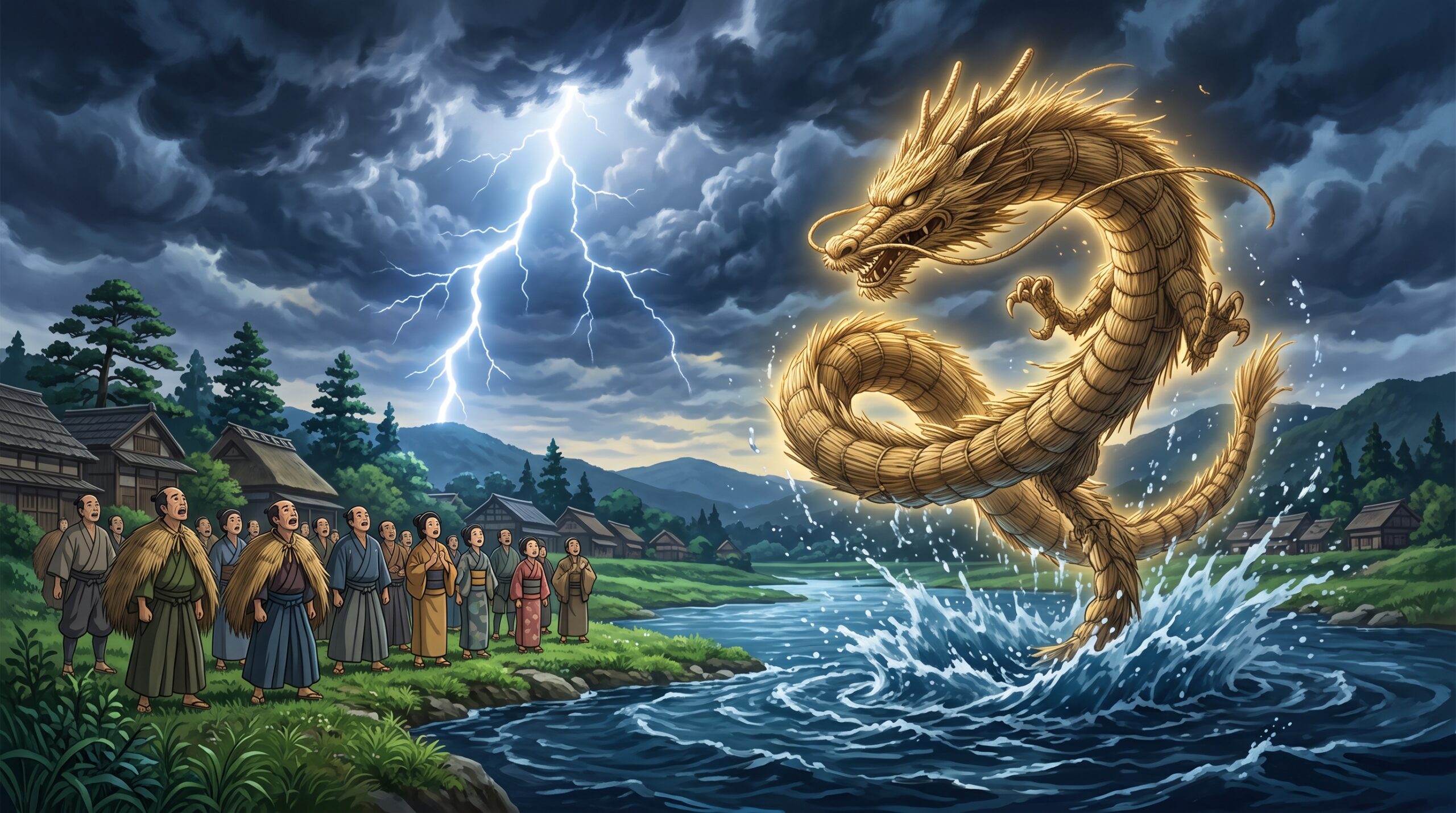
However, one year, an avatar of a jet-black storm, intending to swallow the world, attacked from beyond the horizon. The sky was covered in darkness, waves towered like mountains, and the coastal villages were on the verge of being engulfed. Hearing the screams of the people, Ao rose to face the storm avatar. A fierce battle raged for three days and three nights; the sea churned violently, and lightning continuously streaked across the sky. Yet, the storm’s power was so overwhelming that even Ao’s might could not completely repel it.
“At this rate, the land and the people I love will disappear.”
Making a grave decision, Ao removed the “Emerald Star Jewel” from his forehead—the very source of his life and immense power. Gathering every last ounce of his remaining strength, he hurled the jewel with all his might straight into the center of the jet-black storm.
With a blinding explosion of light, the jewel shattered in mid-air, purifying the storm avatar. The fragmented pieces of the jewel, radiating an emerald glow, rained down into the now-silenced ocean. Miraculously, the moment they touched the water, those shards transformed into lush, green islands. The countless fragments of light eventually became 208 beautiful islands, forming an intricately woven, calm bay.
Because these islands acted as natural breakwaters, the violent waves were subdued, and the sea became as calm as a mirror. Exhausted, Ao transformed into the gentle, rich ocean currents that weave between the islands, continuing to protect the land for eternity. It is passed down in legend that the reason the waters of Kujukushima are so incredibly calm today—acting as a cradle of life that nurtures pearls, oysters, and abundant fish—is because the star shards that turned into islands and the gentle prayer of the dragon god who became the currents still breathe life into this place.
Understanding the Japanese View of Nature through Kujukushima
As this story symbolizes, the landscape of Kujukushima visually embodies the Japanese philosophy of “coexistence with nature.” While in some cultures, nature is often depicted as something to be “overcome and conquered,” in Japan, nature is something to be “lived alongside and revered.”
The complex topography created by the ria coastline and the 208 islands sometimes requires ingenuity from the people living there, but simultaneously, it functions as an “ocean forest” that blocks the rough waves of the open sea and nurtures a rich ecosystem. Every year, around “Kujukushima Day” on September 19th, large-scale clean-up operations are conducted by the citizens. This represents a strong will not to simply take the given beauty of nature for granted, but to actively protect it with human hands and pass it down to the next generation. The heart to love, protect, and nurture nature is the very spirit that flows at the foundation of true Japanese culture.
To Our Readers
The evening view of Kujukushima, where the golden sunset highlights the silhouettes of the 208 islands floating in the sea, is a sight you will never forget once you have seen it. If you were to stand on the observatory and gaze out at these endlessly continuing islands, what kind of story would you hear in the wind? Would you like to spend some time healing your own heart in this green labyrinth created by nature? Please, be sure to add this miraculous sea to the destination of your next trip to Japan.
After reading this article, what are your thoughts on Japan’s archipelagos and its perspective on nature? Does your country also have beautiful legends deeply connected to the natural world?
Reference Links & Related Information
- Sasebo City Official Tourism Site: Kujukushima Pearl Sea Resort
- Kujukushima Pearl Sea Resort: Official Website
- Read more from our Anniversary Series: What’s Today’s Special Day Series
【9月19日は九十九島の日】208の島々が織りなす絶景と日本の自然崇拝、語り継がれる星の欠片の物語
日本の西端、長崎県佐世保市から平戸市にかけて広がる深く青い海。そこには、まるで緑の宝石を散りばめたかのような息をのむ絶景が広がっています。毎年9月19日は、「九十九島(くじゅうくしま)の日」です。この記念日は、「く(9)じゅうく(19)しま」という語呂合わせから、長崎県佐世保市が1999年に制定し、2019年に一般社団法人・日本記念日協会により正式に認定・登録されました。
「世界で最も美しい湾クラブ」にも加盟する九十九島は、リアス式海岸と大小208の島々からなる風光明媚な群島です。1955年に全域が「西海国立公園」に指定され、日本百景にも選定されているこの場所は、単なる美しい風景にとどまらず、日本人の自然への深い畏敬の念と豊かな歴史を今に伝えています。本日は、この奇跡のような海の風景を紐解きながら、日本文化の奥深さを巡る旅へ皆様をご案内します。
歴史と文化:伊能忠敬が愛し、詠んだ無限の風景
「九十九(くじゅうく)」という言葉は、実際の数が99個であることを意味するのではなく、日本の伝統的な表現において「数が極めて多いこと」「数え切れないほど無限であること」を象徴しています。八百万(やおよろず)の神々という言葉があるように、古来より日本人は、数え切れないほど豊かな自然の万物に神聖なものを感じ取ってきました。公式には208とされる島々を「九十九島」と呼ぶこと自体が、果てしなく続く美しい自然への敬意の表れなのです。
この地に魅了された歴史上の偉人は数多く存在します。中でも有名なのが、日本全国を歩いて測量し、精巧な日本地図を作成した江戸時代の偉人、伊能忠敬です。彼は測量のためにこの地を訪れた際、そのあまりの美しさに心を奪われました。そして、「七十に 近き春にぞ あひの浦 九十九島を いきの松原」という狂歌を残しています。これは、「70歳に近い春をこの地で迎えたが、目の前に広がる九十九島のように、私も99歳まで長く生きたいものだ」という彼の感動と生命への願いが込められた力強い歌です。絶景は、いつの時代も人々の心に生きる活力を与えてきました。
【創作物語】星の欠片と龍神の祈り:九十九島誕生秘話
この美しい多島海は、一体どのようにして生まれたのでしょうか。ここでは、その神秘的な地形からインスピレーションを受けた、一つの物語をお届けします。
昔々、まだ日本という国が神々と共に息づいていた時代。肥前国(現在の長崎県)の西の海には、海と人々を護る巨大な水竜「碧(あお)」が棲んでいました。碧の鱗は深い海の色をしており、その額には海の満ち引きを操る巨大な「翠星の宝玉(すいせいのほうぎょく)」が輝いていました。人々は海に感謝し、碧に祈りを捧げ、豊かな海の恵みを受け取りながら平和に暮らしていました。
しかしある年、海の彼方から世界を飲み込もうとする巨大な漆黒の嵐の化身が襲来しました。空は闇に覆われ、波は山のように高くそびえ立ち、海岸の村々を今にも飲み込もうとしていました。人々の悲鳴を聞いた碧は、嵐の化身に立ち向かいました。三日三晩にわたる激しい闘いが繰り広げられ、海は荒れ狂い、空には稲妻が走り続けました。しかし、嵐の力はあまりにも強大で、碧の力をもってしても完全に退けることは困難でした。
「このままでは、愛する陸地が、人々が消えてしまう」
決断を下した碧は、自らの命の源であり、絶大な力を持つ額の「翠星の宝玉」を取り外しました。そして、残されたすべての力を振り絞り、その宝玉を漆黒の嵐の中心に向かって力強く投げつけたのです。
激しい光の爆発と共に、宝玉は嵐の化身を浄化しながら空中で砕け散りました。粉々になった宝玉は、エメラルドの輝きを放ちながら、次々と静まり返った海へと落ちていきました。海面に触れた瞬間、その欠片は不思議なことに、豊かな緑を湛えた島々へと姿を変えていったのです。数え切れないほどの光の欠片は、やがて208の美しい島となり、複雑に入り組んだ穏やかな湾を形成しました。
島々が天然の防波堤となったことで、激しい波は穏やかになり、海は鏡のように静まり返りました。力を使い果たした碧は、島々の間を縫うように流れる静かで豊かな海流へと姿を変え、永遠にこの地を護り続けることになりました。現在、九十九島の海が驚くほど穏やかで、真珠や牡蠣、豊かな魚たちを育む命の揺りかごとなっているのは、島々に姿を変えた星の欠片と、海流となった龍神の優しい祈りが今も息づいているからだと言い伝えられています。
九十九島から読み解く日本の自然観
この物語が象徴するように、九十九島の景観は、日本の「自然との共生」という哲学を視覚的に体現しています。西洋の文化においては、自然はしばしば「克服し、支配するもの」として描かれますが、日本において自然は「共に生き、畏れ敬うもの」です。
リアス式海岸と208の島々が織りなす複雑な地形は、時に人々の生活に工夫を求めますが、同時に外洋の荒波を防ぎ、豊かな生態系を育む「海の森」として機能しています。毎年9月19日の「九十九島の日」前後には、市民による大規模な清掃活動「九十九島CLEANアップ大作戦!」が実施されます。これは、与えられた自然の美しさにただ甘んじるのではなく、人間の手で大切に守り、次の世代へと受け継いでいくという強い意志の表れです。自然を愛し、守り育てる心こそが、真の日本文化の根底に流れる精神なのです。
読者の皆様へ
黄金色に染まる夕陽が、208の島々のシルエットを海に浮かび上がらせる九十九島の夕景は、一度見たら生涯忘れることのできない光景です。もしあなたが展望台に立ち、この果てしなく続く島々を見渡したなら、風の中にどのような物語を感じ取るでしょうか?自然が創り出したこの緑の迷宮で、あなた自身の心を癒す時間を過ごしてみませんか?ぜひ、次の日本への旅の目的地に、この奇跡の海を加えてみてください。
この記事を読んで、日本の多島海や自然への考え方についてどう思いましたか?あなたの国にも、自然と深く結びついた美しい伝説はありますか?
参考リンク・関連情報
- 佐世保市公式観光サイト:海風の国 九十九島
- 複合施設 九十九島パールシーリゾート:九十九島パールシーリゾート公式サイト
- 当ブログの記念日シリーズをもっと読む:What’s Today’s Special Day Series
コメント