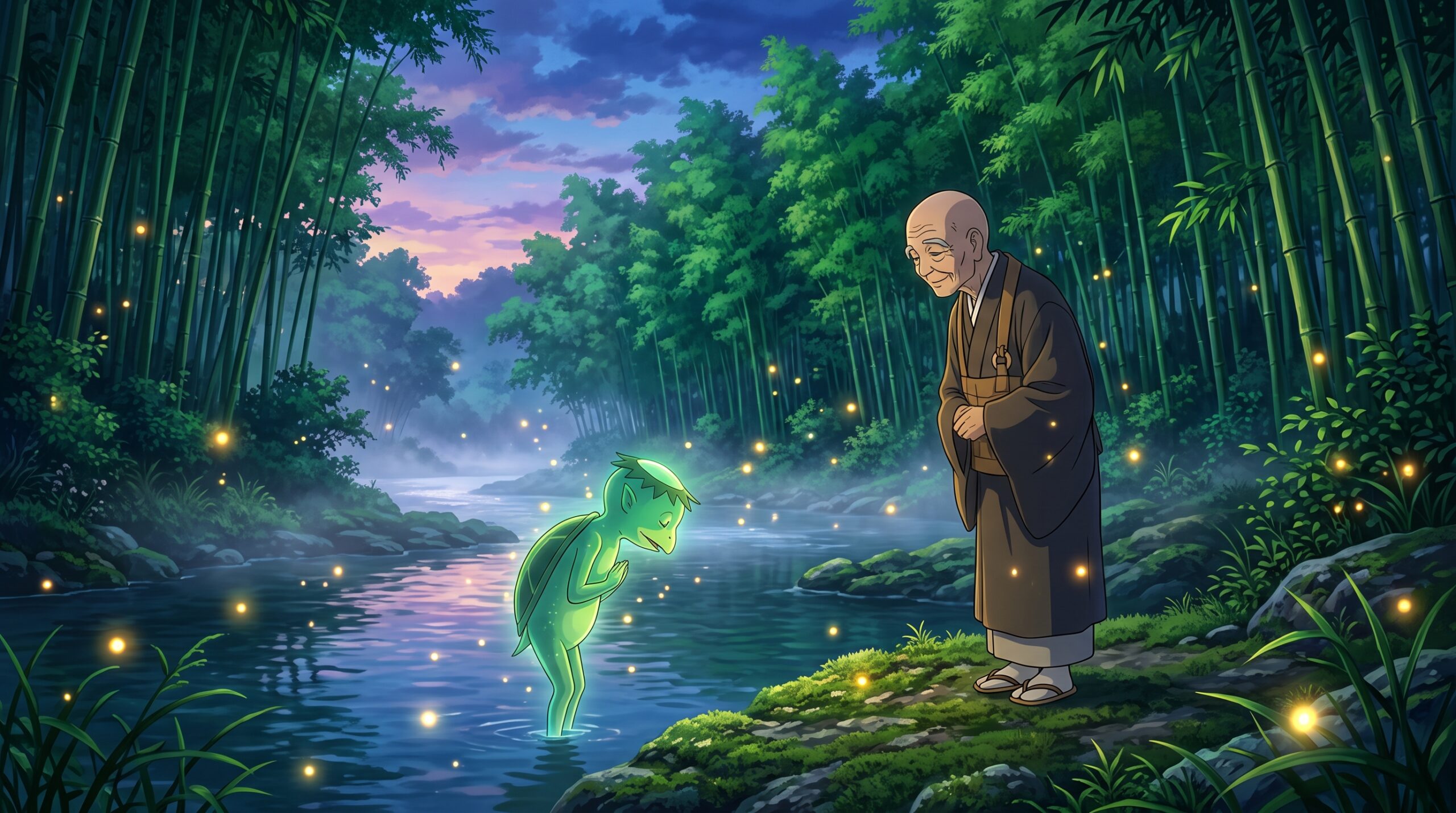
Since ancient times, Japanese people have believed that the abundant natural landscapes of their country are inhabited by numerous mysterious creatures. Among them, the most famous is the “Kappa,” a water creature that has left legends in rivers and ponds all across Japan. Today, we introduce the chilling yet heartwarming folktale of “Konaka no Kappa,” a story passed down in Sano City, Tochigi Prefecture.
The Shadow Lurking in the Akabuchi of the Hatagawa River
Long ago, in what is now Sano City, Tochigi Prefecture, there was a village called Konaka where the clear Hatagawa River flowed. A bridge named Furukawa Bridge spanned the river, and beneath it lay a deep, stagnant pool called “Akabuchi.” In this dark, gloomy abyss lived an old Kappa.
With a green body, a dish on its head filled with water, and webbed hands and feet, this Yokai (supernatural monster) was a massive source of distress for the villagers. Night after night, it would crawl out of the river to ravage the cucumber and watermelon fields that the villagers had worked so hard to cultivate. Even more terrifying, it would attempt to drag children playing by the riverbank into the watery depths.
“We cannot live in peace like this. We must find a way to punish that Kappa,” the troubled villagers gathered to discuss. They decided to set up a watch in a high watchtower in the middle of the fields. This dangerous task was entrusted to Gorohei, a horse trader who was the strongest man in the village.
The Fierce Battle Between Gorohei and the Kappa
Armed with a sharp sickle, Gorohei lay in wait every night, holding his breath in the watchtower. One day, two days passed. Finally, before dawn on the fifth night, amid the thick morning mist, a slimy green shadow crawled up from the riverbank. It was the Kappa, its hair disheveled and the distinct dish on its head.
Gorohei lay flat on the ground, waiting intently for the Kappa to get closer. The moment he thought, “Now!”, Gorohei leaped out in front of the Kappa, swinging his sickle. The Kappa was agile, counterattacking by throwing melons from the field at Gorohei. However, Gorohei’s brute strength prevailed. The sickle swung down sharply, cleanly severing the Kappa’s right arm.
“Gyaaa!” the Kappa screamed in agony, bleeding as it frantically fled back into the Akabuchi pool. Left on the ground was the creepy, slimy green right arm of the Kappa, complete with webbing between its fingers.
The Mercy of Kenryu Shonin
Gorohei took this eerie right arm and rushed to Koshoji Temple, home to Kenryu Shonin (a high-ranking Buddhist monk), who was renowned for his great knowledge and deep compassion. After hearing the whole story, the monk agreed to keep the severed arm.
That very night, as the monk was sleeping, he heard the sound of bitter weeping coming from beside his pillow. Waking up, he found the one-armed Kappa kneeling there, crying tears of deep sorrow.
“I am the Kappa of the Hatagawa River. Gorohei cut off my arm. Please, please give it back to me,” the Kappa pleaded.
The monk questioned it strictly. “I hear you not only ruin the fields but also try to drag innocent children into the river. I cannot return this arm to a wicked creature like you.”
The Kappa rubbed its head deeply against the ground, begging desperately. “I am truly sorry. I will never, ever do bad things again. Please forgive me.”
Realizing that the Kappa’s tears were born of genuine remorse, Kenryu Shonin made the creature firmly promise to cease its malicious deeds and then mercifully returned the right arm. The Kappa reattached the arm perfectly to the stump on its shoulder. Bowing its head to the monk over and over again, it disappeared into the darkness. From that day on, no fields were ever ruined, and no child was ever dragged into the river in Konaka village again.
The Unforgotten Debt of Gratitude
Several years passed. Kenryu Shonin set out on a journey for strict training at Hasedera Temple in the distant Yamato Province (modern-day Nara Prefecture). Along the way, he arrived at the banks of the Yamato River, but heavy rains had caused terrifying floods, and the bridge had been completely washed away.
As the monk stood stranded and at a loss before the raging rapids, a familiar green figure suddenly appeared before him. To his absolute astonishment, it was the “Konaka no Kappa” from the Hatagawa River in Tochigi, hundreds of miles away.
The Kappa said nothing but turned its back to the monk, as if to say, “Please, get on.” When the monk climbed onto its back, the Kappa powerfully swam through the fierce rapids, safely delivering the monk to the opposite shore. Saved by the monk’s mercy years ago, the Kappa had never forgotten its debt of gratitude and crossed great distances to repay it when the monk was in dire need.
Analysis: The Duality of Yokai and the Spirit of “On-gaeshi”
What makes this story incredibly fascinating is how it clearly depicts the “duality of good and evil” inherent in Japanese Yokai. While many Western monsters are simply defeated as absolute “evil,” Japanese Yokai are often given the chance to reflect and reform.
The story does not end with Gorohei’s physical violence (cutting off the arm). The intervention of dialogue and compassion from a “spiritual authority” like Kenryu Shonin transforms the Kappa from a terrifying monster into a creature of honor who keeps its promises. This reflects Japan’s unique moral compass of forgiveness—hating the sin, but not the sinner. Furthermore, the traditional Japanese value of “On-gaeshi” (repaying a debt of gratitude) is profoundly conveyed not through a human, but through the actions of a Yokai.
Cultural Roots: Awe of Nature and Kappa as “Suijin” (Water Deities)
The Kappa is not merely an imaginary monster. In Japanese folklore studies, it is widely believed that Kappa are the fallen forms of “Suijin” (water deities) who reside in rivers and ponds.
Water is an essential blessing for growing crops, but it is also a terrifying threat that causes floods and drowning accidents. The image of the Kappa ruining fields and drowning children symbolizes the fear of uncontrollable natural disasters. However, the Kappa becoming peaceful after a promise to the monk, and eventually saving a human from a raging river, embodies the very essence of Japanese “Animism.” It shows that by respecting and living in harmony with fierce nature, nature will once again bestow its blessings upon humanity.
What Would You Do?
When the terrified monster cried and apologized, Kenryu Shonin chose forgiveness and returned the arm. If you were in the monk’s position, could you have trusted the Kappa’s tears and returned its power? Or would you have driven it away out of fear that it might harm people again?
This Japanese folktale transcends the “fear” of the unknown through “dialogue and forgiveness,” creating a profound bond between human and nature. What do you think about the Kappa’s gratitude? We would love to hear your thoughts!
Reference Link:
Manga Nippon Mukashibanashi Database – Konaka no Kappa
Related Category:
Japanese Folktale Series
- The Shadow Lurking in the Akabuchi of the Hatagawa River
- The Fierce Battle Between Gorohei and the Kappa
- The Mercy of Kenryu Shonin
- The Unforgotten Debt of Gratitude
- Analysis: The Duality of Yokai and the Spirit of “On-gaeshi”
- Cultural Roots: Awe of Nature and Kappa as “Suijin” (Water Deities)
- What Would You Do?
- 小中の河童:恩義を忘れない日本の水神伝説
小中の河童:恩義を忘れない日本の水神伝説
日本の豊かな自然の中には、古くから数多くの不思議な生き物たちが棲んでいると信じられてきました。その中でも特に有名で、日本全国の川や池に伝説を残しているのが「河童(かっぱ)」です。今回は、栃木県佐野市に古くから伝わる、恐ろしくも心温まる昔話「小中の河童(こなかのかっぱ)」の物語をご紹介します。
旗川の赤渕に潜む影
昔々、現在の栃木県佐野市にあたる小中村(こなかむら)には、旗川(はたがわ)という清らかな川が流れていました。その川には古川橋という橋が架かっており、橋の下には「赤渕(あかぶち)」と呼ばれる深く淀んだ淵がありました。この薄暗い淵には、一匹の年老いた河童が棲み着いていました。
緑色の体を持ち、頭の上には水をたたえた皿、手足には水かきを持つこの妖怪は、村人たちにとって大きな悩みの種でした。夜な夜な川から這い上がっては、村人が丹精込めて育てたキュウリやスイカの畑を荒らし回っていたのです。さらに恐ろしいことに、川辺で遊ぶ子どもたちを水の中へ引きずり込もうとする悪さまで働いていました。
「このままでは安心して暮らせない。あの河童をどうにかして懲らしめなければならない」
困り果てた村人たちは集まって相談し、畑の真ん中にある高い番小屋で見張りを立てることに決めました。この危険な役目を任されたのは、村で一番の力持ちであり、馬の売買を生業とする五郎平(ごろへい)という男でした。
五郎平と河童の激闘
五郎平は鋭い鎌(かま)を手に、毎晩番小屋で息を潜めて待ち伏せました。一日、二日と夜が過ぎ、ついに五日目の夜明け前のことです。朝靄(あさもや)が立ち込める中、川の土手からぬらりとした緑色の影が這い上がってくるのが見えました。頭に皿を乗せ、髪を振り乱した河童です。
五郎平は地面に伏せ、河童が近づいてくるのをじっと待ちました。「今だ!」と思った瞬間、五郎平は鎌を振りかざして河童の前に飛び出しました。河童もすばしっこく、畑の瓜を五郎平に向かって投げつけて反撃します。しかし、五郎平の腕力が勝りました。鋭く振り下ろされた鎌は、見事に河童の右腕を切り落としたのです。
「ギャアッ!」と痛みに叫び声を上げた河童は、血を流しながら夢中で赤渕の中へ逃げ帰っていきました。地面に残されたのは、ぬるりとした緑色で、指の間に水かきがついた、薄気味悪い河童の右腕でした。
見龍和尚の慈悲
五郎平はこの気味の悪い右腕を持ち、村で最も学識があり、慈悲深いと評判だった光照寺(こうしょうじ)の見龍和尚(けんりゅうおしょう)のもとへ駆け込みました。事の顛末を聞いた和尚は、その腕を預かることにしました。
その夜のことです。和尚が床に就いていると、枕元からさめざめと泣きじゃくる声が聞こえてきました。目を覚ますと、そこには片腕を失ったあの河童がひざまずき、涙を流していました。
「私は旗川の河童です。五郎平に腕を切り落とされてしまいました。どうか、どうかその腕を返してください」
和尚は厳しく問いただしました。「お前は畑を荒らすだけでなく、罪のない子どもたちを川へ引きずり込もうとしたそうではないか。そんな悪者には返すわけにはいかない」
河童は深く頭を地面にこすりつけ、必死に懇願しました。「本当に申し訳ありません。もう二度と、絶対に悪さはしません。どうかお許しください」
その涙が心からの反省によるものだと悟った見龍和尚は、二度と悪さをしないことを固く約束させ、その右腕を返してやりました。河童は受け取った腕を自分の肩の切り口にピタリとくっつけると、何度も何度も和尚に頭を下げながら、闇の中へと消えていきました。それ以来、小中村で畑が荒らされたり、子どもが川へ引き込まれたりすることは二度とありませんでした。
忘れられなかった恩義
それから数年の歳月が流れた頃のことです。見龍和尚は厳しい修行のために、遠く離れた大和国(現在の奈良県)の長谷寺へと旅に出ました。道中、和尚は大和川のほとりにたどり着きましたが、大雨の影響で川は恐ろしいほどに氾濫し、橋も流されてしまっていました。
激流を前に立ち往生し、途方に暮れていた見龍和尚の前に、突如として見覚えのある緑色の姿が現れました。それはなんと、遠く離れた栃木の旗川に棲んでいた、あの「小中の河童」だったのです。
河童は何も言わず、和尚の前に背中を向けました。「さあ、乗ってください」と言わんばかりの態度です。和尚が背中に乗ると、河童は激流をものともせず力強く泳ぎ切り、無事に和尚を対岸へと送り届けました。和尚の慈悲によって命と腕を救われた河童は、その恩義を何年経っても決して忘れることなく、遠く離れた地で恩返しを果たしたのです。
物語からの考察:妖怪の二面性と「恩返し」の精神
この物語が非常に興味深いのは、日本の妖怪が持つ「善悪の二面性」を明確に描いている点です。西洋のモンスターの多くが絶対的な「悪」として退治されて終わるのに対し、日本の妖怪は反省し、改心する機会を与えられます。
五郎平の暴力(腕を切り落とす)による物理的な解決だけでは物語は終わりません。見龍和尚という「精神的な権威」による対話と慈悲の心が介入することで、河童は恐ろしい怪物から、約束を守る義理堅い存在へと変化します。これは、罪を憎んで人を憎まずという、日本独自の寛容な倫理観を色濃く反映しています。また、「受けた恩は必ず返す」という日本の伝統的な道徳観(恩返し)が、人間ではなく妖怪の行動を通して描かれている点も、深い感動を呼び起こします。
日本文化との関連:自然への畏怖と「水神」としての河童
河童は単なる想像上の化け物ではありません。その起源は、川や池に宿る「水神(すいじん)」が零落(れえらく:神がその地位を失い、妖怪の姿になったもの)した姿であると日本民俗学では考えられています。
水は農作物を育てるために不可欠な恵みであると同時に、洪水や水難事故を引き起こす恐ろしい脅威でもあります。畑を荒らし、子どもを溺れさせる河童の姿は、コントロールできない自然災害への恐怖の象徴です。しかし、和尚との約束によって河童が大人しくなり、最後には濁流から人を救う姿は、荒ぶる自然(水)を敬い、共生していくことで、自然が再び人間に恵みをもたらすという「アニミズム(自然崇拝)」の精神そのものを表しています。
あなたならどうしますか?
恐ろしい悪事を働いていた妖怪が、涙を流して謝罪したとき、見龍和尚は腕を返し、許すことを選びました。もしあなたが和尚の立場だったら、この河童の涙を信じて腕を返すことができたでしょうか? それとも、再び危害を加えられることを恐れて突き放したでしょうか?
自然や未知なるものに対する「恐怖」を「対話と許し」で乗り越え、深い絆を結んだこの日本の昔話。あなたはこの河童の恩返しについて、どう思いましたか? ぜひあなたの考えを聞かせてください。
参考リンク:
まんが日本昔ばなし〜データベース〜 – 小中の河童
関連カテゴリー:
Japanese Folktale Series

コメント