Summer in Japan arrives with blazing sunshine and a chorus of cicadas. However, as mid-August approaches, the Japanese archipelago is enveloped in a slightly mystical and gentle atmosphere. August 14th sits right in the middle of “Obon”—the most special and spiritual period of the year when the souls of ancestors return to the world of the living.
Today, we won’t just explain the history. Through a story that blends perfectly into the Japanese summer landscape, we will deeply explore the “connection of life” that Japanese people have cherished since ancient times.
A Summer Night’s Reunion: The Welcoming Fire and Spirit Horses
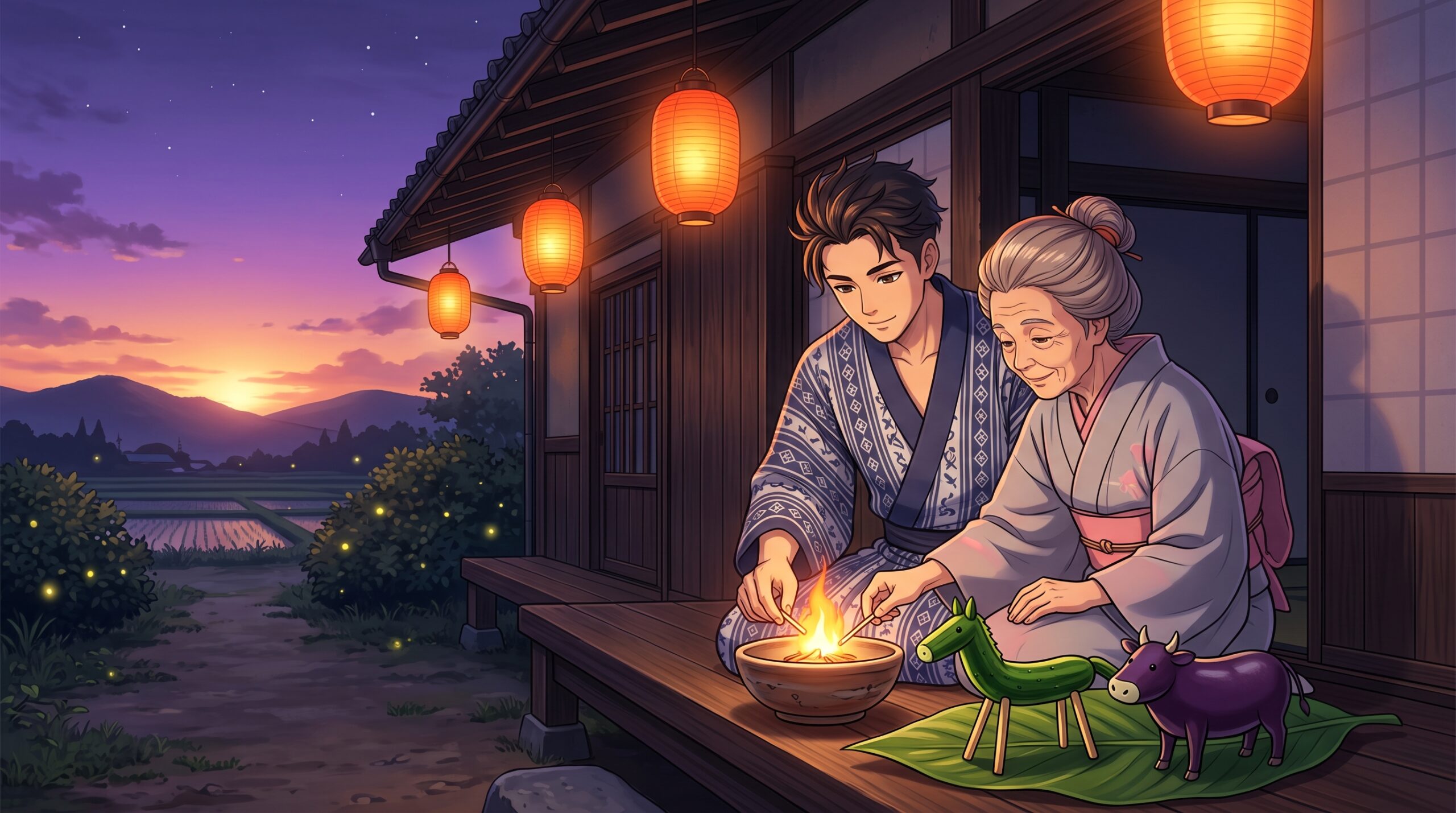
It’s dusk in a rural Japanese town, echoing with the sound of evening cicadas. On the wooden veranda (engawa), there is a slightly clumsy-looking horse made of a cucumber and a cow made of an eggplant. These are called “Shoryouma” (spirit horses). They embody a thoughtful wish: that the ancestors can ride the cucumber horse to arrive quickly, and ride the eggplant cow back to the afterlife slowly, enjoying the scenery along the way.
Haruto, a young man working in the city, had returned to his grandmother’s old house for the first time in years. On the night of August 14th, his grandmother lights a small fire at the front gate. This is the “Mukaebi” (welcoming fire). “Now, Grandpa can find his way home without getting lost,” she smiles, her profile illuminated by the small flame. In that moment, Haruto is enveloped in a mysterious sensation. Though completely invisible, a warm presence is undeniably there. He quietly realizes that he is standing at the forefront of a continuous relay of life.
The History and Deep Culture of Obon: From Ullambana to Unique Evolution
The formal name for Obon is “Urabon’e,” and its origins lie in Buddhism. It is said to have started with a legend about Maudgalyayana, a disciple of Buddha, who made offerings to monks to save his mother from suffering in the realm of hungry ghosts.
However, Obon in Japan is not merely a Buddhist event. It has deeply intertwined with Japan’s indigenous ancestor worship (the belief in respecting ancestors as sacred beings) and agricultural rituals, evolving into something entirely unique. Spirits are welcomed with a fire on August 13th, spend time with the family on the 14th and 15th, and are sent back to the afterlife with a “Sokuribi” (send-off fire) on the 16th. Kyoto’s famous “Gozan no Okuribi” (giant bonfires lit on five mountains) is one of the most spectacular forms of this send-off fire.
Rediscovering “Connection” in Japanese Culture
The core of Japanese culture to decipher from Obon is “coexistence with the dead” and “community bonds.”
In Western cultures, life and death are often distinctly separated. In Japanese culture, however, the dead do not depart to a distant, unreachable world; they remain close, returning every summer to watch over their families. This view of life and death has fostered the Japanese spirit of compassion for others and reverence for nature.
Furthermore, on the nights of Obon, “Bon Odori” (Bon dances) are held all over the country. People gather in a circle around a central wooden stage (yagura) and dance to the rhythm of taiko drums. Originally, this was a Buddhist chant dance to comfort and entertain the returning ancestral spirits. Today, it also serves as a massive summer festival where locals interact across generations, strengthening community bonds.
How Do You Feel?
The quietly burning welcoming fire, the sound of Bon Odori drums echoing in the night sky, and the dining table shared with family. In our fast-paced modern society, Japan’s Obon is a beautiful time to pause and reflect on one’s roots.
Do you have a loved one you remember with all your heart? If you ever have the chance to visit Japan during the summer, why not experience this mystical and warm Obon atmosphere for yourself and jump into the circle of the Bon Odori?
For past entries in the “What’s Today’s Special Day” series, please enjoy our previous articles here.
Reference Link: JNTO: Summer Festivals in Japan (Japan National Tourism Organization)
8月14日:お盆 — 魂が帰る日本の夏、時を超える「つながり」の物語
日本の夏は、燃えるような日差しと蝉の合唱とともにやってきます。しかし、8月の半ばを迎えると、日本列島は少しだけ神秘的で、優しい空気に包まれます。8月14日、それは「お盆(Obon)」の真っ只中。ご先祖様の魂が私たちが住むこの世界へと帰ってくる、一年で最も特別で、スピリチュアルな期間です。
今回は、ただの歴史の解説ではありません。日本の夏の風景に溶け込む一つの物語を通じて、日本人が古来より大切にしてきた「命のつながり」を深く読み解いていきます。
ある夏の夜の再会:迎え火と精霊馬
夕暮れ時、ヒグラシの鳴き声が響く日本の田舎町。縁側には、少し不格好なキュウリの馬と、ナスの牛が置かれています。これは「精霊馬(しょうりょうま)」と呼ばれるもの。ご先祖様が帰ってくるときはキュウリの馬に乗って早く到着できるように、そしてあの世へ戻るときはナスの牛に乗って景色を楽しみながらゆっくり帰れるように、という願いが込められています。
都会で働く青年・ハルトは、何年かぶりに祖母の住む古い家へ帰郷していました。8月14日の夜、祖母は家の門口で小さく火を焚きます。「迎え火(むかえび)」です。「これで、おじいちゃんも迷わずに帰ってこられるね」と微笑む祖母の横顔を照らす小さな炎。その瞬間、ハルトは不思議な感覚に包まれました。決して目には見えないけれど、確かにそこにある温かい存在。連綿と続く命のリレーの先端に自分が立っていることを、彼は静かに悟ったのです。
お盆の歴史と深い文化:盂蘭盆会から独自の進化へ
お盆の正式名称は「盂蘭盆会(うらぼんえ)」と言い、その起源は仏教にあります。釈迦の弟子であった目連尊者が、餓鬼道に落ちて苦しむ母親を救うために、僧侶たちに供物を捧げて供養したという伝説が始まりだとされています。
しかし、日本のお盆は単なる仏教行事ではありません。日本古来の「祖霊信仰(ご先祖様を神聖なものとして敬う信仰)」や農耕儀礼と深く結びつき、独自の進化を遂げました。8月13日に「迎え火」で霊を迎え、14日と15日は共に過ごし供養を行い、16日に「送り火」で再びあの世へと送り出します。京都の有名な「五山送り火(大文字焼き)」も、この送り火の壮大な形の一つです。
日本文化における「つながり」の再確認
お盆から読み解くべき日本文化の核心は、「死者との共生」と「共同体の絆」です。
西洋の文化では、生と死は明確に切り離されることが多いかもしれません。しかし、日本の文化において、死者は遠く離れた別の世界に行ってしまうのではなく、夏になればいつでも私たちの元へ帰ってきて、家族を見守ってくれる身近な存在です。この死生観が、日本人の他者を思いやる心や、自然への畏敬の念を育んできました。
また、お盆の夜には全国各地で「盆踊り(Bon Odori)」が開催されます。広場の中央に組まれたやぐらを囲み、太鼓の音に合わせて町中の人が輪になって踊ります。これは元々、帰ってきたご先祖様の霊を慰め、もてなすための念仏踊りでした。現在では、地域の人々が世代を超えて交流し、絆を深める大規模な夏のフェスティバルとしての役割も果たしています。
あなたはどう感じますか?
静かに燃える迎え火、夜空に響く盆踊りの太鼓の音、そして家族で囲む食卓。日本のお盆は、目まぐるしく過ぎる現代社会の中で、ふと立ち止まり、自分のルーツに思いを馳せるための美しい時間です。
あなたには、心を込めて思い出す大切な人はいますか?もし、夏の日本を訪れる機会があれば、この神秘的で温かいお盆の空気を肌で感じ、盆踊りの輪の中に飛び込んでみませんか?
これまでの「今日は何の日」シリーズについては、こちらから過去の記事もお楽しみいただけます。
参考リンク:JNTO: Summer Festivals in Japan (Japan National Tourism Organization)
コメント