On August 10, 708 (the first year of the Wado era), a monumental paradigm shift occurred in the history of Japan. This date marks the official issuance of the copper “Wadokaichin,” widely recognized as Japan’s first official circulating currency. From this day forward, the Japanese economic system and the values of its people underwent a dramatic evolution from a long-standing barter system to a coin-based economy guaranteed by the state.
The catalyst for this revolution was the discovery of highly pure natural copper, known as “Nikiakagane,” in the Chichibu district of Musashi Province. This copper was presented to Empress Genmei, who viewed it as a highly auspicious omen and changed the era name to “Wado” (meaning harmonious copper). Modeling the successful currency system of the Tang Dynasty in China, she ordered the minting of a unique national currency. The name Wadokaichin translates to “The Copper of Japan, the First Treasure/Coin,” serving as a metallic masterpiece that symbolized the dawn of a new era in Japan.
【Story】A Young Merchant in Fujiwara-kyo Encounters an Unknown Metal
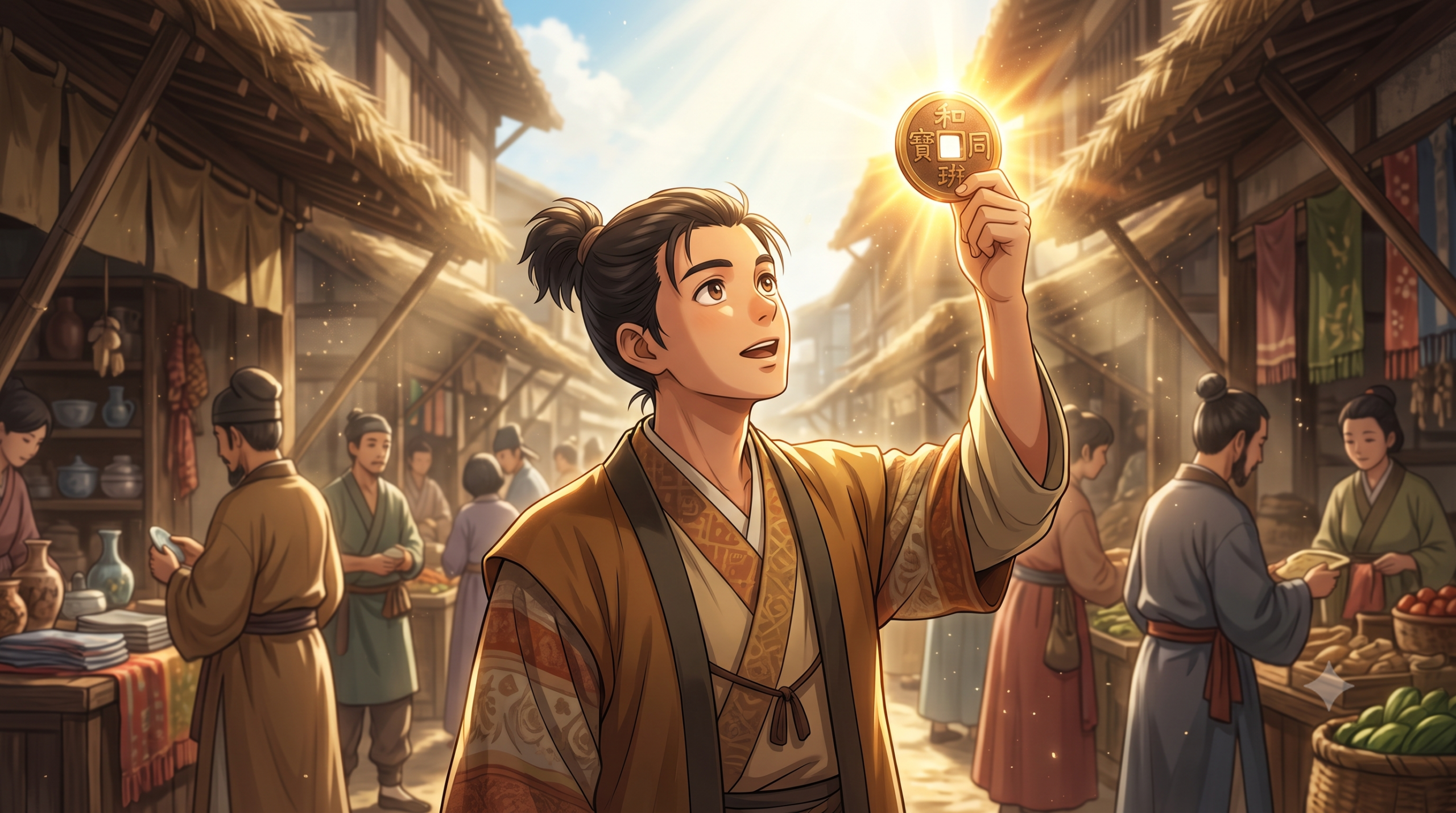
The year was 708, in the summer heat inside the massive, bustling market of the capital city, Fujiwara-kyo. In an era where bolts of hemp, salt, and sacks of rice were the absolute standard of trade, a young merchant named Kenta was negotiating an exchange for high-quality silk, a heavy sack of rice digging painfully into his shoulders. Amidst the heat of the crowd, the cries of livestock, and the smell of the earth, government officials suddenly appeared in the center of the market to make a historic proclamation.
In the official’s hand rested several small, metallic discs, shining dully yet powerfully under the strong summer sun. They featured a square hole in the center, with the four characters of “Wadokaichin” deeply engraved around it. The official declared loudly to the crowd, “From this moment forth, this copper coin represents the value decreed by the nation. This single small coin holds the exact same value as the heavy rice and cloth you struggle to carry.”
The market fell silent for a moment before erupting into a massive uproar. “How can this tiny lump of metal hold the same value as the rice we sweat and bleed to grow? You can’t even eat it!” everyone thought. Yet, Kenta timidly stepped forward and took one of the copper coins. The cold touch of the metal and the overwhelming weight of authority transferred from his palm to his very soul. He realized he no longer needed to pull heavy carts through muddy roads for days; by simply stringing these small discs and hanging them from his waist, he could carry immense wealth. In Kenta’s mind, the common sense of the past crumbled. He set his rice sack down and gripped the unknown metal tightly.
Decoding Japanese Culture through Wadokaichin: Round Heaven, Square Earth
The Wadokaichin was not merely a convenient analog tool created for shopping. It was a symbol of “state prestige,” demonstrating both domestically and internationally that Japan had matured into a centralized state with a rock-solid governance system.
The foundation of its design is the ancient Asian cosmological philosophy of “Ten’en Chihou” (Round Heaven, Square Earth). The circular outer frame represents the endlessly expanding “Heaven,” while the square hole in the center represents “Earth.” In other words, the truth of the universe and the dominion of the state were physically manifested within this small coin. A powerful message was embedded within: holding this coin was akin to holding the logic of the world.
Furthermore, the government was on the verge of constructing the massive new capital, “Heijo-kyo.” To compensate a labor force of tens of thousands, a highly portable currency guaranteed by the government was absolutely necessary. To break the habit of bartering that had lasted for thousands of years, the government enacted a groundbreaking law called the “Chikusen Joi-rei,” granting high social status to those who accumulated coins.
A Question for the Future: What Will You Choose?
From heavy sacks of rice to a single coin that fits in the palm of your hand. The issuance of Wadokaichin on August 10 was a liberation from physical weight and the genesis of believing in the invisible, abstract value of “national credit.” The confusion we feel today when transitioning to cryptocurrency perfectly mirrors the emotions of the Japanese people 1,300 years ago.
Now, I ask you: If tomorrow, the current currency system upon which you rely were to instantly switch to an entirely unknown format, would you be able to immediately believe in and accept this “new value”? Or would you cling to the familiar physical values of the past? History constantly demands change and adaptation from its people. What constitutes “true value” in your own heart?
Enjoy further exploration of Japanese history and anniversaries in the What’s Today’s Special Day Series. To verify the historical artifacts regarding Japanese currency, please refer to the official information from the Currency Museum of the Bank of Japan.
8月10日:日本の貨幣経済の夜明け「和同開珎」の発行
西暦708年(和銅元年)8月10日、日本という国の歴史において極めて重要なパラダイムシフトが起きました。日本最古の公式な流通貨幣として広く知られる「和同開珎(わどうかいちん)」の銅銭が正式に発行された日です。この日を境に、日本の経済システムと人々の価値観は、長きにわたる物々交換の時代から、国家がその価値を保証する貨幣経済へと劇的な進化を遂げることになります。
発端は、武蔵国秩父郡(現在の埼玉県秩父市)から、非常に純度が高く精錬を必要としない自然銅である「和銅(にきあかがね)」が発見され、時の元明天皇に献上されたことでした。天皇はこれを大いなる吉兆として喜び、年号を「和銅」に改元しました。そして、当時の先進国であった唐(現在の中国)の「開元通宝」という貨幣システムをモデルに、国家の基盤を確固たるものにするため、独自の貨幣の鋳造を命じたのです。和同開珎には「和(日本)の銅、開(初めての)、珎(宝・通貨)」という意味が込められており、まさに日本の新しい時代の幕開けを象徴する金属の宝でした。
【ストーリー】藤原京の若き商人、未知の金属に触れる
時は708年の夏、活気あふれる藤原京の巨大な市場。麻布や米、塩が取引の絶対的な基準であったこの時代、若き商人である健太は、いつものように重い米俵を肩に食い込ませながら、上質な絹布との交換交渉を行っていました。人々の熱気、家畜の声、そして土の匂いが混ざり合う中、突然、市場の中心に都の役人たちが現れ、ある重大な布告を行いました。
役人の手には、夏の強い太陽の光を受けて鈍く、しかし力強く輝く小さな金属の円盤が幾つも握られていました。中央には四角い穴が開き、周囲には「和同開珎」という四つの文字が深く刻まれています。役人は群衆に向かって高らかに宣言しました。「これより、この銅銭を国の定めた価値とする。この小さな銭が、お前たちが苦労して運ぶ重い米や布と同じ価値を持つのである」
市場は一瞬静まり返り、やがて大きなどよめきが起こりました。「こんな小さな金属の塊が、私たちが汗水流して育てた米と同じ価値だと?腹の足しにもならないではないか」と、誰もが疑いの目を向けました。しかし、健太は恐る恐る前に進み出て、その銅銭を一枚手に取りました。金属の冷たい感触と、これまでに感じたことのない圧倒的な権威の重みが掌から伝わってきました。重い荷車を引いて何日も泥道を歩く必要がなく、この小さな円盤を紐に通して腰に下げるだけで、莫大な富を持ち運べる。健太の心の中で、これまでの常識が音を立てて崩れ去り、新しい時代の風が吹き抜けた瞬間でした。彼は米俵を置き、その未知の金属を力強く握りしめました。
和同開珎が読み解く日本文化:天円地方の宇宙観と国家の威信
和同開珎は、単なる買い物のための便利な道具として生まれたわけではありません。これは、日本が律令制に基づく中央集権国家として成熟し、確固たる統治システムを確立したことを国内外(特に唐や新羅)に知らしめるための「国家の威信」の象徴でした。
デザインの根底にあるのは、古代のアジア全域に強い影響を与えた宇宙観である「天円地方(てんえんちほう)」の思想です。円形の外枠は果てしなく広がる「天」を、中央の四角い穴は大地である「地」を表しています。つまり、この小さな硬貨の中に、宇宙の真理と国家の支配領域が表現されているのです。硬貨を握ることは、世界の理を握ることに等しいという強烈なメッセージが込められていました。
さらに、当時の政府は巨大な新都「平城京」の建設を目前に控えていました。数万人規模の労働力に対する対価として、重い米や布ではなく、持ち運びが容易で政府が価値を保証する貨幣が絶対に必要だったのです。数千年続いた物々交換の習慣を打破するため、政府は「蓄銭叙位令(ちくせんじょいれい)」という画期的な法律を制定し、貨幣を蓄えた者に高い位階(社会的地位)を与えるという強力なインセンティブを用いました。
未来へ問いかける:あなたはどう選択するか?
重い米俵から、手のひらに収まる一枚の硬貨へ。8月10日の和同開珎発行は、物理的な重さからの解放であり、目に見えない「国家の信用」という抽象的な価値を信じることの始まりでした。現代の私たちが電子マネーや暗号資産に移行する際に感じる戸惑いは、1300年前の日本人が感じたものと本質的に同じです。
ここで、あなたに問いかけます。もし明日、あなたが依存している現在の通貨システムが、全く新しい未知の形態(例えば完全なデジタルデータや、新しい概念の価値基準)に切り替わるとしたら、あなたはその「新しい価値」をすぐさま信じ、受け入れることができますか?それとも、慣れ親しんだ過去の物理的な価値にしがみつきますか?歴史は常に人々に変化と適応を求めています。この記事を読んだ今、あなたの心の中にある「真の価値」とは何か、ぜひ考えてみてください。
日本の歴史や出来事、記念日に関するさらなる探求は、当ブログの今日は何の日シリーズにてお楽しみいただけます。また、日本の貨幣の深い歴史について、現実に展示されている史料を確認したい場合は、日本銀行金融研究所貨幣博物館の公式情報を参照してください。


コメント