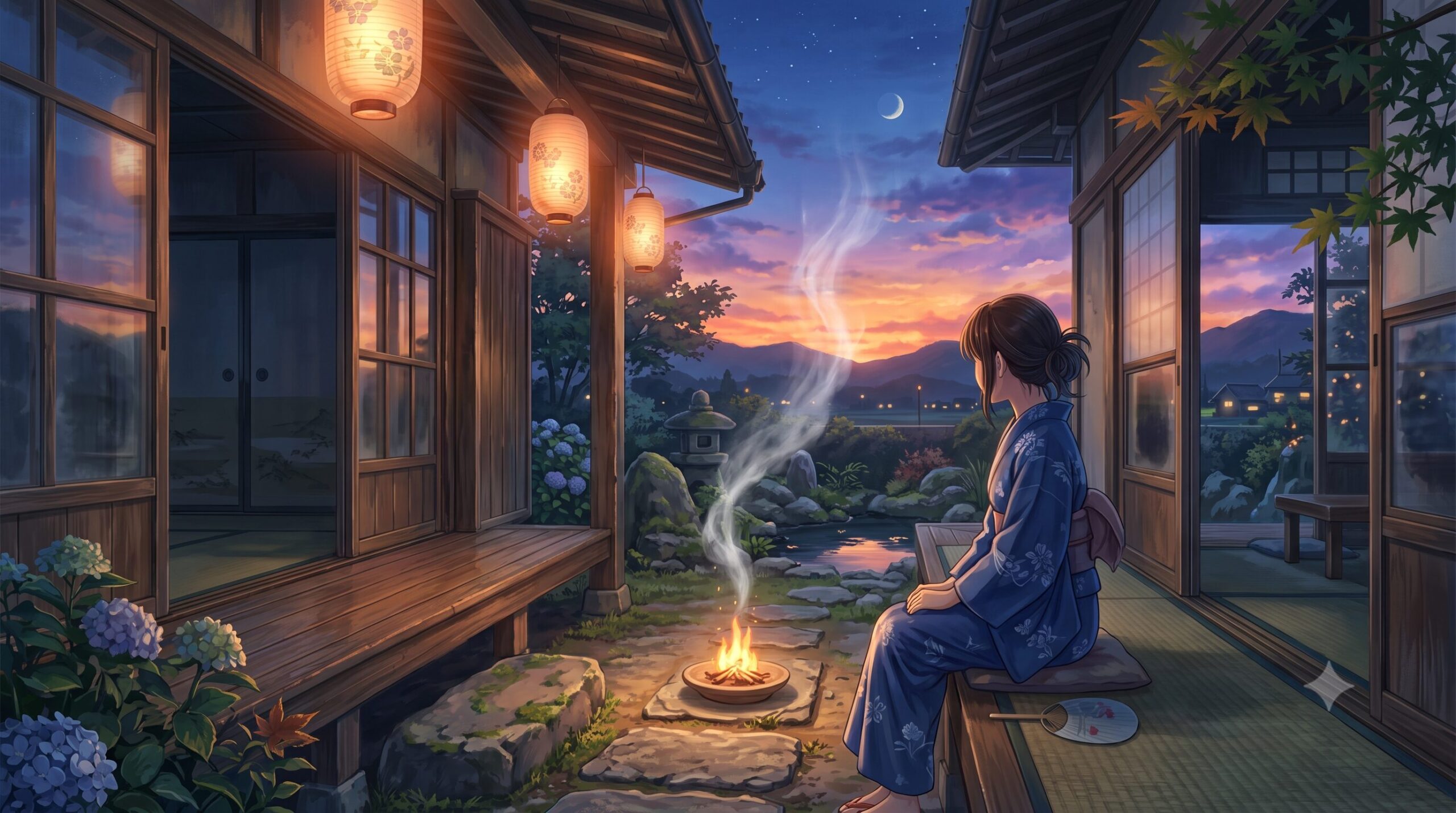
Summer in Japan is about far more than just the changing of the seasons and the intense heat. It brings with it a sacred time when the world of the living and the realm of the dead quietly intersect. July 13th marks the day of “Mukaebi” (the welcoming fire), signaling the beginning of “Obon,” one of Japan’s most profoundly traditional events. On this day at dusk, many Japanese families light a small fire in front of their homes. This fire serves as a warm and certain beacon, ensuring that ancestral spirits can find their way back to their families without getting lost in the dark.
The History and Ritual Details of Mukaebi
The origins of Obon are said to be a beautiful fusion of the Buddhist “Ullambana” festival and Japan’s ancient, indigenous ancestor worship. By the Asuka period (late 6th to early 8th century), it was already being practiced as a solemn ritual at the imperial court, and by the Edo period (17th century), it had taken deep root among the common people. Even today, it is observed from July 13th to 16th (on the solar calendar) in areas like Tokyo, and from August 13th to 16th in many other regions to align with the seasonal feel of the old lunar calendar.
Specific traditional tools are used for the Mukaebi ritual. Stripped hemp stalks, called “Ogara,” are broken into pieces, piled onto an unglazed earthen plate called a “Houroku,” and set alight. Hemp has long been regarded as a pure plant in Japan, believed to possess the power to purify spaces and ward off evil. It is said that ancestors ride the white smoke and follow the crackling sound of the burning Ogara to safely return home.
While lighting the Mukaebi and gazing at prestigious family crests, such as the “Gosan no Kiri,” painted on the hanging Bon lanterns, some people may feel a deep sense of emotion, realizing that their own lives have been continuously passed down from historic lands like Ako. All of these rituals are born from the utmost respect for the unseen and a joyful heart anticipating the spiritual reunion.
Decoding the Depths of Japanese Culture Through Mukaebi: The Continuity of Life and Death
What can be interpreted from the custom of Mukaebi is the unique Japanese view of life and death. In many Western cultures, death is often perceived as an “eternal parting” or an “irreversible severance.” However, in Japan, the relationship with the deceased does not completely end there. Ancestors are believed to return to this world during specific times, such as Obon and Higan, to spend time with their descendants before quietly returning to the afterlife.
At the core of this belief is the philosophy that life, much like the cycles of nature and the seasons, is constantly circulating and connected. Japanese people possess a deep awareness that their current existence is only possible because of countless ancestors who passed down life over generations. The small flame of the Mukaebi is nothing less than a visual representation of this unbroken chain of life, known as “En” (connection or fate). While gazing into the fire illuminating the darkness, modern Japanese people reflect on their roots and offer gratitude for their daily peace.
In a highly materialistic modern society, spiritual rituals like Mukaebi function as a crucial mechanism to remind us that we are part of a much grander flow of time. Speaking to the unseen, offering meals (known as Kagezen) as if sharing a table, and sending them off again—this series of rituals also holds Japan’s unique wisdom of grief care, helping people overcome the sorrow of losing loved ones by preserving them as warm, living memories in their hearts.
To Our Readers
In our hectic modern lives, we often forget where we came from. Yet, the Japanese Mukaebi teaches us the profound truth that the past and present are always connected, and there is always a quiet, watchful presence behind us.
I ask you this: How do you honor and remember those who lived before you, or those who deeply influenced your life but have already departed? If you could light a small fire tonight to guide a soul back to you for just one evening, who would you call upon across the flames, and what words would you share with them?
For more beautiful Japanese traditions and other commemorative days, please explore our What’s Today’s Special Day Series category. For a deeper background on the entire Obon culture in Japan, please visit Japan Guide: Obon Festival.
7月13日「迎え火」:先祖の魂を家に導く、日本独自の美しき精神世界
日本の夏は、単なる季節の移り変わりや厳しい暑さ以上の、深く神聖な意味を持っています。うだるような暑さと共にやってくるのは、生者と死者の世界が静かに交差する特別な時間です。7月13日は、日本の伝統的な行事である「お盆(Obon)」の始まりを告げる「迎え火(Mukaebi)」の日です。この日、日本の多くの家庭では、夕暮れ時になると家の前で小さな火を焚きます。この火は、迷うことなく先祖の魂が家族の元へ帰ってくるための、温かく、そして確かな「道しるべ」なのです。
迎え火の歴史と儀式の詳細
お盆の起源は、仏教の「盂蘭盆会(うらぼんえ)」と、日本古来の祖先霊信仰が美しく融合したものと言われています。飛鳥時代(6世紀後半〜8世紀初頭)にはすでに朝廷で厳かな儀式として行われており、江戸時代(17世紀)になると一般庶民の間にも広く根付きました。現在でも、東京などの一部地域では新暦の7月13日〜16日に、その他の多くの地域では旧暦の季節感に合わせた8月13日〜16日に行われています。
迎え火の儀式には、特有の伝統的な道具が使われます。「焙烙(ほうろく)」と呼ばれる素焼きの平皿の上に、「苧殻(おがら)」と呼ばれる皮を剥いだ麻の茎を折り重ねて火をつけます。麻は古くから清浄な植物とされており、空間を浄化し悪いものを祓う力があると信じられてきました。苧殻が燃える時にパチパチと鳴る音と、高く立ち上る白い煙に乗って、ご先祖様は迷わず家に帰り着くことができるとされています。
迎え火を焚きながら、軒先に吊るされた盆提灯に描かれた「五三桐(ごさんのきり)」などの格式ある家紋を見つめると、自分の命が赤穂のような歴史ある土地から脈々と受け継がれてきたことに深い感慨を覚える人もいるでしょう。これらの一連の儀式はすべて、目に見えない存在に対する最大限の敬意と、再会を喜ぶ心から生まれています。
迎え火から読み解く日本文化の深層:生と死の連続性
この「迎え火」という風習から読み解けるのは、日本人の持つ独自の「死生観」です。西洋の多くの文化において、死は「永遠の別れ」や「不可逆的な断絶」として捉えられることが多いですが、日本では死者との関係はそこで完全に途切れるわけではありません。ご先祖様は、お盆やお彼岸といった特定の時期に現世に戻り、子孫たちと共に時を過ごし、そしてまた静かにあの世へと帰っていくと考えられています。
この考え方の根底には、自然のサイクルや季節の循環と同じように、命もまた巡り、繋がり続けているという思想があります。日本人は、今自分がここに存在しているのは、何世代にもわたって命を繋いできた無数の先祖がいるからだと深く認識しています。迎え火の小さな炎は、その途切れることのない命の連鎖「縁(En)」を視覚化したものに他なりません。暗闇を照らす炎を見つめながら、現代の日本人もまた、自分のルーツに思いを馳せ、日常の平和への感謝を捧げているのです。
物質的な豊かさが極まった現代社会において、この「迎え火」のような精神的な儀式は、自分自身が大きな時の流れの一部であることを思い出させてくれる重要な装置として機能しています。見えないものに語りかけ、共に食卓を囲むように陰膳(かげぜん)を据え、そして再び送り出す。この儀式には、失われた者への悲しみを乗り越え、温かな記憶として心に留め続けるための、日本特有のグリーフケア(悲嘆の癒やし)の知恵も隠されています。
読者の皆様へ
現代の慌ただしい生活の中で、私たちはしばしば「自分がどこから来たのか」を忘れてしまいがちです。しかし、日本の迎え火が教えてくれるのは、過去と現在は常に繋がっており、私たちの背後には常に静かな見守りが存在しているという事実です。
あなたにお聞きします。あなたは、自分より前に生きた人々、あるいはあなたの人生に深い影響を与え、すでに旅立ってしまった人々を、どのように敬い、記憶に留めていますか?もし今夜、あなたが誰かの魂を導くために小さな火を灯すことができるとしたら、その火の向こう側に誰を呼び寄せ、どんな言葉を交わしたいですか?
この記事に関連する、日本の美しい伝統や他の記念日については、ぜひこちらのWhat’s Today’s Special Day Seriesのカテゴリーから探索してみてください。また、お盆という日本文化全体のさらに詳しい背景については、Japan Guide: Obon Festivalをご覧ください。
コメント