A Tale of the Mysterious “Ojii”
Long ago, deep in the mountains of Tanba, there stood a vast and magnificent estate known as the Mondaiyu Mansion. This estate had a small south gate used for daily errands and a grand east gate that was strictly reserved for highly special ceremonies and remained closed otherwise.
Serving this mansion since the era of the current master’s father, and even his grandfather, was an elderly man affectionately called “Ojii” (Grandpa). Strangely enough, no one in the estate knew exactly how old Ojii was or where he originally came from. However, Ojii possessed mysterious knowledge; he crafted secret medicines effective against injuries and continuously saved the people of the estate with his brilliant wisdom. Consequently, everyone wholeheartedly trusted and respected him as a cherished member of the family, never prying into his origins.
One night, an extraordinary event occurred. At the stroke of midnight, countless eerie yet beautiful lights known as “Kitsunebi” (foxfires) emerged in the direction of the distant mountains of Fushimi. The following morning, Ojii suddenly appeared before the master, Mondaiyu, bowing deeply. “Urgent and unavoidable business has arisen, so I must ask for my leave,” he requested. Mondaiyu and the rest of the household were profoundly shocked and desperately pleaded with him not to go. But Ojii’s resolve was as solid as a rock and completely unyielding.
The foxfires continued to appear every night until the seventh night arrived. Ojii spoke once more, “I must absolutely depart tomorrow. I have one final request. When I leave the estate, would you grant me permission to pass through the Grand East Gate?” The East Gate was an exceptionally significant portal, opened only for visiting nobles of high status or major life events like weddings and funerals. Nevertheless, as a token of immense gratitude for Ojii’s decades of devotion to the estate, Mondaiyu graciously granted this request.
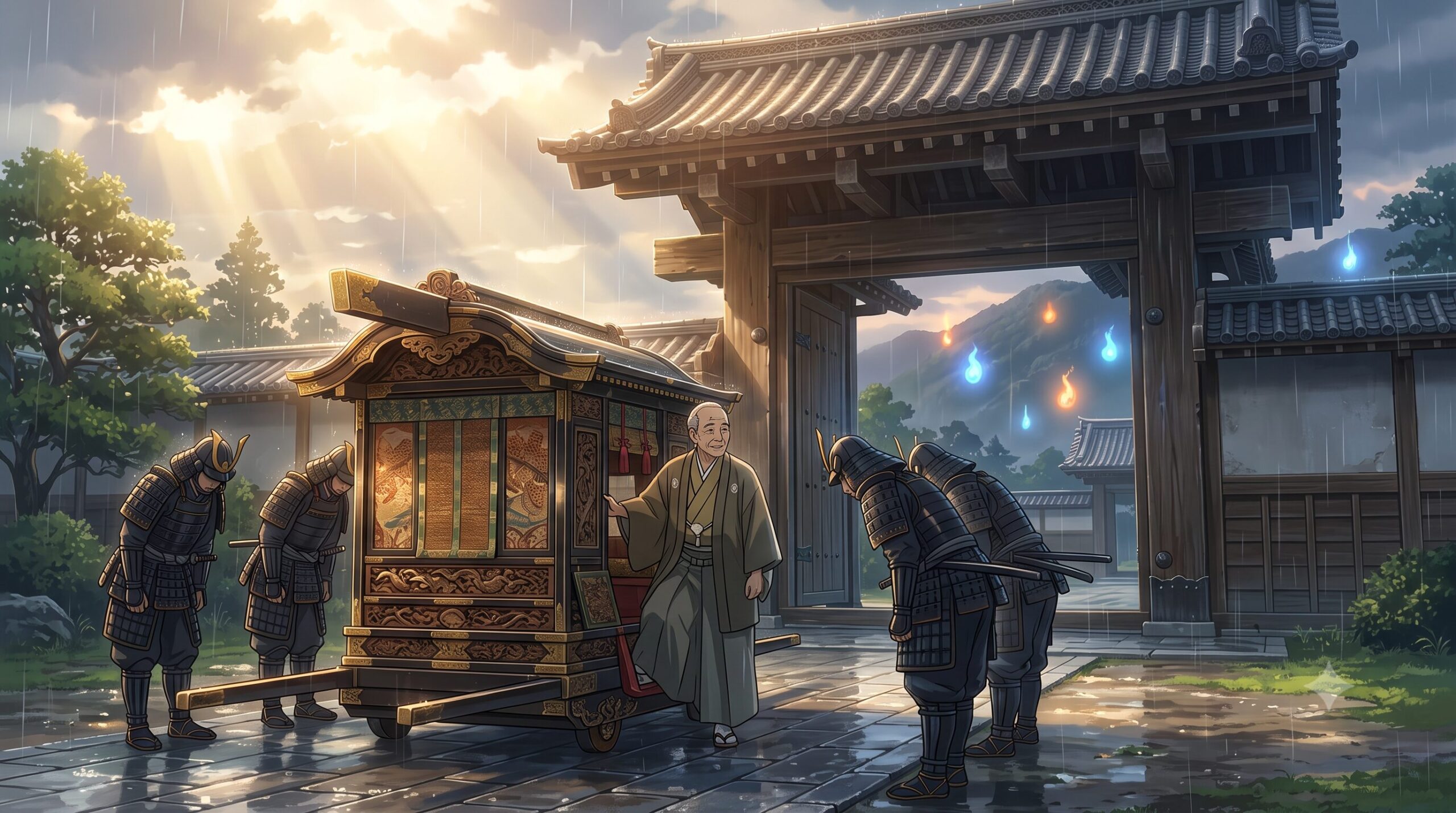
The next morning, the heavy doors of the East Gate were opened. To everyone’s sheer astonishment, a spectacularly gorgeous palanquin rested outside the gate, surrounded by a large entourage of splendidly dressed samurai bowing respectfully. While the people of the mansion stood stunned by the unbelievable sight, Ojii smiled gently and boarded the palanquin with a graceful step. Looking back at the mansion with deep fondness, he quietly departed.
As the grand procession carrying Ojii began to move, despite the clear and bright sky, rain suddenly started to patter down. This is what is known as a “sunshower.” Seeing this, the people of the mansion whispered to each other, “It’s a Kitsune-ame (fox rain).” Looking up at the sky, Mondaiyu realized something profound. “Perhaps, Ojii was actually a revered Fox deity from Fushimi, and those magnificent samurai who came to escort him were messengers of the supreme Inari god holding the highest divine rank.”
Whether Ojii was truly a divine Fushimi Fox can no longer be proven. However, legend has it that ever since that day, whenever a significant event was about to happen at the Mondaiyu Mansion, beautiful foxfires would invariably light up the distant mountains of Fushimi, watching over them.
Story Analysis: Repayment of Kindness and Love for the Human World
This story is not merely a tale of a bizarre supernatural encounter; it is a record of a deep bond forged between an otherworldly being and humans. In Japanese folktales, stories of animals or divine messengers transforming into humans to repay a debt of gratitude are common. However, the most remarkable aspect of this tale is the immense span of time “Ojii” spent remaining in the human realm, continuously helping people for generations.
Despite highly likely being an entity belonging to the extremely high divine rank of Fushimi Inari, Ojii worked tirelessly as a humble servant deep in the Tanba mountains. This might have been due to an immeasurably large debt of gratitude owed to Mondaiyu’s ancestors, or perhaps it was purely out of his love for the warm, everyday lives of humans. Being permitted to pass through the “East Gate” at the very end is the highest form of respect from humans to a divine messenger, serving as a crystallization of cross-species mutual understanding and gratitude. The ending, where he continues to watch over the mansion as foxfires, demonstrates that their parting was not an eternal severance, but rather the beginning of a transformed guardianship.
Connection to Japanese Culture: Inari Faith and Kitsune
To deeply understand this story, one must look at Japan’s “Inari Faith.” At the tens of thousands of Inari shrines across the country, foxes (Kitsune) are considered sacred as the messengers, or “Kenzoku,” of the deity (such as Ukanomitama-no-Kami). Fushimi Inari Taisha in Kyoto, in particular, is the head shrine of all Inari shrines nationwide. The appearance of foxfires in the Fushimi mountains and the arrival of splendid samurai to escort him strongly imply that Ojii was a divine messenger of exceptionally high rank.
Furthermore, the phenomenon of rain falling while the sun is shining has been called “Kitsune no Yomeiri” (The Fox’s Wedding) or “Kitsune-ame” (Fox Rain) in Japan since ancient times. Some theories suggest it is a trick played by foxes to bewitch humans, while others consider it a sign of good omens. The fact that this fox rain fell at the exact moment of Ojii’s departure is a magnificent cultural metaphor. It visually represents the mystical process of him concluding his life as a human, returning to his original sacred fox form, and ascending back to the spiritual realm. It is a true testament to how closely natural phenomena and the spiritual world are intertwined in Japan.
A Question for You
If someone who had been by your side for years, supporting you as a matter of course, turned out to be a mysterious, non-human entity, how would you feel? When the time comes for them to leave, would you be able to see them off with the utmost respect, just like Mondaiyu did? Even in our daily lives, there may be hidden entities watching over us in altered forms. What words of gratitude would you convey to such a wondrous presence?
Related Links
For actual information about Fushimi Inari Taisha, please visit their official website below.
Fushimi Inari Taisha Official Website
Please enjoy other fascinating Japanese folktales from the category below.
Japanese Folktale Series
伏見へ行ったおじいキツネ
不思議な「おじい」の物語
昔々、丹波の深い山奥に「門太夫屋敷(もんだゆうやしき)」と呼ばれる、広大で立派なお屋敷がありました。このお屋敷には、南側に普段使う小さな通用門があり、東側には特別な儀式の時にしか開かれない、壮麗な正面の御門がありました。
この門太夫屋敷には、先代、さらには先々代の当主の時代から仕え続けている「おじい」と呼ばれる一人の老人がいました。奇妙なことに、お屋敷の者たちは誰一人として、このおじいが一体何歳なのか、そしてもともとどこからやって来たのかを知りませんでした。しかし、おじいは不思議な知識を持ち、怪我に効く秘薬を作ったり、見事な知恵で屋敷の人々を何度も助けたりしていました。そのため、皆はおじいの出自を詮索することなく、心から信頼し、大切な家族の一員として敬っていました。
ある夜のことです。真夜中になると、遠く離れた伏見の山の方角に、数え切れないほどの怪しい光「狐火(きつねび)」が浮かび上がりました。そして翌朝、おじいは突然、当主の門太夫の前に進み出て、「どうしても外せない大事な用ができましたので、お暇(いとま)をいただきたい」と深く頭を下げました。門太夫をはじめ、屋敷の者たちは大変驚き、「どうか行かないでくれ」と必死に引き止めました。しかし、おじいの決意は岩のように固く、揺らぐことはありませんでした。
狐火が毎夜現れ続け、ついに7日目の夜を迎えました。おじいは「明日には必ず旅立たねばなりません。最後のお願いです。屋敷を出る際、あの東の御門を使わせてはいただけないでしょうか」と申し出ました。東の御門は、身分の高い貴人が訪れた際や、冠婚葬祭などの極めて特別な時にしか開かれない門です。しかし門太夫は、長年にわたり屋敷に多大な貢献をしてくれたおじいへの感謝の証として、この願いを快く承諾しました。
翌朝、重い音を立てて東の御門が開かれました。すると驚くべきことに、門の外には絢爛豪華な駕籠(かご)が置かれ、立派な身なりをした大勢の侍たちが平伏して控えていたのです。屋敷の者たちが信じられない光景に呆然とする中、おじいは静かに微笑み、悠然とした足取りで駕籠に乗り込みました。そして、名残惜しそうに屋敷を振り返りながら、静かに出発していきました。
おじいを乗せた大行列が動き出すと、空は明るく晴れ渡っているのにも関わらず、突然パラパラと雨が降り出しました。いわゆる「天気雨」です。これを見た屋敷の者たちは口々に「キツネ雨じゃ」と囁き合いました。門太夫は空を見上げ、「もしかすると、おじいは伏見のお狐様であり、迎えに来たあの立派な侍たちは、従一位(じゅいちい)という最高位を持つ稲荷様のお使いだったのかもしれない」と深く悟りました。
おじいが本当に伏見のお狐様だったのか、今となっては確かめる術はありません。しかしそれ以来、門太夫屋敷で何か重要な出来事が起こるたびに、決まって伏見方面の山に沢山の狐火が美しく灯るようになったと伝えられています。
物語の考察:恩返しと人間界への愛情
この物語は、単なる不思議な体験談ではなく、異界の存在と人間との間に結ばれた深い絆の記録です。日本の昔話において、動物や神仏の使いが人間に化けて恩返しをする物語は数多く存在しますが、このお話の特筆すべき点は「おじいが数代にわたって人間界に留まり、日常的に人々を助け続けていた」という長大な時間にあります。
おじいは伏見稲荷という極めて高い神格に属する存在であった可能性が高いにも関わらず、丹波の山奥で一介の使用人として身を粉にして働いていました。これは、過去に門太夫屋敷の先祖から受けた恩義がそれほどまでに大きかったのか、あるいは純粋に人間たちの温かな暮らしを愛していたからなのかもしれません。最後に「東の御門」を通ることを許されたのは、人間側から神の使いへの最大級の敬意であり、種族を超えた相互理解と感謝の結晶と言えます。狐火となって屋敷を見守り続ける結末は、別れが永遠の断絶ではなく、形を変えた守護の始まりであることを示しています。
日本文化との関連:稲荷信仰とキツネ
この物語を深く理解する上で欠かせないのが、日本の「稲荷(いなり)信仰」です。全国に数万社あるとされる稲荷神社において、キツネは神様(宇迦之御魂神など)の使い、すなわち「眷属(けんぞく)」として神聖視されています。特に、京都の伏見稲荷大社は全国の稲荷神社の総本宮であり、物語の中で伏見の山に狐火が見えたこと、そして立派な侍がお迎えに来たことは、おじいが非常に位の高い神使(しんし)であったことを暗示しています。
また、晴れているのに雨が降る現象を、日本では古くから「狐の嫁入り(キツネ雨)」と呼びます。キツネが人間を化かすための術であるという説や、吉兆のサインであるという説があります。おじいが旅立つ瞬間にこのキツネ雨が降ったことは、彼が人間としての生を終え、本来の神聖なキツネの姿へと戻り、霊界へと帰還していく神秘的なプロセスを視覚的に表現した見事な文化的暗喩です。日本の自然現象と精神世界が密接に結びついている証左でもあります。
あなたへの問いかけ
長年当たり前のようにそばにいて、あなたを支えてくれた人が、実は人間ではない神秘的な存在だったとしたら、あなたはどう感じますか?彼らが去り行く時、門太夫のように最高の敬意を払って見送ることができるでしょうか。私たちの日常の中にも、姿を変えて私たちを見守ってくれている存在が隠れているかもしれません。あなたなら、そんな不思議な存在にどのような感謝の言葉を伝えますか?
関連リンク
伏見稲荷大社についての実際の情報は、以下の公式ページをご覧ください。
伏見稲荷大社 公式サイト
その他の魅力的な日本の昔話については、以下のカテゴリーからお楽しみください。
Japanese Folktale Series

コメント