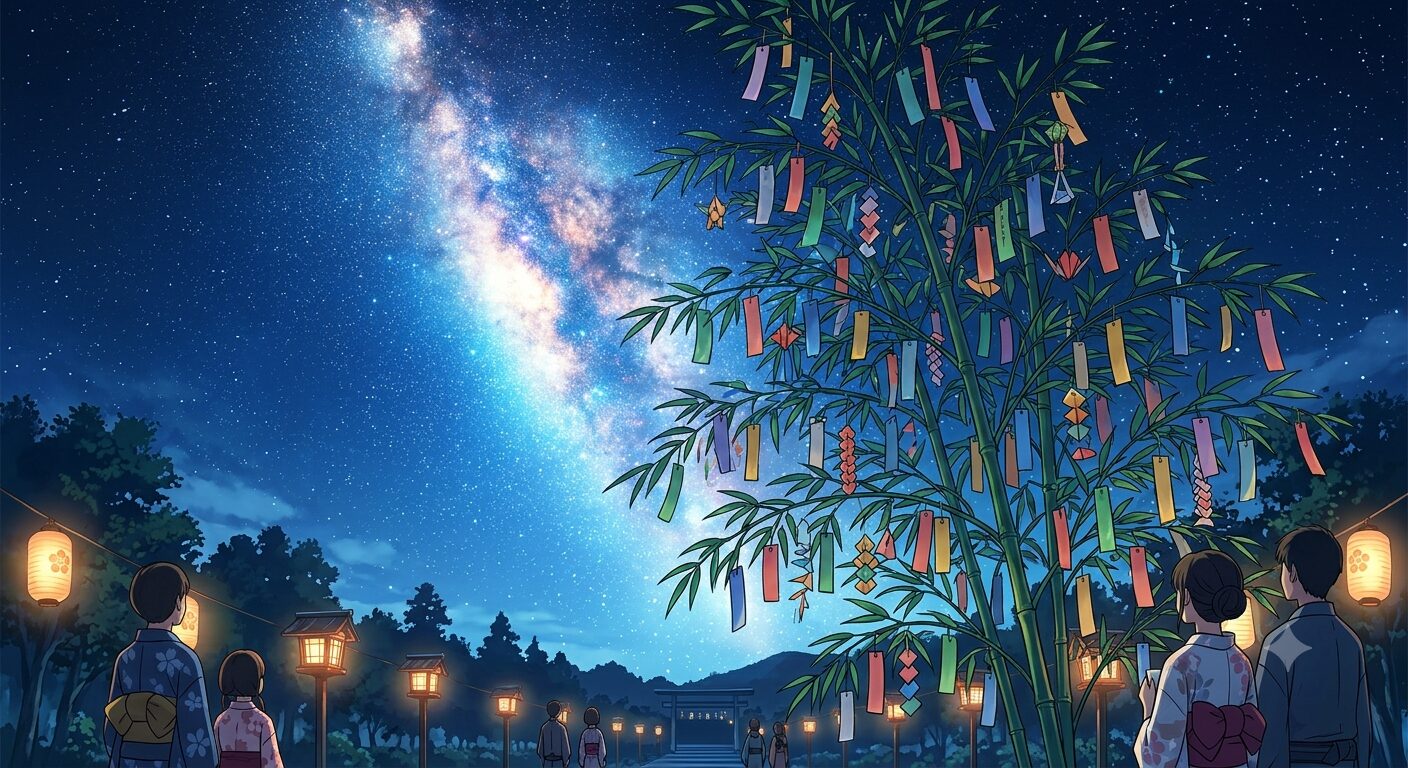
Every year on July 7th, the summer night sky in Japan is enveloped in a special kind of magic. On city streets, at train stations, in schools, and under the eaves of homes, bamboo branches decorated with vibrant strips of paper called Tanzaku and delicate ornaments sway in the wind, creating a cool, refreshing rustle. This day is known as “Tanabata,” or the Star Festival, a beautiful and poignant traditional event that has been celebrated in Japan for centuries.
When peering into the depths of Japanese culture, there is perhaps no other day that so perfectly blends romanticism, reverence for nature, and the pure wishes of the people. How did this special day come to be, and why does it hold such profound meaning for Japanese people today? Let’s unravel the history and cultural background of Tanabata.
The Star-Crossed Lovers: The Legend of Orihime and Hikoboshi
The most famous aspect of Tanabata is the story of two stars separated by the Milky Way. Orihime (representing the star Vega in the constellation Lyra) was a hardworking weaver princess who crafted beautiful cloth for the gods. Hikoboshi (representing Altair in the constellation Aquila) was an earnest and diligent cowherd.
Seeing their dedication, the God of the Heavens (Orihime’s father) introduced them. They fell deeply in love and married. However, their love for each other was so all-consuming that they began to neglect their duties. The loom gathered dust, and the cows wandered aimlessly across the heavens. Enraged by this, the God of the Heavens punished them by separating them on the eastern and western banks of the Milky Way.
Seeing Orihime in endless sorrow, her father took pity and allowed them to reunite just once a year, on the night of July 7th, on the condition that they worked hard the rest of the year. It is said that if it rains on this day, the waters of the Milky Way rise, making it impossible to cross. When this happens, a flock of magpies flies in and spreads their wings to form a bridge for the lovers. This bittersweet love story continues to touch the hearts of the Japanese people today.
Historical Background: The Fusion of Chinese “Qixi” and Japanese “Tanabata-tsume”
The roots of Tanabata do not stem from a single origin. It is a brilliant fusion of the Chinese Qixi festival, introduced during the Nara period (710–794), and ancient Japanese Shinto beliefs.
In China, Qixi was a court event where people prayed to the Weaver Star for improvement in weaving, sewing, calligraphy, and poetry. When this custom reached Japan, it merged with the Shinto legend of Tanabata-tsume. A Tanabata-tsume was a chosen maiden who secluded herself in a weaving hut by the water to weave garments for the gods, praying for a bountiful autumn harvest. Because this sacred purification ritual took place on the 7th day of the 7th month, the unique Japanese reading of “Tanabata” was born.
By the Heian period (794–1185), aristocrats held elegant banquets, gazing at the stars, writing poetry, and placing their wishes on paper mulberry leaves. During the Edo period (1603–1868), with the spread of Terakoya (commoner schools), children began writing their wishes on paper strips to pray for better handwriting, completing the prototype of the modern Tanabata festival.
The Profound Meaning of Bamboo and the Five Colors of Tanzaku
Bamboo grass and five-colored Tanzaku are indispensable to Tanabata. But why bamboo instead of any other tree?
In traditional Japanese animism (the belief that spirits reside in all things), bamboo is considered highly sacred. Surviving the harsh winter cold and growing straight upward toward the sky at an astonishing speed, bamboo symbolizes vitality and acts as a Yorishiro—a conduit for divine spirits to descend to earth. The rustling sound of the bamboo leaves in the wind has long been believed to beckon the gods.
The Tanzaku tied to the branches are traditionally limited to five colors: Blue (Green), Red, Yellow, White, and Black (Purple). This is based on the ancient Chinese philosophy of the Five Elements (Wood, Fire, Earth, Metal, Water). Each color carries a specific meaning; for instance, blue represents virtue, red represents gratitude, and yellow represents sincerity. By choosing the color that best matched their desire, people offered their prayers in harmony with the laws of the universe.
Traditional Food: Somen Noodles Resembling the Milky Way
Japanese festivals are always accompanied by traditional culinary culture, and on Tanabata, it is customary to eat Somen. Somen are extremely thin wheat noodles served cold with a dipping sauce.
There are several reasons for this, but the most romantic interpretation is that the long, thin, white noodles resemble the Milky Way or the delicate threads woven by Orihime. In the heat and humidity of the Japanese summer, cold, smooth Somen was also the wisdom of ancestors praying for good health. By topping the noodles with star-shaped okra and thinly sliced egg crepes (Kinshi-tamago), a beautiful starry sky is recreated right on the dining table.
Understanding the Essence of Japanese Culture Through Tanabata
Through Tanabata, we can deeply understand Japan’s unique aesthetic sense and philosophy.
First is the spirit of Mono no aware (the pathos of things). The fleeting nature of a rendezvous that happens only once a year, and the fragile fate that a single rainy night could force them to wait another year. Since ancient times, the Japanese have been more moved by momentary beauty and ephemerality than by eternity. Just as they admire the falling cherry blossoms, they find immense beauty in the fleeting reunion of Orihime and Hikoboshi.
Second is the harmony between individual desires and the community. During Tanabata, massive bamboo decorations are set up in public spaces like train stations and shopping arcades. The sight of countless personal wishes from strangers gathered on a single tree, swaying together in the wind, is a microcosm of Japanese society—respecting the individual while prioritizing a beautiful collective harmony (the spirit of Wa).
What is Your Wish?
Tanabata is a precious day to look up at the starry sky and face your own heart. In our busy modern society, taking a moment to pause, gaze upward, and ask yourself, “What is my true wish?” is incredibly valuable.
If there were a beautiful bamboo branch and a single Tanzaku right in front of you tonight, what would you wish for? Would it be for your personal growth? The health of your loved ones? Or perhaps for peace for all the people of the world?
How did you feel after reading about Japan’s Tanabata culture? Does your country have a similar tradition of wishing upon a star? Please share your thoughts—and your wishes—in the comments below!
Reference Links
- Internal Link: Explore more in the “What’s Today’s Special Day?” Series
- External Link: Wikipedia: Tanabata
- External Link: Sendai Tanabata Festival Official Site
- The Star-Crossed Lovers: The Legend of Orihime and Hikoboshi
- Historical Background: The Fusion of Chinese “Qixi” and Japanese “Tanabata-tsume”
- The Profound Meaning of Bamboo and the Five Colors of Tanzaku
- Traditional Food: Somen Noodles Resembling the Milky Way
- Understanding the Essence of Japanese Culture Through Tanabata
- What is Your Wish?
- 7月7日「七夕」:星に願いを託す、日本で最もロマンチックな夏の夜
7月7日「七夕」:星に願いを託す、日本で最もロマンチックな夏の夜
毎年7月7日、日本の夏の夜空は特別な魔法に包まれます。街中や駅、学校、そして各家庭の軒先には、色鮮やかな短冊(たんざく)や飾りが結びつけられた笹の葉が風に揺れ、涼しげな音を響かせます。この日は「七夕(Tanabata)」、別名「星祭り(Star Festival)」と呼ばれる、日本に古くから伝わる美しくも切ない伝統行事の日です。
日本文化の深淵を覗くとき、七夕ほどロマンチシズムと自然への畏敬、そして人々の純粋な願いが見事に融合した日はありません。この特別な日がどのようにして生まれ、なぜ現代の日本人にとってもこれほどまでに重要な意味を持っているのか。その歴史と文化的な背景を紐解いていきましょう。
天空の恋人たち:織姫と彦星の伝説
七夕の最も有名な側面は、天の川(The Milky Way)を隔てて引き離された二人の星の物語です。琴座のベガ(Vega)にあたる「織姫(Orihime)」は、神々のために美しい布を織る働き者の機織り娘でした。鷲座のアルタイル(Altair)にあたる「彦星(Hikoboshi)」は、熱心に牛の世話をする真面目な牛飼いでした。
二人の働きぶりを見た天の神(織姫の父)は、二人を引き合わせ、彼らは恋に落ちて結婚しました。しかし、二人は愛し合うあまり、互いの仕事をおろそかにするようになってしまいます。機織り機は埃をかぶり、牛たちは天界をさまようようになりました。これに激怒した天の神は、二人を天の川の東と西に引き離すという罰を与えました。
悲しみに暮れる織姫を見た天の神は哀れに思い、二人が真面目に働くことを条件に、1年にたった1度、7月7日の夜だけ再会することを許しました。もしこの日に雨が降ると、天の川の水かさが増して川を渡ることができなくなるため、カササギという鳥が飛んできて翼を広げ、二人のための橋を架けてくれると言われています。この切ないラブストーリーは、今もなお日本人の心を打ち続けています。
歴史的背景:中国の「乞巧奠」と日本の「棚機」の融合
七夕のルーツは、一つの起源に留まりません。奈良時代(710年〜794年)に中国から伝わった「乞巧奠(Kikkoden)」という行事が、日本古来の信仰と見事に結びついたものです。
乞巧奠とは、織女星(織姫)にあやかり、機織りや裁縫、さらには書道や詩歌などの技芸の上達を星に祈る中国の宮中行事でした。これが日本に伝わると、日本の神道における「棚機津女(Tanabata-tsume)」の伝説と融合します。棚機津女とは、神々の衣服を織るために水辺の機屋(はたや)にこもり、神を迎え入れて秋の豊作を祈る乙女のことです。この神聖な儀式が行われていたのが7月7日であったため、「七夕」と書いて「たなばた」と発音する独自の文化が形成されました。
平安時代(794年〜1185年)になると、貴族たちは星を眺めながら詩歌を詠み、梶の葉(サトイモ科の植物)に願い事を書く優雅な宴を催すようになります。そして江戸時代(1603年〜1868年)には、寺子屋(当時の庶民の学校)の普及により、子どもたちが習字の上達を願って紙の短冊に文字を書くようになり、現在の七夕の原型が完成しました。
笹と五色の短冊に込められた深い意味
七夕に欠かせないのが「笹(竹)」と「五色の短冊」です。なぜ他の木ではなく、笹なのでしょうか?
日本の伝統的なアニミズム(万物に神が宿るという思想)において、竹や笹は非常に神聖な植物とされています。冬の寒さにも負けず、空に向かってまっすぐに、そして驚異的なスピードで成長する竹は「生命力」と「天の神霊が降り立つ依代(よりしろ)」の象徴です。笹の葉が風に揺れて擦れ合う音は、神々を招き寄せると信じられてきました。
笹に飾る短冊は「青(緑)、赤、黄、白、黒(紫)」の5色と決まっています。これは古代中国の「陰陽五行説(Wood, Fire, Earth, Metal, Water)」に基づいています。それぞれの色には意味があり、例えば青は「徳」、赤は「感謝」、黄は「誠実」などを表します。人々は自らの願いに最も適した色の短冊を選び、そこに願いをしたためることで、宇宙の法則と調和しながら祈りを捧げていたのです。
七夕の行事食:天の川に見立てた「そうめん」
日本の祭りには必ず伝統的な食文化が伴いますが、七夕の日は「そうめん(Somen)」を食べるのが一般的です。そうめんは小麦粉で作られた非常に細い麺で、冷たいつゆにつけて食べます。
そうめんを食べる理由はいくつかありますが、最もロマンチックな解釈は、その白く細い麺を「天の川」や「織姫の織りなす糸」に見立てているというものです。暑い日本の夏において、冷たくて喉越しの良いそうめんは、無病息災を願う先人たちの知恵でもありました。星型のオクラや、薄焼き卵を細く切った錦糸卵(きんしたまご)をトッピングすることで、食卓の上にも美しい星空を再現するのです。
七夕から読み解く日本文化の神髄
七夕を通して、私たちは日本特有の美意識や哲学を深く理解することができます。
第一に、「もののあわれ(Mono no aware)」の精神です。1年にたった1度の逢瀬という儚さ、そしてもし雨が降れば来年まで待たなければならないという運命の脆さ。日本人は古くから、永遠に続くものよりも、一瞬の美しさや儚さに心を打たれてきました。桜の散る姿を愛でるのと同じように、織姫と彦星の儚い再会に美しさを見出しているのです。
第二に、個人の願いとコミュニティの調和です。七夕の笹飾りは、駅やショッピングモール、商店街など、公共の場に巨大なものが設置されます。見知らぬ人々の個人的な願い事がひとつの笹に集まり、風に揺れる様は、個を尊重しつつも全体としての美しい調和(和の精神)を大切にする日本社会の縮図とも言えます。
あなたの願いは何ですか?
七夕は、星空を見上げ、自分自身の心と向き合うための大切な日です。忙しい現代社会において、立ち止まって空を見上げ、「自分の本当の願いは何か」を問いかける時間は非常に貴重です。
もし今夜、あなたの目の前に美しい笹の葉と一枚の短冊があったら、あなたは何を願いますか? 自分自身の成長でしょうか。大切な人の健康でしょうか。それとも、世界中の人々が平和に暮らせることでしょうか。
この記事を読んで、日本の七夕文化についてどう思いましたか? あなたの国には、星に願いをかけるような似た文化はありますか? ぜひ、あなたの願い事と一緒に、コメント欄で教えてください。
コメント