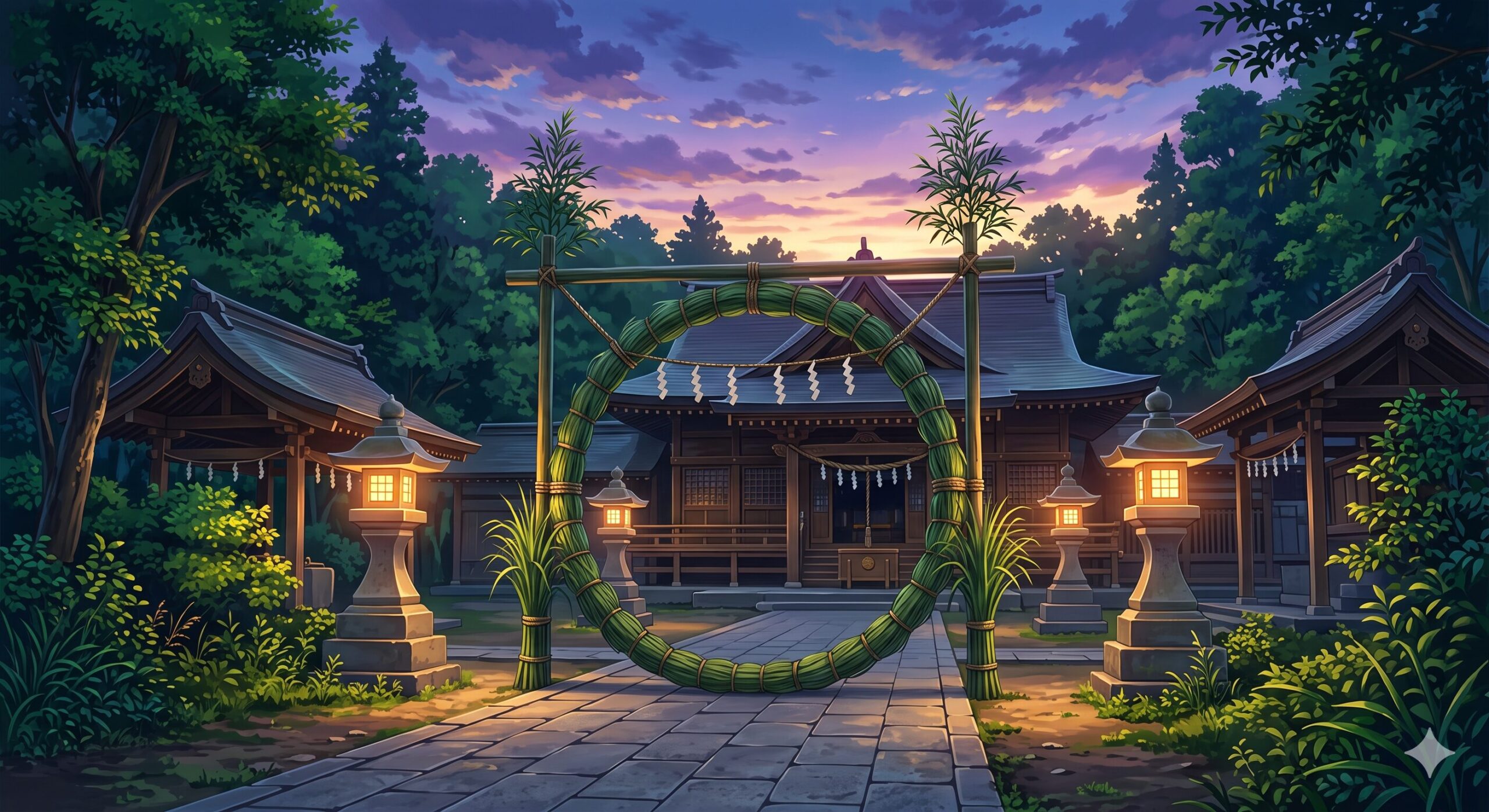
June 30th marks exactly halfway through the year. On this day, a deeply significant Shinto ritual known as “Nagoshi no Oharae” (Summer Purification Rite) is held throughout Japan. Practiced at shrines across the country, this ceremony is far more than a simple religious observance; it is a beautiful reflection of the Japanese spiritual connection to nature and the concept of purity.
The History of Oharae and the Concept of “Kegare”
In Japanese Shintoism, human beings are believed to be inherently pure. However, simply by living our daily lives, we unknowingly accumulate “Tsumi” (sins or transgressions) and “Kegare” (impurities). In this context, “Kegare” does not mean physical dirt. It translates more closely to “withered spirit,” encompassing negative emotions, stress, and misfortune.
The origins of this purification ritual date back to ancient Japanese mythology. According to the Kojiki and Nihon Shoki (the oldest historical records of Japan), the deity Izanagi cleansed himself in a river after returning from the underworld—a practice known as “Misogi.” By the Heian period, Oharae had become a formal imperial court ceremony designed to ward off national disasters. Paired with the year-end purification on December 31st, the June 30th Nagoshi no Oharae is dedicated to washing away the impurities of the first six months and praying for safe passage through the harsh, disease-prone summer months.
Chinowa Kuguri and the Ritual of Katashiro
The most iconic visual of Nagoshi no Oharae is “Chinowa Kuguri.” A massive ring woven from cogongrass (chigaya) is erected at the shrine’s entrance or torii gate. Visitors pass through this ring in a specific figure-eight pattern—left, right, then left again—chanting ancient poems. Cogongrass has long been believed to possess strong power to ward off evil spirits. By stepping through the ring, one’s mind and body are thoroughly cleansed.
Another fascinating practice involves “Katashiro,” small traditional paper dolls cut into the shape of a human. You write your name and age on the paper, gently rub it over your body, and blow on it three times. This act transfers your accumulated “Kegare” onto the paper doll. The shrine then burns or floats the dolls down a river, completely carrying away your misfortunes.
The “Minazuki” Sweet and the Depths of Japanese Culture
Particularly in Kyoto and the broader Kansai region, it is customary to eat a traditional sweet called “Minazuki” on this day. It consists of a white, chewy uirow base topped with red azuki beans, which are believed to ward off evil. The triangular shape is not random; it mimics the precious ice blocks that only the imperial court could afford to eat during ancient summers. Commoners, unable to obtain real ice, created this sweet to visually simulate the cooling effect and pray for good health. It is a perfect example of Japanese aesthetic sensibility and wisdom.
What we can learn from Nagoshi no Oharae is the unique Japanese mental framework of “resetting.” Rather than dwelling on past mistakes or lingering bad luck, the culture emphasizes the importance of purifying oneself at specific seasonal milestones and stepping into the future with a renewed spirit. Aligning oneself with the cycles of nature to maintain a constant state of freshness (Tokowaka) is a mindset highly applicable to our modern, stressful lives.
What Are Your Thoughts?
Nagoshi no Oharae serves as a mid-year spiritual deep-cleanse. How do you reset and let go of the mental fatigue and burdens you’ve accumulated over the past six months? I would love to hear about the purification customs in your culture, or how you personally refresh your mind and spirit.
[Related Links]
External Reference: Jinja Honcho (Association of Shinto Shrines)
Internal Link: Explore more in our “Today’s Special Day” series
6月30日は「夏越の大祓」:日本の夏を告げる魂の浄化儀式
1年の半分が過ぎる6月30日。日本では古来より、この日に「夏越の大祓(なごしのおおはらえ)」という極めて重要な神事が行われてきました。全国各地の神社で行われるこの儀式は、単なる宗教行事にとどまらず、日本人の自然観と精神性を色濃く反映した美しい文化です。
夏越の大祓の歴史と「穢れ」の概念
日本の神道において、人間は本来清らかな存在であると考えられています。しかし、日常生活を送る中で、知らず知らずのうちに「罪(つみ)」や「穢れ(けがれ)」が身に降りかかるとされています。ここで言う「穢れ」とは、物理的な汚れのことではなく、「気枯れ(生命力が枯渇した状態)」や、ネガティブな感情、不運などを指します。
古代の神話、日本書紀や古事記において、伊邪那岐命(いざなぎのみこと)が黄泉の国から戻った際に、川の水で自らを清めた「禊(みそぎ)」が、この大祓の起源とされています。平安時代には、宮中行事として定着し、国の災厄を払う重要な儀式となりました。12月31日の「年越の大祓」と対をなし、6月30日の「夏越の大祓」は、前半の半年の穢れを落とし、猛暑や疫病が広がりやすい厳しい夏を無事に乗り切るための祈りが込められています。
茅の輪くぐりと形代(かたしろ)の儀式
夏越の大祓の最も象徴的な光景が「茅の輪(ちのわ)くぐり」です。神社の鳥居や境内に、チガヤという草で編まれた巨大な輪が設置されます。参拝者は、この輪を「水無月の 夏越の祓 する人は 千歳の命 のぶというなり」という古歌を唱えながら、左、右、左と8の字を描くように3回くぐり抜けます。チガヤには古くから邪気を払う強い力があると信じられており、この輪をくぐることで心身が浄化されるのです。
また、「形代(かたしろ)」または「撫物(なでもの)」と呼ばれる、人の形に切り抜かれた和紙を使った儀式も行われます。自分の名前と年齢を書き、その紙で全身を撫で、最後に息を3回吹きかけます。これにより、自身の穢れを形代に移し、神社でお焚き上げや川流しをしてもらうことで、完全に厄を落とすという仕組みです。
和菓子「水無月」と日本文化の深層
京都を中心とする関西地方では、この日に「水無月(みなづき)」という和菓子を食べる風習があります。白い外郎(ういろう)の上に、邪気を払うとされる赤い小豆が乗せられたお菓子です。三角形の形は、古代の宮中で夏に食べられていた貴重な「氷」を模しています。氷を手に入れることができなかった庶民が、氷の形をしたお菓子を食べることで涼を取り、無病息災を祈ったという、日本人の繊細な知恵と美意識が詰まっています。
夏越の大祓から読み解くことができるのは、「リセットする」という日本特有の精神文化です。過去の過ちや不運にいつまでも囚われるのではなく、節目ごとに心身を清め、新たな気持ちで明日へ向かう。自然のサイクルに自分自身を合わせ、常に「清らかな状態(常若・とこわか)」を保とうとする姿勢は、現代のストレス社会においても非常に有効なマインドセットです。
あなたはどう感じましたか?
1年の折り返し地点で、心と体の大掃除をする「夏越の大祓」。あなたは、この半年間に溜まった心の疲れや重荷を、どのようにリセットしていますか?もしよければ、あなたの国や文化にある「心身を浄化する習慣」や、個人的なリフレッシュ方法を教えてください。
【関連リンク】
外部参考リンク:神社本庁(日本の神道や祭祀に関する公式情報)
内部リンク:今日は何の日シリーズの他の記事を読む
コメント