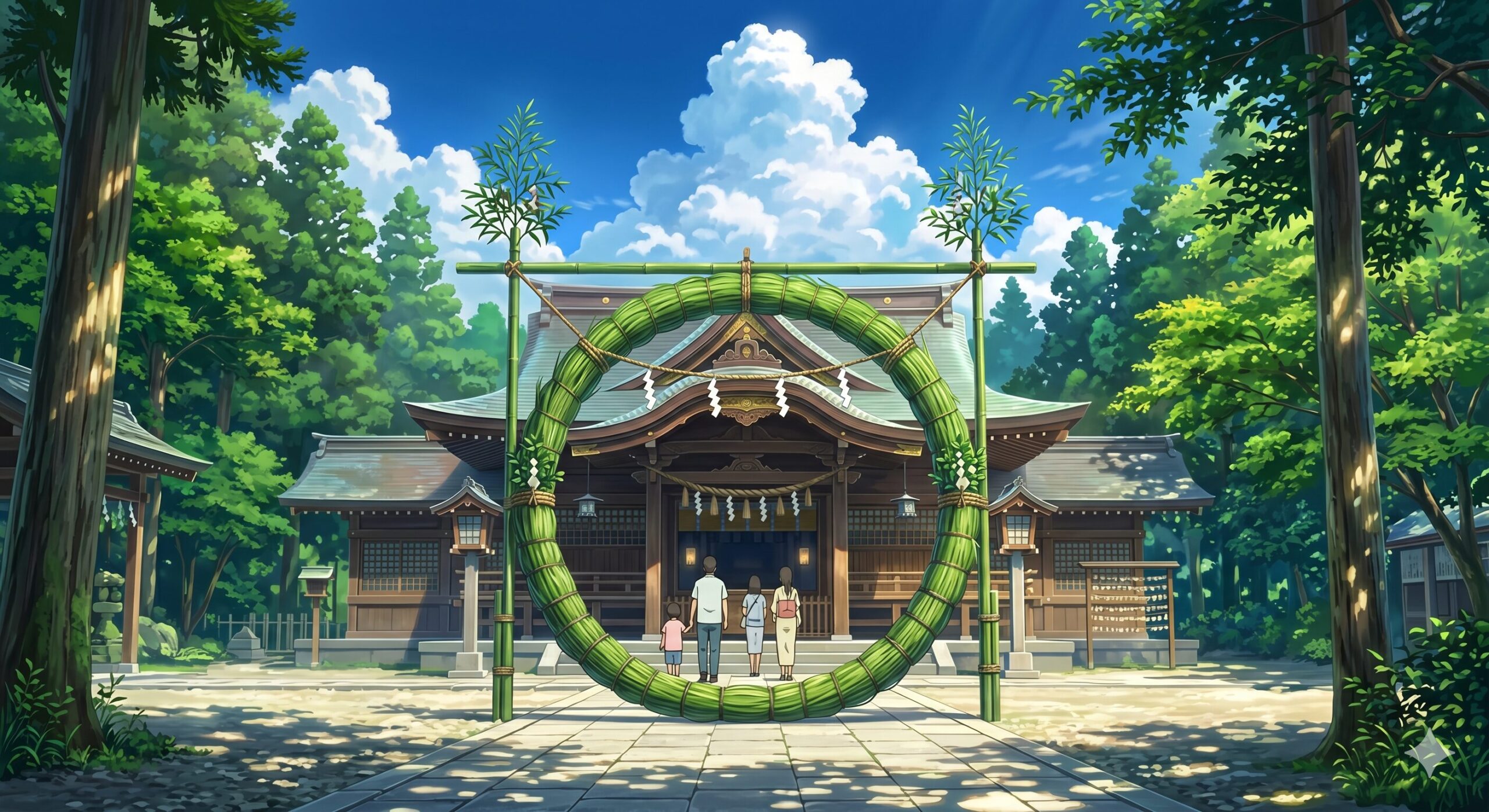
Around June 25th, large, lush green rings begin to appear in the precincts of many Shinto shrines across Japan. This ring is called a “Chinowa,” and its installation is a crucial preparation for the “Nagoshi no Harae” (Summer Purification Rite) held on June 30th. During this season, where the humidity of the rainy season meets the heat of early summer, Japanese people have traditionally passed through this ring to pray for the purification of their minds and bodies.
What is Chinowa Kuguri? Its History and Origins
“Chinowa Kuguri” is a sacred ritual that involves walking through a massive ring woven from cogongrass (chigaya), a highly resilient plant. The roots of this ceremony trace back to the legend of “Somin Shorai,” recorded in the Bingo Fudoki, one of Japan’s oldest historical texts.
According to legend, when a deity (Susanoo-no-Mikoto) was seeking lodging during his travels, the wealthy Kotan Shorai refused him. However, the poor but kind-hearted Somin Shorai welcomed the deity, weaving a mat from millet stalks and offering warm hospitality. Years later, the deity returned to Somin Shorai and instructed him: “If a plague breaks out, wear a woven ring of cogongrass around your waist.” It is said that only Somin Shorai’s family, who followed this teaching, escaped a terrible plague and were promised prosperous descendants.
Over the centuries, the small ring worn around the waist evolved into the giant, human-sized rings seen today. The sight of Shinto priests gathering fresh cogongrass and carefully weaving the rings from around June 25th is a beautiful, seasonal tradition that heralds the arrival of full-blown summer and the preparation for warding off misfortune.
Understanding the Spirit of “Kegare” and “Harae” in Japanese Culture
The core of Japanese culture to be deciphered from this event is the concept of “Kegare” (impurity) and “Harae” (purification). In Japanese Shinto, sins, mistakes, illnesses, and disasters are not seen as absolute “evil,” but rather as “Kegare” (literally, the withering of the spirit)—a state where one’s life force is depleted and energy is stagnant.
From January 1st over the course of six months, people unknowingly accumulate this “Kegare” in their daily lives. Resetting this at the half-year mark at the end of June through “Harae” is the very purpose of Nagoshi no Harae. It was believed that cogongrass, with its strong fragrance and sharp leaves, possessed spiritual power to dispel evil energies. The philosophy of using the power of nature to cleanse oneself and welcome the remaining half of the year with a blank slate strongly reflects the unique Japanese spirituality that values cleanliness and harmony with nature.
Furthermore, when passing through the Chinowa, etiquette dictates walking through it three times in a figure-eight pattern (left, right, left) while chanting an ancient poem: “It is said that those who perform the Summer Purification of the Month of Water will extend their lives by a thousand years.” This represents infinite rebirth and an eternal cycle, illustrating the Japanese view of the universe living in tandem with the cycles of nature.
How Will You Reset Your Half-Year?
In our busy modern lives, we accumulate various stresses and exhaustions every day—the modern equivalent of “Kegare.” Just as the ancient Japanese performed a mental and physical detox by passing through the Chinowa, we too need regular spiritual rest and resetting.
As the first half of the year comes to a close, what kind of time do you want to set aside to purify your own mind and body? If you ever have the opportunity to visit Japan during this season, would you like to pass through a Chinowa at a Shinto shrine, enveloped in the fresh scent of green cogongrass?
Reference Links
- Internal Link: What’s Today’s Special Day Series
- External Link (Official): Jinja Honcho (Association of Shinto Shrines)
6月25日:日本の夏の風物詩「茅の輪くぐり」の準備と「夏越の祓」
6月25日頃になると、日本全国の多くの神社で青々とした大きな輪が境内に設置され始めます。これは「茅の輪(ちのわ)」と呼ばれるもので、6月30日に行われる神事「夏越の祓(なごしのはらえ)」のための重要な準備です。日本の梅雨の湿気と夏の暑さが入り交じるこの時期、古来より人々はこの茅の輪をくぐることで、心身の浄化を祈ってきました。
茅の輪くぐりとは何か?その歴史と起源
「茅の輪くぐり」は、茅(ちがや)という生命力の強いイネ科の植物を編んで作った大きな輪をくぐり抜ける神事です。この儀式のルーツは、日本最古の歴史書の一つである『備後国風土記』に記された「蘇民将来(そみんしょうらい)」の伝説に遡ります。
伝説によると、神様(素戔嗚尊・すさのおのみこと)が旅の途中で宿を求めた際、裕福な巨旦将来(こたんしょうらい)はこれを断りましたが、貧しいながらも心優しい蘇民将来は、粟の殻で座を編み、手厚くもてなしました。数年後、神様は再び蘇民将来の元を訪れ、「疫病が流行したら、茅の輪を腰につけなさい」と教えました。その教えを守った蘇民将来の家族だけが、恐ろしい疫病から逃れ、子孫繁栄を約束されたと伝えられています。
時代が下るにつれ、腰につけていた小さな茅の輪は、現在のように人間がくぐり抜けられる巨大なものへと変化しました。6月25日頃から神職の方々が新鮮な茅を刈り集め、丁寧に輪を編み上げる光景は、本格的な夏の到来と厄落としの準備を告げる日本の美しい風物詩です。
日本文化から読み解く「ケガレ」と「ハラエ」の精神
この行事から読み解くべき日本文化の核心は、「ケガレ(穢れ)」と「ハラエ(祓え)」という概念です。日本の神道において、罪や過ち、病気や災厄は「悪」というよりも、生命力が枯渇し、気が滅入った状態である「気枯れ(ケガレ)」として捉えられます。
1月1日から半年間、日常生活を送る中で知らず知らずのうちに身に降りかかったケガレを、一年の折り返し地点である6月末に「ハラエ」によってリセットする。これが「夏越の祓」の目的です。強い香りと鋭い葉を持つ茅(ちがや)には、邪気を払う霊力が宿ると信じられていました。自然の力を借りて自らを清め、真っ新な状態で残りの半年を迎えるという思想は、常に清潔さと自然との調和を重んじる日本人特有の精神性を色濃く反映しています。
また、茅の輪をくぐる際には「水無月の 夏越の祓 する人は 千歳の命 のぶというなり」という古歌を唱えながら、左、右、左と8の字を描くように3回くぐるのが作法とされています。これは、無限の再生と永遠の循環を意味しており、自然のサイクルと共に生きる日本人の宇宙観を表しています。
あなたの半年をどのようにリセットしますか?
現代の忙しい生活の中で、私たちは日々様々なストレスや疲れ、すなわち現代の「ケガレ」を抱え込んでいます。古代の日本人が茅の輪をくぐり、心身のデトックスを行ったように、私たちにも定期的な魂の休息とリセットが必要です。
一年の半分が終わるこの時期、あなた自身の心と体を浄化するために、どのような時間を持ちたいですか?もしこの時期に日本を訪れる機会があれば、青々とした茅の香りに包まれながら、神社で茅の輪をくぐってみませんか?
参考リンク
- 内部リンク:What’s Today’s Special Day Series
- 外部リンク(神社本庁公式):神社本庁 (Association of Shinto Shrines)

コメント