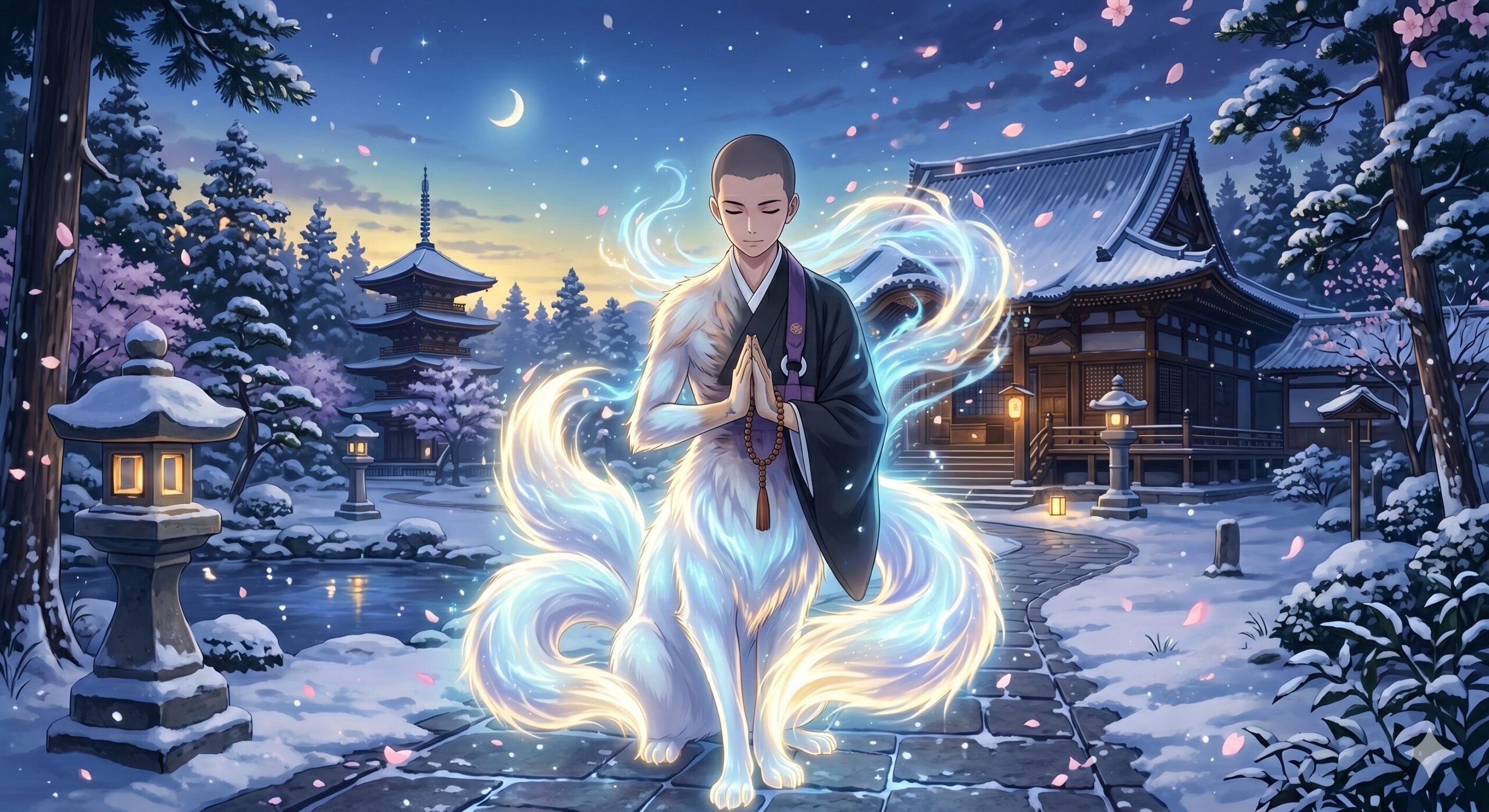
Hidden in the shadows of Japan’s rich nature and history are numerous tales of animals shapeshifting into humans to repay debts of gratitude or show immense loyalty. The folktale we introduce today, “Kitsune Danka” (The Fox Parishioner), is not merely a story of magic. It is a highly literary narrative that deeply portrays unwavering loyalty to a master, the sorrow of being tossed about by the changing eras, and the complex nature of human karma.
Why did a single white fox go so far as to take human form to serve his master? And what does its ending tell us today? We will thoroughly explain everything from the plot of the story to the profound Japanese cultural background hidden within it.
1. The Story of “Kitsune Danka”
Long ago, in Takayama of the Hida region (present-day Gifu Prefecture), there was a grand castle ruled by a lord named Mitsugi Hidetsuna. This lord cherished a beautiful white fox. The fox, in turn, was deeply attached to the people of the castle, playing daily in the garden with the lord’s young son.
However, in the 13th year of Tensho (1585), the castle was attacked and destroyed by the forces of Toyotomi Hideyoshi, and the lord was tragically killed in battle. Amidst the chaos of the war, the white fox was separated from the young master and barely escaped with its life to Suwa in the Shinshu region (Nagano Prefecture).
Having lost its master, the white fox eventually took the form of a human and visited a scholar named Chino Hyogo. Calling himself “Zeian,” the fox became his disciple and passionately devoted himself to his studies.
A few years later, his master Hyogo said to Zeian, “I hear Lord Hidetsuna’s young son is alive. They say he is now a respected monk named Keigaku at Kozen-ji Temple in Kiso.” Hearing this, Zeian realized that his master had seen through his true identity and was warmly encouraging him to go to the young master. Deeply grateful, Zeian left a letter of thanks and headed straight for Kozen-ji Temple in Kiso.
Upon arriving at Kozen-ji, Zeian once again became a human disciple, this time serving the monk Keigaku. Reunited with the young master for the first time in years, the joy of living by his side was irreplaceable for Zeian.
Then, at the beginning of winter, Monk Keigaku entrusted Zeian with an important errand: “Please deliver this letter to my mother, who is staying at Ankoku-ji Temple in Hida, and bring her here.” Gladly heading to Hida, Zeian was caught by nightfall in a deep mountain village called Hiwada, where he rented a room at a hunter’s house.
That night, the hunter was cleaning his famous gun, “Kunitomo.” This gun had a magical power: if one looked through the barrel, it would reveal the true form of any Yokai (monster/spirit). When the hunter casually peeked at Zeian through the barrel, he saw a giant white fox sitting there.
Startled, the hunter shot and killed Zeian late at night when everyone was asleep. However, when he checked the slain fox’s belongings, he found the precious letter addressed from Monk Keigaku to his mother. Upon learning the truth, Monk Keigaku grieved deeply and held a grand memorial service for Zeian. The villagers of Hiwada, also moved by the white fox’s loyalty upon learning the truth, built a shrine at Kozen-ji to enshrine Zeian. From then on, the village of Hiwada became a “Danka” (supporter/parishioner) of Kozen-ji Temple. This is said to be the origin of the “Fox Parishioner.”
2. Deep Analysis: The Sorrow and Unconditional Love of the White Fox
The reason this story touches the hearts of so many lies in the unconditional love of the white fox, Zeian, and the unreasonably tragic ending. While tales of animals returning favors exist worldwide, the defining characteristic of “Kitsune Danka” is the overwhelming loyalty of “hiding one’s true identity and changing one’s name just to serve the child of a former master for a lifetime.”
In the Sengoku (Warring States) period, it was not only humans who lost their homes due to conflict, but animals as well. For the white fox, whose castle burned down and who lost everything, the existence of the young master was its only hope and the very meaning of its life. The episode where the scholar Chino Hyogo realizes the fox’s true identity but deliberately speaks vaguely to tell him the young master’s whereabouts allows us to sense the deep compassion and refined spirit (“Iki”) shared between a human and a spirit animal.
However, that pure loyalty is unreasonably cut short by the fear of a single hunter and the “power of a famous gun.” The hunter may not have had ill intentions. It is a hunter’s nature to shoot when sensing danger from a giant, unidentified fox. This story depicts a very realistic and cruel karma where “a tragedy occurs even when no one is explicitly evil.”
3. Japanese Culture Decoded: Animism and the Spirit of Requiem (“Matsuru”)
The most important cultural characteristics that can be read from this tale are the spirit of Animism—the belief that souls reside in all things—and the act of “Matsuru” (enshrining or holding a memorial service) after committing a tragic mistake.
Since ancient times in Japan, foxes have been both revered as messengers of the gods (Inari) and feared as Yokai that trick humans. However, the white fox in “Kitsune Danka” blends into the human world and is depicted as a being with “duty and compassion” (Giri and Ninjo) even more human-like than humans themselves. This strongly reflects the Japanese view of nature, which recognizes intelligence and emotion in the creatures of the natural world and seeks to coexist with them.
Furthermore, the ending is particularly noteworthy. After shooting the white fox, the villagers did not hide the fact. Instead, they chose the path of atonement by holding a grand memorial service, building a shrine, and having the entire village become supporters (Danka) of the temple. In Japan, there is a culture of pacifying souls (Goryo Shinko) by elevating spirits that hold grudges or beings that suffered tragic deaths into “gods.” “Kitsune Danka” is exactly the kind of story that passes down the moment when a tragedy was overcome, and a new bond and faith were born between humans and nature (the fox).
4. What Would You Have Done?
The white fox hid his true form for the sake of the one he loved, desiring nothing more than to be by his side. That pure, straightforward devotion strongly resonates with our hearts even today.
If you were in the hunter’s shoes, and you saw the figure of a giant fox through the barrel of your gun, could you have let it go without shooting? Or, if you were the white fox, would you have risked your life to go on a journey for your former benefactor?
Despite the unreasonable tragedy, beautiful loyalty and the warm regret of the people remain in “Kitsune Danka.” Please let us know how this story made you feel.
Related Links
- Read more Japanese folktales: Japanese Folktale Series (Our Blog Category)
- History of the temple where the story took place: Kozen-ji Temple (Wikipedia Japanese)
【日本昔話】忠義と悲哀の物語「狐檀家(きつねだんか)」から読み解く日本の心
日本の豊かな自然と歴史の影には、動物たちが人間に化け、恩返しや忠義を尽くす数多くの物語が隠されています。今回ご紹介する「狐檀家(きつねだんか)」は、単なる不思議な昔話ではありません。主人への変わらぬ忠誠心、時代に翻弄された悲哀、そして人間の業を深く描き出した、非常に文学的な価値の高い物語です。
なぜ一匹の白狐が人間の姿となってまで仕えようとしたのか。そして、その結末が私たちに何を語りかけているのか。物語のあらすじから、その奥深い日本文化の背景までを徹底的に解説します。
① 昔話「狐檀家」のストーリー
昔、飛騨の高山(現在の岐阜県)に、三木秀綱(みつきひでつな)という殿様が治める立派な城がありました。この殿様は一匹の美しい白狐をたいそう可愛がっており、白狐もまた殿様の幼い若君と毎日庭で遊ぶほど、城の人々に懐いていました。
しかし、天正13年(1585年)のこと。豊臣秀吉の軍勢によって城は攻め落とされ、殿様はあえなく討ち死にしてしまいます。戦火の混乱の中、若君とはぐれてしまった白狐は、命からがら信州(長野県)の諏訪へと逃げ延びました。
主君を失った白狐は、やがて人間の姿に化け、千野兵庫(ちのひょうご)という学者のもとを訪れます。白狐は「蛻庵(ぜいあん)」と名乗り、彼の弟子として熱心に学問に励みました。
数年が経ったある日、師匠である兵庫は蛻庵にこう語りかけます。「秀綱公の若君は生きておられる。今は木曽の興禅寺で、桂岳(けいがく)という立派な和尚になっているそうだ」。これを聞いた蛻庵は、師匠が自分の正体を見破った上で、若君の元へ行くよう温かく送り出してくれたのだと悟りました。深く感謝した蛻庵は置手紙を残し、一路、木曽の興禅寺へと向かいます。
興禅寺に到着した蛻庵は、再び人間の弟子として桂岳和尚に仕えることになりました。数年ぶりに若君と再会し、そばで生活できる喜びは、蛻庵にとって何にも代えがたいものでした。
そして冬の初め。桂岳和尚は蛻庵に「飛騨の安国寺に身を寄せている母上に手紙を届け、ここへ連れてきてほしい」と大切な使いを頼みます。喜んで飛騨へと向かった蛻庵でしたが、日和田(ひわだ)という山深い村で日が暮れ、一人の猟師の家に宿を借りました。
その夜、猟師が名銃「国友」の手入れをしている最中のことです。この銃は銃口から覗くと妖怪の正体を見破るという不思議な力がありました。猟師が何気なく銃口から蛻庵を覗き込むと、そこにいたのは巨大な白狐だったのです。
驚いた猟師は、皆が寝静まった夜更けに蛻庵を撃ち殺してしまいます。しかし、撃ち倒した白狐の荷物を調べると、そこには桂岳和尚から母へ宛てた大切な手紙が入っていました。事の顛末を知った桂岳和尚は深く嘆き悲しみ、手厚く蛻庵を供養しました。また、真実を知った日和田の村人たちも白狐の忠義に心打たれ、興禅寺に祠を建てて蛻庵を祀りました。それ以来、日和田の村は興禅寺の檀家(お寺を支援する信徒)となり、これが「狐檀家」の始まりだと伝えられています。
② 「狐檀家」の深い考察:白狐の孤独と無償の愛
この物語が多くの人々の心を打つ理由は、白狐「蛻庵」の無償の愛と、理不尽なまでの悲劇的な結末にあります。動物報恩譚(動物が恩返しをする物語)は世界中に存在しますが、狐檀家の特徴は「正体を隠し、名前を変えてでも、かつての主人の子に一生涯仕えようとした」という圧倒的な忠義です。
戦国時代という人間の争いによって居場所を奪われたのは、人間だけでなく動物も同じでした。城が燃え、すべてを失った白狐にとって、若君の存在は唯一の希望であり、生きる意味そのものだったのでしょう。師匠である千野兵庫が白狐の正体に気づきながらも、あえて言葉を濁して若君の居場所を教えたというエピソードからは、人間と妖怪(動物)の間に通い合う「思いやり」と「粋」な計らいを感じ取ることができます。
しかし、その純粋な忠誠心は、一人の猟師の恐怖と「名銃の力」によって理不尽に断ち切られてしまいます。猟師には悪気はなかったのかもしれません。正体不明の大きな狐がいれば、身の危険を感じて撃つのは猟師の性(さが)です。この物語は「誰も明確な悪人ではないのに、悲劇が起きてしまう」という、非常に現実的で残酷な因果を描いています。
③ 読み解ける日本文化:アニミズムと「祀る」という鎮魂の精神
この物語から読み取れる最も重要な日本文化の特徴は、「万物に魂が宿る」というアニミズムの精神と、過ちを犯した後に「祀る(供養する)」という行動です。
日本では古来より、狐は神の使い(稲荷神)として神聖視される一方で、人を化かす妖怪としても恐れられてきました。しかし、「狐檀家」における白狐は、人間の世界に溶け込み、人間以上に人間らしい「義理と人情」を持った存在として描かれています。これは、自然界の生き物に対しても、知性や感情を認め、共生してきた日本人の自然観を色濃く反映しています。
さらに注目すべきは結末です。村人は白狐を撃ち殺してしまった後、その事実を隠蔽するのではなく、手厚く供養し、祠を建て、村全体でそのお寺の「檀家」になるという贖罪の道を選びました。日本では、怨念を持った霊や悲劇的な死を遂げた存在を「神」として祀り上げることで鎮魂する文化(御霊信仰)があります。「狐檀家」はまさに、悲劇を乗り越え、人間と自然(狐)との間に新たな絆と信仰が生まれた瞬間を語り継ぐ物語なのです。
④ あなたなら、どうしますか?
愛する者のために自分の本当の姿を隠し、ただ傍にいることだけを望んだ白狐。その真っ直ぐな思いは、現代を生きる私たちの心にも強く響きます。
もしあなたが猟師の立場だったら、銃口越しに巨大な狐の姿を見たとき、撃たずに見過ごすことができたでしょうか? それとも、もしあなたが白狐だったら、命の危険を冒してまで、かつての恩人のために旅に出るでしょうか?
理不尽な悲劇の中にも、美しい忠義と人々の温かい後悔が残る「狐檀家」。この物語を通して、あなたが感じたことをぜひ教えてください。
関連リンク
- 他の日本の昔話を読む:Japanese Folktale Series(当ブログのカテゴリー)
- 物語の舞台となったお寺の歴史:木曽・興禅寺(Wikipedia)
コメント