Japan is home to countless folktales that depict a beautiful spirituality that the world should know. Today, we introduce a heartwarming story set on Sado Island in Niigata Prefecture, titled “The Swapped Wallet” (Surikaeta Saifu). This is not just a fairy tale; it vividly reflects the moral values and life truths that flow at the foundation of the Japanese people.
- ① The Story of “The Swapped Wallet”
- ② In-Depth Analysis: Why Did the Boatman Exchange the Wallet?
- ③ Connection to Japanese Culture: Why Do Wallets Return to Their Owners in Japan?
- ④ Finally: What Would You Do?
- 日本の隠れた名作昔話:「すりかえた財布」が教える本当の豊かさ
- ① 昔話「すりかえた財布」のストーリー
- ② 深掘り考察:なぜ船頭は財布を交換したのか?
- ③ 日本文化とのつながり:なぜ日本の財布は持ち主の元へ帰るのか?
- ④ 最後に:あなたなら、どうしますか?
① The Story of “The Swapped Wallet”
Jinbei, the Charcoal Burner in Snowy Sado
Once upon a time, in the village of Osaki on Sado Island, Niigata Prefecture, there lived a kind-hearted man named Jinbei. Jinbei worked in the mountains burning charcoal. He and his wife lived a very poor life, but they lived honestly and always kept a smile on their faces.
An Encounter and Feast at Ogi Port
One autumn day, Jinbei went to a wholesaler at the bustling port of Ogi to sell the charcoal he had painstakingly made. On that day, a large merchant ship from distant Osaka was in port.
While resting in the wholesaler’s room, Jinbei ended up sharing a table with the boatman of that ship. The boatman, a man of the sea, was very interested in mountain life and begged Jinbei, “Please tell me some rare stories of the mountains.”
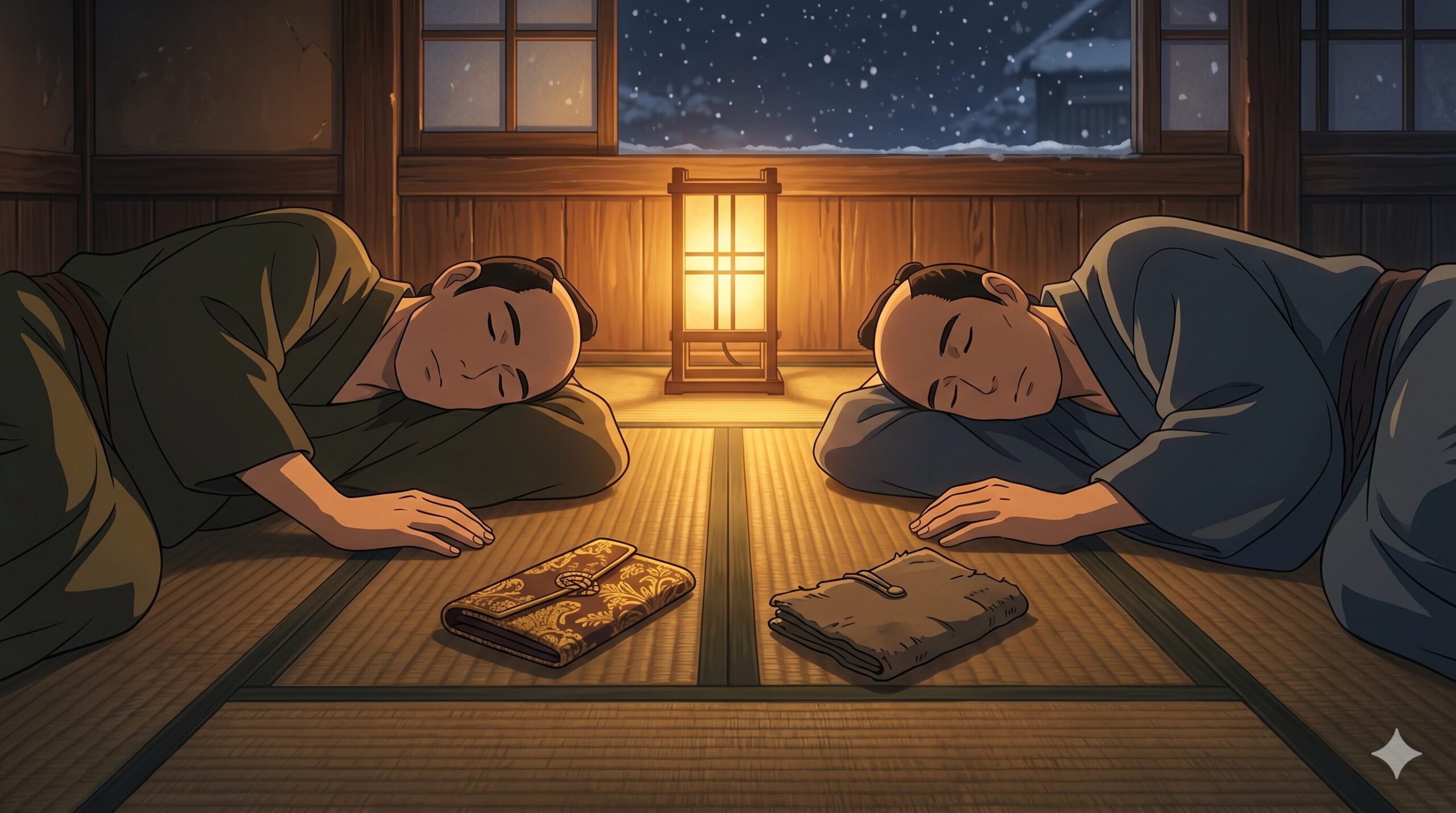
Drinking sake together, the two men excitedly exchanged stories of the sea and the mountains. They hit it off completely, and soon, heavily intoxicated, they fell fast asleep side by side in the room.
The Swapped Wallet and the Fortune
After a while, the time to set sail approached, and the boatman woke up in a panic. In the dark, half-asleep, he grabbed his wallet and rushed out. However, he had mistakenly taken Jinbei’s shabby wallet instead.
The next morning, Jinbei, assuming the remaining wallet was his own, put it in his kimono and returned home.
A few days later, his wife opened the wallet to manage their meager finances and was astonished. Inside, it was packed with a massive amount of Koban (gold coins) she had never seen before. It was at this moment Jinbei realized that his wallet had been swapped with the boatman’s on that day.
The Honest Man’s Decision and a Miracle Three Years Later
Normally, one might rejoice, thinking it was a “gift from the gods,” and spend it. But the honest Jinbei was different. “This is that boatman’s precious money. He must be in great trouble,” he thought, and immediately rushed back to the wholesaler at Ogi Port.
“If the boatman from Osaka returns, please tell him I am keeping his wallet safely,” Jinbei requested. He didn’t touch a single gold coin and continued his poor lifestyle.
However, the ship did not return to Sado for a long time. One year passed, then two… Finally, in the autumn of the third year, the boatman appeared at Ogi Port again.
Jinbei rushed over and offered the wallet, saying, “I have been keeping your wallet safe all this time.” However, the boatman smiled and shook his head.
“Jinbei-san, ever since I took the wrong wallet that time, my business has thrived, my voyages have been smooth sailing, and only good things have happened to me. Your wallet is a lucky charm for me. Please, let’s keep the trade as it is.”
Jinbei was surprised by these unexpected words but accepted the boatman’s strong wish. Thus, Jinbei, who continued to live honestly, used the unexpected fortune to live happily ever after with his wife.
② In-Depth Analysis: Why Did the Boatman Exchange the Wallet?
The most fascinating aspect of this story is that the boatman, having lost a wallet full of money, did not try to get it back but rather offered to “keep the exchange.” Hidden here is a deep reflection on human psychology and the mechanics of luck.
For the boatman, Jinbei’s worn-out, shabby wallet was not just a piece of cloth; it had become a symbol of “honesty” and “selflessness.” Living in the harsh environment of the business world (as a merchant boatman) swirling with greed and calculation, the pure and honest energy of someone like Jinbei likely became a spiritual anchor for him, helping him steady his mind and make correct decisions.
The boatman’s decision to value spiritual worth (a lucky, honest wallet) over material worth (a large amount of gold) strongly challenges us to ask, “What is true wealth?”
③ Connection to Japanese Culture: Why Do Wallets Return to Their Owners in Japan?
One of the things that surprises many foreign tourists visiting Japan is the fact that “in Japan, a dropped wallet is often turned in to the police with all the money inside, and returns to its owner.” This everyday “miracle” in modern Japan is proof that the “spirit of valuing honesty,” just like Jinbei’s, has been carved into the DNA of the Japanese people for hundreds of years.
In Japan, there is an ancient saying, “Otentosama ga miteiru” (The Sun is watching). It teaches that even when no one else is looking, the sun (nature or the gods) sees all your deeds, so you must not behave in a shameful manner.
The reason Jinbei didn’t touch the large sum of money for three whole years was because of this strong ethical sense that “the Sun is watching.” Unjustly gaining profit that does not belong to you taints your own soul. This unique Japanese spirituality is the foundation of the incredibly good public safety and a sense of trust in others found in modern Japanese society.
④ Finally: What Would You Do?
If you accidentally acquired a wallet filled with a massive amount of money, not knowing if the owner would ever return… Could you, like Jinbei, wait patiently for three whole years?
Or would you think it was a gift from the heavens and use it for yourself?
The story of “The Swapped Wallet” quietly asks us what choices we should make in life. Are there any stories with similar morals in your country? Please let us know your thoughts.
Related Links
- Read more wonderful Japanese Folktales: Japanese Folktale Series (Internal)
- Discover the beautiful scenery of Sado Island: Sado Official Tourist Information (External)
日本の隠れた名作昔話:「すりかえた財布」が教える本当の豊かさ
日本には、世界に誇るべき美しい精神性を描いた昔話が無数に存在します。今回は、新潟県の佐渡島を舞台にした心温まる物語、「すりかえた財布」をご紹介します。この物語は、単なるおとぎ話ではなく、日本人の根底に流れる道徳観や人生の真理を鮮やかに映し出しています。
① 昔話「すりかえた財布」のストーリー
雪深い佐渡の炭焼き、甚兵衛
むかしむかし、新潟県の佐渡島にある大崎村に、甚兵衛(じんべえ)という心の優しい男が住んでいました。甚兵衛の仕事は山に入って炭を焼くこと。妻のおカカと二人、生活は決して楽ではありませんでしたが、毎日を誠実に、そして笑顔を絶やさずに暮らしていました。
小木港での出会いと意気投合
ある年の秋のことです。甚兵衛さんは、丹精込めて焼いた炭を売るために、活気あふれる小木(おぎ)の港にある問屋へと足を運びました。その日はちょうど、遠く大阪から大きな商船が寄港していました。
問屋の座敷で休んでいると、その船の船頭さんと相席になりました。海の男である船頭さんは、山の暮らしに大変興味を持ち、「どうか山の珍しい話を聞かせてくれないか」と甚兵衛さんに頼み込みました。
二人は酒を酌み交わしながら、海と山の話に花を咲かせました。すっかり意気投合し、やがて酔いが回った二人は、座敷に並んでぐっすりと眠り込んでしまったのです。
すりかわった財布と大金
しばらくして、船を出す時間が近づき、船頭さんは慌てて目を覚ましました。暗がりの中、寝ぼけ眼で自分の財布をつかんで出て行きましたが、実はそれは間違えて手にした「甚兵衛さんの粗末な財布」だったのです。
翌朝、甚兵衛さんも自分の財布だと思い込んで、残されていた財布を懐に入れて家へと帰りました。
それから数日後、家計をやりくりしようと妻のおカカが財布を開けてびっくり仰天。中には見たこともないような大量の小判(金貨)がぎっしりと詰まっていたのです。ここで初めて、甚兵衛さんはあの日、船頭さんと財布がすり替わってしまったことに気が付きました。
正直者の決断と三年目の奇跡
普通なら「神様からの贈り物だ」と喜んで使ってしまうかもしれません。しかし、正直者の甚兵衛さんは違いました。「これはあの船頭さんの大切なお金だ。困っているに違いない」と、すぐに小木港の問屋へ駆け込みました。
「もし大阪の船頭さんが戻ってきたら、財布を預かっていると伝えてくだせえ」。甚兵衛さんはそう頼み、小判には一切手を付けず、元の貧しい生活を続けました。
しかし、船はなかなか佐渡へはやって来ません。一年が過ぎ、二年が過ぎ……ようやく三年目の秋になって、あの船頭さんが再び小木の港に姿を現したのです。
甚兵衛さんは大急ぎで駆けつけ、「あなたの財布はずっとお預かりしていました」と差し出しました。ところが、船頭さんはにっこりと笑って首を横に振ったのです。
「甚兵衛さん、あの時財布を間違えてからというもの、私の商売は大繁盛、乗る船は常に順風満帆、良いことばかりが起きたんです。あなたのその財布は、私にとって幸運のお守りです。どうか、あのまま交換したということにしてくれませんか」
思いがけない言葉に甚兵衛さんは驚きましたが、船頭さんの強い願いを受け入れました。こうして、正直に生き続けた甚兵衛さんは、思いがけず手にした大金をもとに、おカカと末長く幸せに暮らしたということです。
② 深掘り考察:なぜ船頭は財布を交換したのか?
この物語で最も興味深いのは、大金が入った財布を失った船頭が、取り返そうとするどころか「そのまま交換してほしい」と申し出た点です。ここには、人間の心理と幸運のメカニズムに関する深い考察が隠されています。
船頭にとって、甚兵衛さんの使い古された粗末な財布は、単なる布切れではなく「誠実さ」と「無欲さ」の象徴となっていました。ビジネスの世界(商船の船頭)という、欲望や計算が渦巻く厳しい環境に身を置く彼にとって、甚兵衛さんのような純朴で正直なエネルギーは、自身の心の乱れを整え、正しい判断を下すための精神的な拠り所となったのでしょう。
物質的な価値(大量の小判)よりも、精神的な価値(幸運を呼ぶ誠実な財布)を重んじた船頭の決断は、「本当の豊かさとは何か」を私たちに強く問いかけています。
③ 日本文化とのつながり:なぜ日本の財布は持ち主の元へ帰るのか?
海外から日本を訪れる旅行者の多くが驚くことの一つに、「日本では落とした財布が、中身のお金ごとそのまま警察に届けられ、持ち主の元へ戻ってくる」という事実があります。この現代日本における「奇跡」のような日常は、甚兵衛さんのような「正直さを尊ぶ心」が、何百年も前から日本人のDNAに刻み込まれていることの証明です。
日本には古くから「お天道様(おてんとうさま)が見ている」という言葉があります。誰も見ていないところであっても、太陽(自然や神仏)はあなたの行いを全て見ているから、恥ずかしい行動をしてはいけない、という教えです。
甚兵衛さんが三年間も大金に手を付けなかったのも、この「お天道様が見ている」という強い倫理観があったからです。自分のものではない利益を不当に得ることは、自分自身の魂を穢(けが)すことである。この日本独自の精神性は、現代の日本社会の驚異的な治安の良さと、他者への信頼感の土台となっています。
④ 最後に:あなたなら、どうしますか?
もし、あなたが偶然大金の入った財布を手に入れ、持ち主が戻ってくるかどうかも分からない状況に置かれたとしたら……。あなたは甚兵衛さんのように、三年間もただひたすらに待ち続けることができるでしょうか?
それとも、神様からの贈り物だと思って自分のために使ってしまうでしょうか?
「すりかえた財布」の物語は、私たちが人生でどのような選択をするべきか、静かに問いかけてきます。あなたの国には、これに似た教訓を持つ物語はありますか?ぜひ、あなたの考えを聞かせてください。
関連リンク集
- 日本の素晴らしい昔話をさらに読む:Japanese Folktale Series(内部リンク)
- 物語の舞台、佐渡島の美しい風景を知る:佐渡観光ナビ(外部リンク)
- 参考資料:まんが日本昔ばなしデータベース「すりかえた財布」
コメント