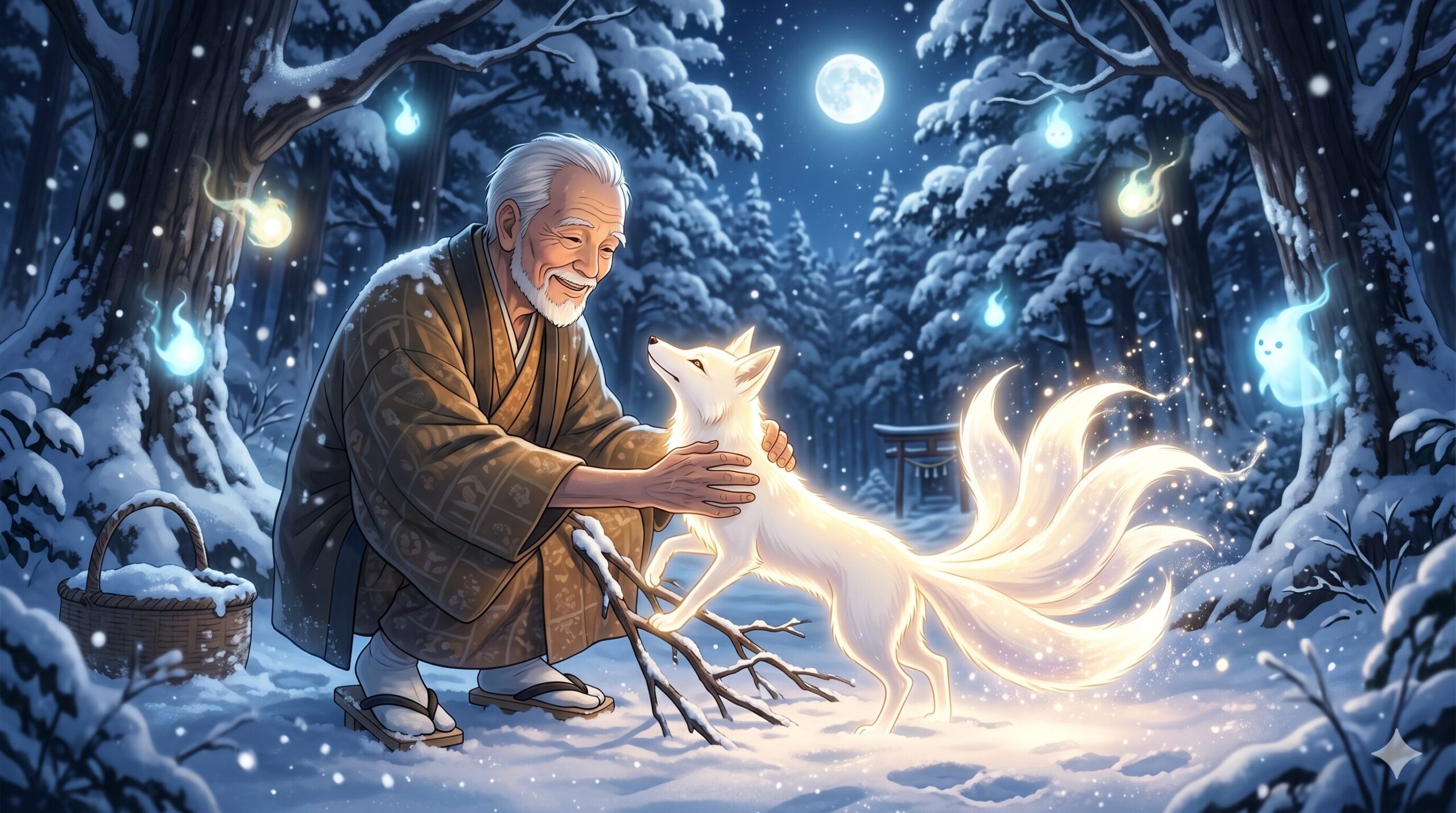
Once upon a time, in a snowy northern province of Japan, lived a kind-hearted old man named Gosaku. Though poor, he lived a quiet life, deeply respecting nature and always grateful for the blessings of the mountains.
Chapter 1: The Encounter in the Snowy Mountains
It happened on a harsh winter day. Gosaku entered the mountain to gather firewood when he heard a pitiful “kyun, kyun” cry echoing through the snow. Following the sound, he found a fox cub caught in a hunter’s trap, unable to move. The pristine white snow was stained red, and the small creature was trembling from the biting cold and intense pain.
Gosaku carefully released the trap, took off his own worn-out straw raincoat (Mino), and wrapped it around the cub. “That must have hurt. You are safe now. Hurry back to the mountain,” he said gently, applying some of his own medicinal herbs to its wound. The fox cub stared intently at Gosaku’s face before limping away, disappearing deep into the snowy mountains.
Chapter 2: The Visitor on a Blizzard Night
Several years passed. That winter brought unprecedented heavy snowfall, completely isolating the village. Gosaku’s food supplies had run out, and he barely had enough firewood to keep warm. “I might not survive this winter,” Gosaku accepted his fate quietly.
On a night with a fierce blizzard, there was a knock at the door. “Who could it be at this hour?” Gosaku wondered. When he opened the door, a beautiful young woman wearing a pure white kimono, looking like a snow spirit, stood there. Clutching a large cloth bundle (Furoshiki), she pleaded, “I have lost my way in the storm. Could you please let me stay for just one night?”
Gosaku welcomed her in, saying, “This is a poor house with nothing to offer, but it will shield you from the blizzard. Please, come in.” The woman then untied her bundle, saying, “As a token of my gratitude.” Inside was an abundance of fresh fish, mountain vegetables, and delicious sake. That night, warmed by the meal the woman prepared, Gosaku felt his body and soul return to life.
Chapter 3: The True Identity Revealed
The woman introduced herself as “Oyuki.” From that day on, she mysteriously brought wonderful food from nowhere and took care of Gosaku. While deeply grateful for her kindness, Gosaku couldn’t help but wonder how she managed to bring fresh food every day to a village completely blocked by snow.
One night, as the subtle signs of spring were approaching, Gosaku woke up to see a faint light leaking from the next room. He quietly peeked inside. Oyuki was nowhere to be seen. Instead, a beautiful fox was sitting there, skillfully sewing Gosaku’s torn clothes. On the fox’s leg was the distinct scar from the wound Gosaku had treated years ago.
Noticing Gosaku’s gasp, the fox turned around. Enveloped in a soft light, the fox transformed back into Oyuki. She bowed deeply and spoke softly. “Grandfather, I am the fox cub you saved that day. I borrowed human form to repay the debt of life I owe you. However, now that you know my true identity, I can no longer stay here.”
Gosaku tried to stop her, saying, “Please don’t go. You are like a real daughter to me.” But Oyuki smiled through her tears and said, “I will never forget your kindness. Please take care of yourself.” With a gust of wind signaling the arrival of spring, she turned into a streak of light and returned to the mountain. The next morning, exactly where Oyuki had been sitting, Gosaku found a small pouch filled with gold coins that would never deplete.
Folktale Analysis: The Fox as a Symbol of the Sacred and the Feared
The tale of “The Grateful Fox” (Kitsune no Ongaeshi) heavily reflects the traditional Japanese perspective on animals. In Japanese folklore, foxes (Kitsune) are not merely wild animals but beings possessing spiritual power and high intelligence. They are sometimes depicted as mischievous tricksters who deceive humans, and other times as honorable beings who never forget a debt.
The ending, where the non-human entity must leave once its true identity is discovered, is a classic trope in Japanese “Irui Konin-tan” (tales of inter-species marriage) and “Irui Hoon-tan” (tales of animal gratitude). This demonstrates the ancient Japanese worldview that there is an uncrossable, definitive boundary between the human world and the realm of nature (the realm of gods). The melancholic realization that humans and spirits can interact but never live together eternally highlights the profound beauty of this story.
Connection to Japanese Culture: Animism and the Spirit of “On” (Gratitude)
There are two core elements of Japanese culture that can be deciphered from this story.
First is the spirit of Animism, represented by the concept of “Yaoyorozu no Kami” (Eight Million Gods). Since ancient times, Japanese people have believed that divine spirits reside in all things—mountains, rivers, and animals like foxes and raccoon dogs (Tanuki). Foxes, in particular, are highly revered at Inari Shrines across Japan as the divine messengers of Inari Okami, the Shinto deity of agriculture and fertility. Gosaku’s act of saving the fox is a direct reflection of respect for nature, and the fox’s gratitude symbolizes the blessings humans receive from nature.
Second is the concept of “On” (debt of gratitude) and “Giri” (duty/obligation), which lies at the foundation of Japanese morality. The intense ethical mandate that a received favor must absolutely be repaid is beautifully portrayed through the fox. Gosaku’s unconditional love, expecting nothing in return, paired with the fox’s dedication to repaying her life debt even at great personal cost, symbolizes the ideal form of relationships in Japanese society.
Related Links
- Internal Link: Japanese Folktale Series
- External Link: Kitsune – Wikipedia (Japanese Fox Folklore)
- External Link: Inari Ōkami – Wikipedia (The Shinto God of Foxes and Agriculture)
A Question for You
The fox went as far as hiding her true identity to repay the person who saved her life, and when discovered, chose the honorable path of leaving. If you were in the fox’s position, would you risk your identity being exposed to go and help your savior? Or would you find another way to repay the favor? Let us know what you think!
- Chapter 1: The Encounter in the Snowy Mountains
- Chapter 2: The Visitor on a Blizzard Night
- Chapter 3: The True Identity Revealed
- Folktale Analysis: The Fox as a Symbol of the Sacred and the Feared
- Connection to Japanese Culture: Animism and the Spirit of “On” (Gratitude)
- Related Links
- A Question for You
- キツネの恩返し:日本の雪景色に隠された神秘と感謝の物語
キツネの恩返し:日本の雪景色に隠された神秘と感謝の物語
昔々、雪深い北の国に、吾作(ごさく)という心優しいお爺さんが住んでいました。吾作は貧しいながらも、山の恵みに感謝し、自然を敬いながら静かに暮らしていました。
第一章:雪山での出会い
ある厳しい冬の日のことです。薪を拾いに山へ入った吾作は、雪の中で「キュン、キュン」という悲痛な鳴き声を耳にしました。声のする方へ向かうと、そこには猟師が仕掛けた罠に足を挟まれ、身動きが取れなくなっている子ギツネがいました。白い雪は赤く染まり、子ギツネは寒さと痛みに震えています。
吾作は罠を外し、自分の着ていた古い蓑(みの)を脱いで子ギツネを包み込みました。「痛かったろうに。もう大丈夫だ、早く山へお帰り」と優しく声をかけ、持っていた傷薬を塗ってやりました。子ギツネは吾作の顔をじっと見つめた後、足を引きずりながら雪山の奥深くへと消えていきました。
第二章:吹雪の夜の訪問者
それから数年の歳月が流れました。その年の冬は例年にない大雪に見舞われ、村は完全に孤立してしまいました。吾作の家には食べるものが底をつき、暖を取るための薪も残りわずかとなっていました。「今年の冬は越せないかもしれない」と、吾作は静かに覚悟を決めました。
そんな猛吹雪の夜、家の戸を叩く音がしました。「こんな夜更けに誰だろう」と戸を開けると、そこには雪ん子のように真っ白な着物を着た美しい娘が立っていました。娘は大きな風呂敷包みを抱え、「道に迷ってしまいました。どうか一晩だけ泊めていただけないでしょうか」と懇願しました。
吾作は「何もない貧しい家だが、吹雪をしのぐことはできる。さあ、入りなさい」と娘を招き入れました。すると娘は、「お礼にこちらを」と言って風呂敷を解きました。中には、新鮮な魚、山の木の実、そして美味しいお酒がたっぷりと入っていました。その夜、娘の作ってくれた温かい料理に、吾作は心も体も生き返る思いでした。
第三章:明かされた正体
娘は「お雪」と名乗り、それから毎日、どこからともなくご馳走を持やってきては、吾作の身の回りの世話をしました。吾作はお雪の優しさに感謝しつつも、雪に閉ざされた村にどうやって毎日新鮮な食べ物を持ってこれるのか、不思議に思っていました。
ある春の気配が近づく夜、吾作がふと目を覚ますと、隣の部屋から微かな光が漏れていました。そっと覗き見ると、そこにはお雪の姿はなく、美しい毛並みを持つ一匹のキツネが、吾作の破れた着物を縫っていました。そのキツネの足には、かつて吾作が治療した傷跡がはっきりと残っていました。
吾作が息を呑んだ音に気づき、キツネは振り返りました。光に包まれると、キツネは再びお雪の姿に戻りました。お雪は深く頭を下げ、静かに語り始めました。「お爺さん、あの時助けていただいた子ギツネです。命を救っていただいたご恩を返すため、人間の姿を借りて参りました。しかし、正体を知られたからには、もうここにはいられません。」
吾作は「行かないでおくれ、お前は私の本当の娘のようなものだ」と引き留めようとしましたが、お雪は涙を浮かべながら微笑み、「お爺さんの優しさは一生忘れません。どうかお元気で」と言い残し、春の訪れを告げる風とともに、一筋の光となって山へ帰っていきました。翌朝、お雪が座っていた場所には、決して尽きることのない金貨が入った小さな袋が置かれていました。
昔話の考察:キツネが象徴する「神聖」と「畏怖」
この「キツネの恩返し」という物語には、日本における動物観が色濃く反映されています。日本の民間伝承において、キツネは単なる野生動物ではなく、霊力を持った存在として描かれます。時には人を化かすトリックスターとして、時には恩を忘れない義理堅い存在として登場します。
正体を知られた異類(人間以外の存在)が去らなければならないという結末は、「異類婚姻譚(いるいこんいんたん)」や「異類報恩譚(いるいほうおんたん)」の典型的なパターンです。これは、人間界と自然界(神の領域)の間には越えられない明確な境界線が存在するという、古代日本人の世界観を示しています。交わることはできても、永遠に共に生きることは許されないという切なさが、物語の美しさを際立たせています。
日本文化との深い繋がり:アニミズムと「恩」の精神
この物語から読み解ける日本文化の核心は、主に二つあります。
第一に、「八百万の神(やおよろずのかみ)」に代表されるアニミズム(自然崇拝)の精神です。日本では古くから、山や川、そしてキツネやタヌキなどの動物にも神霊が宿ると考えられてきました。特にキツネは、五穀豊穣を司る「稲荷神(いなりのかみ)」の使い(眷属)として、全国の稲荷神社で厚く信仰されています。吾作がキツネを助けた行為は、自然への敬意そのものであり、キツネの恩返しは自然からの恩恵を暗喩しています。
第二に、日本人の道徳観の根底にある「恩(On)」と「義理(Giri)」の精神です。受けた恩は必ず返すという強烈な倫理観が、キツネという動物を通して美しく描かれています。見返りを求めない吾作の無償の愛と、命の恩義に報いるために自らの身を削るキツネの姿は、日本社会において理想とされる人間関係のあり方を象徴しています。
関連リンク
- 内部リンク:Japanese Folktale Series(日本の昔話シリーズ)
- 外部リンク:Kitsune – Wikipedia (Japanese Fox Folklore)
- 外部リンク:Inari Ōkami – Wikipedia (The Shinto God of Foxes and Agriculture)
あなたへ問いかけ
キツネは自らの正体を隠してまで、命の恩人に恩返しをしました。そして正体がバレた時、潔く去る道を選びました。もしあなたがこのキツネの立場なら、正体がバレるリスクを負ってでも助けに行きますか?それとも、別の方法で恩返しをしますか?ぜひ、あなたの考えを教えてください。
コメント