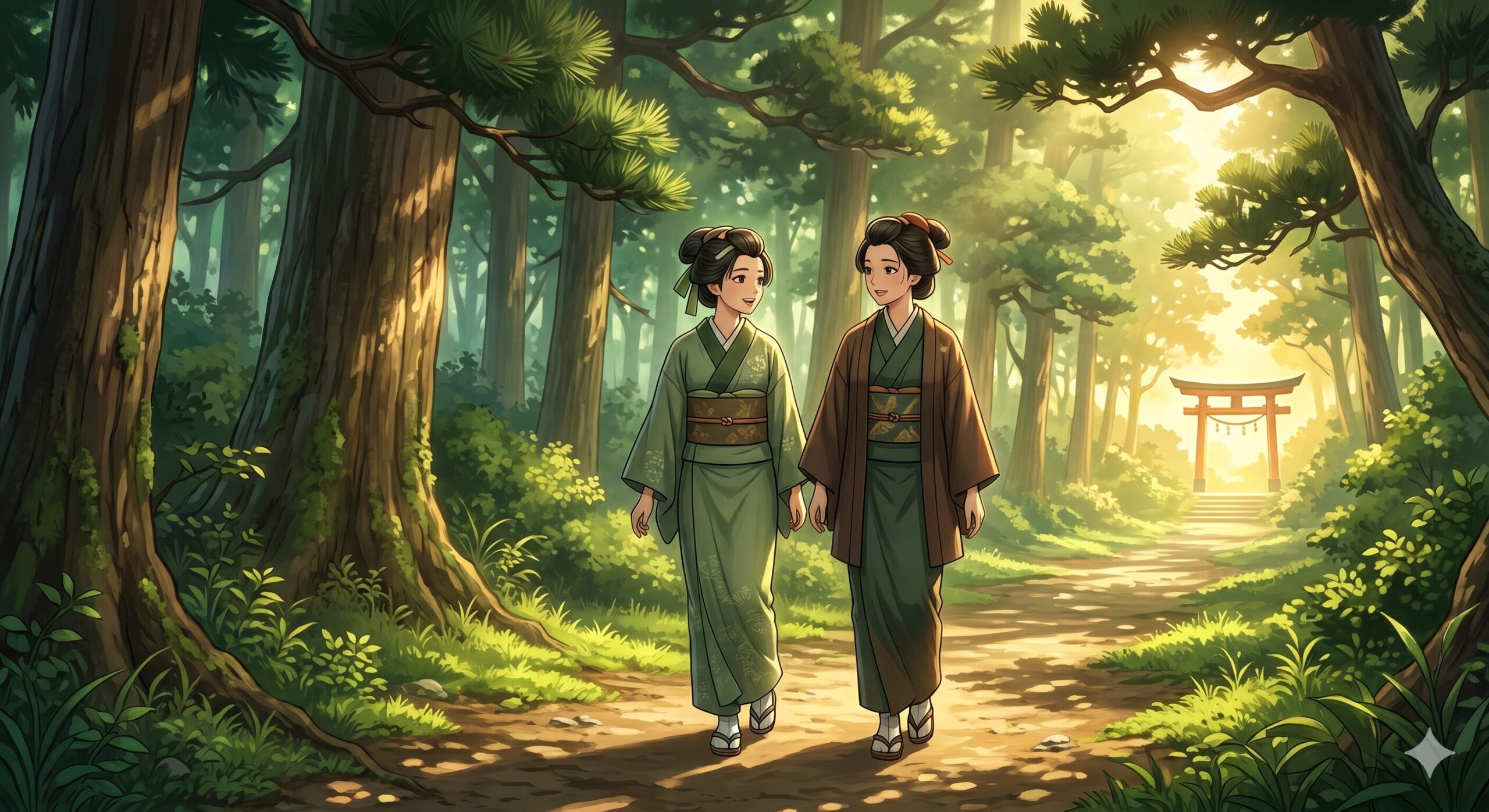
Japan is home to countless beautiful and mysterious folktales that deeply intertwine nature and human life. Today, we introduce a heartwarming, miraculous story from the Edo period: “Osugi and Omatsu’s Pilgrimage to Ise” (Osugi to Omatsu no Ise-mairi). More than just a travelogue, this is a masterpiece that perfectly blends pure selflessness with Japan’s deeply rooted animistic beliefs.
Chapter 1: Two Maidens at Gohei’s Inn
Long ago in Edo-period Japan, it was every citizen’s lifelong dream to visit the Ise Grand Shrine in Mie Prefecture—a journey known as the “Ise Pilgrimage” (Ise-mairi). The main highways leading to Ise were lined with inns, bustling with eager travelers from all over the country.
Tucked away in a quiet back alley off the lively main street was a small, cozy inn run by a kind old man named Gohei and his wife. One day, two young maidens, showing the exhaustion of a long journey, arrived at Gohei’s door. They introduced themselves as “Osugi” and “Omatsu,” stating they had walked all the way from the distant Ishize Village in Echigo Province (modern-day Niigata Prefecture).
When Gohei and his wife gently asked, “What did you pray for at the Ise Shrine?”, the maidens’ answer took them completely by surprise.
“We prayed that the severe back pain of the lady at the Tanaka-ya dumpling shop would be cured.
That Chobei’s terrible injury would heal as quickly as possible.
And that Rokusuke and Okiyo would safely be united in marriage.”
The girls had not asked for a single blessing for themselves. They had undertaken this grueling journey purely for the health and happiness of their fellow villagers. Gohei and his wife were deeply moved by the boundless compassion of these young, beautiful maidens.
Chapter 2: Short on Coins and Gohei’s Kindness
The next morning, as the maidens were preparing to leave, they opened their coin pouch to pay the inn fee of 200 *mon* (copper coins). However, no matter how they counted, they were slightly short. Seeing Osugi and Omatsu looking down in shame and apology, Gohei’s wife smiled warmly.
“Please don’t worry about it. My husband has business in Echigo soon, so you can simply pay us when he visits.”
She showed them this kindness so the girls wouldn’t have to face the harsh journey home with empty pockets. Deeply grateful, the two maidens bowed and began their long walk back to Echigo.
Chapter 3: Reunion in Echigo and a Mysterious Truth
That summer, exactly as promised, Gohei traveled to Echigo on village business. Finishing his work quickly, he eagerly headed to Ishize Village to reunite with the kind-hearted maidens.
However, as he walked through the village asking from door to door, he found that absolutely no one had ever heard of any girls named “Osugi” or “Omatsu.”
Perplexed and tired from walking, Gohei happened upon a dumpling shop named Tanaka-ya and decided to rest. He recounted the story of the two maidens he met at his inn in Ise to the shop’s proprietress.
Her eyes widened in absolute shock. “How incredible! To tell you the truth, right around the time those girls would have been praying at Ise, my terrible back pain completely vanished. Not only that, but Chobei’s severe injury healed miraculously at the same time, and Rokusuke and Okiyo’s marriage was arranged without a hitch!”
Chapter 4: The Spirits’ Gratitude
Astonished, yet slightly disappointed that he couldn’t see the girls again, Gohei began his journey home. As he walked along the path leading out of the village, he noticed a massive, magnificent Cedar tree (Sugi) towering over the landscape. Nestled right beside it stood an equally impressive Pine tree (Matsu).
Looking up at the branches of the great Cedar, Gohei spotted something small hanging from a branch. Stepping closer, he realized it was an old woman’s coin pouch. When he opened it, he found exactly 200 *mon*—the exact amount owed for that night at the inn.
When the villagers heard this, they pressed their hands together in tearful prayer.
“The spirits of the Cedar and Pine trees, who have always watched over us so kindly, must have taken the form of human maidens to make the pilgrimage to Ise on our behalf!”
Realizing that the true identities of Osugi and Omatsu were these two ancient trees, Gohei’s heart swelled with the joy of reunion. He stood there for a very long time, gently speaking to the Cedar and the Pine.
- Chapter 1: Two Maidens at Gohei’s Inn
- Chapter 2: Short on Coins and Gohei’s Kindness
- Chapter 3: Reunion in Echigo and a Mysterious Truth
- Chapter 4: The Spirits’ Gratitude
- Deep Dive Analysis: Why Did the Spirits Pray for Others?
- Cultural Connections: Okage-mairi and the World of Animism
- Question for You: What if Nature is Watching Over You?
- 【日本の昔話】お杉とお松の伊勢参り:村人を救った心優しき精霊の物語
- 物語の深掘り考察:なぜ精霊たちは他人のために祈ったのか?
- 日本文化との繋がり:お陰参りとアニミズムの世界
- あなたへ問いかけ:もしも自然があなたを見守っているとしたら?
Deep Dive Analysis: Why Did the Spirits Pray for Others?
The most remarkable aspect of this folktale is that the protagonists, Osugi and Omatsu, sought absolutely no personal gain. They were not human, but spirits of flora. For beings of nature, human affairs (illness, injury, romance) should theoretically be irrelevant. Yet, they had clearly watched over the villagers living their lives around them for many years, viewing them as their own “family.”
The image of spirits—who loved the simple daily lives of humans resting in their shade and laughing while eating dumplings—pulling up their roots and embarking on a perilous journey just to pray for human happiness is a profound depiction of “unconditional love.” Furthermore, their strict adherence to repaying the owed 200 *mon* by hanging it on the branch showcases the sincere Japanese spirit of honoring one’s debts and never returning kindness with ingratitude.
Cultural Connections: Okage-mairi and the World of Animism
1. The “Okage-mairi” Boom of the Edo Period
During the Edo period, a phenomenon of mass pilgrimages to the Ise Grand Shrine, known as “Okage-mairi,” swept across Japan. Traveling was done entirely on foot, making it a life-risking journey that took months. Because of this, villages often pooled their money to send a representative in a system called “Daisan” (proxy pilgrimage). Osugi and Omatsu voluntarily took on this role of “Daisan” for their beloved village.
2. The Philosophy of Yaoyorozu no Kami (Animism)
Since ancient times, Japan has held the belief of “Yaoyorozu no Kami” (Eight Million Gods). This is an animistic belief that gods and spirits reside in all aspects of nature—mountains, rivers, wind, and especially “trees.” Even today, massive trees centuries old are enshrined as “Goshinboku” (sacred trees) at Shinto shrines and are deeply protected. The story of Osugi and Omatsu vividly reflects this unique Japanese spiritual culture, where nature possesses a heart and coexists alongside humanity.
Question for You: What if Nature is Watching Over You?
How did you feel reading this story?
What if the trees in your garden, or the plants along your daily commute, are actually watching over you quietly, wishing for your happiness and success?
In our busy modern society, it is easy to take the presence of nature for granted. But why not pause for a moment and say “Thank you” to the nature around you? If you knew a spirit was watching over you, what words would you offer them? I invite you to think about it!
[Reference Links]
・External Reference (Japanese): Manga Nippon Mukashibanashi Database – Osugi and Omatsu
・Related Category: Japanese Folktale Series
【日本の昔話】お杉とお松の伊勢参り:村人を救った心優しき精霊の物語
日本には、自然と人間が深く交わり合う美しくも不思議な昔話が数多く存在します。今回ご紹介するのは、江戸時代に日本中で大流行した「伊勢参り」にまつわる、心温まる奇跡の物語『お杉とお松の伊勢参り』です。ただの旅行記ではなく、他者を思いやる純粋な心と、日本に古くから根付く自然信仰(アニミズム)が見事に融合した傑作です。
第一章:五平の宿に訪れた二人の娘
昔々、江戸時代の日本。全国の人々が一生に一度は行きたいと憧れたのが、三重県にある「伊勢神宮」への参拝、すなわち「お伊勢参り」でした。伊勢神宮に続く街道沿いには多くの宿屋が立ち並び、参拝客で大変な賑わいを見せていました。
大通りの賑わいから少し離れた裏通りに、五平(ごへい)という優しいお爺さんとその妻が営む小さな宿屋がありました。ある日のこと、五平の宿に長旅の疲れを見せる二人の若い娘がやって来ました。二人は「お杉(おすぎ)」と「お松(おまつ)」と名乗り、遠く離れた越後国(現在の新潟県)の石瀬村から遥々歩いてきたと言います。
五平さん夫婦が「お伊勢様には、どんなお願い事をしてきたんだね?」と優しく尋ねると、二人の口からは意外な言葉が飛び出しました。
「田中屋というお団子屋のおかみさんの腰痛が治るように。
長兵衛さんの大怪我が一日も早く治るように。
そして、六助さんとお清さんが無事に結ばれますように、とお願いしてまいりました」
娘たちは自分たちの幸せや利益を一切願わず、村の人々の健康や幸せのためだけに過酷な旅をしてきたのです。五平さん夫婦は、この若く美しい娘たちの底抜けの優しさに深く感動しました。
第二章:足りない宿代と五平の優しさ
翌朝、娘たちが出立する際、宿代の二百文を払おうとしましたが、巾着の中身を数えても少々お金が足りません。申し訳なさそうにうつむくお杉とお松を見て、五平さんの妻は優しく微笑みかけました。
「気になさんな。うちのじいさんは近いうちに越後へ行く用事があるから、その時にでも払ってくれればええよ」
そう言って、二人が手ぶらで帰りの過酷な旅路を歩むことにならないよう、心遣いを見せたのです。二人は深く感謝し、越後へと帰っていきました。
第三章:越後での再会と不思議な事実
その年の夏、約束通り五平さんは村の寄り合いの用事で越後へ赴くことになりました。用事を早々に済ませた五平さんは、あの心優しい娘たちに再会するため、石瀬村へと足を運びました。
しかし、村中を隅から隅まで尋ね歩いても、「お杉」や「お松」という名の娘を知る者は一人もいませんでした。
不思議に思いながらも歩き疲れた五平さんは、ふと田中屋というお団子屋を見つけ、そこに入りました。そして、伊勢の宿で出会った二人の娘のいきさつを、おかみさんに話して聞かせました。
すると、おかみさんは目を丸くして驚きました。「なんと不思議なことでしょう。実は、ちょうどその娘さんたちが伊勢をお参りした頃、私の酷い腰痛がすっかり治ってしまったのです。そればかりか、長兵衛さんの怪我もその頃に完治し、六助とお清の縁談もトントン拍子にまとまったんですよ!」
第四章:精霊からの恩返し
五平さんは驚きつつも、結局二人に会えなかったことを少し残念に思いながら、帰路につくことにしました。村外れの道を歩いていると、一本の巨大で立派な「杉の木」がそびえ立っているのが見えました。そして、そのすぐそばには、同じく立派な「松の木」が寄り添うように立っていました。
ふと杉の木を見上げると、枝に何か小さなものがぶら下がっています。近づいて見てみると、それは女物の古い巾着袋でした。中を開けると、なんとそこには、あの日の宿代である「二百文」がぴったりと入っていたのです。
この話を聞いた村人たちは、涙を流して手を合わせました。
「いつも村人たちのことを優しく見守ってくれていた杉と松の木の精霊が、娘の姿に化けて、私たちの代わりにお伊勢様へお参りしてくださったのだ」
五平さんは、お杉とお松の正体がこの二本の木であったことに気づき、再会できた喜びに胸を震わせながら、いつまでもいつまでも、杉と松の木に優しく語りかけていたのでした。
物語の深掘り考察:なぜ精霊たちは他人のために祈ったのか?
この昔話で最も注目すべき点は、主人公である「お杉とお松」が、自己の利益を一切求めなかったことです。彼女たちは人間ではなく植物の精霊です。自然界の存在である彼女たちにとって、人間の営み(病気、怪我、恋愛)は本来無関係のはずです。しかし、彼女たちは長年自分たちの周囲で生活を営む村人たちを「家族」のように見守っていたのでしょう。
人間が自然を大切にし、木陰で休み、団子を食べながら笑い合う。そんなささやかな日常を愛した精霊たちが、自らの根を抜き、危険な旅に出てまで人々の幸福を祈ったという事実は、真の「無償の愛」を描いています。また、足りなかった宿代二百文を後からきっちりと木にぶら下げていた律儀さからは、恩を仇で返さない、誠実な日本の精神性が読み取れます。
日本文化との繋がり:お陰参りとアニミズムの世界
1. 江戸時代の一大ブーム「お陰参り」
江戸時代、交通網の発達とともに「お陰参り(おかげまいり)」と呼ばれる伊勢神宮への集団参拝が大流行しました。当時は移動手段が徒歩のみであり、数ヶ月がかりの命がけの旅でした。そのため、村全体でお金を出し合い、代表者が代わりにお参りに行く「代参(だいさん)」というシステムも存在しました。お杉とお松は、自ら進んでこの「代参」の役割を担ったとも言えます。
2. 八百万の神(アニミズム)の思想
日本には古くから「八百万の神(やおよろずのかみ)」という考え方があります。山、川、風、そして「木」などの自然万物に神や精霊が宿っているとするアニミズムの信仰です。樹齢数百年を超える巨木は「御神木(ごしんぼく)」として現代でも神社に祀られ、大切に保護されています。お杉とお松の物語は、まさにこの「自然には心が宿り、人間と共存している」という日本特有の精神文化を色濃く反映しています。
あなたへ問いかけ:もしも自然があなたを見守っているとしたら?
この物語を読んで、あなたはどんなことを感じましたか?
もしも、あなたの家の庭にある木や、毎日の通勤路にある花壇の植物たちが、実は静かにあなたを見守り、あなたの幸せを願ってくれているとしたらどうでしょう?
現代の忙しい社会では、自然の存在を当たり前のように感じてしまいがちです。しかし、少しだけ立ち止まって、周囲の自然に「ありがとう」と声をかけてみませんか? あなたなら、あなたを見守ってくれている存在に、どのような言葉をかけますか? ぜひ考えてみてください。
【参考リンク】
・外部参考:まんが日本昔ばなしデータベース – お杉とお松の伊勢参り
・関連カテゴリー:Japanese Folktale Series(日本の昔話シリーズ)

コメント