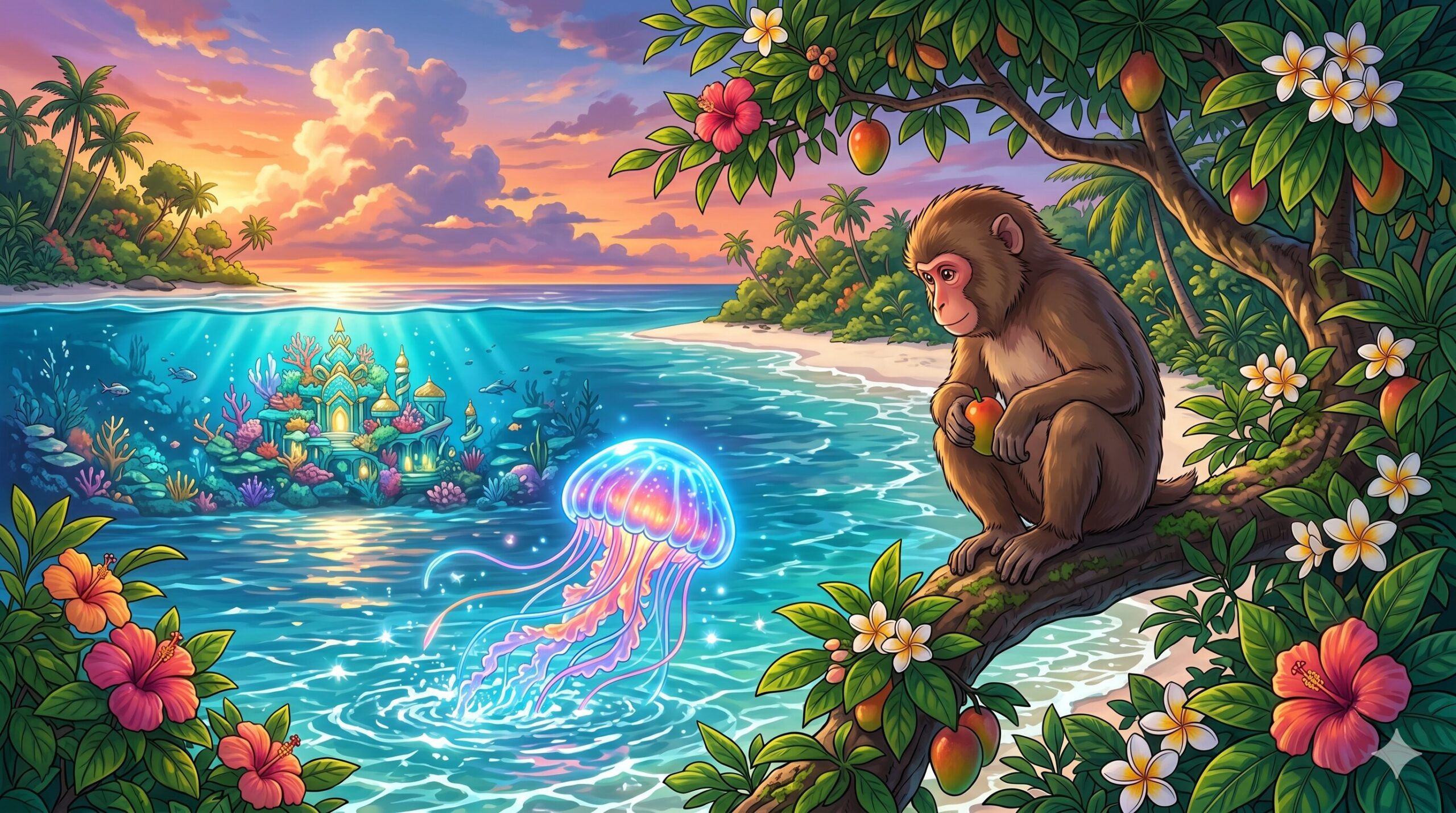
Japan is home to countless folktales that explain the mysteries of nature and animal ecology with a blend of humor and profound moral lessons. The story we are introducing today offers a classic, unique Japanese answer to a simple question: “Why do jellyfish have no bones?” Welcome to the world of “The Jellyfish without Bones” (Kurage no Honenashi), a tale of a battle of wits between a creature of the sea and a creature of the land.
① The Story: The Jellyfish without Bones
Once upon a time, deep beneath the ocean waves, there existed a magnificent and prosperous kingdom called the Dragon Palace (Ryugu-jo), adorned entirely with coral and pearls. It was ruled by the great Dragon King, and all the sea creatures lived in perfect harmony. In those ancient days, jellyfish did not have the soft, gelatinous bodies they do today. Instead, they possessed hard bones, strong fins, and four legs, making them sturdy and impressive creatures.
One fateful day, the Dragon King fell gravely ill. No matter what medicines were administered, his condition did not improve, and the entire underwater palace was enveloped in deep sorrow. The finest doctor of the sea was summoned, and he delivered a grim diagnosis: “The only way to cure His Majesty’s illness is to have him consume the live liver of a monkey from the surface world.”
However, most sea creatures could not survive on land. The responsibility fell upon the jellyfish, who had legs and could walk on the shore. Given this vital mission by the Dragon King, the jellyfish eagerly headed toward the land to procure a monkey’s liver.
Upon reaching a forested island, the jellyfish spotted a monkey playing in the branches of a tree. The jellyfish cleverly invited the monkey: “Mr. Monkey, do you know of a wonderful place called the Dragon Palace? It is a paradise where a grand feast is held every day, and you can eat the most delicious foods to your heart’s content. Let me give you a ride on my back and show you the way!”
Filled with curiosity and tempted by the promise of endless food, the monkey gladly climbed onto the jellyfish’s back, and they began their journey across the sea. However, when they reached the exact middle of the ocean, the naive jellyfish accidentally let his secret slip. “Actually, Mr. Monkey, the Dragon King is terribly ill. I was ordered to bring you to the palace so that we could use your liver as medicine to cure him.”
Hearing this, the monkey was terrified to his core. But he knew that if he panicked, he would be thrown into the sea and drown. Thinking at lightning speed, the monkey calmly replied, “Oh my goodness! Why didn’t you tell me sooner? You see, just this morning, I washed my precious liver thoroughly and hung it out to dry on the branch of a tree on the mountain. I am completely useless to you without my liver! We must hurry back and get it!”
The gullible jellyfish completely believed the monkey’s absurd lie. “That is a disaster! We must return at once,” the jellyfish said, turning around and carrying the monkey straight back to the shore. As soon as they reached the land, the monkey swiftly leaped off, climbed to the top of the highest tree, and laughed loudly. “You foolish jellyfish! How could any living creature take their liver out of their body and still be alive? Never come back here again!”
Realizing he had been thoroughly tricked, the jellyfish had no choice but to return to the Dragon Palace empty-handed. When the Dragon King heard the report, he flew into a violent rage. “You absolute fool! My life is in danger because of your incompetence!” The King ordered his guards to beat the jellyfish severely as punishment. The beating was so intense that all of the jellyfish’s hard bones were completely shattered, and he lost his magnificent fins and legs. From that day forward, the jellyfish became a soft, boneless creature, doomed to simply drift along with the ocean waves.
② Analyzing the Folktale: The Contrast Between Naivety and Wit
The core themes of this story are the critical importance of keeping a secret and the value of quick thinking in a crisis. The jellyfish, entrusted with a vital mission by the highest authority, ruined everything through sheer carelessness. Dropping his guard right before achieving his goal and revealing the truth serves as a powerful reminder—even in modern business and daily life—that “loose lips sink ships.”
On the other hand, the monkey’s behavior demonstrates phenomenal crisis management. In a desperate situation where death seemed certain, rather than crying or fighting, he found a massive blind spot in his opponent’s logic (the unrealistic lie that a liver can be left outside the body) and successfully escaped. Overcoming danger through intellect rather than brute force is a highly praised virtue in many Japanese folktales.
③ Connection to Japanese Culture: Karma and Awe of Nature
This narrative strongly reflects the traditional Japanese moral concept of “Inga-oho” (the Buddhist teaching of karmic retribution, where one’s actions inevitably yield corresponding consequences). The jellyfish losing its bones is not described as a simple natural evolution, but as a direct punishment for its foolishness and failure. Japanese folklore frequently employs “Yuraitan” (origin tales) to explain the physical characteristics of animals—such as why a tail is short or a neck is long—by linking them to their past actions or character flaws.
Furthermore, the “Dragon Palace” (Ryugu-jo) symbolizes the awe and deep respect the Japanese people hold for the sea. As an island nation, Japan has always viewed the deep ocean as a realm containing immense, supernatural power (represented by the Dragon King) and boundless wealth. It serves as a mystical boundary where the terrestrial and aquatic worlds intersect.
If you wish to explore more stories packed with Japan’s rich spiritual heritage, please browse our Japanese Folktale Series. For those interested in the academic background and historical variations of this specific tale, examining the historical context of The Jellyfish without Bones (Japanese Wikipedia) is highly recommended.
④ What Would You Do?
The jellyfish was punished for being too honest and careless, while the monkey saved his own life by telling a lie. If you were in the jellyfish’s position, how would you have ensured the monkey arrived safely at the Dragon Palace without him finding out the truth? Or, if you were the monkey trapped in the middle of the ocean, what kind of lie would you have invented to secure your escape? Please share your thoughts and creative ideas in the comments section or on our social media!
日本の深海に潜む秘密:昔話「クラゲの骨なし」が語る知恵と教訓
日本には、自然界の謎や動物たちの生態を、ユーモアと深い教訓を交えて語り継いできた数多くの昔話が存在します。今回紹介する物語は、「なぜクラゲには骨がないのか?」という素朴な疑問に対する、古き良き日本のユニークな解答です。海と陸の生き物が織りなす知恵比べの物語、「クラゲの骨なし」の世界へご案内します。
① 物語:クラゲの骨なし
昔々、海の底には見渡す限り珊瑚や真珠で飾られた美しく豊かな国、「竜宮城」がありました。そこは竜王という偉大な王によって治められ、海の生き物たちは平和に暮らしていました。当時のクラゲは、現在のような柔らかいゼリー状の姿ではなく、硬い骨と立派なヒレ、そして4本の足を持つ、とても頑丈で立派な姿をしていました。
ある日、竜宮城の主である竜王が重い病に倒れてしまいました。どんな薬を使っても一向に回復せず、城中は深い悲しみに包まれます。そこに海の医者が呼ばれ、こう告げました。「竜王様の病を治すには、陸に住む『猿の生き肝(肝臓)』を飲ませるしか方法はありません」
しかし、海の生き物たちは陸に上がることができません。そこで白羽の矢が立ったのが、足があり陸を歩くことができるクラゲでした。竜王の命を受けたクラゲは、猿の生き肝を手に入れるため、意気揚々と陸地へと向かいました。
陸の島にたどり着いたクラゲは、木の上で遊んでいる一匹の猿を見つけました。クラゲは巧みな言葉で猿を誘います。「猿さん、竜宮城という素晴らしい場所を知っていますか?そこは美味しいごちそうが食べ放題で、毎日が楽しい宴の場所です。私が背中に乗せて案内しましょう」
好奇心旺盛な猿は、すっかりその気になり、クラゲの背中に乗って海を渡り始めました。しかし、海の真ん中まで来たとき、クラゲは猿に向かってふと口を滑らせてしまいます。「実は猿さん、竜宮城の竜王様が重い病気でね。あなたの生き肝を薬にするために、あなたを連れて行けと命令されたのですよ」
これを聞いた猿は心底驚き、恐怖に震えましたが、ここでパニックになれば海に落とされてしまいます。猿は一瞬で機転を利かせ、こう答えました。「なんてことだ!それならそうと、早く言ってくれればよかったのに。私は今日、大切な生き肝を綺麗に洗って、山の木の枝に干してきてしまったのです。生き肝がない私が行っても役には立ちません。急いで取りに戻りましょう!」
お人好しで騙されやすいクラゲは、猿の嘘を完全に信じ込みました。「それは大変だ!すぐに戻ろう」と、クラゲは来た道を引き返し、再び猿を陸へと送り届けました。陸に着くや否や、猿は素早く高い木の上に登り、「馬鹿なクラゲめ!生き肝を体から取り出して生きていられるわけがないだろう!二度と来るな!」と笑い飛ばしました。
自分が完全に騙されたことに気づいたクラゲは、仕方なく手ぶらで竜宮城へ戻りました。事の顛末を聞いた竜王は激怒しました。「この愚か者め!貴様のせいで私の命が危ないのだ!」竜王は家来たちに命じ、クラゲをこっぴどく打ち据えました。その結果、クラゲの硬かった骨はすべて粉々に砕け散り、立派なヒレも足もなくなってしまいました。それ以来、クラゲは骨のない柔らかい姿で、ただ波に漂うだけの存在になってしまったのです。
② 昔話の考察:愚直さと知恵のコントラスト
この物語から読み取れる最大のテーマは、「機密保持の重要性」と「危機的状況における機転」です。クラゲは竜王からの重大な任務を帯びていながら、自らの不用意な発言によって全てを台無しにしました。目的を達成する直前で気を緩め、相手に真実を語ってしまうクラゲの姿は、ビジネスや日常の人間関係においても「口は災いのもと」であることを強烈に示唆しています。
一方で、猿の行動は見事な危機管理能力を示しています。絶体絶命の状況において、泣き叫んだり暴れたりするのではなく、相手の思考の盲点(生き肝を体外に置いておけるという非現実的な嘘)を突き、見事に窮地を脱しました。力ではなく知恵で危機を乗り越える猿の姿は、多くの日本の昔話において称賛される特質です。
③ 日本文化との関連:因果応報と自然界への畏敬
この物語は、日本の伝統的な死生観や道徳観である「因果応報(自らの行いが必ず自分に返ってくるという仏教の教え)」を強く反映しています。クラゲの骨がなくなったのは単なる自然現象ではなく、自らの愚かさと失敗に対する罰としての結果です。日本の昔話は、動物の身体的特徴(なぜ尻尾が短いのか、なぜ首が長いのかなど)を、彼らの過去の行動や性格の欠陥と結びつけて説明する「由来譚(ゆらいたん)」という手法をよく用います。
また、「竜宮城」という存在は、海に囲まれた島国である日本において、海への畏敬の念と豊かな恩恵への憧れを象徴しています。未知の深海には人知を超えた強大な権力者(竜王)が存在し、陸の生き物と海の生き物が交錯する境界線としての役割を果たしています。
本記事で紹介したような、日本の豊かな精神性が詰まった他の物語も、ぜひ当サイトのJapanese Folktale Seriesから探求してみてください。さらに、この物語の学術的な背景やバリエーションについて詳しく知りたい方は、クラゲの骨なしに関する歴史的背景も非常に参考になります。
④ あなたならどうしますか?
クラゲは正直すぎたが故に罰を受け、猿は嘘をついたことで命を救われました。もしあなたがクラゲの立場なら、どうやって猿を竜宮城まで無事に連れて行ったでしょうか?あるいは、猿の立場なら、海の上で自分が狙われていると知ったとき、どんな嘘をついて逃げ道を作りますか?ぜひ、あなたの考えやアイデアをコメント欄やSNSでシェアしてください。


コメント